
Loading NuWatt Energy...
We use your location to provide localized solar offers and incentives.
We serve MA, NH, CT, RI, ME, VT, NJ, PA, and TX
Loading NuWatt Energy...
NuWatt designs, installs, and manages solar, battery, heat pump, and EV charger systems across 9 states. One company, one warranty, one point of contact.
Get a Free QuoteQuick Answer
Modern solar panels last 30–40 years with less than 0.5% annual degradation. After 25 years, panels still produce 87–92% of original output. Warranties guarantee 25 years of production; actual lifespan often exceeds 35 years. The inverter is the first component to need replacement, typically at year 12–15.
Year-by-year degradation data, panel warranty comparisons, inverter lifespan facts, and when replacing makes sense — backed by real production data.
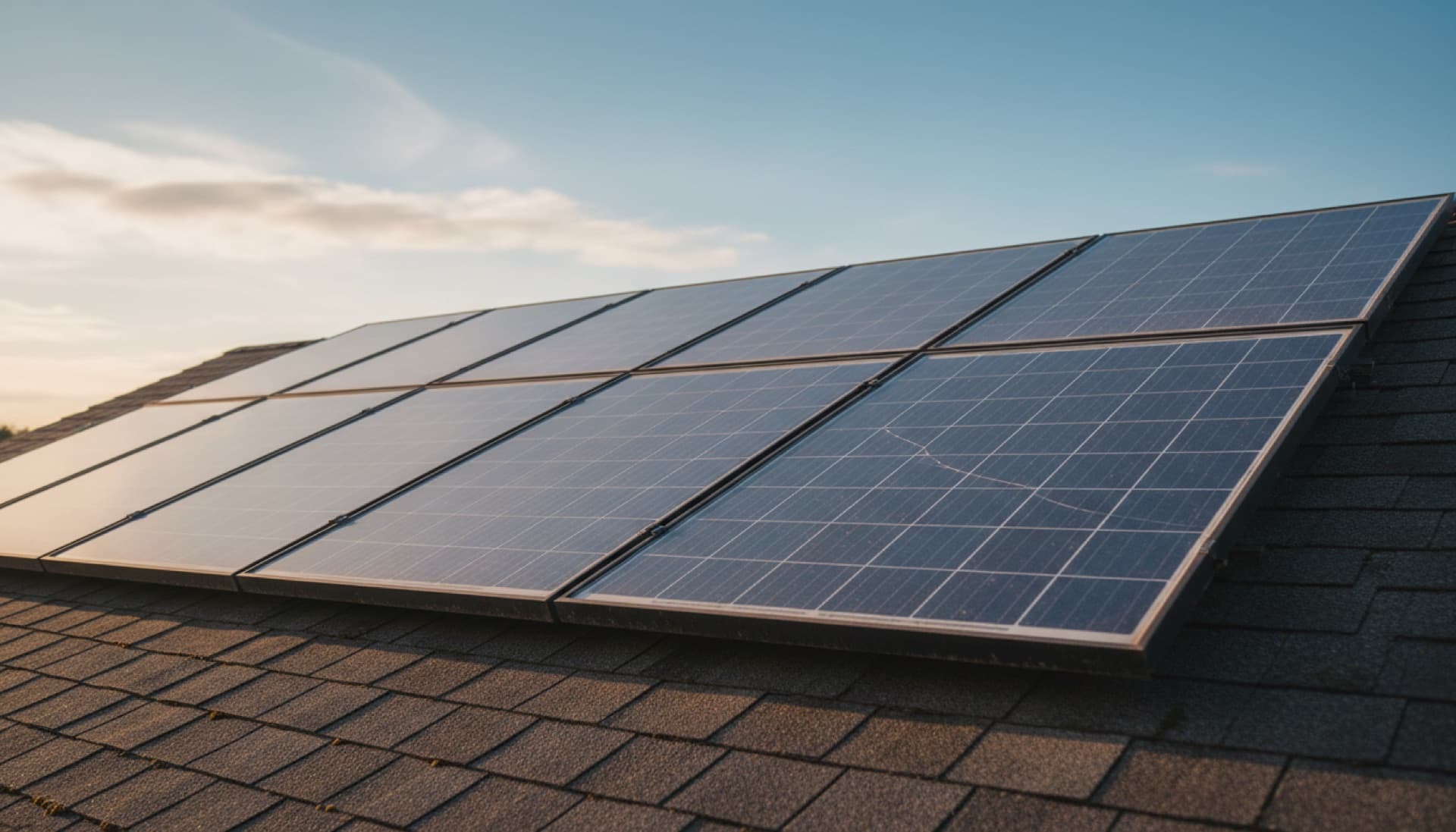
Solar panel degradation is the gradual reduction in energy output over time. The industry-standard degradation rate is 0.3–0.5% per year, meaning panels lose about half a percent of their output each year. This is caused by normal exposure to UV light, thermal cycling, and minor chemical changes within the silicon cells.
Most panels experience a slightly higher “first-year” degradation of 1–3% as the cells settle in, followed by a steady linear decline. The table below uses a conservative 0.5% annual rate after an initial 2% first-year drop — actual performance is often better.
| Year | Output (%) | 10 kW System (kWh/yr)* | Notes |
|---|---|---|---|
| 1 | 100.0% | 12,000 | Baseline production |
| 5 | 97.5% | 11,700 | Negligible visual change |
| 10 | 95.0% | 11,400 | Still within all warranty thresholds |
| 15 | 92.5% | 11,100 | Mid-life — inverter may need attention |
| 20 | 90.0% | 10,800 | Still generating significant savings |
| 25 | 87.5% | 10,500 | End of most performance warranties |
| 30 | 85.0% | 10,200 | Panels continue producing economically |
| 35 | 82.5% | 9,900 | Many panels still operational |
| 40 | 80.0% | 9,600 | End of expected useful life |
*Based on a 10 kW system in New England producing ~12,000 kWh in Year 1. Assumes 0.5%/yr linear degradation.
At New England's average rate of $0.27/kWh, a 10 kW system that drops from 12,000 kWh to 10,200 kWh at year 30 still saves you $2,754 per year on your electric bill. Over a 30-year lifetime, that system generates roughly $95,000–$105,000 in electricity — far more than its $28,000–$32,000 purchase price.
Every solar panel comes with two warranties: a product warranty (covers manufacturing defects and hardware failure) and a performance warranty (guarantees minimum output at year 25 or 30). NuWatt installs three panel tiers, each with industry-leading warranty coverage.
| Panel | Tier | Product | Performance | Yr 25 Output | Degradation |
|---|---|---|---|---|---|
| Hyundai HiE-S440VG | Entry | 25 years | 25 years | 86.5% | 0.50%/yr after Year 1 |
| Silfab SIL-440-BG | FEOC-Compliant | 30 years | 30 years | 87.6% | 0.40%/yr after Year 1 |
| REC Alpha Pure-R 460 | Premium | 25 years | 25 years | 92.0% | 0.25%/yr after Year 1 |
Best Budget
Hyundai 440W
Solid 25-year warranty at the lowest price point. Ideal for budget-conscious homeowners.
Best for Lease/PPA
Silfab 440W
30-year dual warranty and FEOC-compliant. Required for Propel financing.
Best Longevity
REC Alpha 460W
Industry-leading 0.25%/yr degradation. Still at 92% output at year 25.
Normal degradation rarely “kills” a solar panel. Instead, premature failure comes from specific physical and electrical issues. Understanding these risks helps you protect your investment and catch problems before they spread.
Cause: Thermal cycling, hail, shipping damage
Prevention: Quality panels with thicker cells; proper handling during install
Cause: Shading, cell mismatch, dirty panels
Prevention: Microinverters or optimizers; annual cleaning; tree trimming
Cause: Voltage leakage in humid environments
Prevention: PID-resistant panels (all NuWatt panels); proper grounding
Cause: Falling branches, severe hail, animal activity
Prevention: Professional installation; homeowner insurance; trimming nearby trees
In NuWatt's experience with 2,500+ installations, fewer than 0.3% of panels have failed due to manufacturing defects. The most common issue is inverter failure or wiring degradation — both are far cheaper to fix than panel replacement. Regular monitoring (built into all NuWatt systems) catches these issues early.
While solar panels can last 35+ years, the inverter is the component most likely to need replacement first. Inverters convert DC electricity from your panels into AC electricity your home uses. They contain electronic components that are more susceptible to heat, humidity, and voltage stress than the panels themselves.
The two main inverter architectures have significantly different lifespans and warranty coverage.
| Model | Type | Warranty | Extendable | Expected Life |
|---|---|---|---|---|
| Enphase IQ8+ | Microinverter | 25 years | N/A | 25-30 years |
| SolarEdge HD-Wave | String + Optimizers | 12 years | Yes, to 25 yr (~$200) | 12-20 years |
| SMA Sunny Boy | String Inverter | 10 years | Yes, to 20 yr | 10-15 years |
Replacement cost: If a string inverter fails outside warranty, expect to pay $1,500–$3,500 for a replacement including labor. Enphase microinverter replacement is typically $300–$500 per unit, but failures are rare within the 25-year warranty period.
Not every drop in production means you need new panels. Here is a decision framework for the most common scenarios homeowners face.
NuWatt offers free production assessments for existing solar systems. We can diagnose whether your system needs repair, panel replacement, or expansion — and handle warranty claims with manufacturers regardless of who installed your system originally.
Modern solar panels last 30-40 years. Manufacturers guarantee at least 25 years of production, but real-world data from installations dating to the 1990s shows panels still producing at 80%+ output after 35 years. The panels themselves rarely fail — inverters and wiring are more likely to need attention first.
Yes, but very slowly. The industry standard degradation rate is 0.3-0.5% per year. Premium panels like REC Alpha degrade at just 0.25% annually. After 25 years, a typical panel still produces 87-92% of its original output — well above the point of economic usefulness.
Physical damage from severe weather events (large hail, fallen tree limbs) accounts for the majority of premature panel failures. Manufacturing defects are rare in Tier 1 panels (less than 0.1% failure rate). Most panels that "fail" are actually experiencing inverter or wiring issues, not panel degradation.
String inverters (SolarEdge, SMA) typically last 12-20 years and may need one replacement during the life of your panels. Enphase microinverters carry a 25-year warranty and are expected to last as long as the panels themselves. Inverter replacement costs $1,500-3,500 depending on the system.
Usually not. If your panels are still producing 80%+ of their rated output, replacing them is not cost-effective. Instead, consider adding panels to make up for lost production if you need more energy. Replace only if panels are physically damaged, show significant hot spots, or production has dropped below 70%.
Product warranties from major manufacturers (Hyundai, Silfab, REC) transfer automatically to new homeowners — no paperwork needed. Performance warranties also transfer. However, installer workmanship warranties vary: NuWatt's 25-year workmanship warranty transfers to the new owner at no cost.
Compare your system's actual annual production to its expected production (shown in your monitoring app). A drop of more than 1% per year beyond the first year suggests an issue. Common culprits include new shading (tree growth), dirty panels, or a failing microinverter. A professional inspection costs $150-300.
Extreme heat reduces efficiency temporarily but does not significantly affect lifespan. Cold weather actually improves panel efficiency. The biggest weather risk is thermal cycling — rapid temperature swings that can cause micro-cracks over time. All panels sold in the U.S. are tested to withstand -40F to +185F.
NuWatt installs industry-leading panels with 25–30 year warranties, backed by our own 25-year workmanship guarantee. Get a free, no-pressure quote in under 2 minutes.