
Loading NuWatt Energy...
We use your location to provide localized solar offers and incentives.
We serve MA, NH, CT, RI, ME, VT, NJ, PA, and TX
Loading NuWatt Energy...
NuWatt designs, installs, and manages solar, battery, heat pump, and EV charger systems across 9 states. One company, one warranty, one point of contact.
Get a Free QuotePay Just 25% -- EVT Covers the Rest

Efficiency Vermont covers 75% of insulation and air sealing costs for all VT electric customers, up to $4,000 per project. Income-eligible households get 100% coverage -- completely free. In Vermont's Zone 6 climate with 7,700 heating degree days, insulation is the single most impactful home energy improvement.
Updated February 2026
All Vermont electric customers qualify for the standard 75% rebate. Income-eligible households receive full coverage at no cost.
Up to $4,000 per project. Most homeowners pay just 25% of insulation cost after EVT rebate.
Requirement: Must complete on-site energy audit first. Available to all Vermont electric customers.
Fully covered — $0 out of pocket for qualifying households
Requirement: Household income at or below 80% Area Median Income (AMI), or enrolled in qualifying assistance programs.
Each measure below shows the typical full cost, what you pay after the 75% EVT rebate, and the R-value target for Vermont's Zone 6 climate.
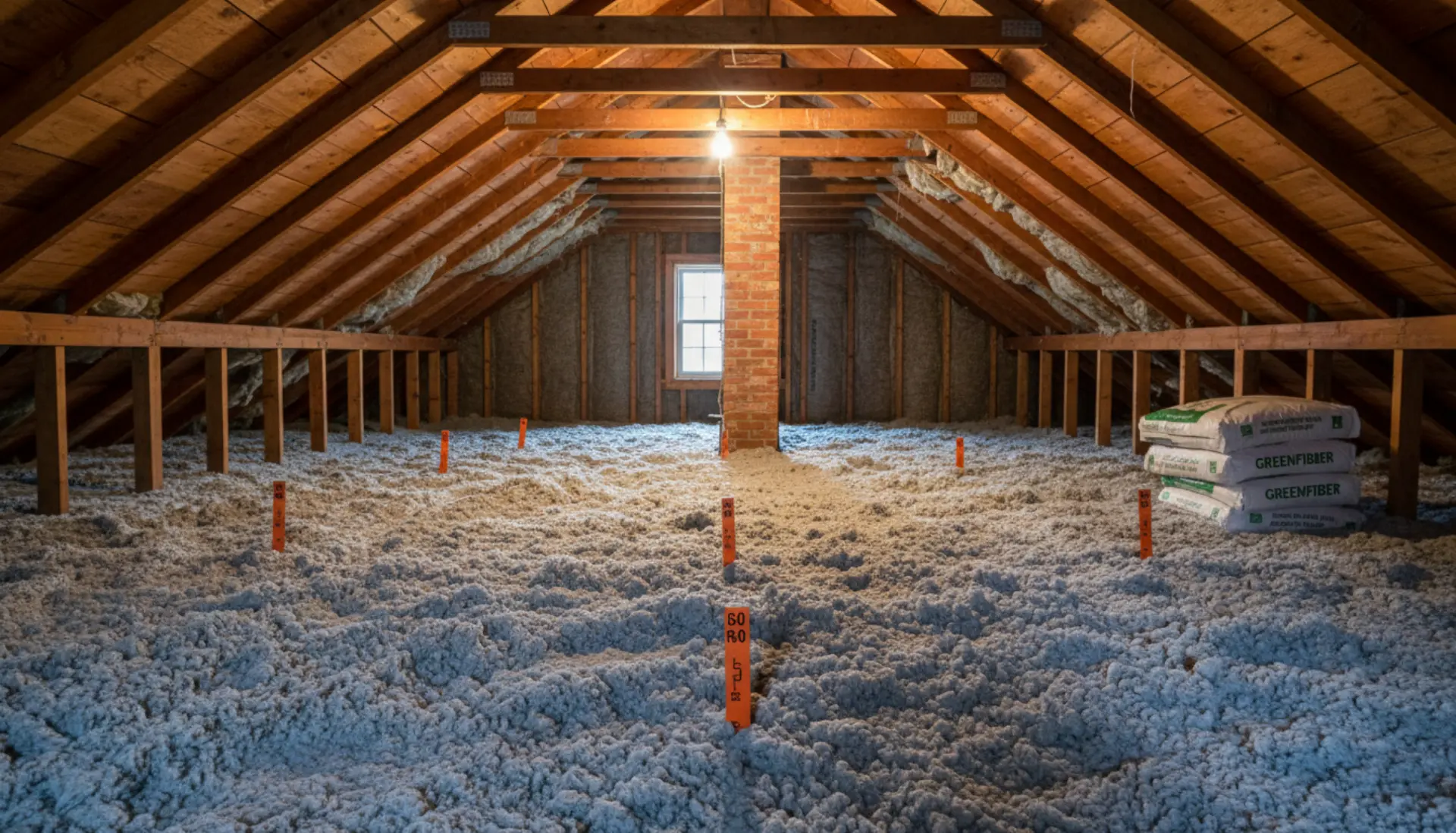
Blown-in cellulose or fiberglass to R-60 (VT Zone 6 code minimum). Many VT homes have R-19 or less — upgrading to R-60 dramatically reduces heat loss through the roof.
Dense-pack cellulose through small drill holes. Many older VT farmhouses and Colonials (pre-1970) have zero wall insulation. R-21 target for 2x6 walls.
Rim joist spray foam plus wall or ceiling insulation. Eliminates cold floors above unheated basements. Critical for VT winters.
Seal air leaks identified during blower door test — attic bypasses, chimney chases, recessed lights, plumbing stacks, electrical penetrations. VT homes average 3,000-5,000 CFM50.
Seal leaky duct joints with mastic. Insulate exposed ducts in unconditioned spaces. Improves HVAC efficiency 20-30%.
Combine attic, walls, basement, and air sealing for maximum savings. Here is the typical full-project math.
Reduces drafts, cold spots, and ice dams. Evens out temperatures between floors. Quieter home. Critical for VT sub-zero winters.
Vermont is entirely IECC Climate Zone 6 — among the coldest in New England. ~7,700 heating degree days means insulation is more critical here than almost anywhere in the lower 48. Many pre-1970 farmhouses have little or no wall insulation.
The EVT 75% insulation rebate is funded by Vermont ratepayers and is completely unaffected by the federal expiration. It remains fully available in 2026.
EVT covers 75% of insulation and air sealing costs for all Vermont electric customers, with a maximum rebate of $4,000 per project. Income-eligible households (at or below 80% AMI) receive 100% coverage -- completely free insulation with $0 out-of-pocket cost. The rebate is typically applied as an instant discount at installation, not as a reimbursement.
Yes. A comprehensive on-site energy audit ($100 copay, or free for income-eligible households) is required before you can receive insulation rebates. The audit identifies what measures your home needs, determines specific R-values, and calculates your rebate amounts. Without an audit on file, you cannot access the 75% insulation discount.
Vermont is entirely IECC Climate Zone 6, which requires R-49 to R-60 for attic insulation. EVT recommends R-60 for optimal performance. Many older Vermont homes have R-19 or less in the attic -- upgrading to R-60 dramatically reduces heat loss through the roof and helps prevent ice dams.
After the 75% EVT rebate, most homeowners pay $375-$1,000 for attic insulation, $500-$1,500 for wall insulation, $325-$950 for basement/crawlspace insulation, and $175-$550 for air sealing. A whole-home insulation project that would cost $5,900-$17,300 typically costs just $1,475-$4,000 after the rebate.
No. The Section 25C energy efficiency tax credit expired December 31, 2025. It provides $0 in 2026 for insulation, air sealing, or any other home energy improvements. The EVT 75% insulation rebate is funded by Vermont ratepayers and is unaffected by the federal expiration.
Insulation work typically starts within 2-4 weeks of completing your audit and choosing a contractor. Most attic insulation projects take 1-2 days, wall insulation (dense-pack) takes 1-3 days, and basement insulation takes 1-2 days. The EVT rebate is applied as an instant discount, so you only pay your 25% share at installation.
No. The EVT insulation rebate requires work to be performed by an EVT participating insulation contractor. The contractor handles all rebate paperwork and applies the discount directly. DIY insulation does not qualify for the EVT rebate.
Vermont farmhouses present several challenges: balloon-frame construction with air leaks from basement to attic, Cape Cod-style sloped ceilings with complex insulation geometry (ice dam prone), post-and-beam construction that is difficult to insulate without encapsulation, stone/brick foundations requiring moisture management before insulation, and knob-and-tube wiring that must be addressed before wall insulation.
This guide is provided by NuWatt Energy as an educational resource. All rebate amounts, R-values, and program requirements are sourced from efficiencyvermont.com. Call EVT at 888-921-5990 to schedule your energy audit and get started.
Required first step. FREE phone or $100 on-site audit.
Complete overview of all Efficiency Vermont programs.
100% free insulation for qualifying households.
$800/unit standard. Pair with insulation for best results.
Insulate first, then convert. Optimal savings strategy.
Zone 6 performance data. Better with good insulation.
Start with a $100 energy audit (free for income-eligible households) to unlock the 75% insulation rebate. Most VT homeowners pay just $1,475-$4,000 for whole-home insulation.