Loading NuWatt Energy...

We use your location to provide localized solar offers and incentives.
We serve MA, NH, CT, RI, ME, VT, NJ, PA, and TX
Loading NuWatt Energy...
NuWatt designs, installs, and manages solar, battery, heat pump, and EV charger systems across 9 states. One company, one warranty, one point of contact.
Get a Free Quote
Lowest solar cost in the US ($2.70/W) meets highest production (1,500 kWh/kW/yr). Get your Level 2 charger for near $0 net cost before the federal credit expires.
$1,000
30C Tax Credit
$250+
Utility Rebate
~$0
Net Charger Cost
6/30/26
Credit Expires
Texas is the best state in the US for solar + EV. Here is why.
Texas solar averages $2.70/W installed — the lowest in the US. Combined with one electrician visit, one permit, and one inspection, bundled installation saves an additional $500-$1,000 vs. separate projects.
Texas produces 1,500 kWh per kW per year — 25% more than northeastern states. Your panels generate more energy per dollar, which means fewer panels needed to charge your EV.
Stack Section 30C ($1,000) + utility rebates ($250+) + no state income tax + property tax exemption. The 30C credit expires June 30, 2026 — act now.
Select your EV, enter your annual miles, and choose your utility territory to see exactly how much extra solar you need and what it will cost in Texas.
Adjust inputs below to see your TX results
24.2 kWh/100mi · 310 mi range
$0.1500/kWh
Total Annual Savings
$436/yr
Solar offset savings · 12 yr payback
Annual EV Energy
2,904kWh
Extra Solar Needed
1.9kW
Additional Panels
~5panels
Solar Upgrade Cost
$5,227
You save $1,244/yr vs gas
$436/yr
Solar EV Offset
12 yrs
Payback Period
Based on Oncor (DFW) ($0.1500/kWh) ·1,500 kWh/kW/yr TX avg · $2.7/W installed · Gas: $3.50/gal at 25 MPG · 30C expires 6/30/26 · No residential ITC (25D expired 12/31/25)
Four steps from daily driving to panel count. Texas sun means fewer panels.
Start with your annual miles (US avg: 12,000) and your EV's efficiency rating (kWh per 100 miles).
12,000 mi/yrMultiply: (miles / 100) x efficiency. A Tesla Model Y at 24.2 kWh/100mi x 12,000 miles = 2,904 kWh/year.
2,904 kWh/yrDivide by TX solar production: 2,904 kWh / 1,500 kWh/kW/yr = 1.9 kW. Texas needs 20% fewer panels than northern states.
1.9 kW extraDivide by panel wattage: 1,900W / 420W/panel = 5 additional panels on your roof.
~5 panels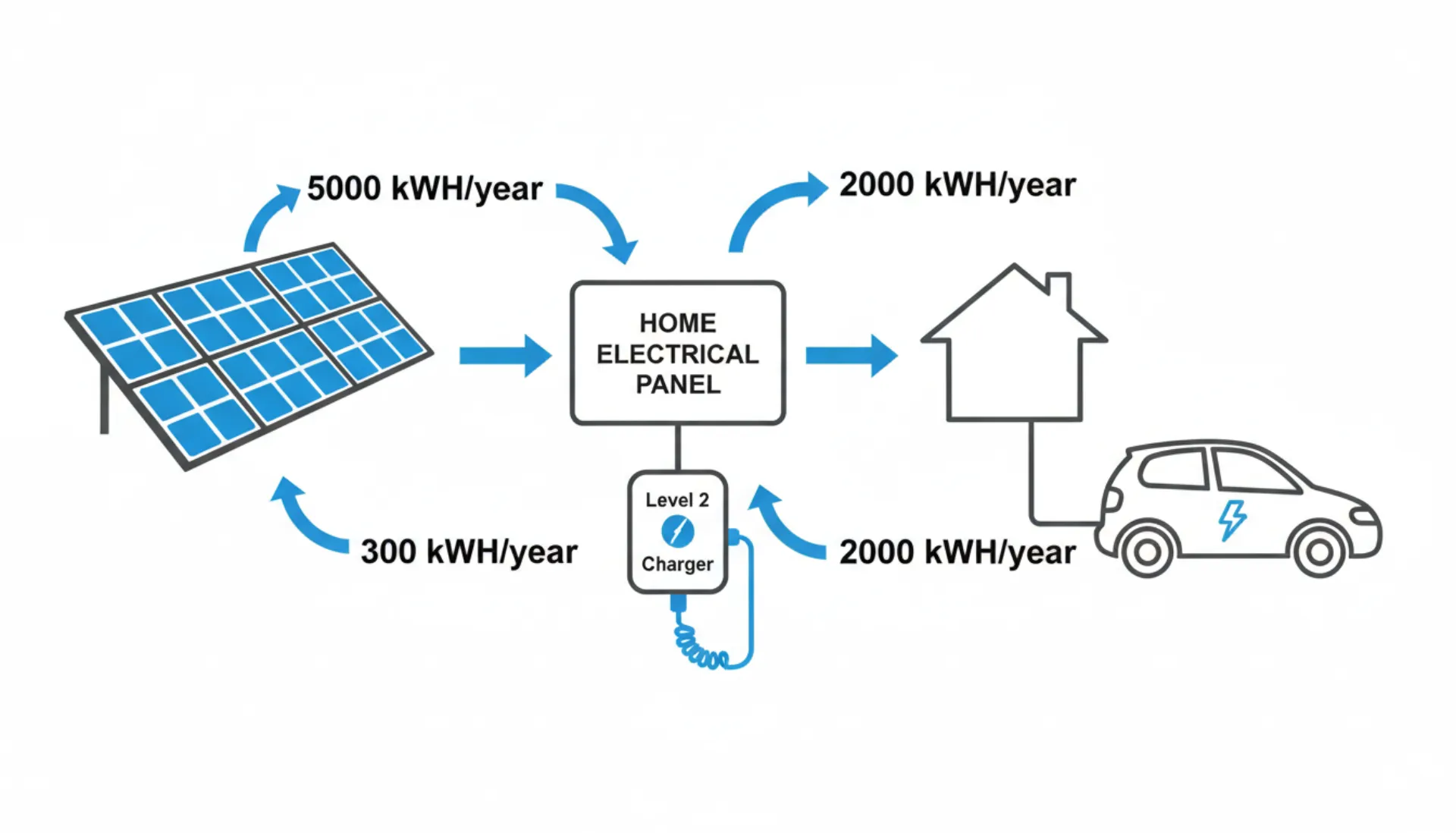
Annual EV energy: (12,000 / 100) x 24.2 = 2,904 kWh
Additional solar: 2,904 / 1,500 = 1.9 kW
Extra panels: 1,900 / 420 = ~5 panels
Solar upgrade cost: 1.9 kW x $2,700/kW = $5,130
Charger net cost: $1,200 - $1,000 (30C) - $250 (utility) = ~$0
Annual savings: $436/yr electricity (Oncor rate) = $436/yr
Average Texas commute: 30 miles/day (10,950 miles/year). Here is exactly how many extra panels each EV needs, using real EPA efficiency ratings and TX solar production.
Formula: (daily miles / mi per kWh) x 365 days = annual kWh. Then: annual kWh / 1,500 kWh/kW/yr (TX production) = extra kW needed.
| EV Model | Efficiency | Daily kWh (30 mi) | Annual kWh | Extra Solar (kW) | Extra 420W Panels | Extra Cost @ $2.70/W |
|---|---|---|---|---|---|---|
| Tesla Model 3 LR Most efficient sedan | 3.1 mi/kWh | 9.7 kWh | 3,532 kWh | 2.4 kW | 6 panels | $6,358 |
| Tesla Model Y LRMost Popular #1 selling EV in TX | 2.9 mi/kWh | 10.3 kWh | 3,776 kWh | 2.5 kW | 6 panels | $6,797 |
| Hyundai Ioniq 5 V2H capable | 2.8 mi/kWh | 10.7 kWh | 3,911 kWh | 2.6 kW | 7 panels | $7,039 |
| Chevy Equinox EV Budget-friendly | 2.7 mi/kWh | 11.1 kWh | 4,056 kWh | 2.7 kW | 7 panels | $7,300 |
| Ford Mustang Mach-E Crossover | 2.5 mi/kWh | 12.0 kWh | 4,380 kWh | 2.9 kW | 7 panels | $7,884 |
| Kia EV6 800V fast charging | 2.8 mi/kWh | 10.7 kWh | 3,911 kWh | 2.6 kW | 7 panels | $7,039 |
| Tesla Cybertruck Popular in TX | 2 mi/kWh | 15.0 kWh | 5,475 kWh | 3.6 kW | 9 panels | $9,855 |
| Ford F-150 Lightning Truck — least efficient | 2.1 mi/kWh | 14.3 kWh | 5,214 kWh | 3.5 kW | 9 panels | $9,386 |
Efficient EV (Model 3)
30 mi/day = 9.7 kWh/day = 2.4 kW extra solar
6 extra panels, ~$6,400
Average EV (Model Y)
30 mi/day = 10.3 kWh/day = 2.5 kW extra solar
6 extra panels, ~$6,800
Truck (F-150 Lightning)
30 mi/day = 14.3 kWh/day = 3.5 kW extra solar
9 extra panels, ~$9,400
Massachusetts would need 25-30% more panels for the same EVs because MA solar produces only 1,150 kWh/kW/yr vs Texas 1,500 kWh/kW/yr. This is why TX is the best state for solar + EV.
In deregulated ERCOT territory, time-of-use (TOU) plans let you pay $0.06-0.10/kWh off-peak vs $0.15-0.22/kWh on-peak. Charge your EV at night, let solar earn during the day.
Municipal utilities (Austin Energy, CPS Energy) have their own rate structures — see comparison below.
| Territory / Provider | Off-Peak Rate | On-Peak Rate | Off-Peak Hours | EV Cost/Day (10 kWh) | Annual EV Savings vs Flat |
|---|---|---|---|---|---|
| Oncor (TXU Free Nights)Best for EV Free overnight — best EV charging plan | $0.00/kWh | $0.18/kWh | 9 PM - 6 AM | $0.00 | $548/yr |
| Oncor (Reliant TOU) Standard TOU plan | $0.08/kWh | $0.17/kWh | 9 PM - 7 AM | $0.80 | $255/yr |
| CenterPoint (Green Mtn TOU) Houston TOU with solar buyback | $0.09/kWh | $0.19/kWh | 8 PM - 6 AM | $0.90 | $219/yr |
| CenterPoint (Chariot Solar) 100% solar buyback plan | $0.07/kWh | $0.16/kWh | 9 PM - 6 AM | $0.70 | $292/yr |
| AEP Texas (TOU plans) Corpus Christi, Laredo, RGV | $0.08/kWh | $0.16/kWh | 10 PM - 6 AM | $0.80 | $255/yr |
| Austin Energy (flat) No TOU but best solar buyback (VoS) | $0.12/kWh | $0.12/kWh | Flat rate | $1.20 | $110/yr |
| CPS Energy (flat) Low flat rate + solar net metering | $0.13/kWh | $0.13/kWh | Flat rate | $1.25 | $91/yr |
Daytime (10 AM - 4 PM)
Solar panels produce maximum power during expensive on-peak hours ($0.15-0.22/kWh). Excess production earns solar buyback credits or offsets your AC cooling load.
Overnight (9 PM - 6 AM)
Charge your EV at off-peak rates ($0.06-0.10/kWh). Set your charger timer to start at 9 PM. A full overnight charge (10 hours x 7.6 kW = 76 kWh) covers 200+ miles.
Net Result
You earn $0.15-0.22/kWh from solar during the day, spend $0.06-0.10/kWh charging at night. That is a $0.07-0.16/kWh spread on every kWh your EV uses.
Gas car (30 MPG, $3.00/gal)
12,000 mi/yr
$985/yr
$82/mo
EV on flat rate ($0.15/kWh)
Model Y, 12,000 mi
$529/yr
$44/mo
EV on TOU off-peak ($0.08/kWh)
Model Y, 12,000 mi
$282/yr
$24/mo
EV + solar (TOU arbitrage)
Solar offsets all EV kWh
~$0/yr
~$0/mo
Based on Tesla Model Y (24.2 kWh/100mi), 12,000 mi/yr. Gas at $3.00/gal TX avg. Solar + TOU eliminates nearly all fuel cost.
Your charger draws 7.6-11.5 kW constantly. Your solar panels produce 0-8+ kW depending on the time of day. Here is why that mismatch does not matter — and how to use it to your advantage.
Full charge time: Tesla Model Y (75 kWh battery) takes ~10 hours on a 32A charger, ~6.5 hours on a 48A charger.
Based on 8 kW system facing south in DFW/Houston/Austin. Summer production is higher; winter ~20% lower.
Your solar produces ~35 kWh/day (8 kW system in TX). Your EV needs ~10 kWh/day (Model Y, 30 mi commute).
That leaves 25 kWh/day for your home — covering most or all of your AC cooling, appliances, and everything else.
Solar offsets total monthly consumption. The grid acts as your free battery.
12-6 AM
Off-peak charging window
EV Charges
$0.06-0.10/kWh on TOU plan
6 AM-12 PM
Solar ramps up
Solar Powers Home
Building to peak production
12-5 PM
Peak solar + peak demand
Max Solar Offset
Offsets expensive AC cooling
5-12 PM
Solar fades, grid on-peak
Grid + Battery
EV timer waits for off-peak
Pro tip: Set your EV charger timer to start at 9 PM or later (when TOU off-peak begins). Most EVs and smart chargers (Tesla Wall Connector, ChargePoint Home Flex, Emporia) have built-in scheduling. Your car will be fully charged by morning at the lowest possible rate.
Most Texans size their solar for their home first, then add panels for EV. Here is how to calculate the total system you need.
Find your current annual kWh
Check your electric bill or REP portal. Average TX home: 14,000-16,000 kWh/year (higher than national avg due to cooling).
Add your EV annual kWh
From the table above: Model Y at 12,000 mi = 2,904 kWh/yr. F-150 Lightning at 12,000 mi = 5,712 kWh/yr.
Divide by TX production
Total kWh / 1,500 kWh/kW/yr = system size in kW.
Multiply by $2.70/W for cost
Lowest installed cost in the US. No 25D federal credit (expired).
Average Home + Model Y
$225/moTotal kWh
17,904
System
11.9 kW
Panels
29
Est. Cost
$32,200
Large Home + F-150 Lightning
$320/moTotal kWh
25,712
System
17.1 kW
Panels
41
Est. Cost
$46,200
Efficient Home + Model 3
$150/moTotal kWh
12,371
System
8.2 kW
Panels
20
Est. Cost
$22,200
Average Home + Two EVs
$225/mo + 2 EVsTotal kWh
20,808
System
13.9 kW
Panels
34
Est. Cost
$37,400
Costs at $2.70/W installed. No federal 25D credit (expired Dec 2025). Add $800-$2,000 for EV charger (near $0 net after 30C + utility rebate). Property tax exempt under TX Tax Code 11.27.
Every dollar you can claim in 2026. No residential solar ITC (25D expired).
| Incentive | Amount | Type | Status | Notes |
|---|---|---|---|---|
| Section 30C (EV Charger) | Up to $1,000 | Federal tax credit | Active | Expires June 30, 2026. 30% of cost, max $1,000 residential. |
| Utility EV Charger Rebates | $250+ (varies) | Utility rebate | Active | Varies by utility/REP. Oncor, CenterPoint, Austin Energy, CPS Energy offer various programs. |
| Austin Energy Solar + EV | ~$3,000+ total | Utility program | Active | Austin Energy territory only. Solar rebate + Value of Solar rate + EV incentives combined. |
| CPS Energy Rebates | $100-275/ton HP | Utility rebate | Active | San Antonio territory. Heat pump rebates can stack with solar + EV for whole-home electrification. |
| Property Tax Exemption | Varies by county | Tax exemption | Active | TX Tax Code 11.27 provides exemption. Implementation varies by county appraisal district. |
| No State Income Tax | 0% | Tax advantage | Active | Texas has no state income tax. Solar savings and EV fuel savings are never taxed at the state level. |
| Solar Buyback Plans (ERCOT) | $0.05-0.10/kWh export | Bill credit | Active | Deregulated ERCOT market. Shop REPs for best solar buyback rate. Not 1:1 net metering. |
| Section 25D (Residential Solar ITC) | $0 | Expired | Dead | Expired December 31, 2025. No federal credit for homeowner-owned solar. |
| Section 25C (Energy Efficiency) | $0 | Expired | Dead | Expired December 31, 2025. No federal credit for heat pumps, insulation, etc. |
The One Big Beautiful Bill Act (OBBBA), signed July 4, 2025, set the final expiration for the Section 30C EV charger tax credit at June 30, 2026. There is no extension provision. Here is what qualifies and what does not.
Timeline tip: Solar + EV charger installations in Texas typically take 4-8 weeks from contract to completion (faster permitting than northeastern states). To meet the June 30, 2026 deadline, sign a contract by early May 2026 at the latest.
Level 2 is the standard for home charging. Here is what to know.
Most Texas homes built after 2000 have 200A panels, which can handle solar + EV charger without upgrades. Older homes may need a panel upgrade ($1,500-$3,000). Texas new construction often includes EV-ready wiring in garages.
Texas heat is a factor for charger placement. Avoid direct afternoon sun on the charger unit. Garage installations are ideal. If outdoor, use a NEMA 4X rated enclosure and consider shade placement to extend charger lifespan.
Texas permitting is generally faster than northeastern states. Most municipalities process solar + EV permits in 1-3 weeks. Some jurisdictions offer expedited permitting for solar installations.
Texas is deregulated in ERCOT territory (85% of the state). Rates vary by retail electric provider. Below are the major TDU (transmission/distribution utility) territories.
Note: In ERCOT areas, you choose your REP (retail electric provider) and rate plan. Austin Energy and CPS Energy are municipal utilities outside ERCOT with fixed rates.
Dallas-Fort Worth metro
Best for: Largest TDU — many REP solar plans available
Houston metro
Best for: High cooling load = big solar offset potential
Austin metro
Best for: Best solar economics — effective 1:1 credits + rebates
San Antonio metro
Best for: Low rates + HP rebates for whole-home electrification
In deregulated ERCOT territory, shop for a retail electric provider (REP) with a solar buyback plan. Providers like Green Mountain Energy, TXU Solar Buyback, and Chariot Energy offer export credits of $0.05-0.10/kWh. Set your EV to charge overnight when wholesale rates are lowest. Your solar panels generate during expensive afternoon peak hours, maximizing the spread between what your solar earns and what your EV costs. Austin Energy customers get the best deal with their Value of Solar rate that effectively provides 1:1 credit.
Texas has unique advantages that make it the best state for solar + EV.
Texas solar produces 1,500 kWh per kW per year — 25% more than Massachusetts and 40% more than Connecticut. This means fewer panels for the same EV charging capacity, lower total cost, and faster payback.
At $2.70/W installed, Texas has the lowest residential solar costs in the country. Combined with high production, the cost-per-kWh of solar energy in Texas is unbeatable even without the expired 25D ITC.
Texas has no state income tax. Your solar savings, EV fuel savings, and any solar export income are never taxed at the state level. This is a permanent structural advantage over states with 5-10% income tax.
In ERCOT territory (85% of TX), you choose your electricity provider and rate plan. Shop for the best solar buyback rate and off-peak EV charging rate. Competition drives down costs and improves terms.
Texas cooling accounts for 40-60% of a home electricity bill in summer. Solar directly offsets this peak-hour consumption. Add an EV charger and you eliminate both your biggest utility bill driver and your gas pump visits.
After the 2021 winter storm and ongoing ERCOT grid stress events, many Texans add batteries to their solar + EV systems. A Powerwall can keep your home running and your EV charged during grid outages.
Everything homeowners ask about bundling solar with an EV charger in TX.
Fewer than most states thanks to Texas sun. Most EVs need 2,400-4,900 extra kWh per year (12,000 miles). With 1,500 kWh/kW/yr solar production in Texas, that translates to just 1.6-3.3 kW of additional solar, or roughly 4-8 extra 420W panels. Texas needs fewer panels than northern states for the same EV.
Texas does not have statewide mandated net metering. Instead, the deregulated ERCOT market offers solar buyback plans through retail electric providers (REPs). Austin Energy offers a 1:1 Value of Solar rate. In ERCOT territory, compare solar buyback rates from providers like TXU, Reliant, Green Mountain, and Chariot Energy. Rates range from $0.05-0.10/kWh for exports.
ERCOT (Electric Reliability Council of Texas) manages the deregulated Texas grid. In ERCOT territory (about 85% of the state), you choose your retail electric provider and rate plan. This means you can shop for plans that offer favorable solar buyback rates and off-peak EV charging rates. Austin Energy, CPS Energy, and co-ops operate outside ERCOT with their own rates.
The Section 30C credit expires June 30, 2026. The One Big Beautiful Bill Act (OBBBA), signed July 4, 2025, accelerated the expiration date. There is no extension mechanism. To claim the credit, your EV charger must be placed in service by June 30, 2026.
No. The Section 25D residential solar ITC expired December 31, 2025. Homeowners who purchase solar systems in 2026 receive $0 federal tax credit. However, Texas solar is still among the best investments in the country due to the lowest installed costs ($2.70/W), highest production (1,500 kWh/kW/yr), and no state income tax.
A Level 2 charger unit costs $400-$800, and professional installation (240V circuit, wiring, permit) adds $400-$1,200, for a total of $800-$2,000. After the Section 30C credit ($1,000) and available utility rebates ($250 varies), most Texas homeowners pay near $0 net for the charger.
Austin Energy offers some of the best utility incentives in Texas. Their solar rebate program and EV charger incentives combined can exceed $3,000 in total benefits. Austin Energy also offers a Value of Solar rate that effectively provides 1:1 credit for solar production, making it the best utility territory in Texas for solar + EV.
Yes, but you need to size correctly. Texas cooling uses 40-60% of a home electricity bill in summer. A typical 8-10 kW system covers the home, and you add 1.6-3.3 kW for EV charging on top. The good news: Texas produces 1,500 kWh/kW/yr — 25% more than northern states — so your panels work harder per dollar.
A battery is not required but is valuable in Texas for two reasons: (1) protection from ERCOT grid outages and extreme weather events, and (2) time-of-use arbitrage where you store cheap solar energy and use it during expensive peak evening hours when your EV charges. Some Texas solar providers bundle batteries with installation.
Texas law (Section 11.27, Tax Code) provides a property tax exemption for the appraised value added by solar and wind energy devices. However, implementation varies by county appraisal district. Most major metro counties (Harris, Dallas, Travis, Bexar) honor the exemption. Check with your county appraisal district to confirm.
Time-of-Use (TOU) plans in ERCOT territory charge different rates depending on when you use electricity. Off-peak rates (typically 9 PM - 6 AM) average $0.06-0.10/kWh, while on-peak summer afternoon rates can exceed $0.15-0.22/kWh. By charging your EV overnight on off-peak rates and letting solar panels produce during expensive afternoon peaks, you maximize the spread — paying $0.08/kWh for EV fuel while your solar earns credits at $0.15+/kWh.
The F-150 Lightning is the least efficient popular EV at 2.1 miles per kWh (47.6 kWh/100mi). At 12,000 miles per year, it needs about 5,712 kWh annually — roughly 3.8 kW of extra solar in Texas (1,500 kWh/kW/yr production), or about 9 additional 420W panels. Compare that to a Tesla Model 3, which needs only about 4 extra panels for the same miles.
Yes. A Level 2 charger draws 7.6-11.5 kW continuously, but a typical Texas home solar system produces 5-8 kW at peak midday. The grid covers the difference in real time. The key insight: you do not need to charge your EV only when the sun is shining. Solar offsets your total monthly kWh consumption, and your EV charges overnight. Over a billing period, the math works out — solar generates during the day, EV charges at night, and the grid acts as your battery.
The solar portion of your EV bundle can be financed through NuWatt's Propel structure: a third-party owner installs FEOC-compliant Silfab 440W panels and claims the 40% Section 48E ITC. You pay ~$117/month on 8 kW ($2.90/W), $0 down, 8.99% APR, 25-year term, 660 FICO minimum. The EV charger portion qualifies separately for the Section 30C credit (expires June 30, 2026 — act soon). Bundle both for maximum savings on one project.
See Propel Financing for SolarLock in the Section 30C credit before June 30, 2026. Our TX-licensed installers handle solar panels, EV charger, and all permitting in one project.
Free, no-obligation quote. Licensed TX electricians. Typical installation: 4-8 weeks.
$2.70/W installed — lowest in the US
Level 2 installation guide for TX
Live wholesale + retail rates
Compare REP solar export plans
Solar math post-ITC expiration
How the TX grid affects solar
Oncor, CenterPoint, AEP rates
Whole-home electrification bundle
Municipal rates + Value of Solar
DFW territory incentives
Every available TX incentive
ERCOT resilience with solar