Loading NuWatt Energy...

We use your location to provide localized solar offers and incentives.
We serve MA, NH, CT, RI, ME, VT, NJ, PA, and TX
Loading NuWatt Energy...
NuWatt designs, installs, and manages solar, battery, heat pump, and EV charger systems across 9 states. One company, one warranty, one point of contact.
Get a Free Quote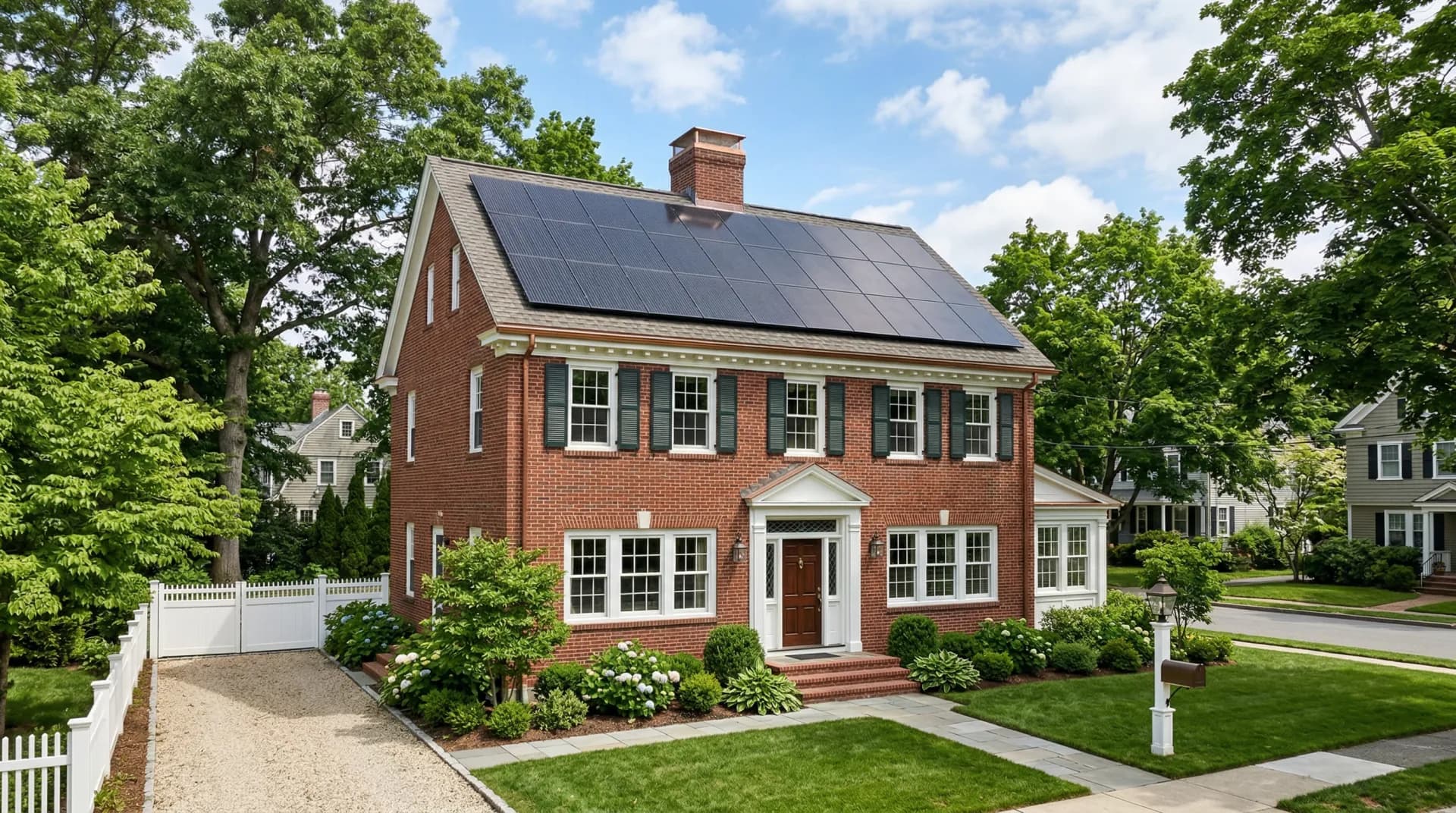
The federal residential solar tax credit is gone. The installer you choose in 2026 matters more than ever. We compared pricing, local expertise, SMART 3.0 enrollment, ConnectedSolutions capability, and warranty coverage from five companies actively installing across Massachusetts.
The best solar companies in Massachusetts in 2026 are NuWatt Energy (best overall value and program expertise), Sunrun (best for $0-down lease/PPA), Trinity Solar (best budget option), Boston Solar (best for Greater Boston), and Tesla (best for Powerwall integration). With the federal residential ITC expired, choosing an installer who understands SMART 3.0 enrollment and ConnectedSolutions battery incentives is critical for maximizing your savings in the highest-rate electricity market in New England.
Key numbers every MA homeowner should know before comparing solar quotes. Massachusetts has the highest electricity rates in New England, making solar one of the strongest investments in the country even without a federal tax credit.
$0.2836/kWh
Highest residential rate in MA (serves ~60% of households)
~$3.30/W
Range: $3.10–$3.50/W depending on installer and panel tier
$0.03/kWh
20-year term, $0.06/kWh for low-income. PY2026 cap: 600 MW
1:1 Retail
Full retail credit for residential systems ≤10 kW, annual true-up
6.25% Exempt
Full sales tax exemption on solar equipment and installation
20-Year Exempt
Solar adds home value without increasing property tax for 20 years
We evaluated each installer on eight criteria that matter most for Massachusetts homeowners in the post-ITC landscape. Companies that understand MA-specific programs ranked higher because those programs now represent the largest financial incentives available to homeowners.
SMART 3.0 enrollment, ConnectedSolutions, Mass Save knowledge
Clear per-watt pricing with dealer fees disclosed upfront
Tier-1 panels, quality inverters, workmanship coverage
BBB rating, Google reviews, complaint patterns
Own crews vs subcontracted, local office presence
Cash, loan, lease/PPA availability and terms
Contract-to-PTO speed and MA permitting experience
Years in MA, statewide vs regional coverage
Detailed profiles with honest pros and cons. We call out weaknesses for every company, including NuWatt, because you deserve an unbiased comparison.
Deep MA program expertise with in-house installation crews and all panel tiers
2008, Chelmsford MA
$3.10–$3.40/W cash; competitive lease/PPA via Propel
MA, NH, CT, RI, ME, VT, NJ, PA, TX
Statewide
Best for: Homeowners who want a local company with proven MA program expertise, transparent pricing, and hands-on support
Largest US residential solar company with strong lease/PPA options
2007, San Francisco CA
$3.50–$4.00/W cash equivalent; lease/PPA competitive
Nationwide (22+ states)
Eastern + Central MA
Best for: Homeowners prioritizing $0-down financing with a national brand backing
Aggressive pricing with a large Northeast footprint and strong eastern MA presence
1994, Wall Township NJ
$3.00–$3.30/W (often the lowest quoted price)
Northeast US (MA, CT, NJ, NY, PA, MD, DE, NH, RI)
Eastern MA focus
Best for: Price-sensitive homeowners looking for the lowest upfront cost
Local MA-only installer with strong reputation in the Greater Boston area
2011, Woburn MA
$3.20–$3.50/W
Massachusetts only
Greater Boston + Eastern MA
Best for: Greater Boston homeowners who want a local MA-only company with strong community roots
Sleek ecosystem with Powerwall bundling and standardized online pricing
2006, Palo Alto CA (solar division from SolarCity acquisition)
$2.80–$3.20/W (online pricing, often excludes complexity adders)
Nationwide
Statewide (online)
Best for: Tech enthusiasts who want the Tesla ecosystem, Powerwall integration, and app experience
How the five companies stack up on the features that matter most in Massachusetts.
| Feature | NuWatt | Sunrun | Trinity | Boston | Tesla |
|---|---|---|---|---|---|
| Local Crews | Yes | No (subcontracted) | Mixed | Yes | No (subcontracted) |
| SMART 3.0 Expertise | Yes | Limited | Limited | Yes | No |
| ConnectedSolutions Help | Yes | No | No | Limited | No |
| $0-Down Option | Yes (Propel) | Yes | Yes | No | Yes |
| Avg Price/Watt | $3.10–$3.40/W cash | $3.50–$4.00/W cash equivalent | $3.00–$3.30/W (often the lowest quoted price) | $3.20–$3.50/W | $2.80–$3.20/W (online pricing, often excludes complexity adders) |
| Warranty | 25 yr | 25 yr | 25 yr | 25 yr | 25 yr |
| BBB Rating | A+ | A+ | A | A+ | B |
| MA Coverage | Statewide | Eastern + Central MA | Eastern MA focus | Greater Boston + Eastern MA | Statewide (online) |
Your Massachusetts utility determines your electricity rate, net metering credits, and ConnectedSolutions battery income. Here is how the three major utilities compare for solar economics in 2026.
Highest rate = fastest payback. Best ConnectedSolutions payout in MA at $275/kW summer.
Second-highest rate. Solid ConnectedSolutions program at $225/kW summer + $50/kW winter.
Lowest rate = longest payback. No ConnectedSolutions battery income available. Solar still worthwhile.
Not sure which utility you have?
Check your electric bill or use our MA utility rate comparison guide to understand how your specific utility affects solar economics and which programs you can access.
The solar landscape in Massachusetts shifted dramatically when the One Big Beautiful Bill Act let the Section 25D residential tax credit expire on December 31, 2025. Here is what that means for your installer decision.
The 30% federal tax credit for homeowner-owned solar (Section 25D) expired. There is no longer a $7,000–$10,000 credit to offset your upfront cost on cash or loan purchases. This makes every other savings lever—SMART 3.0, net metering, ConnectedSolutions—more important than ever.
The SMART program pays $0.03/kWh for 20 years. On a typical 8 kW system producing 9,600 kWh/year, that is roughly $5,760 over the program term. With the ITC gone, SMART is the largest direct incentive available to MA solar owners. Many national installers do not properly enroll customers, leaving thousands of dollars unclaimed.
Battery owners enrolled in Eversource's ConnectedSolutions earn up to $275/kW per summer season plus $50/kW winter. A single Powerwall can generate $1,375–$1,625/year. Enrollment requires installer cooperation—not all companies handle this process. This income stream dramatically improves battery payback.
Under a lease or PPA, the third-party system owner (not the homeowner) claims the Section 48/48E commercial ITC. This means $0-down options like NuWatt's Propel program now offer some of the best economics for homeowners who cannot afford $25,000+ upfront. The ITC benefit passes through as lower monthly payments.
The Mass Solar Loan program ended in 2020. There is no longer a state-subsidized low-interest solar loan available. Current solar loans from private lenders carry 6–8% APR. Be wary of installers who reference this program as if it is still active—it is a sign they are not up to date on MA solar financing.
Massachusetts has the highest residential electricity rates in New England, with Eversource at $0.34/kWh and National Grid at $0.32/kWh. These rates make solar payback periods shorter than in neighboring states, even without the federal tax credit. Every kWh your system produces offsets expensive grid power.
Bottom Line
In 2025, you could choose almost any installer and still save money thanks to the 30% tax credit. In 2026, your installer's knowledge of MA programs—SMART 3.0 enrollment, ConnectedSolutions configuration, net metering optimization, and honest financing guidance—directly determines whether you leave thousands of dollars in incentives unclaimed.
Protect yourself from bad deals. If you encounter any of these warning signs during the sales process, proceed with caution.
The residential solar tax credit (Section 25D) expired on December 31, 2025. Any installer still quoting 30% off is either uninformed or dishonest. The only way to access the ITC now is through a lease/PPA where the third-party system owner claims Section 48/48E.
SMART 3.0 pays $0.03/kWh for 20 years—roughly $5,760 on a typical system. An installer who does not proactively discuss SMART enrollment either lacks MA-specific expertise or does not handle the paperwork. Both are dealbreakers.
If you are adding a battery and your utility is Eversource or National Grid, ConnectedSolutions income of $1,125–$1,625/year is too significant to leave on the table. Your installer should handle enrollment as part of the battery quote.
Dealer fees (also called origination fees) of 15–30% are baked into many solar loans. If an installer won't break out the dealer fee separately, you cannot accurately compare their loan price to a cash price or another company's quote.
Solar systems last 25+ years. You want an installer with a local presence who will be around for warranty service, system monitoring, and any future issues. A company with no MA office may not prioritize your post-installation needs.
A competent MA installer should model your 20-year SMART income based on your specific system size and expected production. If they cannot produce this projection, they likely do not handle SMART enrollment.
Legitimate solar companies encourage you to get multiple quotes. A company that pressures you to sign immediately—especially by claiming a "limited-time discount"—is using a high-pressure sales tactic. Massachusetts law gives you 3 business days to cancel most home improvement contracts.

Massachusetts solar installations vary significantly by installer, panel tier, and design approach.
City-specific guides with local pricing, utility rates, and installer recommendations.
The average cost of solar panels in Massachusetts in 2026 is approximately $3.10–$3.50/W before any incentives, with the statewide average around $3.30/W. For a typical 8 kW system, that translates to roughly $26,400 before SMART 3.0 income and other incentives. Pricing varies by installer: NuWatt quotes $3.10–$3.40/W, Trinity Solar $3.00–$3.30/W, and Tesla $2.80–$3.20/W (though Tesla pricing often excludes complexity adders for roof type, electrical upgrades, and permitting).
SMART (Solar Massachusetts Renewable Target) 3.0 is a state incentive that pays solar system owners $0.03/kWh for residential systems under 25 kW, with $0.06/kWh for low-income qualified households, over a 20-year contract term. The PY2026 capacity cap is 600 MW. On a typical 8 kW system producing 9,600 kWh/year, SMART pays roughly $288/year or $5,760 over the full 20-year term. This program is now one of the most important incentives for MA solar economics. Not all installers properly enroll customers—ask specifically about SMART enrollment during your quote process.
Yes. Massachusetts offers 1:1 retail net metering for residential systems up to 10 kW. Larger residential systems receive private net metering credits. Excess generation carries forward monthly, with an annual true-up. Net metering combined with SMART 3.0 income means Massachusetts solar owners benefit from both bill credits and direct incentive payments, making it one of the strongest solar states even without a federal tax credit.
Yes, solar remains a strong investment in Massachusetts in 2026 even without the Section 25D residential tax credit. Massachusetts has the highest electricity rates in New England (Eversource $0.34/kWh, National Grid $0.32/kWh), the SMART 3.0 program pays $0.03/kWh for 20 years, net metering credits offset most of your bill, sales tax on solar is exempt (6.25% savings), and the 20-year property tax exemption protects your home value. Lease/PPA options let the third-party system owner claim the Section 48/48E commercial ITC, passing savings to you through lower monthly payments. Typical payback is 8–11 years depending on system size, utility, and financing.
Solar payback in Massachusetts typically ranges from 8–11 years, depending on your utility, system size, and financing method. Eversource customers ($0.34/kWh) see the fastest payback at roughly 8–9 years. National Grid customers ($0.32/kWh) typically see 9–10 years. Unitil customers ($0.2833/kWh) see 10–11 years. These estimates factor in SMART 3.0 income ($0.03/kWh for 20 years), net metering credits, and the 6.25% sales tax exemption. After payback, your system generates essentially free electricity for the remaining 15–20 years of its lifespan.
ConnectedSolutions is a demand response program run by Eversource and National Grid in Massachusetts that pays battery owners for brief dispatches during peak electricity demand. Eversource pays $275/kW for summer events plus $50/kW for winter events. National Grid pays $225/kW summer plus $50/kW winter. For a 13.5 kWh Tesla Powerwall (5 kW), that means $1,375–$1,625 per year from Eversource or $1,125–$1,375 from National Grid. Note: Unitil does NOT participate in ConnectedSolutions. Enrollment requires specific inverter configuration and paperwork—not all installers handle this process. Always ask whether ConnectedSolutions enrollment is included in your solar-plus-battery quote.
Compare against any competitor. We show you the full breakdown including SMART 3.0 income projections, ConnectedSolutions earnings, and honest cash vs. lease economics for your specific MA utility.
No high-pressure sales. No hidden dealer fees. Just transparent pricing from a local company that has been installing solar in Massachusetts since 2008.