Loading NuWatt Energy...

We use your location to provide localized solar offers and incentives.
We serve MA, NH, CT, RI, ME, VT, NJ, PA, and TX
Loading NuWatt Energy...
NuWatt designs, installs, and manages solar, battery, heat pump, and EV charger systems across 9 states. One company, one warranty, one point of contact.
Get a Free Quote
The federal residential solar tax credit is gone. In New Jersey, your installer's knowledge of the ADI/SREC-II program, net metering, and utility rate structures now determines whether you maximize your investment. We compared pricing, program expertise, and warranty coverage from five companies actively installing in NJ.
The best solar companies in New Jersey in 2026 are NuWatt Energy (best overall value and ADI expertise), Trinity Solar (best NJ-native installer with competitive pricing), and Sunrun(best for $0-down financing). With the federal residential ITC expired, choosing an installer who understands New Jersey's ADI program ($85.00–$85.00/MWh for 15 years), net metering, and your specific utility rate territory is critical for maximizing savings.
New Jersey is consistently a top-5 solar state per capita. Here are the key numbers driving the economics in 2026.
~$0.23/kWh
PSE&G, JCP&L, ACE, RECO territories
~$3.00/W
$2.85–$3.15/W range across installers
$85.00/MWh
Rising to $85.00/MWh
1:1 Retail
Full retail credit, all utilities
100% Exempt
6.625% tax waived on solar equipment
100% Exempt
No increase from solar installation
We evaluated each installer on eight criteria that matter most for New Jersey homeowners in the post-ITC landscape. Companies that understand NJ-specific programs ranked higher because those programs now represent the largest financial incentives available.
ADI enrollment, 15-year revenue projections, SREC-II knowledge
Clear $/W pricing with no hidden dealer fees or markups
Tier-1 panels, quality inverters, workmanship coverage
BBB rating, Google reviews, complaint patterns and resolution
Own crews vs subcontracted, NJ office presence
Cash, loan, lease/PPA availability and terms
Utility interconnection and net metering enrollment expertise
North, Central, South, and Shore service area coverage
Detailed profiles with honest pros and cons. We call out weaknesses for every company, including NuWatt, because you deserve an unbiased comparison.
Transparent pricing with deep ADI program expertise across all NJ utility territories
2008, Chelmsford MA
$2.85–$3.15/W cash; competitive lease/PPA via Propel
All NJ (North, Central, South, Shore) + MA, NH, CT, RI, ME, PA, TX
Best for: Homeowners who want transparent pricing, multiple panel options, and expert ADI program guidance
Largest US residential solar company with strong lease and PPA options
2007, San Francisco CA
$3.20–$3.60/W cash equivalent; lease/PPA competitive
Nationwide (22+ states including all of NJ)
Best for: Homeowners who want $0-down financing with a nationally recognized brand
Headquartered in NJ with aggressive pricing and the largest NE footprint
1994, Wall Township NJ
$2.75–$3.10/W (often the lowest quoted price in NJ)
Northeast US (NJ, MA, CT, NY, PA, MD, DE, NH, RI)
Best for: Price-sensitive NJ homeowners who value a locally headquartered company
NJ-based installer with strong coverage in Central and South Jersey
2009, South Plainfield NJ
$2.90–$3.25/W
NJ, PA, FL, NY, CT
Best for: Central and South NJ homeowners looking for a competitive local installer
Sleek ecosystem with Powerwall bundling and online ordering
2006, Palo Alto CA (solar division from SolarCity acquisition)
$2.70–$3.10/W (online pricing, often excludes complexity adders)
Nationwide
Best for: Tech enthusiasts who want the Tesla ecosystem and Powerwall integration
How the five companies stack up on the features that matter most in New Jersey.
| Feature | NuWatt | Sunrun | Trinity | Momentum | Tesla |
|---|---|---|---|---|---|
| Rating | 4.9 | 4.2 | 4.4 | 4.1 | 3.9 |
| Local Crews | Yes | No (subcontracted) | Mixed | Mixed | No (subcontracted) |
| ADI/SREC Expertise | Yes | Limited | Limited | Limited | No |
| Net Metering Help | Yes | Limited | Yes | Limited | No |
| $0-Down Option | Yes (Propel) | Yes | Yes | Yes | Yes |
| Avg Price/Watt | $2.85–$3.15/W cash | $3.20–$3.60/W cash equivalent | $2.75–$3.10/W (often the lowest quoted price in NJ) | $2.90–$3.25/W | $2.70–$3.10/W (online pricing, often excludes complexity adders) |
| Warranty | 25 yr | 25 yr | 25 yr | 25 yr | 25 yr |
| BBB Rating | A+ | A+ | A | A | B |
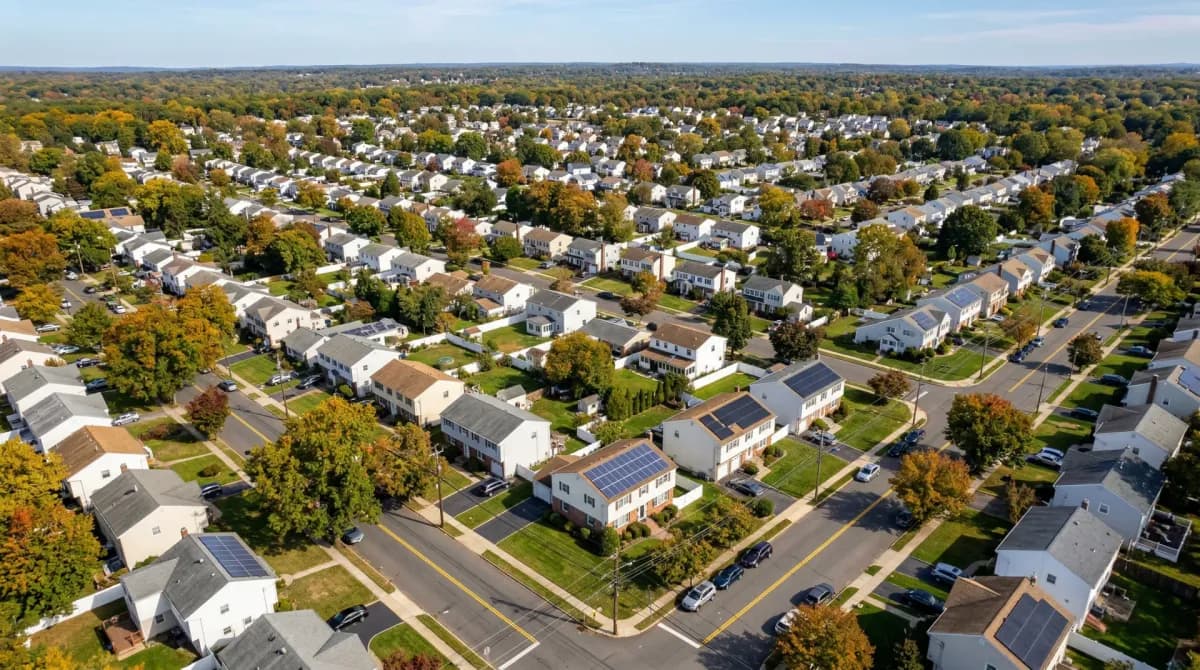
Solar installations across NJ utility territories — PSE&G, JCP&L, ACE, and RECO
New Jersey has four utility territories with different rate structures. Your utility determines your solar savings, payback timeline, and which installers have the most experience in your area.
~$0.26/kWh
North & Central NJ
Newark, Jersey City, New Brunswick, Trenton area
9–10 years
~70% of NJ customers
~$0.24/kWh
Central & Western NJ
Morristown, Toms River, Princeton area
10–11 years
~20% of NJ customers
~$0.23/kWh
South NJ
Atlantic City, Cherry Hill, Vineland
10–12 years
~8% of NJ customers
~$0.25/kWh
Bergen County (NW)
Mahwah, Ramsey, Upper Saddle River
9–11 years
~2% of NJ customers
All four utilitiessupport net metering at 1:1 retail credit for residential solar. ADI enrollment is the same regardless of utility territory. The key difference is your rate: higher rates mean faster payback. Check your actual bill — time-of-use plans and rate tiers can push effective rates higher than these averages.
The solar landscape in New Jersey shifted when the One Big Beautiful Bill Act let the Section 25D residential tax credit expire on December 31, 2025. Here is what that means for your installer decision.
The 30% federal tax credit for homeowner-owned solar expired. There is no longer a $7,000–$10,000 credit to offset your upfront cost on cash or loan purchases. This makes New Jersey's state-level incentives — especially the ADI program — more important than ever.
The ADI incentive rate is increasing from $85.00/MWh (EY2025-26) to $85.00/MWh — an 11% increase. For a typical 8 kW system producing 9.5 MWh/year, that means $905/year in ADI revenue locked in for 15 years. An installer who cannot navigate ADI enrollment is leaving thousands of dollars in incentives unclaimed.
Under a lease or PPA, the third-party system owner claims the Section 48/48E commercial ITC and passes savings through lower monthly payments. This makes $0-down options more competitive relative to cash purchases in 2026 than they were when homeowners could claim their own 30% credit.
New Jersey consistently ranks in the top 5 states per capita for solar installations. The ADI program, 100% sales and property tax exemptions, strong net metering, and high electricity rates keep NJ among the best markets for solar in 2026. The Community Solar Energy Program (CSEP) is also expanding access for renters.
Bottom Line
In 2025, you could choose almost any installer and still save money thanks to the 30% tax credit. In 2026, your installer's knowledge of NJ's ADI program, net metering structure, and your specific utility rate territory directly determines whether you leave thousands of dollars in incentives unclaimed. ADI alone can add $8,000–$14,000+ over 15 years.
Protect yourself from bad deals. If you encounter any of these warning signs during the sales process, proceed with caution.
The ADI program is the single largest financial incentive for NJ solar owners, paying $85.00–$85.00/MWh for 15 years. An installer who cannot explain ADI enrollment, payment timelines, and expected revenue either lacks NJ expertise or does not handle program enrollment—both are serious red flags.
NJ has four distinct utility territories with different rate structures. Your system design and savings projections depend on your specific utility rate. An installer who uses a generic rate for all of NJ is likely producing inaccurate savings estimates.
The residential solar tax credit (Section 25D) expired on December 31, 2025. Any installer quoting a 30% federal credit for cash or loan purchases in 2026 is either misinformed or dishonest. The only way to access the ITC now is through a lease/PPA where the third-party system owner claims Section 48/48E.
NJ has one of the most active solar markets in the country with robust permitting and inspection requirements. An installer without local NJ presence may struggle with municipal permitting, utility interconnection timelines, and ADI enrollment paperwork.
ADI payments represent $8,000–$12,000+ in cumulative revenue over 15 years for a typical residential system. An installer who cannot or will not model these payments into your ROI analysis is not giving you the complete financial picture.
Legitimate solar companies encourage you to get multiple quotes. Any installer pressuring you to sign immediately—especially with a "limited-time discount"—is using a predatory sales tactic. New Jersey consumer protection law gives you 3 business days to cancel most home improvement contracts.
City-specific guides with local pricing, utility rates, and installer recommendations.
The average cost of solar panels in New Jersey in 2026 is approximately $2.85–$3.15 per watt before incentives, with an average around $3.00/W. For a typical 8 kW system, that translates to roughly $24,000 before the ADI incentive. NJ’s ADI program pays $85.00/MWh over 15 years, which can add $8,000–$12,000 in cumulative revenue. Sales tax is 100% exempt and there is no property tax increase from solar.
New Jersey’s SREC-II program has transitioned to the Administratively Determined Incentive (ADI). Under the ADI, residential solar systems receive fixed payments of $85.00 per megawatt-hour (MWh) for Energy Year 2025-26. These payments continue for 15 years from your system’s interconnection date. Unlike the old SREC market where prices fluctuated, ADI rates are fixed and predictable. A typical 8 kW system generating about 9.5 MWh per year would earn roughly $815–$905 annually in ADI payments.
Yes, New Jersey has statewide net metering for residential solar systems. You receive 1:1 retail credit for excess electricity sent to the grid, meaning every kilowatt-hour you export offsets a kilowatt-hour you would otherwise buy. Credits accumulate monthly and are trued up annually at the avoided cost of wholesale electricity. Net metering is available through all NJ utilities: PSE&G, JCP&L, ACE, and RECO.
Yes, solar remains a strong investment in New Jersey in 2026. While the Section 25D residential tax credit expired on December 31, 2025, NJ has the ADI program paying $85.00–$85.00/MWh for 15 years, 100% sales tax exemption, 100% property tax exemption, and net metering at retail rates. NJ electricity rates average $0.26/kWh, making solar savings substantial. Lease/PPA options let the third-party owner claim the Section 48/48E commercial ITC and pass savings through lower monthly payments. Typical payback for cash purchases is 8–11 years.
Solar payback in New Jersey typically ranges from 8 to 11 years depending on your utility territory, system size, and financing choice. PSE&G customers at $0.23/kWh see payback around 9–10 years. JCP&L customers at $0.24/kWh see 10–11 years. ACE customers at $0.23/kWh see 10–12 years. ADI payments of $815–$905 per year accelerate payback significantly compared to states without production incentives. After payback, you enjoy 15–20+ years of essentially free electricity plus continued ADI revenue.
PSE&G territory is generally the best for solar in New Jersey due to the highest residential rates at approximately $0.23/kWh, which means faster payback and greater lifetime savings. JCP&L at $0.24/kWh and ACE at $0.23/kWh are close behind. RECO at $0.25/kWh serves a smaller territory in Bergen County. All four utilities support net metering and ADI enrollment. The key factor is your actual rate—check your bill, as time-of-use plans and rate tiers can push effective rates higher than these averages.
Compare against any competitor. We show you the full breakdown including ADI revenue projections, utility-specific savings, and honest cash vs. lease economics.
No high-pressure sales. No hidden dealer fees. Transparent pricing with ADI program expertise from a company that serves all of New Jersey.