Loading NuWatt Energy...

We use your location to provide localized solar offers and incentives.
We serve MA, NH, CT, RI, ME, VT, NJ, PA, and TX
Loading NuWatt Energy...
Use the free estimator for a preliminary layout, or share your preferred response method with the commercial team. Final feasibility still requires site, utility, and engineering review.
Start with a real roof fit, then calculate savings from the building's utility tariff, interval demand, structural scope, verified incentives, and financing—not a statewide average.
Tariff-specific
Utility Input
Property-specific
Roof Input
Engineered
Mounting
Verified
Incentives
Warehouse solar ROI cannot be calculated credibly from roof size or a statewide electric-rate average alone. It requires the actual utility tariff and interval demand, a roof-specific layout, structural and roofing scope, production, financing, and verified incentives. The Section 48E begin-construction window closed July 4, 2026: projects that began construction on or before that date may use the longer continuity pathway. Commercial solar projects starting now generally must be placed in service by December 31, 2027. The statutory credit is 6%; it can increase to 30% when the applicable prevailing-wage and registered-apprenticeship requirements are met. Bonus depreciation for commercial solar is 100% in the first year, not 20%. The One Big Beautiful Bill Act permanently restored the full first-year deduction under IRC Section 168(k) for qualifying property acquired and placed in service after January 19, 2025, and IRS Notice 2026-11 confirms it. The 20% figure still circulating comes from the superseded TCJA phasedown that OBBBA replaced.
Free address-based tool
See a preliminary roof outline and panel fit before the utility-bill and engineering review.
No account required to see your roof result
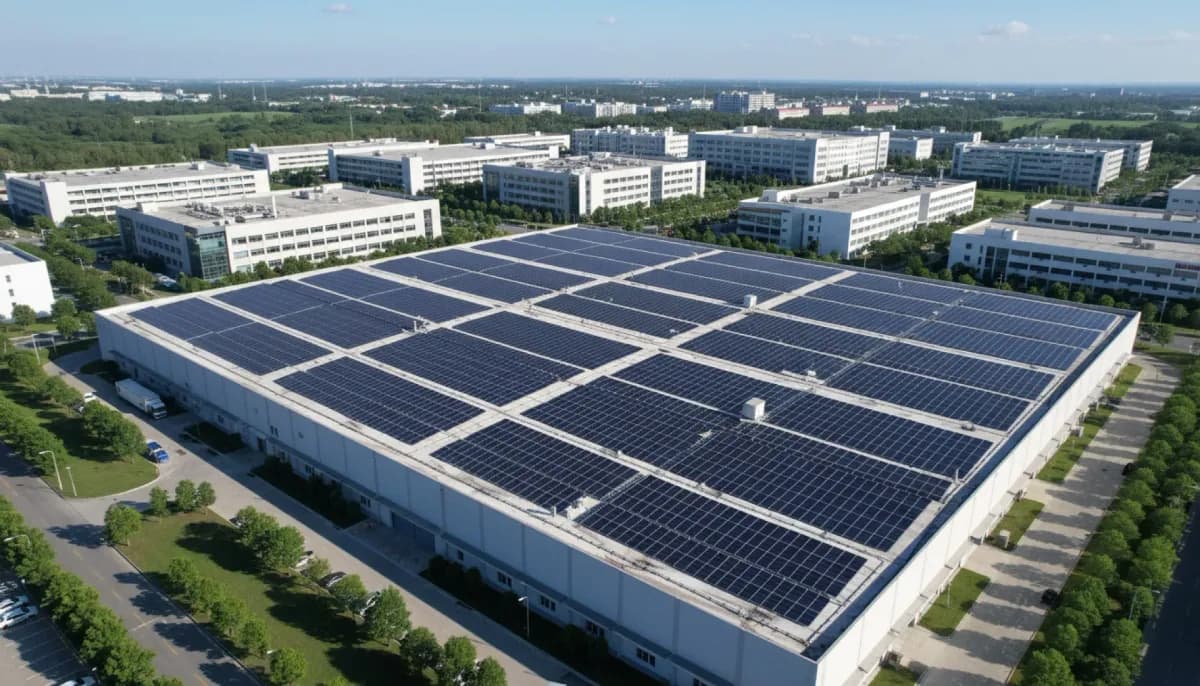
Warehouses often combine large roof areas with daytime electric use. That makes them strong candidates to screen, but not automatically good projects: every advantage below has to be confirmed at the property.
Large surfaces may allow efficient layouts after equipment, access, drainage, fire setbacks, and membrane constraints are mapped.
Aerial and site analysis should quantify shade from trees, neighboring buildings, parapets, and rooftop equipment.
Do not assume a steel warehouse has spare capacity. A licensed engineer must verify the deck, joists, framing, loads, and racking concept.
Warehouse operations (lighting, forklifts, HVAC, refrigeration) align with solar production hours, maximizing self-consumption.
If the actual tariff includes demand charges, interval data can show whether solar or storage coincides with the billed peak.
A roof-fit model can screen larger properties quickly, then engineering and interconnection determine the buildable system size.
The federal Investment Tax Credit remains the most powerful incentive for commercial solar in 2026. Warehouse owners who meet additional criteria can stack bonuses on top of the 30% base credit. Here is how the stacking works:
Base ITC
Prevailing wage + apprenticeship required
Domestic Content Bonus
US-manufactured panels (Silfab, First Solar, Qcells)
Energy Community Bonus
Brownfield, coal closure, or fossil fuel employment area
Low-Income Bonus
Low-income census tract or qualified project
Potential adders are eligibility-dependent
Do not include an adder until its current requirements and project eligibility are documented.
MACRS Bonus Depreciation: 100%, Permanently Restored
Bonus depreciation for commercial solar is 100% in the first year, not 20%. The One Big Beautiful Bill Act permanently restored the full first-year deduction under IRC Section 168(k) for qualifying property acquired and placed in service after January 19, 2025, and IRS Notice 2026-11 confirms it. The 20% figure still circulating comes from the superseded TCJA phasedown that OBBBA replaced.
These inputs must be verified for the property. If a proposal substitutes statewide averages or gross roof area, treat its payback as a marketing illustration—not an investment model.
| Input | What to verify | Why it changes ROI |
|---|---|---|
| Utility bill and interval demand | Serving utility, rate class, supplier contract, demand ratchet, interval load, and export treatment | Determines the avoided energy and demand value; a statewide average cannot replace it |
| Usable roof and production | Roof outline, equipment, access, setbacks, shade, orientation, layout, and site-specific production model | Sets realistic system size and annual generation rather than deriving capacity from gross square footage |
| Roof and structural scope | Membrane condition, warranty, drainage, deck and framing capacity, wind, snow, racking, and reinforcement | Can change usable area, mounting approach, construction scope, insurance, and lifecycle cost |
| Price and financing | Defined equipment, inclusions, allowances, escalation, financing terms, and ownership structure | A headline price per watt is not comparable when scope or financing assumptions differ |
| Incentives and tax treatment | Current eligibility, labor rules, sourcing, adders, depreciation, timing, and taxpayer-specific use | Only verified incentives belong in the investment case; have tax counsel confirm treatment |
The preliminary roof estimator is a fit check, not stamped engineering or a financial quote.
Commercial bills can differ sharply inside the same state. The correct starting point is the serving utility, rate class, interval demand, supplier contract, and export rules for the actual account. Statewide average rates are not used as a substitute.
| State | Utility-specific inputs | Program verification |
|---|---|---|
| MA | Identify the distribution company, rate class, interval demand, and SMART eligibility. | Model SMART, net-metering, tax, and interconnection rules for the specific account. |
| CT | Confirm Eversource or UI territory, rate class, demand ratchet, and interval profile. | Use the current NRES or applicable tariff and project-specific export treatment. |
| RI | Confirm Rhode Island Energy service class, demand charges, and interval usage. | Verify the current renewable-energy and export pathway before pricing revenue. |
| NH | Identify the serving utility or cooperative and the exact commercial tariff. | Check utility-specific export credit, demand treatment, tax, and financing eligibility. |
| NJ | Confirm the electric distribution company, rate class, and interval demand. | Verify the current incentive block and project eligibility rather than using a statewide average. |
| ME | Confirm CMP, Versant, or municipal territory and the account tariff. | Model the current export or procurement pathway for the actual project size. |
| VT | Identify the distribution utility and commercial rate schedule. | Check the utility-specific interconnection and compensation path. |
| PA | Identify the EDC, supplier contract, tariff, and demand profile. | Model utility rules and current market certificate value separately. |
| TX | Identify utility or REP, tariff, contract term, demand charges, and export terms. | Use the site contract and local program; there is no single statewide commercial rate. |
Some commercial tariffs bill both energy use and peak demand. Whether solar reduces that demand charge depends on when the account's billed peak occurs, the tariff's ratchet rules, and how solar production overlaps interval load.
A battery can be evaluated against the same interval model. Its value depends on usable power and energy, controls, efficiency, load shape, tariff rules, operating reserve, degradation, and any grid-services revenue—not a generic percentage assumption.
For a detailed analysis of battery-based peak shaving strategies, see our demand charge battery guide.
The Section 48E begin-construction window closed July 4, 2026: projects that began construction on or before that date may use the longer continuity pathway. Commercial solar projects starting now generally must be placed in service by December 31, 2027. The statutory credit is 6%; it can increase to 30% when the applicable prevailing-wage and registered-apprenticeship requirements are met.
What "begin construction" means: The applicable beginning-of-construction test and continuity requirements depend on project size and facts. Have tax counsel document the relied-on pathway.
FEOC component sourcing: Prohibited-foreign-entity and material-assistance rules are detailed and time dependent. Procurement records should support the specific project claim; a brand name or domestic-content statement alone is not proof.
This guide describes the inputs required for an investment model. It does not publish a statewide-average payback or price-per-watt quote because commercial tariffs, roof scope, interconnection, financing, and incentives are property-specific.
Federal timing and bonus-depreciation copy is rendered from the site's canonical tax facts. Program eligibility still requires current project-level verification and tax advice.
The roof-fit estimate is preliminary. A proposal should replace screening assumptions with a site production model, the actual utility tariff and interval data, engineering, interconnection scope, and documented incentive eligibility.
Last updated: February 2026
There is no responsible warehouse payback number without the actual utility tariff, interval demand, usable roof area, structural and roof scope, production model, financing, and verified incentives. Use the examples on this page to understand the inputs, then run the property and utility-specific analysis before making an investment decision.
Our commercial team will analyze your warehouse roof, energy usage, and incentive eligibility to provide a custom ROI projection.
Free address-based tool
Start with the warehouse address. Confirm the outline, review the preliminary panel fit, then unlock the cost and utility-specific next steps.
No account required to see your roof result