Loading NuWatt Energy...

We use your location to provide localized solar offers and incentives.
We serve MA, NH, CT, RI, ME, VT, NJ, PA, and TX
Loading NuWatt Energy...
NuWatt designs, installs, and manages solar, battery, heat pump, and EV charger systems across 9 states. One company, one warranty, one point of contact.
Get a Free Quote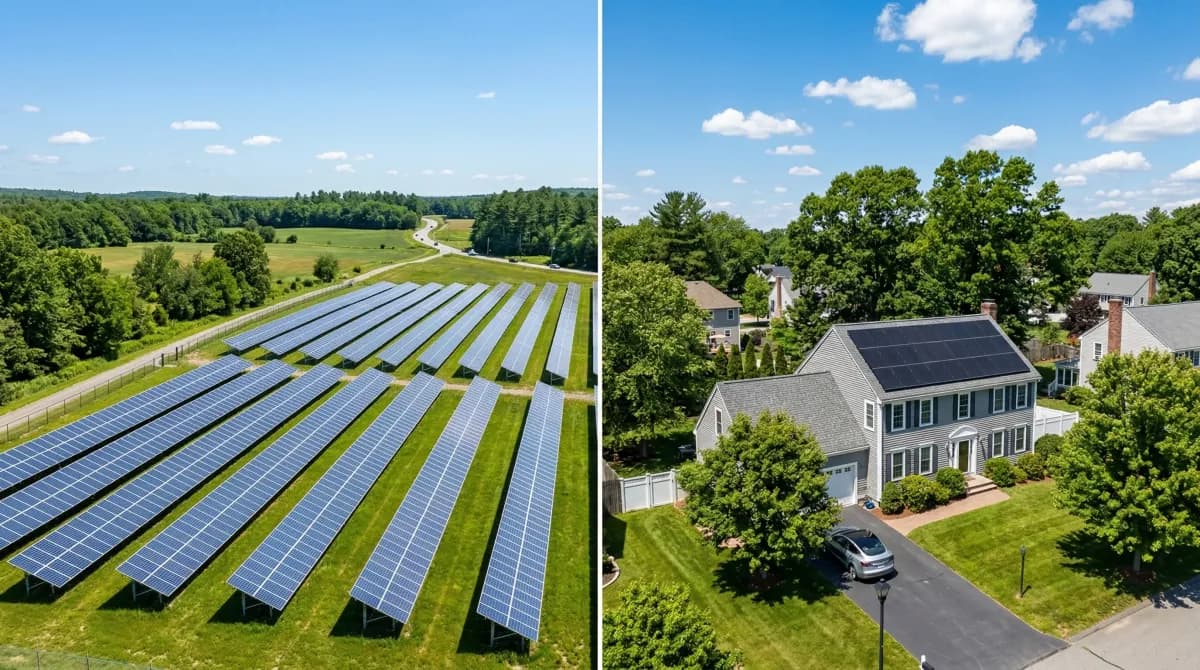
Community solar: no panels, no roof, 5-15% bill savings. Rooftop solar: you own it, 50-90% savings. The right choice depends on your home, budget, and goals.
Quick Answer
Rooftop solar saves more money (50-90% of your bill vs. 5-15% for community solar) and adds $15,000-$25,000 to your home value. Community solaris better if you rent, have a shaded/old roof, live in a condo, or don't want upfront costs. In 2026 with no federal residential tax credit, rooftop costs $18,000-$35,000 upfront but pays back in 7-12 years. Community solar costs $0 upfront but saves far less over time.
Panels on your roof, power for your home
Subscribe to a share of an off-site solar farm
Every factor that matters, compared head-to-head.
| Feature | Rooftop Solar | Community Solar |
|---|---|---|
| Upfront cost | $18,000-$35,000 (or $0 with lease/PPA) | $0 |
| Monthly savings | 50-90% of electric bill | 5-15% of electric bill |
| 25-year total savings | $40,000-$80,000 | $3,000-$10,000 |
| Ownership | You own the system (cash/loan) or lease it | You subscribe — no ownership |
| Roof required | Yes — south-facing, good condition, no shade | No |
| Maintenance | Minimal (you or installer handles) | None — farm operator handles everything |
| Battery backup | Yes — add a battery for outage protection | No — no on-site equipment |
| Moving/portability | Stays with the house (increases value) | Cancel or transfer subscription |
| Credit score needed | 640+ for loans; none for cash | Usually none |
| Timeline to start | 2-4 months (design, permit, install) | 1-4 weeks (sign up, wait for allocation) |
| Home value impact | +$15,000-$25,000 (LBNL study) | None |
| Federal tax credit | $0 (25D expired). Lease/PPA: 30% to owner under 48E | Typically included in lower rate |
Within community solar, there are two distinct models. Understanding the difference matters for your long-term economics.
You buy a share of the solar farm (typically $2,000-$5,000) and own that share for 20-25 years. Credits are applied to your bill based on actual production. Over time, your upfront investment pays for itself and then produces pure savings.
You subscribe to a share and pay a monthly rate that is typically 5-15% below what you would pay the utility for the same electricity. No upfront cost, but your savings are locked at that discount percentage for the contract term (usually 12-25 months).
No roof access. Community solar works with just a utility account. No landlord permission needed.
Trees, dormers, or north-facing angles make rooftop unviable. Community solar captures energy off-site.
HOA restrictions, shared roof, or no direct roof ownership. Community solar bypasses all of these.
Historic district rules may prohibit roof-mounted panels. Community solar is invisible to the building.
Cannot afford $18,000-$35,000 for rooftop and don't qualify for financing. Community solar is $0 down.
If you plan to move within 3-5 years, community solar's flexibility beats rooftop's long payback period.
$0 down. Fixed payments. Ownership option after year 5. No dealer fees. No prepayment penalty.
Homeowners capture the full long-term savings ($40,000-$80,000 over 25 years) and the home value boost.
South-facing roof, minimal shade, and a roof with 10+ years of life left. Ideal rooftop candidate.
Rooftop saves 50-90% on electricity vs. 5-15% for community solar. Not even close on total savings.
Only rooftop solar pairs with a home battery for outage protection. Community solar has no on-site equipment.
Solar + heat pump is the ultimate electrification package. Community solar can't power your heat pump during an outage.
Rooftop payback is 7-12 years. After that, it's pure profit. The longer you stay, the more you save.
Community solar availability varies widely by state. Rooftop solar is available everywhere, but incentive levels differ.
| State | Rooftop | Community | Notes |
|---|---|---|---|
| Massachusetts | Both strong. Community solar via Eversource/NGrid. Rooftop with SMART 3.0 and net metering. | ||
| Maine | NEB community solar through CMP/Versant. Rooftop net metering available. | ||
| Rhode Island | Community solar and REG program. Strong rooftop net metering. | ||
| New Hampshire | Rooftop only. Community solar legislation pending (anticipated 2026). | ||
| Connecticut | Shared clean energy facilities exist but are limited. Strong rooftop programs. | ||
| Vermont | GMP community solar + strong net metering. Both options available. | ||
| New Jersey | CSEP community solar program. Strong ADI/SREC-II rooftop incentives. | ||
| New York | Largest community solar market in the US. Strong NYSERDA rooftop incentives. | ||
| Texas | Rooftop only. Deregulated market, no community solar program. |
In some states, yes. If your rooftop solar system offsets 70% of your electricity usage, you can subscribe to community solar for the remaining 30%. This makes sense when:
Important: In most states, net metering credits from rooftop solar are more valuable per kWh than community solar credits. Always maximize your rooftop system first, then use community solar for the remainder.
Community solar lets you subscribe to a share of a larger, off-site solar farm and receive credits on your electric bill for the energy your share produces. You pay nothing upfront, sign up online, and typically save 5-15% on your monthly electricity costs. The solar farm is usually located within your utility territory. You never own any panels — you are essentially buying discounted electricity.
Community solar typically saves 5-15% on your electric bill — roughly $10-$30/month for an average New England home. Rooftop solar saves 50-90% ($100-$250/month) because you generate your own electricity and avoid the utility markup entirely. Over 25 years, rooftop solar saves $40,000-$80,000 while community solar saves $3,000-$10,000. Rooftop provides much larger savings but requires upfront investment.
Yes. Community solar is one of the few solar options available to renters. Since no panels are installed on your property, you just need a utility account in the service territory. When you move, you can transfer your subscription or cancel it (depending on contract terms). Community solar is available for renters in Massachusetts, Maine, Rhode Island, New Jersey, New York, and several other states.
In some states, yes. If your rooftop system does not offset 100% of your usage, you can subscribe to community solar for the remaining electricity. Massachusetts and New York allow this. However, the economics are less compelling since net metering credits from rooftop solar are usually more valuable than community solar credits.
Legitimate community solar programs are not scams — they are regulated by state public utility commissions. However, some door-to-door and telemarketing operations use aggressive tactics, lock-in contracts, and unclear escalator clauses. Always verify the company is listed with your state energy office, read the full contract, and confirm there are no upfront fees. If it sounds too good to be true, it probably is.
Owned rooftop solar transfers to the new owner and typically increases home value by $15,000-$25,000 (Lawrence Berkeley National Lab data). Leased rooftop solar may complicate the sale — the buyer must qualify for the lease transfer or you must buy out the remaining term. Community solar subscriptions can usually be canceled or transferred when you move.
Most community solar programs do not require a credit check for subscription. You just need a utility account in good standing. This makes community solar accessible to people who cannot qualify for solar loans. Rooftop solar financing typically requires a 640+ credit score for favorable loan terms.
Both displace fossil fuel generation equally per kWh produced. A rooftop system offsets more of your personal consumption (50-100% vs. 5-15% for community solar), so the total environmental impact of going rooftop is larger for an individual household. However, community solar makes solar accessible to millions who cannot install rooftop panels — expanding the total amount of renewable energy on the grid.
NuWatt can evaluate your home for rooftop solar or connect you with community solar options in your area. Free assessment, no pressure.