Loading NuWatt Energy...

We use your location to provide localized solar offers and incentives.
We serve MA, NH, CT, RI, ME, VT, NJ, PA, and TX
Loading NuWatt Energy...
NuWatt designs, installs, and manages solar, battery, heat pump, and EV charger systems across 9 states. One company, one warranty, one point of contact.
Get a Free QuoteAuxiliary heat vs emergency heat — the difference between a normal $300 January bill and a shocking $900 one. How to check if your heat pump is running aux heat, what triggers it, and how to stop it from draining your wallet.
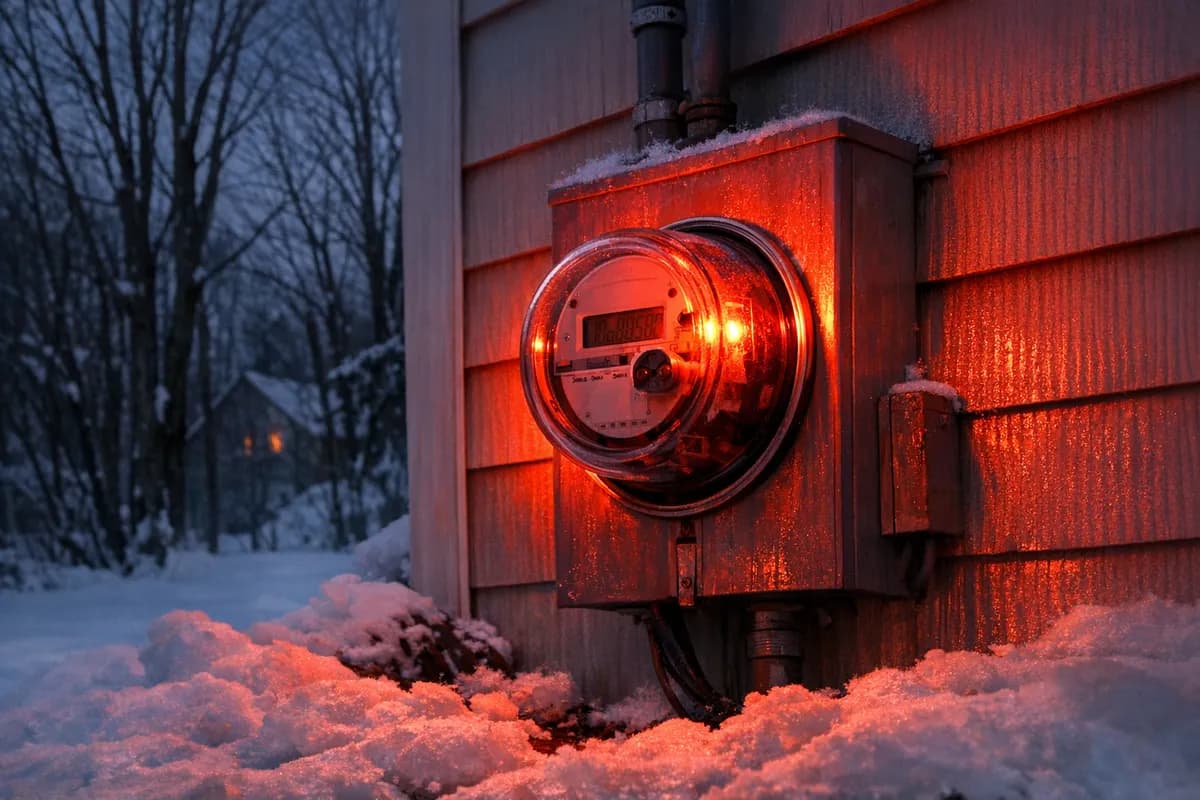
A heat pump running normally at COP 3.0 costs about $280-$350/month in a Connecticut January. The same home with auxiliary or emergency heat running constantly hits $800-$950/month. The culprit is almost always: large thermostat setbacks, an accidentally-engaged “Emergency Heat” setting, or an undersized system. The good news — most of these are fixable today.
They both use electric resistance strips, but the way they work — and what they cost — is very different.
Auxiliary Heat (AUX) | Emergency Heat (EM HEAT) | |
|---|---|---|
| What it is | Backup electric strips that ASSIST the heat pump when it can't keep up alone | Electric strips running INSTEAD of the heat pump (compressor OFF) |
| When it activates | Automatically — during recovery from setbacks, extreme cold, or defrost cycles | Manually — homeowner switches thermostat to "Emergency Heat" (or compressor failure) |
| Heat pump compressor | Still running (heat pump + strips together) | OFF — only electric strips are heating |
| Effective COP | 1.5-2.0 (blended — heat pump + strips) | 1.0 (pure electric resistance) |
| Electricity draw | 5-15 kW (heat pump 2-5 kW + strips 5-10 kW) | 5-15 kW (strips only, no compressor savings) |
| Monthly cost impact at $0.27/kWh | +$50-$150/month if running frequently | +$150-$300/month if left on |
| Thermostat indicator | "AUX" light on thermostat display | "EM HEAT" or "EMER" on display |
| When it's appropriate | Brief periods during extreme cold — self-corrects as temperature rises | ONLY when the outdoor unit has completely failed and you need heat until repair |
Typical 2,000 sq ft CT home, 3-ton heat pump, Eversource $0.33/kWh.
Hartford, central/eastern CT — $0.27/kWh
New Haven, Bridgeport, SW CT — $0.28/kWh
Most homeowners can cut aux heat hours by 70-90% with these changes.
Keep set point within 2°F of target at all times. No deep setbacks. This alone eliminates most unnecessary aux heat.
Potential savings: $200-$600/winter
Ecobee and Honeywell T10 Pro can lock out aux heat above a set outdoor temperature (e.g., 35°F). Energize CT $50 rebate available.
Potential savings: $200-$400/winter
An undersized heat pump triggers aux heat constantly. A Manual J load calculation ensures correct sizing for your CT home.
Potential savings: $300-$800/winter
CT homes lose 25-40% of heat through air leaks. Energize CT Home Energy Solutions (HES) audit identifies and fixes leaks for $50-$100.
Potential savings: $150-$400/winter
Dirty filters restrict airflow, reducing heat pump efficiency and making the system work harder to reach set point.
Potential savings: $50-$150/winter
Blocked airflow forces defrost cycles, during which aux heat may run to maintain indoor comfort.
Potential savings: $50-$200/winter
Low refrigerant, dirty coils, or a failing defrost board all increase aux heat reliance. Fall checkup catches these before winter.
Potential savings: $100-$300/winter
Emergency heat should only be used during an actual outdoor unit failure. If someone accidentally switched it on, switch back to "Heat" immediately.
Potential savings: $300-$700/month
Don’t panic every time you see “AUX” on your thermostat. Brief auxiliary heat activation is expected in these scenarios:
During defrost, aux strips run 2-10 minutes to maintain indoor comfort while the heat pump melts outdoor coil frost.
Below 10-15°F for several hours, even a properly-sized system may need brief aux heat assistance. This is normal in northwest CT.
When the system first starts after being off, it may briefly use aux heat to bring the space up to temperature.
Strong CT winter winds increase heat loss. The system may call for brief aux heat assistance during gusty conditions.
The most common cause is auxiliary or emergency heat running on your heat pump system. Auxiliary heat strips draw 5-15 kW of electricity at COP 1.0, compared to the heat pump's COP 3.0. At Connecticut's $0.27-$0.28/kWh rate, this triples your heating cost per BTU. Common triggers include large thermostat setbacks (5°F+), an undersized system, a stuck "Emergency Heat" setting, or a failing outdoor unit. Check your thermostat for "AUX" or "EM HEAT" indicators.
Auxiliary (AUX) heat means electric resistance strips are running alongside your heat pump compressor — the system uses both to meet demand. Emergency (EM HEAT) heat means the compressor is OFF and only the electric strips are running. Auxiliary heat activates automatically during extreme cold or recovery from setbacks. Emergency heat is manually selected via the thermostat and should only be used when the outdoor unit has failed. Both are expensive, but emergency heat is the most costly because you lose all compressor efficiency.
At Eversource's $0.33/kWh, auxiliary heat strips running at 10 kW cost $2.70/hour. If they run 4 hours per day during recovery from setbacks, that's $10.80/day or $324/month extra. Compare this to normal heat pump operation costing roughly $0.90/hour for the same heat output. Over a full Connecticut winter (November-March), unnecessary aux heat use can add $500-$1,800 to your electric bills.
Check your thermostat display for "AUX" or "AUX HEAT" text. This appears when the electric resistance strips are active. You can also check your Eversource or UI online account for daily usage spikes — normal heat pump winter usage is 30-50 kWh/day, while frequent aux heat pushes it to 70-120+ kWh/day. If your outdoor unit is silent but indoor vents blow warm air, you're on emergency heat only.
Only when the outdoor heat pump unit has completely failed — the compressor won't start, the outdoor fan isn't running, or you see/hear clear signs of mechanical failure. Emergency heat keeps your home warm while you wait for repair. Once the outdoor unit is fixed, immediately switch back to normal "Heat" mode. Never use emergency heat as a convenience setting; it costs 3x more than normal operation.
Yes. Smart thermostats like the Ecobee Premium and Honeywell T10 Pro offer auxiliary heat lockout features. You set an outdoor temperature threshold (e.g., 35°F) — above that temperature, the thermostat prevents aux heat from activating. They also use intelligent recovery to gradually raise temperature without triggering aux heat. Energize CT offers a $50 rebate on qualifying smart thermostats.
Brief auxiliary heat activation during extreme cold (below 15-20°F for extended periods) is normal for most heat pump systems. The heat pump is still running — aux heat just supplements it. This should be occasional, not constant. If aux heat runs all day even when outdoor temperatures are above 30°F, something is wrong: the system may be undersized, low on refrigerant, or have a failed component.
The difference is small: Eversource at $0.33/kWh vs United Illuminating at $0.28/kWh. For a 10 kW aux heat strip running 100 hours per winter, that's $270 (Eversource) vs $280 (UI) — a $10 difference. The real cost driver is how OFTEN aux heat runs, not which utility you have. Both utilities participate in Energize CT programs with the same rebates for heat pumps and smart thermostats.