Loading NuWatt Energy...

We use your location to provide localized solar offers and incentives.
We serve MA, NH, CT, RI, ME, VT, NJ, PA, and TX
Loading NuWatt Energy...
NuWatt designs, installs, and manages solar, battery, heat pump, and EV charger systems across 9 states. One company, one warranty, one point of contact.
Get a Free QuoteSet-and-forget 68°F in winter. Don’t use large setbacks — they trigger expensive auxiliary heat at 3x the cost. Smart thermostat comparison and Energize CT $50 rebate.
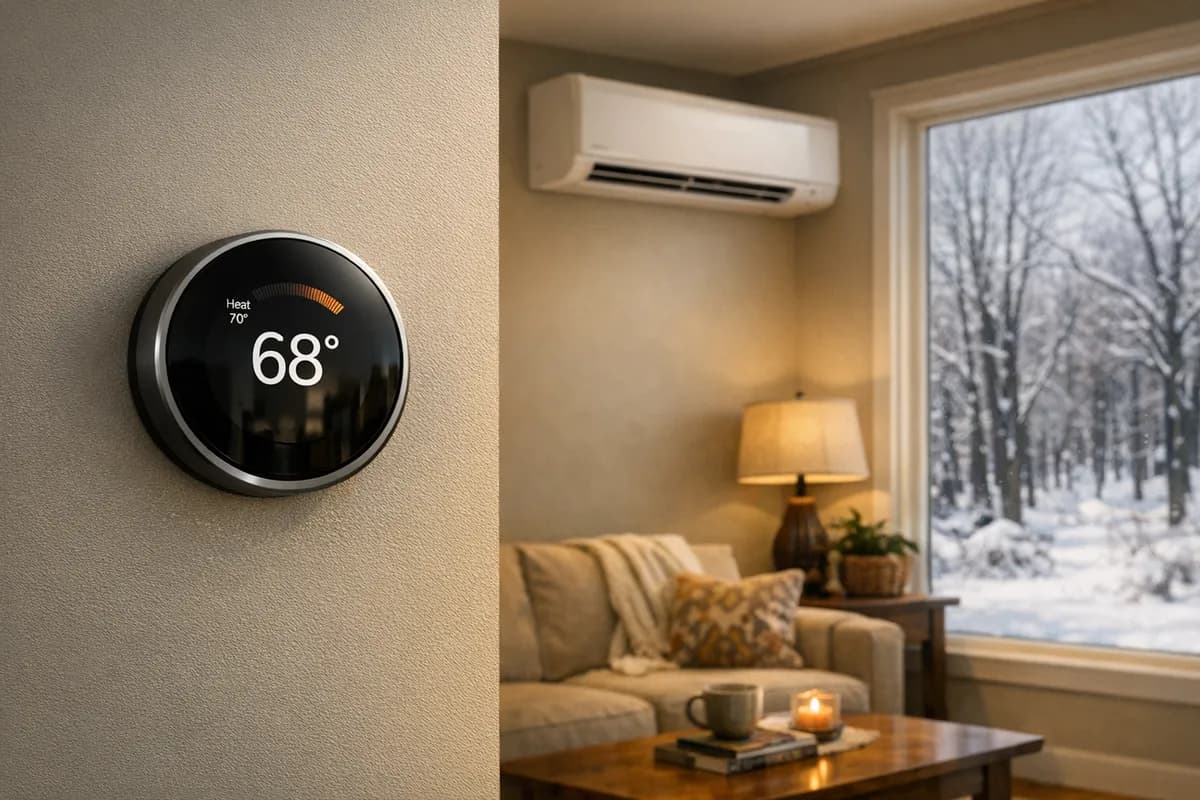
Treating your heat pump thermostat like a gas furnace thermostat. With gas, large setbacks save money because the furnace recovers fast and cheap. With a heat pump, large setbacks trigger auxiliary electric resistance heat at COP 1.0— three times more expensive than heat pump operation at COP 3.0. At Connecticut’s $0.27/kWh, this means paying $0.08/kWh of useful heat instead of $0.027/kWh. A 10°F setback can add $80-$180/month to your winter electric bill.
Connecticut’s climate demands different strategies for each season. The key principle: keep heat pump temperature changes small and gradual.
Large setbacks (5°F+) force the system to recover quickly, triggering expensive auxiliary/emergency heat strips at COP 1.0 instead of heat pump COP 3.0.
Heat pumps cool efficiently at moderate set points. Running colder than needed increases runtime and energy use disproportionately.
CT shoulder seasons have wide temperature swings. Set a 3-4°F deadband between heating and cooling set points to prevent unnecessary cycling.
Based on a typical 2,000 sq ft CT home with a 3-ton heat pump system. Eversource/UI rate: $0.33/kWh. Aux heat strips: 10 kW.
| Scenario | Night Drop | Aux Heat Hours | Extra Cost/mo | Annual Heat Cost | Rating |
|---|---|---|---|---|---|
| Set-and-forget at 68°F | 0°F | ~0 hrs/winter | $0 | $1,100-$1,400 | Optimal |
| Small setback to 66°F at night | 2°F | ~5 hrs/winter | $3-$8 | $1,130-$1,460 | Acceptable |
| Moderate setback to 62°F at night | 6°F | ~40 hrs/winter | $25-$55 | $1,350-$1,700 | Avoid |
| Deep setback to 58°F (away all day) | 10°F | ~120+ hrs/winter | $80-$180 | $1,800-$2,500 | Costly |
Estimates based on Eversource/UI $0.33/kWh. Heat pump COP 3.0, aux heat COP 1.0. Actual costs vary by home insulation, system size, and outdoor temperatures.
Your heat pump’s Coefficient of Performance (COP) is the ratio of heat delivered to electricity consumed. A COP of 3.0 means for every 1 kWh of electricity, the heat pump delivers 3 kWh of heat by moving warmth from outdoor air.
Connecticut’s electric rates ($0.33-$0.28/kWh for Eversource and UI) are among the highest in the country. This makes the COP 3.0 vs COP 1.0 difference especially painful. A homeowner running aux heat for 4 hours on a cold January morning after a deep setback pays roughly $10-$15 extra for that single recovery event. Repeated daily over a Connecticut winter, that adds up to $600-$1,800 in unnecessary costs.
Not all smart thermostats are created equal for heat pumps. Look for auxiliary heat lockout, compressor protection, and heat pump balance features.
| Thermostat | HP Aware | Aux Lockout | Compressor Protect | Price | CT Rebate | Best For |
|---|---|---|---|---|---|---|
| Ecobee Premium | $220-$250 | $50 | Best overall for heat pumps. Room sensors included. True aux heat lockout by temperature. | |||
| Ecobee Smart Thermostat Enhanced | $170-$190 | $50 | Same heat pump intelligence as Premium, fewer smart-home extras. Best value. | |||
| Google Nest Learning (4th Gen) | $250-$280 | $50 | Good learning capability but limited aux heat lockout. Nest "Heat Pump Balance" setting helps. | |||
| Honeywell T10 Pro | $180-$220 | $50 | Pro-grade thermostat with installer-configurable aux lockout. Requires professional setup. | |||
| Emerson Sensi Touch 2 | $120-$150 | $50 | Budget-friendly option. Decent heat pump support but no advanced aux lockout. |
"Turn it way down when you leave for work to save money"
With a heat pump, a 10°F setback triggers aux heat strips on recovery, costing MORE than keeping it steady. Aux heat at COP 1.0 costs 3x as much per BTU as the heat pump at COP 3.0.
"Programmable thermostat setbacks always save energy"
True for gas furnaces and oil boilers, FALSE for heat pumps. Gas furnaces recover quickly at high efficiency. Heat pumps recover slowly and may activate expensive backup heat.
"My old thermostat works fine with my new heat pump"
Old single-stage thermostats can't manage aux heat lockout, compressor protection, or variable-speed control. A heat-pump-aware smart thermostat is critical for efficiency.
"Setting it to 72°F heats faster than 68°F"
Heat pumps deliver the same BTU output regardless of set point. Setting 72°F doesn't heat faster, it just runs longer and is more likely to trigger aux heat.
Pro tip: Pair the $50 thermostat rebate with a heat pump installation. An Ecobee with aux heat lockout typically saves $200-$400/year vs a standard thermostat, paying for itself in under 6 months even without the rebate.
Set your thermostat to "Heat Pump" mode (not "Gas" or "Oil"). This ensures the compressor runs first and aux heat is only backup.
If your thermostat supports it, set aux heat lockout to 35-40°F outdoor temperature. Above this threshold, the heat pump handles the load alone. Below it, aux heat can assist.
Set night temperature 1-2°F below daytime. For a 68°F day setting, program 66-67°F at bedtime. NEVER program more than a 3°F setback.
For shoulder seasons, set at least 3-4°F between heating and cooling set points (e.g., heat at 68°F, cool at 72°F).
Set minimum compressor off-time to 5 minutes. This prevents short-cycling that damages the compressor and reduces efficiency.
If your thermostat has "Smart Recovery" or "Intelligent Recovery," enable it. This feature gradually adjusts temperature before your scheduled change, avoiding aux heat.
The optimal setting is 68°F during the day and 66-67°F at night. Never drop more than 2-3°F at once. Large setbacks trigger auxiliary/emergency heat strips at COP 1.0, which costs 3x more per BTU than the heat pump at COP 3.0. At Connecticut's $0.27/kWh rate, auxiliary heat costs ~$0.08/kWh of useful heat vs ~$0.027/kWh for heat pump operation.
When you raise the thermostat by 5°F or more, the system detects a large gap between room temperature and set point. To recover quickly, it activates auxiliary (electric resistance) heat strips. These strips draw 5-15 kW and operate at COP 1.0 compared to your heat pump's COP 3.0. The result is 3x higher electricity consumption per unit of heat until the set point is reached.
The Ecobee Premium and Ecobee Smart Thermostat Enhanced are the best choices for Connecticut heat pump homes. Both offer true auxiliary heat lockout by outdoor temperature, compressor protection timers, and room sensors. They prevent unnecessary aux heat activation during recovery. Energize CT offers a $50 rebate on qualifying smart thermostats.
Yes. Energize CT offers a $50 rebate on qualifying ENERGY STAR smart thermostats for Eversource and United Illuminating customers. Eligible models include Ecobee, Google Nest, Honeywell, and Emerson Sensi thermostats. The rebate is applied instantly at participating retailers or claimed online after purchase.
Only in a true emergency when the heat pump outdoor unit has failed. Emergency heat bypasses the heat pump entirely and runs only the electric resistance strips at COP 1.0. At $0.27/kWh, emergency heat costs approximately $180-$250/month more than normal heat pump operation for a typical CT home. If your heat pump is working, never switch to emergency heat.
Set a 3-4°F deadband between your heating and cooling set points during shoulder seasons. For example, heat at 68°F and cool at 72°F. This prevents the system from cycling between heating and cooling modes during CT's variable spring and fall weather, which wastes energy and puts unnecessary wear on the compressor.
While some old thermostats are physically compatible, they lack critical heat-pump-specific features: auxiliary heat lockout by outdoor temperature, compressor protection timers, variable-speed control, and intelligent recovery. A heat-pump-aware smart thermostat like the Ecobee or Honeywell T10 Pro can save $200-$400/year by preventing unnecessary aux heat activation.
Set to 60-62°F minimum to prevent pipe freezing. Do NOT turn the heat off entirely. Even at 60°F, the heat pump will operate at COP 3.0 during mild periods. When you return, raise the temperature by only 2°F every 30-60 minutes to avoid triggering aux heat during recovery. A smart thermostat can automate this gradual warmup.