Loading NuWatt Energy...

We use your location to provide localized solar offers and incentives.
We serve MA, NH, CT, RI, ME, VT, NJ, PA, and TX
Loading NuWatt Energy...
NuWatt designs, installs, and manages solar, battery, heat pump, and EV charger systems across 9 states. One company, one warranty, one point of contact.
Get a Free QuoteCombine solar carports with EV charging infrastructure for the ultimate CT commercial energy project. Stack the Section 48/48E ITC (30-70%) on solar with CT sales- and property-tax exemptions. Finance 100% through CT Green Bank C-PACE. Add battery storage for demand charge management and maximize revenue.
Solar ITC
30-70%
CT Sales Tax Exempt
6.35%
C-PACE Available
100%
Net Metering
Up to 2 MW
CT solar carport + EV charging projects can stack: Section 48/48E ITC (30-70% of solar carport cost), CT Green Bank C-PACE 100% financing, CT sales tax exemption (6.35% on solar), CT property tax exemption (100% on solar), CT DEEP EV charger incentives, and MACRS 100% first-year bonus depreciation (permanent under OBBBA). A typical 200 kW carport + EV project at $680,000 can achieve net effective cost of ~$335,000 with 4.4-year payback. The federal Section 30C EV charger credit expired June 30, 2026 and is no longer available for new installs.
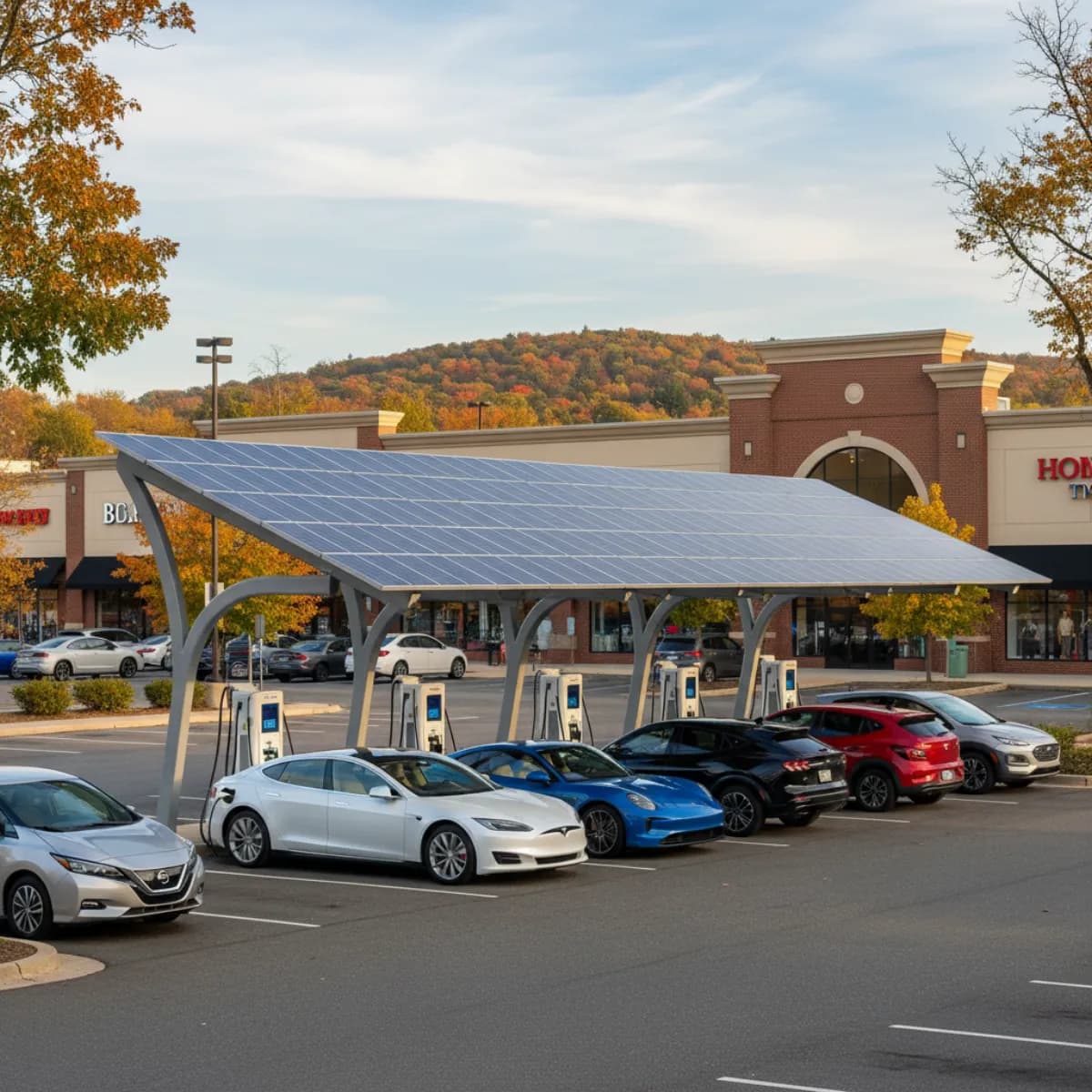
Solar carports and EV charging are a natural pairing. The carport structure provides covered parking while generating clean electricity. EV chargers utilize that electricity on-site, reducing grid dependence and increasing the economic value of your solar investment. In Connecticut, this combination unlocks a uniquely powerful incentive stack that neither component achieves alone.
The Section 48/48E ITC covers the solar generation system including the carport structure at 30-70%. (The federal Section 30C EV charger credit expired June 30, 2026 and is no longer available for new installations.) CT Green Bank C-PACE finances 100% of both components. CT's 6.35% sales tax exemption and 100% property tax exemption apply to the solar component. Combined with MACRS 100% first-year bonus depreciation (permanent under OBBBA) on the solar system, the effective cost of the bundled project drops dramatically.
Connecticut's EV adoption is accelerating, driven by the CHEAPR purchase rebate program and state clean vehicle mandates. CT has committed to 100% zero-emission vehicle sales by 2035. Commercial properties with EV charging infrastructure are increasingly viewed as premium by tenants, employees, and customers. Adding solar-powered EV charging positions your property for this transition while generating immediate financial returns.
Net metering at retail rate for systems up to 2 MW means any solar production not consumed by EV charging or building loads earns full credit on your Eversource CT or United Illuminating bill. At CT's average blended commercial rate of $0.27-$0.30/kWh, net metering credits are highly valuable.
Seven incentives that stack to reduce your effective project cost by 50-65%.
Base 30% ITC for the solar generation component (panels, inverters, racking). Bonus adders for domestic content (+10%), energy community (+10%), and low-income (+10-20%). The carport structure itself qualifies as part of the solar installation cost basis when it is integral to the solar system.
The federal Alternative Fuel Vehicle Refueling Property Credit expired June 30, 2026 and is no longer available for new installations. Through mid-2026 it covered up to 30% of EV charger equipment and installation costs (6% without prevailing wage and apprenticeship), capped at $100,000 per charging port, for property in a low-income or non-urban census tract. Projects placed in service on or before that date can still claim it on IRS Form 8911; CT projects deploying now rely on the ITC, C-PACE, and CT DEEP EV programs above.
CT Green Bank C-PACE covers both solar carport and EV charging infrastructure. 100% financing with no upfront cost, repaid via property tax over 20-25 years. Both solar and EV components are eligible improvements under the CT C-PACE program.
Connecticut Hydrogen and Electric Automobile Purchase Rebate supports EV adoption by providing purchase incentives. While this benefits vehicle purchasers (not charger owners), it drives EV adoption and increases charger utilization. Employers can promote CHEAPR to employees as part of a solar carport + EV charging workplace benefit.
CT Department of Energy and Environmental Protection (DEEP) administers EV infrastructure incentive programs funded by the VW settlement and federal NEVI formula funding. Programs target public-facing chargers and workplace charging. Check CT DEEP for current application windows.
Connecticut exempts solar energy equipment from the 6.35% state sales tax. On a $500,000 solar carport system, this saves $31,750 immediately. EV charger equipment is taxable — only the solar component receives this exemption.
Solar energy systems in CT are 100% exempt from property tax assessment. The solar carport adds $0 to your assessed property value regardless of installation cost. With CT commercial property tax rates of 2.0-3.5%, this saves thousands annually.
Choosing the right charger type depends on your use case, dwell time, and budget.
7.2-19.2 kW per port
50-350 kW per port
Electrical Service Note: DCFC stations typically require 480V 3-phase service with 100-400A capacity. Many CT commercial properties have adequate service for L2 chargers but may require a service upgrade for DCFC. Factor $25,000-$75,000 for service upgrades if needed. Design the electrical panel with spare capacity for future charger expansion — adding circuits during construction costs 80% less than retrofitting.
Three approaches to EV charging monetization — choose based on your property type and goals.
Offer free EV charging as an employee benefit or customer amenity. Solar carport offsets electricity cost.
Advantages
Considerations
Best for: Employers, upscale retail, medical offices
Charge users per kWh or per session via networked chargers. CT allows per-kWh billing for EV chargers.
Advantages
Considerations
Best for: Public-facing retail, parking garages, gas stations
Provide free L2 charging as an amenity and monetize DCFC for rapid charging. Balances goodwill with revenue.
Advantages
Considerations
Best for: Shopping centers, mixed-use developments, municipal lots
DC fast chargers create significant demand spikes that can dramatically increase your commercial electricity bill. A single 50 kW DCFC operating at full power creates a 50 kW demand charge — at CT commercial demand rates of $8-$18/kW/month, that is $400-$900/month in demand charges from a single charging session.
Battery storage systems (typically 100-200 kWh for mid-size carport installations) sit between the grid and the EV chargers, buffering demand spikes. When an EV plugs in, the battery supplements grid power, reducing the peak demand the utility sees. A well-sized battery system can reduce DCFC-related demand charges by 30-60%.
Additionally, battery storage enables solar time-shifting. Solar carports produce peak power from 10 AM to 3 PM, but EV charging demand often peaks from 4-7 PM (employees leaving work, evening retail traffic). Battery storage bridges this gap, storing midday solar production for late afternoon EV charging demand, increasing self-consumption and reducing grid purchases.
Southern CT retail plaza, Eversource territory
Solar carport design must integrate with existing parking lot layouts, traffic flow patterns, and ADA accessibility requirements. Standard carport spans cover 2-3 parking rows (typically 36-54 feet) with column spacing of 18-20 feet between support posts. Minimum clearance height is 14 feet 6 inches for fire truck access in most CT municipalities.
ADA requirements for EV charging stations specify that accessible spaces must include an 11-foot minimum width with a 5-foot access aisle, a firm and level surface, an accessible route from the charging station to the building entrance, controls mounted at 15-48 inches height, and clear signage. For CT commercial properties, plan for at least 1 ADA-accessible EV charging space per 25 total charging spaces.
Drainage must be maintained — solar carport canopies redirect rainwater that previously fell on open pavement. Integrate gutters and downspouts into the carport design to channel water to existing drainage infrastructure. CT stormwater management regulations may require retention or treatment of redirected runoff for larger installations.
Calculate carport ROI with ITC, MACRS, and C-PACE
Complete guide to commercial solar incentives
100% financing via CT Green Bank
Model battery ROI for demand charge reduction
Yes. The Section 48/48E Investment Tax Credit covers the full cost of a solar carport installation, including the carport structure itself when it is integral to the solar energy system. The IRS has ruled that structural components necessary for the solar installation (racking, canopy structure, foundations) are part of the eligible cost basis. For a CT solar carport, this means the 30% base ITC (plus bonus adders up to 70%) applies to panels, inverters, racking, and the carport structure. Only components with independent utility (e.g., lighting, signage) are excluded.
NuWatt designs and installs solar carports with integrated EV charging for Connecticut commercial properties. We handle ITC, C-PACE, and all CT incentive applications.