Loading NuWatt Energy...

We use your location to provide localized solar offers and incentives.
We serve MA, NH, CT, RI, ME, VT, NJ, PA, and TX
Loading NuWatt Energy...
NuWatt designs, installs, and manages solar, battery, heat pump, and EV charger systems across 9 states. One company, one warranty, one point of contact.
Get a Free Quote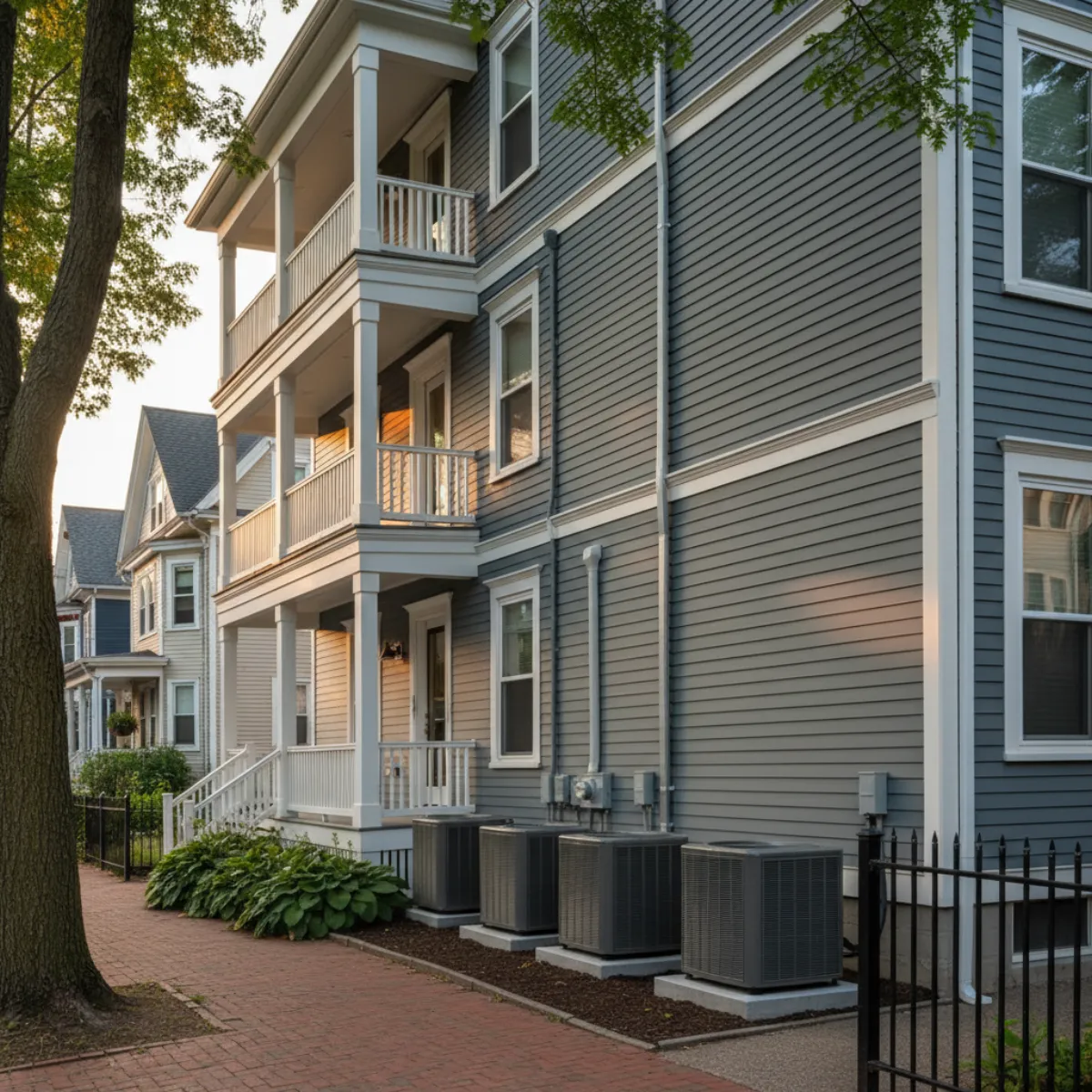
A Cambridge triple-decker needed quiet cooling, tenant-by-tenant control, and heating electrification without tearing open finished walls. The design used ductless zoning, careful outdoor-unit placement, and clean exterior line-set routing.
Mini-splits work well in Cambridge triple-deckers when each floor and bedroom load is modeled separately. This case used 7 indoor zones across 3 floors, 2 outdoor units, quiet placement away from neighboring windows, and a phased backup strategy so tenants could adopt heat pump heating without losing steam heat resilience.
| Category | Project Detail | Why It Matters |
|---|---|---|
| Home type | Three-family triple-decker, 3 floors | Sets the envelope, duct, and zoning constraints. |
| Previous heating | Gas steam heat with window AC | Determines fuel-switching economics and backup strategy. |
| Equipment | Mitsubishi Hyper-Heat ductless multi-zone | Cold-climate equipment selection affects winter performance. |
| Capacity and zones | 3.5 tons, 7 zones | Shows whether the project is room-level or whole-home. |
| Rebate pathway | Partial-home or phased whole-home pathway by dwelling unit | Rebate rules vary by state, utility, equipment, and project scope. |
| Cost range | $31,000-$39,000 before rebates | Useful for comparing quote reasonableness. |
| Net cost range | $22,500-$30,500 after standard rebate target | Shows cost after standard rebate target, before final approval. |
| Estimated savings | $1,600-$2,400 | Modeled operating-cost impact, not a guarantee. |
Triple-deckers rarely have one clean load profile. Top floors overheat in summer, lower floors hold cold, and middle floors are affected by both.
Outdoor units had to fit within a narrow urban lot without sending defrost noise toward bedroom windows.
Routing refrigerant lines through finished apartments required a plan that preserved interior finishes.
Tenant education mattered because heat pumps work best with steady setpoints instead of deep setbacks.
NuWatt designed separate zones for living areas and bedrooms, allowing each apartment to control comfort independently.
Outdoor units were placed on vibration-isolated stands with service clearances and snow clearance.
Line-set covers were routed vertically on the least visible elevation to keep the facade clean.
A commissioning walkthrough covered filter cleaning, remote control schedules, and backup heat settings.
| Decision | Reason | Field Note |
|---|---|---|
| Use ductless zoning instead of ducted retrofit | Ductwork would have required major demolition and reduced ceiling height. | In finished triple-deckers, ductless often has the best comfort-to-disruption ratio. |
| Split floors across two outdoor units | This kept refrigerant runs manageable and avoided overloading one compressor. | Multi-family zoning should be designed around occupancy and load diversity. |
| Plan noise before equipment placement | Neighboring windows and narrow lots can make a technically good design feel bad in practice. | Outdoor-unit placement reflects real installation experience and reduces avoidable callbacks. |
Living areas and bedrooms controlled separately.
Reduced line-set complexity and compressor oversizing.
Quieter bedrooms and better exterior appearance.
Final value depends on approved tonnage and scope.
Urban access and multi-floor routing added time.
Key for multifamily buildings.
Measured rooms, side-yard clearance, line-set paths, and electrical access.
Sequenced work by floor to reduce disruption.
Mounted heads, set outdoor units, routed line sets, and completed electrical tie-ins.
Explained filter maintenance, remote controls, and heat mode behavior.
Final costs, rebates, and savings require a site-specific quote, utility confirmation, equipment selection, home energy assessment, and Mass Save approval.
Yes. Mini-splits are often the least disruptive way to add heating and cooling to triple-deckers because they avoid central ductwork. The main design issues are zoning, outdoor-unit placement, line-set routing, and tenant education.
Yes. Each indoor head or thermostat-controlled ducted zone can be controlled separately. For multifamily homes, room-level or apartment-level control is usually one of the biggest comfort benefits.
They can, if the home, equipment, contractor, and project scope meet Mass Save rules. Multifamily and rental situations require extra care because program rules vary by dwelling unit and occupancy.
Use cold-climate outdoor units with low sound ratings, vibration isolation, correct clearances, and placement away from neighboring bedroom windows. Good placement is part of the design, not an afterthought.
Yes. A phased approach can keep existing steam heat while heat pumps take over most heating and all cooling. Controls and tenant expectations need to be clear.