Loading NuWatt Energy...

We use your location to provide localized solar offers and incentives.
We serve MA, NH, CT, RI, ME, VT, NJ, PA, and TX
Loading NuWatt Energy...
NuWatt designs, installs, and manages solar, battery, heat pump, and EV charger systems across 9 states. One company, one warranty, one point of contact.
Get a Free QuoteOver 40% of Massachusetts homes lack ductwork. Should you install wall-mounted mini-splits or add a central ducted air handler? We compare costs, efficiency, comfort, noise, and aesthetics for every MA home type.
$12K–$22K
Mini-Split (3-5 zones)
$10K–$18K
Ducted (existing ducts)
Up to $8,500
Mass Save Rebate
40%+
MA Homes w/o Ducts
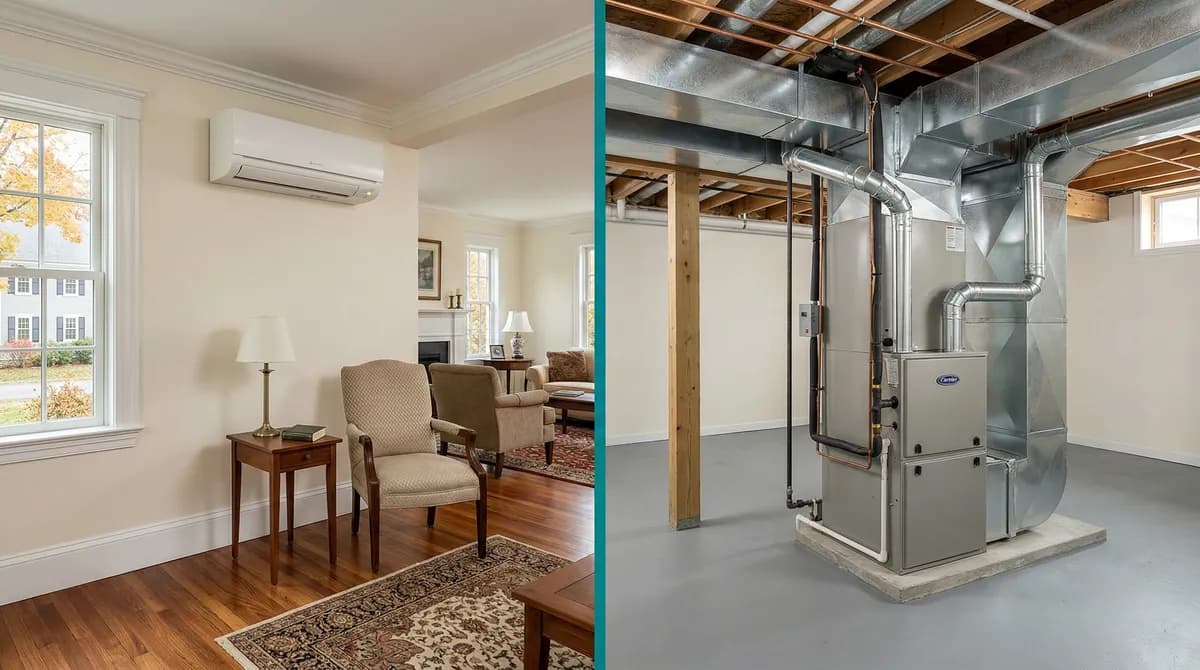
If your Massachusetts home has existing ductwork (common in post-1950 Colonials and Ranches), a central ducted heat pump is usually the best value at $10,000-$18,000. It reuses your ducts, installs in 1-2 days, and keeps everything hidden from view.
If your home does NOT have ductwork (most Cape Cods, pre-1950 Colonials, Victorians), ductless mini-splits are the clear winner at $12,000-$22,000. They install in 2-4 days with no major renovation. Adding new ductwork to a ductless home costs $8,000-$15,000 extra and requires significant construction.
Both qualify for the same Mass Save whole-home rebate of $2,650/ton (up to $8,500 max). Income-eligible households may receive enhanced rebates. The 0% HEAT Loan covers up to $25,000 for either system type.
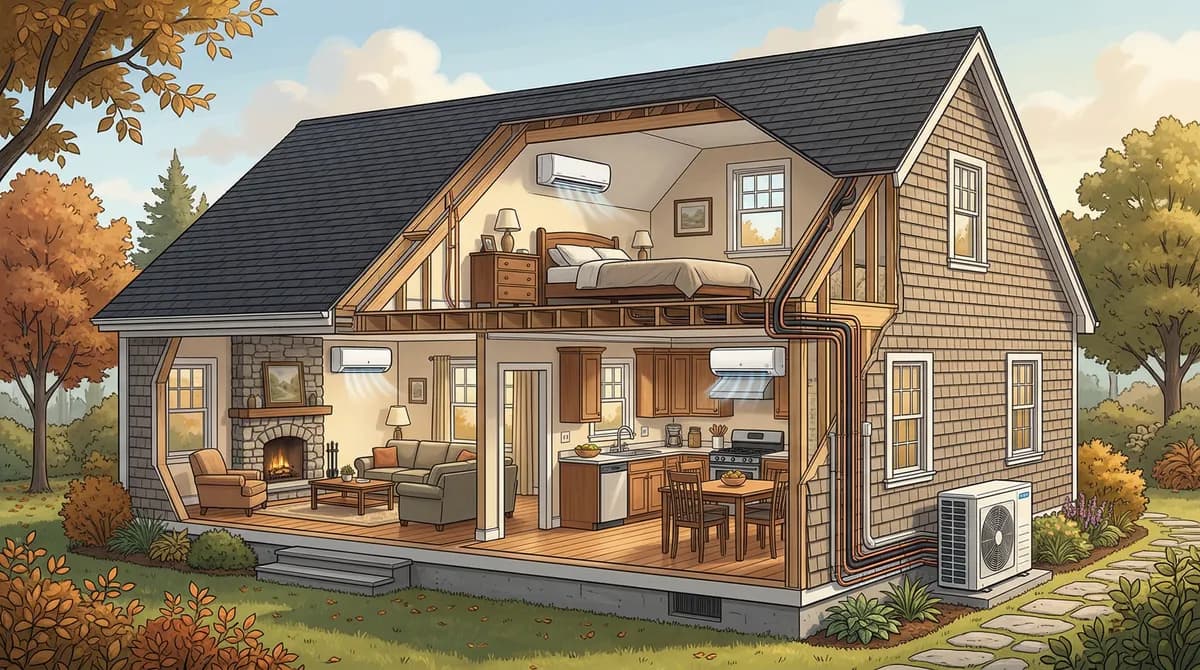
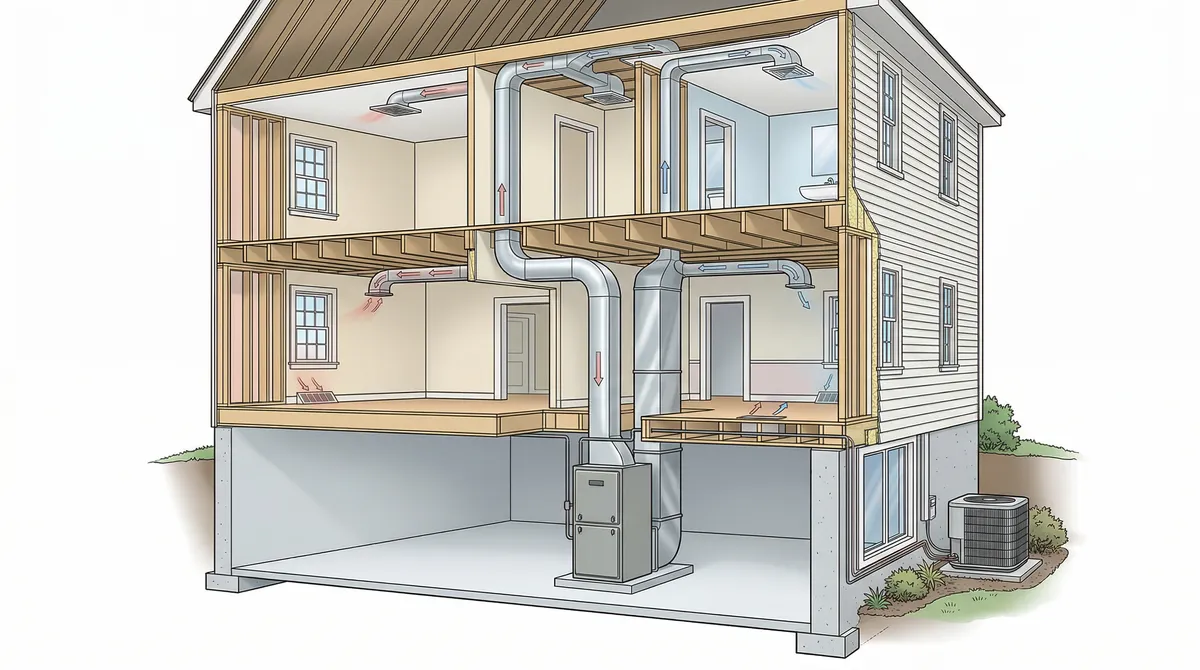
Both use the same heat pump technology (inverter-driven compressors that move heat in or out). The difference is how conditioned air reaches your rooms.
3-5 wall units + 1-2 outdoor units
1 air handler + 1 outdoor unit
Massachusetts-specific costs and performance data for 2026. All prices are before Mass Save rebates.
| Feature | Mini-Split | Ducted (Existing Ducts) | Ducted (New Ductwork) |
|---|---|---|---|
| Installed Cost (Whole-Home) | $12,000 – $22,000 (3-5 zones) | $10,000 – $18,000 (existing ducts) | $18,000 – $30,000 (new ductwork) |
| Energy Efficiency | 5-10% more efficient (no duct losses) | 15-25% duct losses (even sealed) | 10-15% duct losses (new, sealed) |
| Indoor Noise Level | 19-26 dB (whisper quiet) | 35-45 dB (air handler fan) | 35-45 dB (air handler fan) |
| Aesthetics | Visible wall units in each room | Hidden — only vents visible | Hidden — only vents visible |
| Temperature Control | Per-room zoning (each unit independent) | Single thermostat (whole house) | Single thermostat or zoned dampers |
| Installation Time | 2-4 days | 1-2 days (swap equipment) | 5-10 days (ductwork + equipment) |
| Renovation Required | Minimal — line sets through walls | None if ducts exist | Major — soffits, chases, drywall |
| Airflow Distribution | Directional from wall unit | Uniform through ceiling/floor vents | Uniform through ceiling/floor vents |
| Mass Save Rebate | Up to $8,500 (whole-home) | Up to $8,500 (whole-home) | Up to $8,500 (whole-home) |
| Best For | Homes WITHOUT existing ductwork | Homes WITH existing ductwork | New construction or gut renovations |
Why mini-splits win on paper but ducted wins on comfort
Mini-splits deliver conditioned air directly into each room. No energy is lost traveling through ducts. In a Massachusetts winter, this means the mini-split converts nearly 100% of its output into room heating.
Ducted systems push air through vents in every room simultaneously, creating uniform temperatures throughout the house. No hot or cold spots. The fan continuously circulates air, improving filtration and humidity control.
In a typical 2,000 sq ft Massachusetts home, a mini-split system uses roughly 8,000-10,000 kWh/year for heating and cooling, while a ducted system uses 9,000-12,000 kWh/year for the same load. At $0.38/kWh (Eversource), that is a difference of $380-$750/year in operating costs. Over 15 years, the mini-split saves $5,700-$11,250 — often enough to offset its higher installation cost.
Mini-split indoor units are whisper-quiet; ducted keeps noise remote
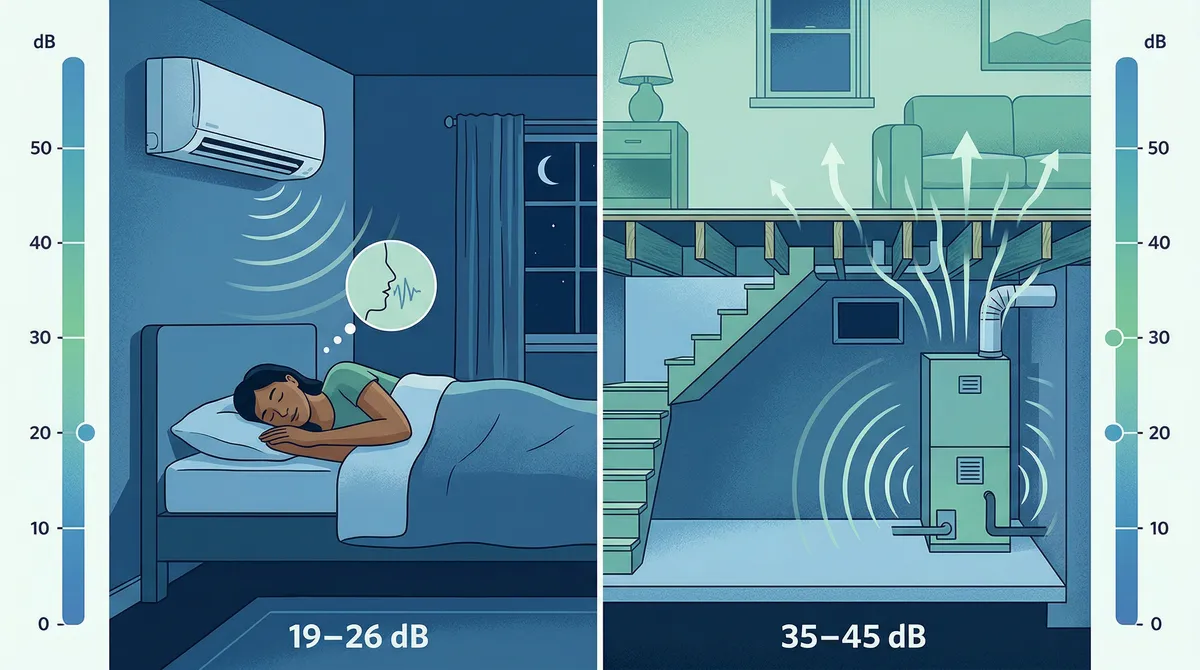
Indoor Unit: 19-26 dB
Softer than a whisper (30 dB)
Outdoor Unit: 48-58 dB
Moderate conversation
Best for bedrooms. You will not hear the indoor head while sleeping. Outdoor noise is the trade-off — especially if your neighbor is close (common in Somerville, Cambridge, Brookline). Most MA towns require 50 dB at the property line.
Air Handler (basement/attic): 35-45 dB
Quiet background hum
Airflow through vents: 25-35 dB
White noise effect
Outdoor Unit: 52-60 dB
Similar to mini-split
Best when air handler is in the basement. The fan noise stays below living spaces. Some people prefer the gentle whoosh of air through vents — it masks other household sounds. Attic-mounted air handlers can be noticeable in second-floor bedrooms.
The biggest reason homeowners hesitate on mini-splits
Pro tip: Ceiling cassettes cost 10-20% more than wall units but blend into the ceiling with only a small grille visible. Very popular in Massachusetts historic districts where wall units feel out of place.
Key advantage: For homeowners who dislike the look of wall-mounted units, ducted systems are invisible inside the home. This is a major selling point in upscale MA towns like Wellesley, Concord, and Brookline.
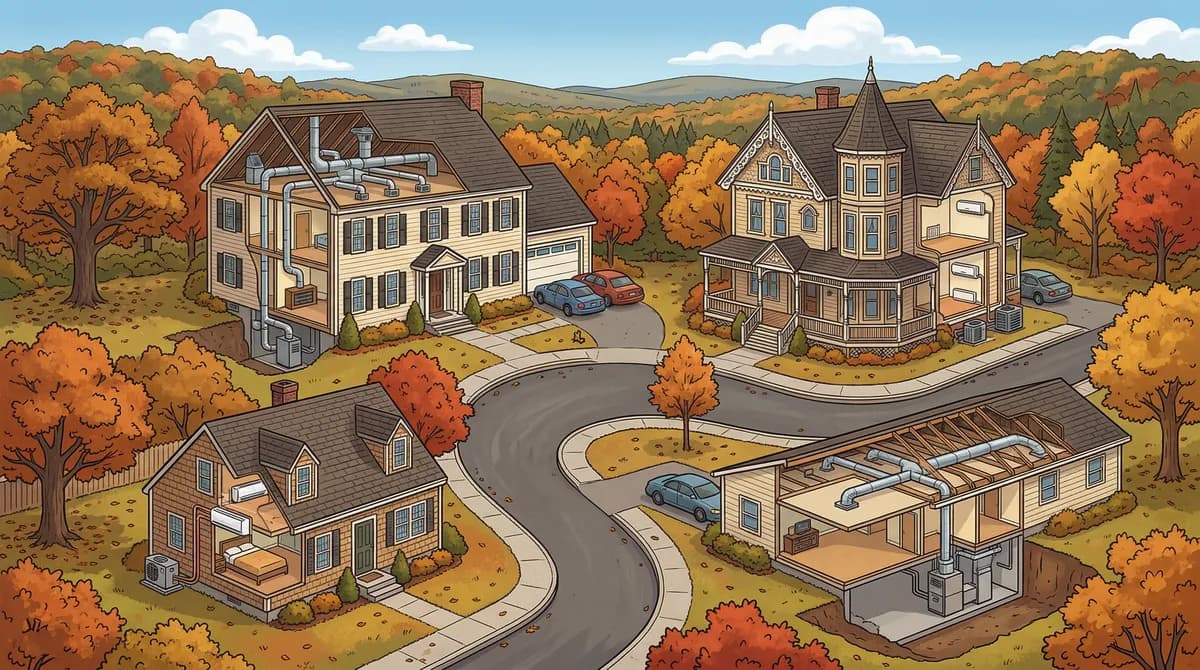
Your home's construction era and style determines which heat pump type is the most practical and cost-effective.
Recommended: Central Ducted Heat Pump
Most post-1950 Colonials have forced-air ductwork from an existing furnace. A ducted heat pump replaces the furnace and AC in one system, reusing existing ducts. Lowest cost, fastest install, nothing visible on walls.
Typical Cost: $10,000 – $18,000
Recommended: Mini-Splits (3-4 Zones)
Older Colonials typically have radiators or baseboard heat with no ductwork. Mini-splits install in 2-3 days with minimal disruption. One wall unit per floor plus bedrooms. Adding ductwork would mean tearing open walls and ceilings.
Typical Cost: $14,000 – $20,000
Recommended: Mini-Splits (2-3 Zones)
Cape Cods are the quintessential Massachusetts home style — 1.5 stories, rarely with ductwork. A 2-zone system (main floor + upstairs) covers most Cape Cods. The compact layout means short refrigerant line sets and lower installation cost.
Typical Cost: $10,000 – $16,000
Recommended: Mini-Splits (4-5 Zones)
Victorians have complex floor plans, high ceilings, and multiple small rooms — never designed for ductwork. Mini-splits handle each room independently. Ceiling cassettes hide nicely in the ornate plaster ceilings. Running ducts through a Victorian would be destructive and expensive.
Typical Cost: $16,000 – $22,000
Recommended: Central Ducted (or Hybrid)
Ranches often have basement ductwork from a furnace. A ducted heat pump is the simplest swap. If the bedrooms lack duct runs, add 1-2 mini-split heads for a hybrid setup. The single-story layout means uniform duct runs with minimal losses.
Typical Cost: $10,000 – $16,000
Recommended: Hybrid (Ducted + Mini-Split)
Split-levels often have partial ductwork on the main and lower levels but not in the upper bedrooms. A ducted heat pump handles the main zones while mini-split heads cover the bedrooms. This hybrid approach is the most common MA installer recommendation for split-levels.
Typical Cost: $16,000 – $24,000
If you choose a ducted heat pump, your existing ductwork must be inspected, sealed, and insulated before installation. Heat pumps blow air at lower temperatures than furnaces (90-110°F vs 120-140°F), so even small duct leaks that were tolerable with a furnace become a major problem with a heat pump.
Ducted heat pump + mini-splits — increasingly common in MA
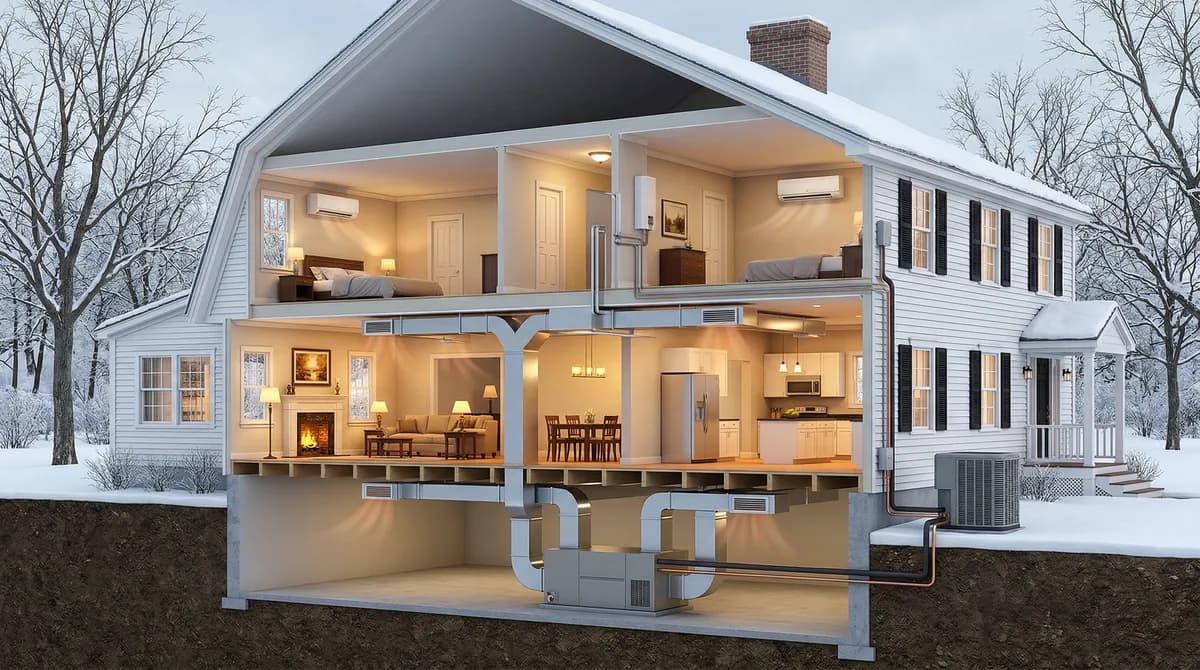
Many Massachusetts homes have partial ductwork — typically on the first floor from an old furnace, but no ducts reaching upstairs bedrooms, a finished attic, or an addition. The hybrid approach puts a ducted heat pump on the existing ductwork and adds 1-3 mini-split heads where ducts do not reach.
Typical Cost
$16,000 – $28,000
Before Mass Save rebates
Best For
Split-Level / Colonial
Partial ductwork homes
Comfort
Best of Both Worlds
Uniform + per-room control
Colonial: Ducted 1st floor + mini-splits for 2nd/3rd floor bedrooms
Split-Level: Ducted for lower/main level + mini-split for upper bedrooms
Ranch + Addition: Ducted for main house + mini-split for sunroom/addition
Cold-climate performance is non-negotiable in MA. These models are NEEP Cold Climate listed and Mass Save qualified with R-32 or R-454B refrigerant.
Cold Climate
Full output to 5°F, 76% at -13°F
Noise
19 dB indoor / 51 dB outdoor
Most-installed brand in MA. Hyper-Heat is the gold standard for cold-climate mini-splits.
Cold Climate
Full output to 5°F, rated to -15°F
Noise
20 dB indoor / 49 dB outdoor
Slightly lower price than Mitsubishi with comparable cold-climate performance. Strong MA installer network.
Cold Climate
Full output to 5°F, rated to -13°F
Noise
19 dB indoor / 52 dB outdoor
Daikin Aurora line designed specifically for cold climates. Fit series is a slim, low-profile wall unit.
Cold Climate
Full output to 5°F, 75% at -13°F
Noise
35 dB air handler / 54 dB outdoor
Purpose-built for cold climates. Variable-speed compressor with EVI (Enhanced Vapor Injection). Top MA installer choice.
Cold Climate
Full output to 10°F, rated to -15°F
Noise
38 dB air handler / 56 dB outdoor
Backed by the largest HVAC distribution network. Greenspeed Intelligence variable-speed technology.
Cold Climate
Full output to 5°F, 76% at -13°F
Noise
32 dB air handler / 51 dB outdoor
Connects to Mitsubishi multi-zone outdoor units. Ideal for hybrid setups with mini-split heads on other zones.
Mass Save does not favor one system type over the other. Your rebate depends on capacity installed and whether the heat pump serves as your primary heating source.
$2,650/ton
$8,500 max
Heat pump is primary heat for entire home. Replaces oil, gas, or propane. Requires cold-climate NEEP-listed model.
$1,125/ton
$8,500 max
Heat pump supplements existing heating. Covers the majority of heating load but backup system remains.
$250/ton
$2,500 max
Any qualifying heat pump installation. Single-zone or supplemental use. ENERGY STAR certified minimum.
Sizing Bonus: $500
Awarded when system is properly sized per Manual J load calculation. Prevents oversizing.
Weatherization Bonus: $500
Available when insulation/air sealing completed within 12 months of heat pump install.
HEAT Loan: 0% APR up to $25,000
Covers both mini-split and ducted systems. Income-tiered terms (3/5/7 years). Can finance net cost after rebate.
Income-Eligible: Enhanced Rebates
Households under 60% AMI may receive rebates covering most or all of the project cost. Apply through your utility.
After Mass Save rebates and the 0% HEAT Loan, the out-of-pocket difference between systems narrows significantly.
4-zone (typical Colonial w/o ducts)
$97 – $153/mo
(HEAT Loan, 7yr, 0% APR)
3-ton (typical Colonial w/ ducts)
$42 – $97/mo
(HEAT Loan, 7yr, 0% APR)
Ducted 1st floor + 2 heads upstairs
$125 – $208/mo
(HEAT Loan, 7yr, 0% APR)
Federal 25C tax credit is gone. The $2,000 federal heat pump tax credit expired December 31, 2025. Mass Save rebates are the primary incentive for Massachusetts homeowners in 2026. Do not let any installer quote a federal credit — it does not exist.
How each system handles -10°F nights and 95°F summer humidity
Mini-Split
Each head delivers warm air directly into the room from a single point on the wall. Rooms closest to the head are warmest; far corners may be 2-4°F cooler. Ceiling fans can help circulate. Per-room temperature control means bedrooms stay cooler while living areas are warm.
Ducted
Warm air blows from multiple vents throughout the room, creating uniform temperatures with no hot or cold spots. Continuous fan circulation maintains even warmth. However, duct losses mean the system works harder — especially in attics or crawl spaces exposed to 10°F outdoor temperatures.
Mini-Split
Excellent dehumidification in each room. Cold climate mini-splits are oversized for MA cooling loads, which can cause short-cycling in mild summer weather — reducing dehumidification. Some models have a “dry mode” that prioritizes moisture removal over temperature.
Ducted
Whole-house dehumidification through a single coil. Air returns pull humid air from every room, dehumidify at the air handler, and redistribute dry cool air. More uniform moisture removal. Optional whole-house dehumidifier integrates directly into the duct system.
Answer these three questions to narrow your choice.
Yes — I have ducts from a furnace/AC
Strong candidate for ducted heat pump. Reuse existing ducts. Lowest cost option at $10,000-$18,000. Skip to Question 3.
No — I have radiators/baseboard/nothing
Mini-splits are your best option. Adding new ductwork costs $8,000-$15,000 extra and requires major renovation. Not worth it.
Yes — I dislike visible wall units
Consider ceiling cassettes (recessed, 10-20% more), short-run ducted heads (hidden in closets), or a full ducted system if ductwork exists or can be added.
No — function over form
Standard wall-mounted mini-splits give you the best value and highest efficiency. Most homeowners find they stop noticing the units after a few weeks.
Yes — I want different temps in each room
Mini-splits are the clear winner. Each head has its own thermostat. Keep bedrooms at 65°F while living areas are at 70°F. No wasted energy heating unoccupied rooms.
No — uniform temperature is fine
A ducted system with a single thermostat keeps the whole home at one temperature. Simpler to operate. Add zone dampers ($500-$1,500) for limited per-zone control.
Get a free assessment from a Mass Save network installer. They will evaluate your home, check your ductwork (if any), and recommend the right system — mini-split, ducted, or hybrid.
Complete rebate guide — $8,500 max
Overview with interactive quiz
Zone count guide for every MA home type
Models rated to -13°F for MA winters
Cost comparison for oil-to-HP conversion
When gas-to-HP makes financial sense
Top 10 brands with MA installer data
How to vet MA heat pump contractors