Loading NuWatt Energy...

We use your location to provide localized solar offers and incentives.
We serve MA, NH, CT, RI, ME, VT, NJ, PA, and TX
Loading NuWatt Energy...
NuWatt designs, installs, and manages solar, battery, heat pump, and EV charger systems across 9 states. One company, one warranty, one point of contact.
Get a Free Quote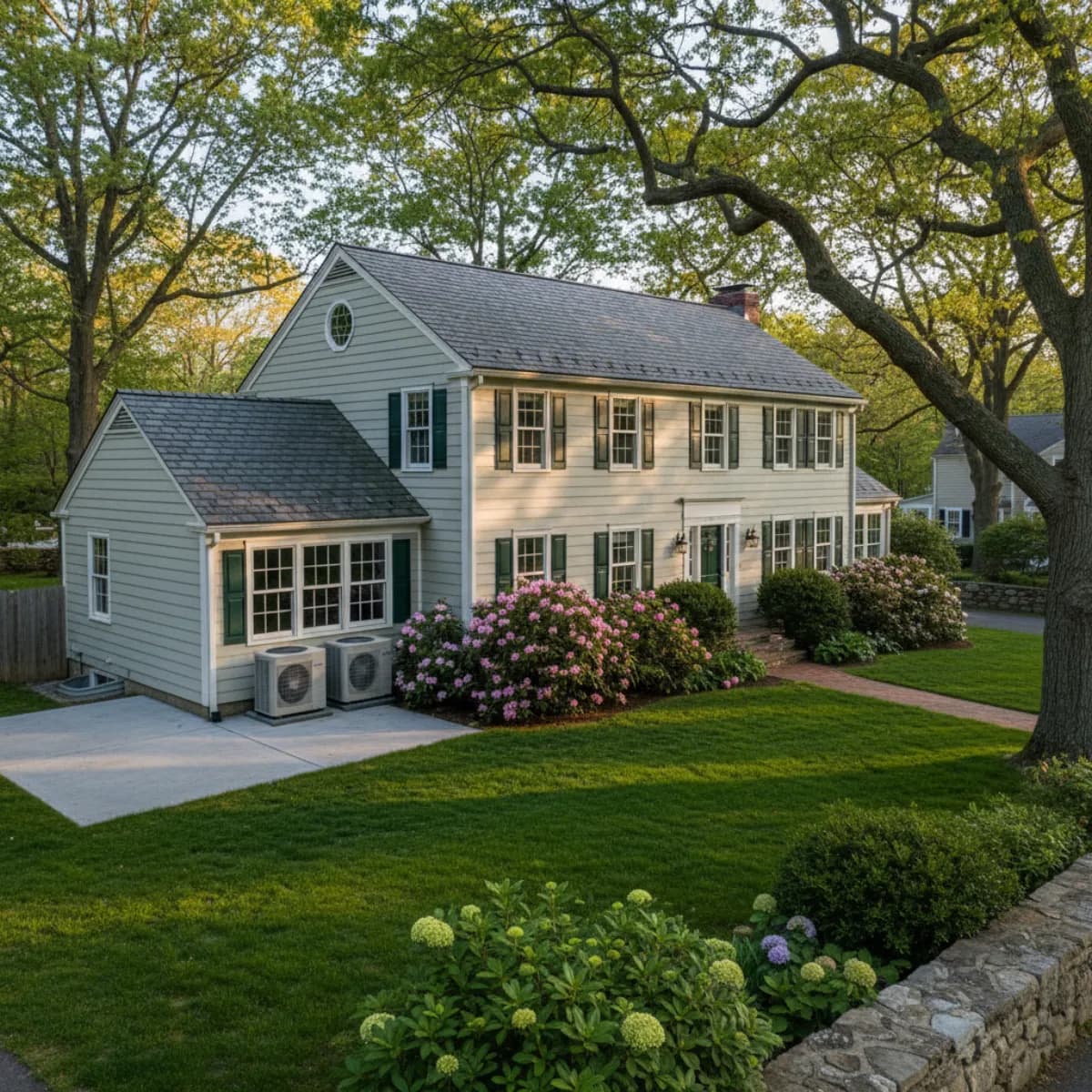
A Newton colonial replaced most oil heating hours with a right-sized Mitsubishi Hyper-Heat system. The design prioritized bedroom comfort, first-floor load balance, clean line-set routing, Mass Save documentation, and a conservative backup strategy for the first winter.
A Newton oil-to-heat-pump conversion usually starts with a Manual J load calculation, Mass Save eligibility review, and room-by-room zoning plan. This case used a 4-ton Mitsubishi Hyper-Heat system with 6 indoor zones, retained oil backup for resilience, targeted up to $8,500 in Mass Save rebates, and reduced most annual oil use.
| Category | Project Detail | Why It Matters |
|---|---|---|
| Home type | 1920s colonial, 2,350 sq ft | Sets the envelope, duct, and zoning constraints. |
| Previous heating | Oil boiler with window AC units | Determines fuel-switching economics and backup strategy. |
| Equipment | Mitsubishi Hyper-Heat multi-zone system | Cold-climate equipment selection affects winter performance. |
| Capacity and zones | 4 tons, 6 zones | Shows whether the project is room-level or whole-home. |
| Rebate pathway | Standard whole-home heat pump pathway | Rebate rules vary by state, utility, equipment, and project scope. |
| Cost range | $28,000-$34,000 before rebates | Useful for comparing quote reasonableness. |
| Net cost range | $19,500-$25,500 after standard rebate | Shows cost after standard rebate target, before final approval. |
| Estimated savings | $2,100-$2,800 | Modeled operating-cost impact, not a guarantee. |
The home had large load differences between the south-facing living room, shaded dining room, upstairs bedrooms, and partially finished third floor.
A single oversized ductless system would have short-cycled in shoulder seasons and left bedrooms uncomfortable.
The homeowner wanted to preserve the oil boiler temporarily while proving winter performance before removing the tank.
The Mass Save application needed eligible cold-climate equipment, clear tonnage documentation, and home energy assessment coordination.
NuWatt modeled the home room by room, then split the load across 2 outdoor units to avoid one oversized compressor doing all of the work.
Six indoor zones covered the living room, dining room, kitchen, primary bedroom, two secondary bedrooms, and the third-floor office.
Outdoor unit placement was kept away from bedroom windows and property-line pinch points to reduce winter defrost noise concerns.
The oil boiler was configured as emergency backup, not normal heating, so the homeowner could monitor first-winter performance without sacrificing resilience.
| Decision | Reason | Field Note |
|---|---|---|
| Use two outdoor units instead of one large unit | Split capacity improved part-load efficiency and reduced the risk of short-cycling in mild weather. | This follows cold-climate design practice: match zones to load, not only total tonnage. |
| Retain oil as backup for one winter | The homeowner wanted confidence before removing the tank. Controls were set so heat pumps carried normal heating. | A staged conversion is often the lower-risk path in older homes. |
| Prioritize bedroom zoning | Bedrooms had different solar gain, insulation quality, and occupancy schedules. | Comfort complaints usually come from room-level imbalance, not whole-house capacity alone. |
Right-sized from Manual J load modeling.
Separate bedroom and first-floor control.
Standard 2026 whole-home cap.
Compared with oil at typical MA winter use.
Backup kept for unusual cold snaps and resilience.
Plus design and commissioning visits.
Mass Save readiness check, utility territory review, and room-by-room site survey.
Manual J load model, equipment schedule, outdoor unit placement, and line-set routing.
Outdoor pads, indoor heads, electrical coordination, condensate routing, and finish work.
Refrigerant checks, airflow verification, controls setup, and homeowner walkthrough.
Final costs, rebates, and savings require a site-specific quote, utility confirmation, equipment selection, home energy assessment, and Mass Save approval.
Yes. Many older Newton homes use heat pumps as the primary heating system while keeping an oil boiler as temporary or emergency backup. The key is controls setup: the heat pump should carry normal heating, with the boiler reserved for rare backup needs.
The standard Mass Save whole-home rebate is $2,650 per ton, capped at $8,500 in 2026. Income-eligible households may qualify for enhanced support. Eligibility depends on equipment, utility territory, home assessment status, and project scope.
Yes. Mitsubishi Hyper-Heat systems are designed for cold-climate operation and are commonly selected for Boston-area design temperatures. Proper sizing, placement, and commissioning matter as much as brand selection.
Most whole-home ductless or mixed ductless projects take 2-5 installation days after design, permitting, and electrical planning. A 6-zone Newton-style project commonly takes about 3 installation days plus commissioning.
Usually, yes. A well-designed oil-to-heat-pump conversion can reduce oil consumption 70-90%, depending on insulation, thermostat behavior, backup controls, and electricity rates.