Loading NuWatt Energy...

We use your location to provide localized solar offers and incentives.
We serve MA, NH, CT, RI, ME, VT, NJ, PA, and TX
Loading NuWatt Energy...
NuWatt designs, installs, and manages solar, battery, heat pump, and EV charger systems across 9 states. One company, one warranty, one point of contact.
Get a Free QuoteMaine has no residential time-of-use rates — and that is an important fact most battery guides ignore. Here is an honest look at when a home battery makes sense in Maine, where the real value lies (hint: ice storms, not arbitrage), and how CMP and Versant customers should think about storage differently.
$0.00
TOU Spread (None)
2-5
Major Outages/Winter
$0.27-$0.32
CMP / Versant Rate
$0 ITC
25D Expired
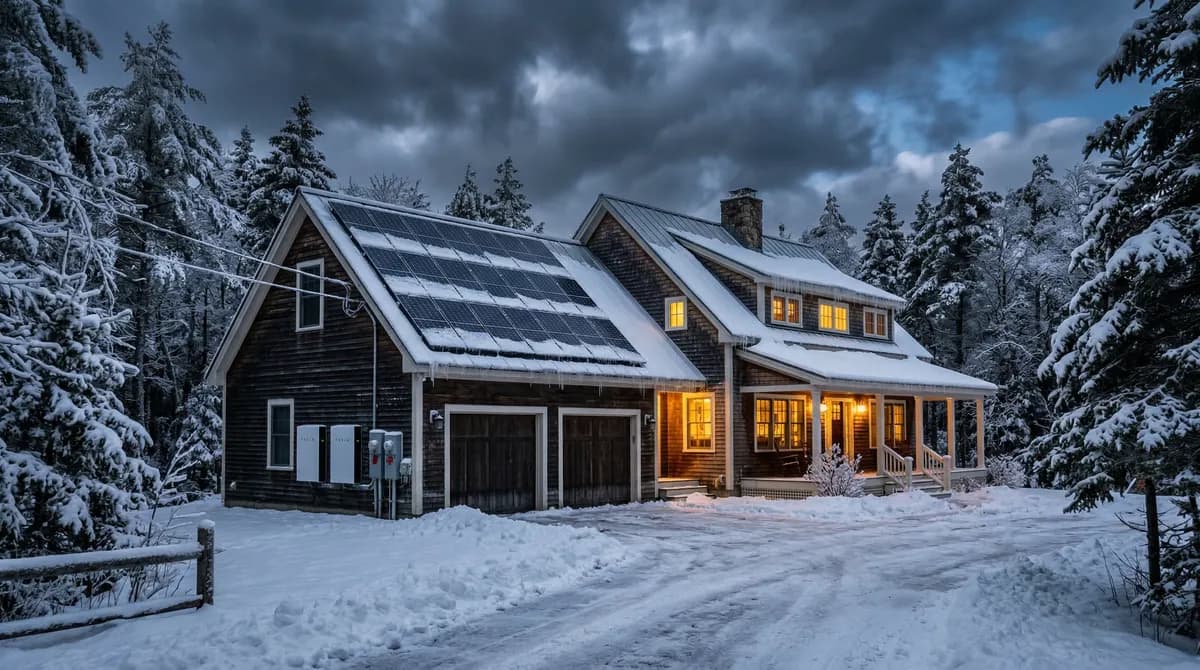
Short answer:For energy savings alone, no. For backup power during Maine's brutal ice storms, it can be invaluable.
Maine does not offer residential time-of-use rates from either CMP or Versant Power. Without a peak/off-peak price spread, there is zero TOU arbitrage revenue available. A battery's financial payback from energy savings alone (self-consumption optimization) exceeds 20 years.
However, Maine averages 2-5 major power outages per winter season. The December 2023 ice storm left 290,000+ customers without power for up to 5 days. For homeowners with heat pumps, medical equipment, or work-from-home needs, battery backup is not about ROI — it is about resilience.
Bottom line for Maine homeowners:
Both of Maine's investor-owned utilities use flat-rate structures for residential customers. There is no peak/off-peak differential, no seasonal rate variation, and no time-of-use option to opt into.
| Feature | CMP | Versant Power |
|---|---|---|
| Average Rate | $0.27/kWh | $0.32/kWh |
| Supply Rate | $0.11/kWh | $0.14/kWh |
| Delivery Rate | $0.16/kWh | $0.18/kWh |
| Residential TOU Rate | Not Available | Not Available |
| TOU Arbitrage Potential | $0/year | $0/year |
| Customers | ~640,000 | ~160,000 |
| NEB Credit | 1:1 retail | 1:1 retail |
| Interconnection | 2-4 weeks | 2-4 weeks |
| Minimum Bill | $8.00/month | $9.00/month |
| Battery DR Program | None | None |
In states like Massachusetts or Connecticut, batteries can earn $400-700+/year through TOU arbitrage and demand response programs (ConnectedSolutions). In Maine, with flat rates and no DR program, battery value comes exclusively from backup power and self-consumption. This changes the calculus significantly — batteries are an insurance purchase in Maine, not an investment with financial returns.
Without TOU arbitrage, Maine batteries deliver value through three channels — and the first one dominates all others.
The #1 reason Maine homeowners install batteries
Maine is one of the most outage-prone states in New England. Heavy ice loading on overhead power lines, combined with dense tree cover and rural service territories, creates extended outages that can last 2-5 days in severe storms. For homes with heat pumps, losing power in January means losing heat — and risking frozen pipes, spoiled food, and unsafe living conditions.
2-5
Average annual outages
Major outage events per winter season affecting 10,000+ customers
8-48 hrs
Average outage duration
Ice storms can leave rural areas without power for 2+ days
290K+
2023 ice storm (Dec)
Customers lost power, some for 5+ days in rural areas
180K+
2024 nor'easter (Jan)
Major coastal/inland outages affecting both CMP and Versant
Modest savings — but every kWh counts at $0.27-$0.32/kWh
With NEB providing 1:1 retail credits, there is limited financial incentive to self-consume rather than export. However, a battery helps you avoid the minimum bill charge ($8-$9/month) and ensures you use every kWh during the annual true-up — excess credits are compensated at avoided cost rate (much lower than retail).
Positioning for potential rate changes
The Maine PUC has discussed rate modernization as EV adoption grows and the grid incorporates more renewables. While no formal TOU rulemaking is underway, installing a battery now means your hardware is already in place when time-varying rates arrive. Batteries have a 10-15 year lifespan, so today's purchase may unlock arbitrage value in the second half of its life. Similarly, if Maine ever introduces a demand response program similar to ConnectedSolutions in neighboring states, battery owners would be first in line to participate.
Maine's geography and climate create uniquely dangerous outage conditions. Understanding outage patterns helps size your battery system correctly.
A single frozen pipe burst costs $5,000-$20,000 in repairs and water damage. A 13.5 kWh battery costs $10,000-$15,000. If a battery prevents even one frozen pipe event over its 10-15 year lifespan, it has paid for itself. For all-electric homes with heat pumps, this is not hypothetical — it is a near-certainty without backup power during a multi-day winter outage.
In states with TOU rates, battery sizing targets peak-window coverage. In Maine, sizing is about outage duration and heating load. Heat pump homes need significantly more storage than homes with oil/propane backup heat.
Best for: Budget-conscious homeowners who want basic outage protection
Best for: Homeowners with oil/propane heat who need electrical backup only
Best for: All-electric homes relying on heat pumps through Maine winters
If your primary heat source is a heat pump (as Efficiency Maine has been encouraging), you need substantially more battery capacity than states where backup is a convenience. A heat pump draws 3-5 kW continuously in cold weather. A single 13.5 kWh battery at 80% depth of discharge provides only 10.8 kWh usable — roughly 2-3 hours of heat pump operation at full load. For overnight coverage during a winter storm, plan for two batteries (20-27 kWh) or keep an oil/propane backup heating option.
The combination of solar panels, battery storage, and a heat pump creates a resilient, all-electric home that dramatically reduces both energy costs and outage vulnerability. Here is what the full system looks like for a typical Maine home.
10,800 kWh/year production
$26,190-$28,710
Backup + self-consumption
$10,000-$15,000
Heating + cooling for 80% of year
$4,000-$8,000 (after Eff. ME rebates)
$40K-$52K
Total Investment
$2,900+
Annual NEB Savings
$1,500+
Annual Fuel Savings (HP)
12-15 yrs
Combined Payback
The resilience dividend: During a winter outage, solar recharges your battery during daylight hours while the heat pump keeps your home warm. Even on a cloudy Maine winter day, a 9 kW system produces 15-25 kWh — enough to partially recharge a 13.5 kWh battery and run essential loads. This creates a self-sustaining cycle that no generator can match (generators need fuel deliveries during storms).
We believe in transparency. Here are the real numbers — batteries in Maine are hard to justify on pure economics, but the non-financial value can be significant.
While homeowners get $0 in federal tax credits, third-party financing companies can still claim the Section 48/48E commercial ITC (30%) on projects beginning construction before July 4, 2026. Battery-inclusive PPA and lease agreements in Maine let the financing company capture the ITC and pass savings to you as a lower rate. This is currently the most cost-effective way to add battery storage in Maine without paying full retail cost.
Not every Maine homeowner needs a battery. Here is how to decide.
Both Maine utilities follow similar interconnection procedures for residential battery storage systems. Here is what to expect.
Southern & central Maine (~70% of state)
Avg Rate
$0.27/kWh
Interconnection Time
2-4 weeks
NEB Credit
1:1 retail credit
Battery Interconnection
Submit interconnection application with battery specs. Utility review takes 2-4 weeks. Battery must be UL-listed and installed by a licensed electrician. Net meter must be upgraded if not already bidirectional.
Subsidiary of Avangrid/Iberdrola. Largest utility in Maine. No residential TOU rate. Battery value is backup power and self-consumption optimization.
Northern & eastern Maine (~30% of state)
Avg Rate
$0.32/kWh
Interconnection Time
2-4 weeks
NEB Credit
1:1 retail credit
Battery Interconnection
Submit interconnection application with battery specs. Utility review takes 2-4 weeks. Battery must be UL-listed and installed by a licensed electrician. Net meter must be upgraded if not already bidirectional.
Formerly Emera Maine. Higher rates mean more savings per self-consumed kWh. No residential TOU rate. Battery backup is especially critical in remote northern service area.
Key difference: Versant customers benefit more from self-consumption optimization due to higher rates ($0.32 vs $0.27/kWh). Each kWh you store and use later saves $0.05 more in Versant territory compared to CMP. Over a battery's 10-15 year life, this adds up to $500-$750 in additional value.
No. Neither CMP nor Versant Power offers residential time-of-use rates as of 2026. Maine uses a flat-rate structure for residential customers. This means there is no peak/off-peak price differential to exploit with battery arbitrage. Battery value in Maine comes from backup power during outages, self-consumption optimization of solar production, and future-proofing for potential TOU rates.
It depends on your priorities. Purely on energy economics (payback from electricity savings), batteries are hard to justify in Maine without TOU rates — payback exceeds 20 years from self-consumption gains alone. However, Maine averages 2-5 major power outages per winter from ice storms and nor'easters. If you value keeping your heat pump running, protecting frozen pipes, and maintaining power during multi-day outages, the backup value can be priceless. Many Maine homeowners view batteries as insurance, not an investment.
A single home battery (10-13.5 kWh) costs $10,000-$15,000 installed in Maine. A dual-battery setup for heat pump backup (20-27 kWh) runs $18,000-$28,000. There is no federal tax credit for homeowner-purchased batteries (Section 25D expired December 31, 2025). If you use a PPA or lease that includes a battery, the third-party owner can claim the Section 48/48E commercial ITC (30%) on projects beginning construction before July 4, 2026.
Yes, but sizing matters. A typical Maine heat pump draws 3-5 kW while running. A single 13.5 kWh battery provides roughly 4-5 hours of heat pump operation. For overnight backup during a winter outage, you need 20-30 kWh (two batteries). If you have solar panels, they can recharge the battery during daylight hours, extending your runtime significantly — even on cloudy winter days, a 9 kW system produces enough to partially recharge.
The Tesla Powerwall 3 (13.5 kWh) and Enphase IQ Battery 10T (10.5 kWh) are the most popular choices in Maine. Both have cold-weather ratings, but installation location matters — most Maine installers mount batteries in heated garages or basements to maintain optimal performance. The Franklin WH aPower2 (13.6 kWh) is another solid option with built-in heater for outdoor installation.
No. Neither CMP nor Versant offers battery-specific incentives, rebates, or demand response programs as of 2026. Maine does not have a ConnectedSolutions-style program (that program exists only in Massachusetts, Rhode Island, and Connecticut). Efficiency Maine focuses incentives on heat pumps and weatherization, not battery storage. The only potential financial support is through third-party ownership (PPA/lease) where the Section 48/48E ITC applies.
Maine NEB gives you 1:1 retail credit for exported solar electricity. With a battery, you can store excess solar during the day and use it at night instead of exporting it. Since NEB already gives you full retail credit, the battery does not increase your per-kWh value — it simply shifts WHEN you use your solar power. The main benefit is reducing your minimum bill charges and ensuring you use every kWh your panels produce.
It is possible but not imminent. The Maine PUC has discussed rate modernization, and as grid-scale renewables and EV adoption grow, time-varying rates become more likely. However, no formal rulemaking is underway as of early 2026. Installing a battery now positions you to benefit immediately if TOU rates are introduced, since your hardware will already be in place and your system can be reprogrammed for peak-shifting.
For most Maine homeowners, solar panels alone (without a battery) offer better financial returns. With 1:1 NEB credits, you get full retail value for exported solar without needing to store it. A 9 kW system costs $26,190-$28,710 and pays back in 15-17 years with CMP or 12-14 years with Versant. Add a battery only if backup power is a priority or you plan to go all-electric with heat pumps.
$2.91-$3.19/W installed. CMP vs Versant payback comparison. No federal ITC, no state rebate.
Read moreFull rate breakdown, NEB credits, interconnection timelines, and which territory offers better solar value.
Read moreThe electrification path for Maine homes. How solar powers your heat pump and slashes oil/propane costs.
Read moreHow 1:1 net energy billing works, annual true-up rules, and how batteries interact with NEB credits.
Read moreHow PPA/lease providers claim Section 48 ITC — the best option for Maine homeowners post-25D.
Read moreHow to evaluate solar in Maine with $0 federal tax credit. Honest payback analysis and best strategies.
Read moreWe will analyze your utility territory, outage history, heating system, and energy usage to determine if a battery makes sense for your Maine home — and honestly tell you if it does not.