Loading NuWatt Energy...

We use your location to provide localized solar offers and incentives.
We serve MA, NH, CT, RI, ME, VT, NJ, PA, and TX
Loading NuWatt Energy...
NuWatt designs, installs, and manages solar, battery, heat pump, and EV charger systems across 9 states. One company, one warranty, one point of contact.
Get a Free Quote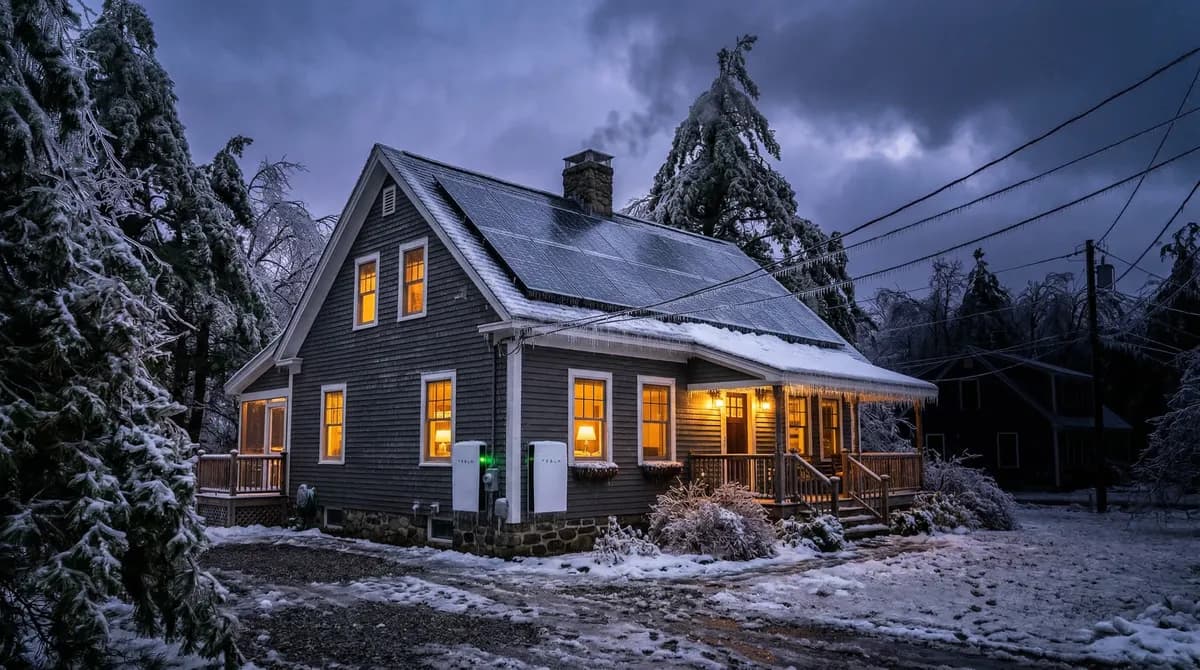
Maine experiences more ice storms than any other New England state. CMP and Versant Power have documented multi-day outages affecting hundreds of thousands of customers. A home battery paired with solar panels keeps your heat pump running, your pipes from freezing, and your lights on when the grid goes dark.
2-5
Avg outages/winter
290K+
Customers affected (Dec 2023)
2-7 days
Rural restoration
12-18 hrs
Battery backup
Maine is uniquely vulnerable to extended power outages. The state's combination of aging grid infrastructure, dense forest canopy, coastal exposure, and ice storm frequency creates a perfect storm for multi-day blackouts every winter. Unlike Massachusetts or Connecticut, Maine has vast rural areas where utility crews take days to reach downed lines.
Massive glaze ice event. Rural interior Maine saw 5+ day outages. CMP deployed 1,800+ line crews.
Duration: 1-5 days
Heavy wet snow and 50+ mph gusts toppled trees across southern and coastal Maine.
Duration: 1-3 days
Late-season freezing rain event across Versant territory in northern Maine.
Duration: 12-48 hours
Maine averages more ice storm events per capita than any other New England state.
Duration: 2-5 major events/year
A grid-tied solar system without a battery shuts down during a power outage (required by electrical code for line worker safety). Adding a battery changes everything: your home becomes an independent power island that can run for hours or even days.
Modern battery systems like the Tesla Powerwall monitor weather forecasts and automatically charge to 100% from the grid before a predicted storm. This means your battery is full before the ice storm even arrives — buying you maximum runtime from the first moment power goes out.
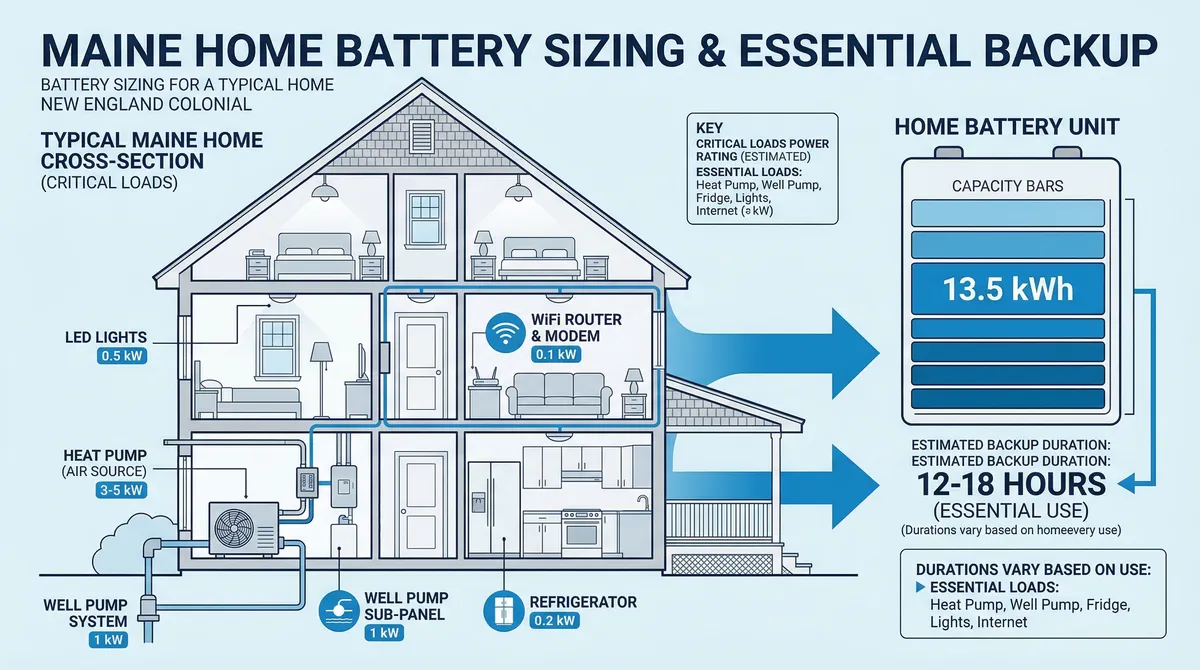
Not all loads are created equal. During a Maine winter outage, you need to prioritize the systems that keep your home safe. Here is what draws power and how much each load costs your battery.
3,000-5,000 W
Critical priorityKeeps pipes from freezing. Without power, heat pump stops entirely.
750-1,500 W
Critical priority40%+ of Maine homes use private wells. No power = no water.
150-400 W
High priorityPreserves food during multi-day outages. Runs intermittently.
100-300 W
High prioritySafety and comfort. LED efficiency makes this a low draw.
20-50 W
Medium priorityCommunication during emergencies. Phone charging.
500-1,000 W
Situational priorityIce storm melt + spring thaw. Runs intermittently on cycle.
A typical Maine home running heat pump + well pump + fridge + lights + Wi-Fi draws approximately 4.5-7.5 kW at peak demand. Over 12 hours, that is 54-90 kWh — but actual consumption is much lower because loads cycle on and off. Real-world usage is typically 30-50% of peak, putting effective overnight draw at 16-35 kWh.
This is why a 13.5 kWh battery covers essentials (without heat pump) for 12-18 hours, but you need 20-30 kWh for heat pump backup through a winter night.
Choose your battery capacity based on what you need to keep running. Most Maine homeowners with heat pumps should plan for the Standard or Heat Pump tier.
Oil/propane-heated homes that only need electrical backup
What it covers
Fridge, lights, Wi-Fi, phone charging
Runtime
8-14 hours
Installed cost
$6,000-$10,000
Heat pump backup?
Homes with well water needing reliable overnight coverage
What it covers
Essentials + well pump + select circuits
Runtime
12-18 hours
Installed cost
$12,000-$16,000
Heat pump backup?
All-electric homes relying on heat pumps through Maine winters
What it covers
Heat pump, well pump, all circuits, overnight heating
Runtime
6-12 hours
Installed cost
$22,000-$32,000
Heat pump backup?
Maine has rapidly adopted cold-climate heat pumps — Efficiency Maine has installed over 100,000 units statewide. But heat pumps are 100% dependent on electricity. When the grid goes down, your heat pump stops immediately. This is the strongest argument for battery storage in Maine.
Heat pump power consumption increases as outdoor temperature drops. At 0°F to -15°F (common in northern Maine), a cold-climate mini-split draws 3-5 kW — up to 50% more than at 30°F. Your battery sizing should account for worst-case cold-weather draw, not mild-weather ratings.
Mild
30°F
2.0-3.0 kW
Cold
10°F
3.0-4.0 kW
Extreme
-10°F
4.0-5.5 kW
The incentive landscape for batteries in Maine is limited compared to heat pumps. Here is what is available and what is not.
Efficiency Maine does not offer rebates, incentives, or low-interest loans for home battery storage as of March 2026. Their programs focus on:
The one remaining federal benefit for batteries: if you obtain your battery through a PPA or lease, the third-party system owner can claim the Section 48/48E commercial Investment Tax Credit (30%).
| Factor | Cash Purchase | Third-Party Lease/PPA |
|---|---|---|
| Upfront cost (13.5 kWh) | $12,000-$16,000 | $0 |
| Federal tax credit | $0 (25D expired) | 30% (48/48E — owner claims) |
| Effective cost | $12,000-$16,000 | Monthly payment ~$80-$150/mo |
| Ownership | You own it outright | Third party owns, you use |
| Warranty/maintenance | Manufacturer warranty only | Typically included in lease |
| NEB credits | All credits yours | Split per agreement |
| Best for | Homeowners who want ownership + long-term savings | No upfront budget, want backup ASAP |
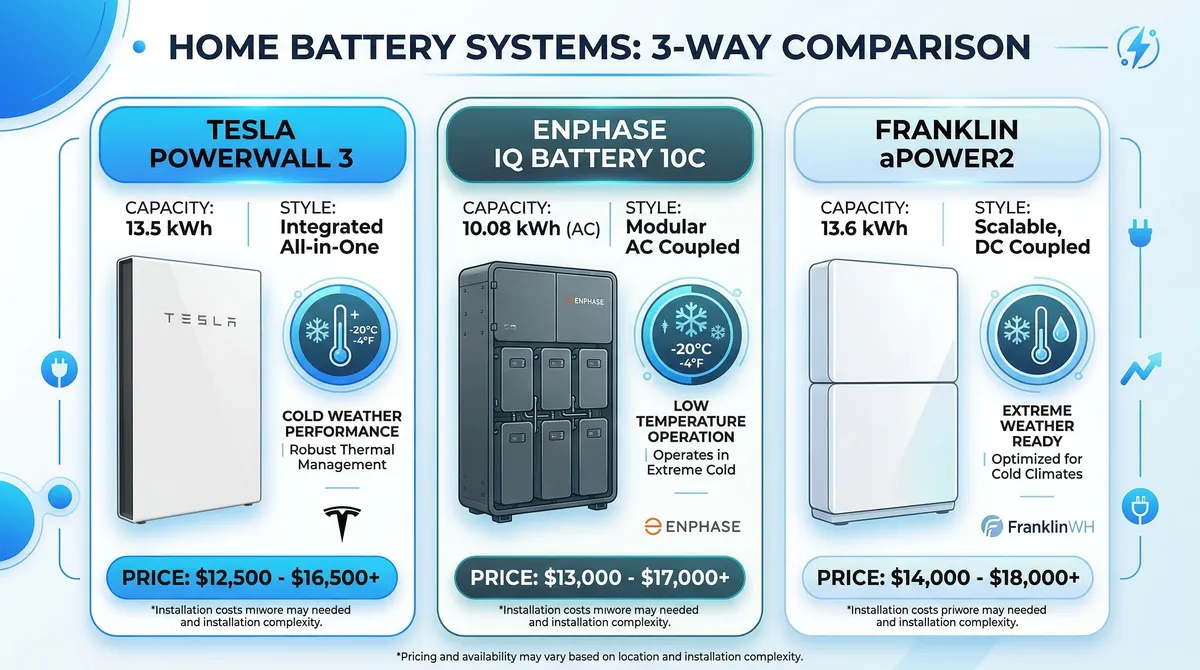
All three of these batteries are rated for cold-weather operation and are available from Maine installers. Cold-weather performance is critical — cheap batteries without thermal management lose capacity below freezing.
Power output
11.5 kW continuous
Warranty
10 years
Cold rating
Rated to -4°F (-20°C)
Price range
$12,000-$15,500 installed
Best for: Most Maine homeowners — best all-around performance
Power output
3.84 kW continuous
Warranty
15 years
Cold rating
Rated to -4°F (-20°C)
Price range
$10,000-$14,000 installed
Best for: Homes already using Enphase microinverters
Power output
5 kW continuous / 10 kW peak
Warranty
12 years
Cold rating
Rated to -4°F (-20°C) with integrated heater
Price range
$11,000-$14,500 installed
Best for: Outdoor installations in exposed Maine locations
Both Maine utilities have reliability scores well below the national average. Versant territory in northern Maine faces longer restoration times due to remote infrastructure, while CMP affects more total customers due to its larger service area.
| Metric | CMP | Versant |
|---|---|---|
| Service territory | Southern & central Maine (~70%) | Northern & eastern Maine (~30%) |
| Customers | ~640,000 | ~160,000 |
| Average electric rate | $0.27/kWh | $0.32/kWh |
| SAIDI (avg outage minutes/yr) | ~180-240 min | ~200-300 min |
| SAIFI (avg interruptions/yr) | ~1.5-2.0 | ~1.8-2.5 |
| Ice storm exposure | High (inland/coastal mix) | Very high (remote lines, heavy forest) |
| Typical restoration time | 12-48 hours (urban) / 2-5 days (rural) | 24-72 hours (towns) / 3-7 days (rural) |
| Battery interconnection | 2-4 weeks | 2-4 weeks |
| NEB (net metering) | 1:1 retail credit | 1:1 retail credit |
Southern and central Maine. Higher customer density means more resources for restoration, but also more total outage events by volume. Coastal areas face nor'easter exposure. CMP rates at $0.27/kWh make the self-consumption value of batteries lower than Versant.
Battery payback from self-consumption: ~20+ years (backup value is the primary justification)
Northern and eastern Maine. Remote service lines through dense forest mean longer restoration times. Versant's higher rate ($0.32/kWh) means slightly better self-consumption value for batteries. Rural customers with private wells have the strongest case for battery backup.
Battery payback from self-consumption: ~18+ years (backup value is the primary justification)
Where and how you install a battery matters significantly in Maine's climate. Follow these guidelines for maximum reliability during the storms that matter most.
A heated garage, basement, or utility room keeps the battery at optimal operating temperature. Lithium batteries lose 10-20% capacity below 32°F.
All three recommended batteries (Powerwall 3, IQ 10C, aPower2) are rated to -4°F. Budget batteries without thermal management fail in Maine winters.
Use your heat pump's draw at -10°F (4-5.5 kW), not the nameplate rating at 47°F. Maine ice storms hit when it's coldest.
Tesla Powerwall and Enphase both offer weather-based pre-charging. Enable these features — they ensure your battery is at 100% before a storm arrives.
If budget is tight, wire only critical circuits (heat pump, well pump, fridge, lights) to the backup panel. This extends battery runtime significantly.
Battery alone gives you one night. Battery + solar gives you multiple days. Even 2-3 peak sun hours in January partially recharge a battery.
Get a free battery sizing assessment from a Maine-certified installer. We will analyze your critical loads, heat pump requirements, and utility territory to recommend the right system for your home.
How batteries work without TOU rates in Maine
Combining solar and heat pumps for maximum savings
Current solar pricing across Maine
Best heat pumps for Maine winters
How the commercial ITC benefits homeowners through PPAs
Utility rate comparison for solar customers