Loading NuWatt Energy...

We use your location to provide localized solar offers and incentives.
We serve MA, NH, CT, RI, ME, VT, NJ, PA, and TX
Loading NuWatt Energy...
NuWatt designs, installs, and manages solar, battery, heat pump, and EV charger systems across 9 states. One company, one warranty, one point of contact.
Get a Free QuoteBalloon framing. No insulation. Fieldstone foundations. Multiple additions built over two centuries. Connected barns. Maine farmhouses present unique heating challenges — but modern cold-climate mini-splits and Efficiency Maine weatherization make the transition from oil entirely practical.
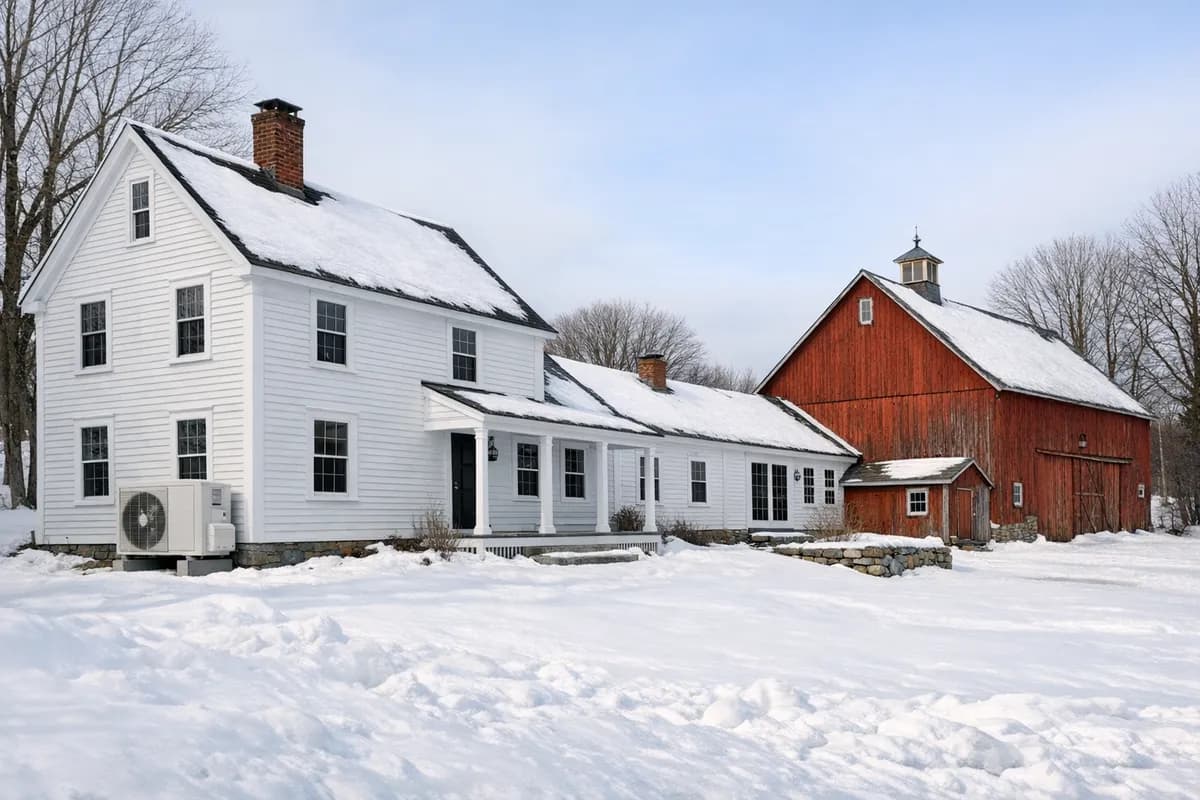
Maine has one of the oldest housing stocks in the nation. Thousands of farmhouses built between 1780 and 1920 are still occupied — many still heating with oil furnaces or boilers that their owners would love to replace. But these homes have characteristics that make heating them fundamentally different from a modern house.
The good news: every single one of these challenges has a practical solution. The key is doing things in the right order — weatherize first, then install heat pumps — and taking a zone-by-zone approach instead of trying to condition the entire structure.
Pre-1940 farmhouses use balloon framing where wall studs run continuously from foundation to roofline — no fire stops between floors. This creates massive air channels where warm air rises unimpeded from basement to attic. Dense-pack cellulose insulation fills these cavities and dramatically reduces this stack effect.
Solution: Dense-pack cellulose blown into wall cavities ($2-3/sq ft). Efficiency Maine covers 75-100%.
Many Maine farmhouses have zero insulation in their walls — just clapboard siding, sheathing boards, and plaster or wallpaper inside. Some have newspaper stuffed in walls from a century ago. Heat loss through uninsulated walls can account for 30-35% of total heat loss.
Solution: Dense-pack cellulose or foam injection through small drilled holes (minimally invasive). R-13 to R-15 achieved.
Laid-up fieldstone foundations are porous, uninsulated, and often have gaps where cold air infiltrates. Basement temperatures of 35-45 degrees F in winter radiate cold upward through floor joists. This is why floors are always cold in old farmhouses.
Solution: Rigid foam board (2-3 inches) on interior foundation walls + spray foam at rim joist. Efficiency Maine-subsidized.
The typical Maine farmhouse has been added onto 2-4 times over its 150-250 year life. Original house, ell, kitchen addition, summer kitchen, connected barn. Each section has different construction, different insulation (or none), and different air sealing quality.
Solution: Zone each addition independently with its own mini-split head. Size each zone to its actual heat loss.
A farmhouse with ell and additions might be 3,000-5,000 sq ft but the family only actively uses 1,500-2,000 sq ft in winter. Heating the entire structure is wasteful. The old strategy of closing off rooms and living near the woodstove was actually efficient.
Solution: Zone-by-zone heating with mini-splits. Heat the rooms you use, setback on unused rooms. Close off unneeded wings.
Maine's iconic "Big House, Little House, Back House, Barn" connected architecture means the attached barn or workshop is a massive cold-air reservoir connected to the living space. Barn doors, gaps, and uninsulated walls between barn and house bleed heat.
Solution: Insulate and air-seal the wall between heated living space and unheated barn/ell. Install a thermal break.
This is the single most important step for any old Maine farmhouse. Weatherization before heat pump installation reduces the number of units needed, lowers operating costs by 30-50%, and makes the house dramatically more comfortable. Efficiency Maine subsidizes most or all of the cost.
Standard Income
75% covered
Up to $8,000 in subsidies
Income-Eligible (under 80% AMI)
100% covered
Up to $12,000+ in subsidies
Impact on Heat Pump Sizing
Weatherizing a leaky farmhouse typically reduces heat loss by 30-50%. This means you need fewer heat pump zones and smaller units — saving $3,000-$8,000 on the heat pump installation itself.
Installing heat pumps beforeweatherizing is a common and expensive mistake. In an uninsulated farmhouse, you will need 30-50% more BTU capacity to maintain comfortable temperatures. This means more units, higher equipment cost, and higher operating cost. Weatherize first, then right-size the heat pump system to the improved building envelope. Efficiency Maine's home energy audit (free for many homeowners) will guide the process.
Farmhouses do not need (and should not have) a single central system. Mini-splits let you heat the rooms you use and ignore the ones you do not. This is actually how old farmhouses were always heated — selectively — just with modern technology instead of a parlor stove.
This is where the family spends 70% of their waking hours. Open floor plans in many farmhouse kitchens allow one head to serve a large area. Prioritize this zone first.
Sleeping comfort matters. A single mini-split in the primary bedroom provides both heating and cooling (increasingly valued in Maine summers). Set to 65-68 degrees F for sleeping.
A strategically placed unit in an upstairs hallway can serve 2-3 bedrooms with doors left ajar. Not as precise as individual units but cost-effective for occasional-use rooms.
If you work from home (common in rural Maine), a dedicated zone for the office makes sense. Ell additions often have thinner walls and need their own unit.
Formal parlors, guest rooms, and unused wings can be closed off in winter with doors shut. This is the traditional Maine approach and it still works. No need to heat rooms you use twice a year.
Before Rebates
$13,000-$19,500
Efficiency Maine Rebate
-$3,000 to -$9,000
After Rebates
$7,000-$16,500
Note: Federal 25D residential tax credit expired Dec 31, 2025. $0 federal credit available. Efficiency Maine state rebates remain the primary incentive.
Maine farmhouses and wood stoves go together like lobster and butter. The wood stove is not just tradition — it is a practical necessity in rural Maine where power outages from ice storms can last days and heat pumps require electricity to run.
If you prefer not to rely on a wood stove, a battery backup system (Enphase IQ Battery, Tesla Powerwall) can keep one or two heat pump zones running during outages. A 10 kWh battery can power a single mini-split for 8-15 hours. Combined with solar panels, it can theoretically run indefinitely during daytime — though Maine winter solar production is limited. Most farmhouse owners prefer the reliability and simplicity of a wood stove.
Here are three real-world farmhouse types common in Maine and how to approach heat pump installation for each.
Classic 1.5-story Cape with steep roof, knee walls, and usually an ell addition off the back. Low ceilings (7.5-8 ft) help retain heat. Typically 3-4 rooms per floor.
Approach: 3-zone mini-split system. Zone 1: main floor open living/kitchen. Zone 2: primary upstairs bedroom. Zone 3: hallway unit for other bedrooms. Weatherize knee walls and attic (critical). Keep wood stove in living room.
Estimated Cost
$11,000-$15,000 after rebates
Annual Oil Savings
$2,500-$3,500/year oil displacement
Two-story center-chimney colonial with 4+ rooms per floor. Often has an attached ell and summer kitchen. Massive footprint, balloon framing, fieldstone foundation. Many have been in the same family for generations.
Approach: 4-5 zone system. Zone 1: kitchen/family room. Zone 2: living/dining area. Zone 3: primary bedroom. Zone 4: upstairs hall. Close off unused rooms. Weatherize extensively before installing. Keep wood stove and consider retaining oil for first winter.
Estimated Cost
$14,000-$22,000 after rebates
Annual Oil Savings
$3,000-$5,000/year oil displacement
Working farm home built to survive the most brutal winters in New England. Connected barn structure ("Big House, Little House, Back House, Barn"). Often has had minimal updates. Heating with oil + wood.
Approach: 3-4 zone system with Fujitsu XLTH (-15 degrees F rated). Focus on core living areas only. Keep wood stove as primary backup — power outages are more common and longer in northern ME. Weatherize heavily (Efficiency Maine income-eligible covers 100%). Keep oil furnace connected for first two winters.
Estimated Cost
$12,000-$18,000 after rebates
Annual Oil Savings
$3,500-$5,500/year oil displacement (higher oil use in Zone 6)
Many old Maine farmhouses still have 100-amp electrical service — some even 60 amps. Heat pumps require adequate electrical capacity.
Cannot support heat pumps safely. Must upgrade to at least 200A. May require utility to upgrade the service drop as well.
Cost: $3,000-$6,000
Can support 1-2 mini-split zones if other loads are moderate. 3+ zones or adding EV charging will likely require 200A upgrade.
Cost: $2,500-$4,500 (if needed)
Adequate for whole-home heat pump system, electric vehicle charging, and future electrification. No upgrade needed.
Cost: $0
Rural Maine note: Farmhouses on long utility runs from the road may face higher panel upgrade costs ($1,000-$3,000 more) due to the need for upgraded service entrance cables. CMP or Versant may also need to upgrade the transformer if the property is on an older single-phase line. Your installer should coordinate with the utility before starting work.
Yes. Ductless mini-splits are ideal for old Maine farmhouses because they require no ductwork — just a 3-inch hole through the wall for the refrigerant line. Most farmhouses have no existing ductwork, making ductless systems the natural choice. A zone-by-zone approach lets you heat the rooms you use most without trying to condition the entire structure at once.
Absolutely, and Efficiency Maine covers 75-100% of weatherization costs depending on income. Old farmhouses with balloon framing and no insulation can lose 50-60% of heat through walls and the attic. Insulating and air-sealing before installing heat pumps reduces the number of units needed, lowers operating costs, and dramatically improves comfort. Weatherization typically costs $5,000-$15,000 for a farmhouse, but Efficiency Maine subsidizes most or all of it.
Most Maine farmhouses need 3-5 zones depending on size and layout. A typical approach: one zone for the main kitchen/living area (the heart of the house), one for the primary bedroom, one for upstairs bedrooms, and optionally zones for a home office or ell addition. You do not need to heat every room — many farmhouse owners close off rarely-used rooms in winter, just as their grandparents did.
Fieldstone foundations are porous and uninsulated, which means significant heat loss through the basement/crawl space. Efficiency Maine weatherization can address this with rigid foam insulation on the interior of the foundation walls ($2,000-$4,000 for a typical farmhouse). This alone can reduce heat loss by 15-20% and eliminate cold floors, which is one of the biggest comfort complaints in old Maine homes.
Yes, but with planning. Northern Maine farmhouses in Aroostook County and the western mountains (Zone 6, design temp -18 to -22 degrees F) need Fujitsu XLTH or Mitsubishi Hyper-Heat units rated to -15 to -13 degrees F, and you should keep a backup heat source (wood stove or existing oil furnace) for the coldest nights. The heat pump handles 80-90% of heating; backup covers the extremes.
This is very common in Maine farmhouses (original 1800s section plus 1920s kitchen addition plus 1970s family room). Each addition likely has different wall thickness, insulation levels, and air sealing. Treat each section as its own zone with an independent mini-split head. This way you can set different temperatures for different sections based on their actual heat loss characteristics.
Yes — wood stoves are essential backup heat for Maine farmhouses, especially in rural areas where power outages from ice storms can last days. Heat pumps require electricity to operate. A wood stove provides heat during outages and can supplement the heat pump on the coldest nights. Many Maine farmhouse owners use the wood stove as their primary gathering-place heat and let mini-splits handle the rest of the house.
Efficiency Maine covers 75% of weatherization costs for standard-income homeowners (up to $8,000) and 100% for income-eligible households (up to $12,000+). Weatherization includes attic insulation (R-49+), wall cavity insulation (dense-pack cellulose), air sealing, basement/foundation insulation, and a blower door test before and after. For a leaky old farmhouse, this is transformative.
Weatherize first with Efficiency Maine (75-100% covered), then install zone-by-zone mini-splits. Keep your wood stove. Eliminate oil. Your farmhouse has survived centuries — now make it comfortable.