Loading NuWatt Energy...

We use your location to provide localized solar offers and incentives.
We serve MA, NH, CT, RI, ME, VT, NJ, PA, and TX
Loading NuWatt Energy...
NuWatt designs, installs, and manages solar, battery, heat pump, and EV charger systems across 9 states. One company, one warranty, one point of contact.
Get a Free Quote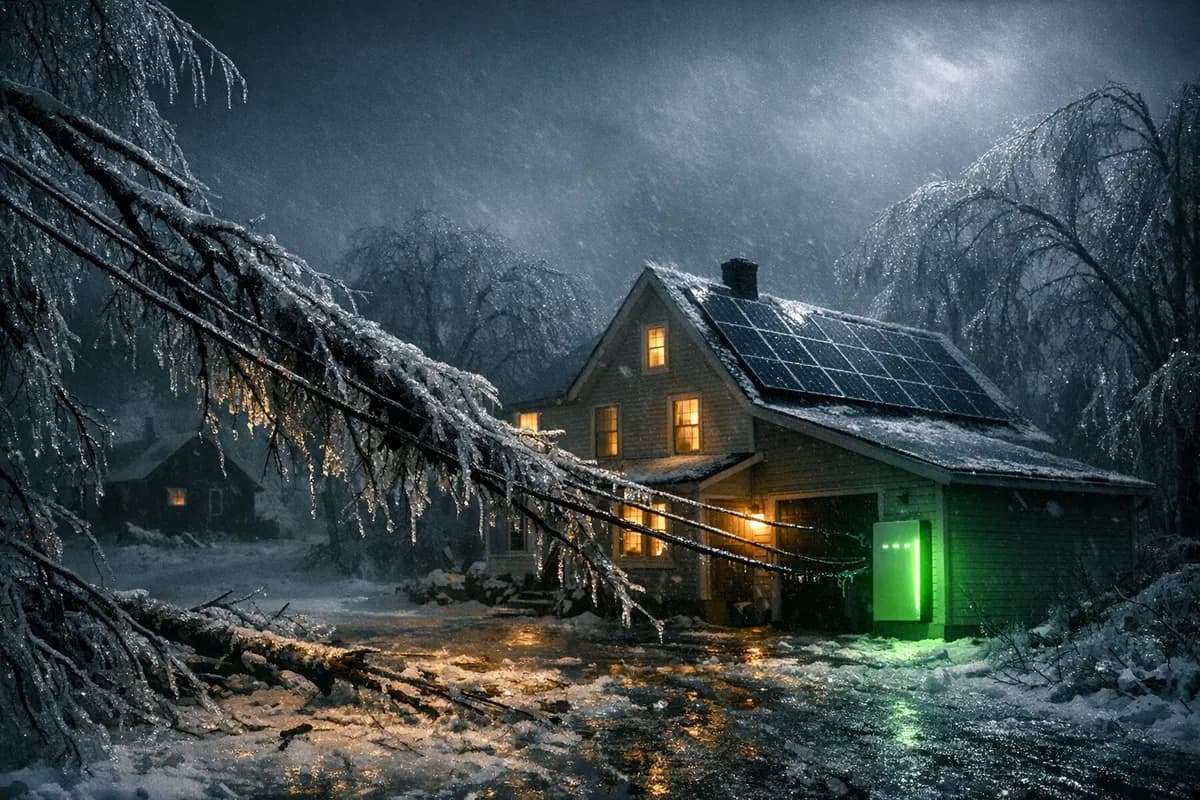
Rural Maine is the most outage-vulnerable area in New England. The 2023 ice storm left 400,000+ without power for up to a week. Solar panels alone shut off during blackouts. Battery backup is essential -- and it is the #1 reason Maine homeowners add storage.
400K+ Affected
2023 Ice Storm
Up to 7 Days
Rural Outage Duration
10-14 hrs
Battery Backup
Indefinite
Solar + Battery
Maine experiences major grid disruptions almost every winter. Ice storms, nor'easters, and wind events regularly leave tens of thousands without power for days.
Devastating glaze ice event coated trees and power lines across Maine. Rural interior communities saw 5-7 day outages. CMP deployed 1,800+ line crews from 10 states. Many households without heat in sub-zero temperatures.
400,000+
Customers Affected
1-7 days
Outage Duration
Heavy wet snow and 50+ mph gusts toppled trees across southern and coastal Maine. Portland metro saw widespread 24-48 hour outages.
180,000+
Customers Affected
1-4 days
Outage Duration
Late-season ice storm hit central Maine. Freezing rain on already stressed infrastructure.
90,000+
Customers Affected
1-3 days
Outage Duration
Worst power outage in Maine history at the time. Entire communities isolated. Some rural areas waited 10+ days for restoration.
500,000+
Customers Affected
2-10 days
Outage Duration
Catastrophic ice storm devastated northern New England. 80,000 miles of line damaged. Many Maine homes went weeks without power in January cold.
700,000+ (NE-wide)
Customers Affected
Up to 3 weeks
Outage Duration
Maine has 17.6 million acres of forest (89% forested, highest in the US). Power lines run through miles of trees, exposed to ice loading, wind throw, and falling branches. A single tree can take out miles of line.
Climate models show increasing freezing rain events in Maine as winter temperatures oscillate near the freeze/thaw boundary. The 2023-2024 season saw three major ice events -- the most in a decade.
Maine is the most rural state in New England. Aroostook County alone is larger than Connecticut and Rhode Island combined. Line crews prioritize population centers, leaving rural homes last in restoration.
Ice storms and nor'easters strike when you need power most. Without electricity, your heat pump, boiler circulator pump, and well pump all stop. In -10°F weather, pipes can freeze within hours.
This is the single most misunderstood fact about solar power. Many Maine homeowners are shocked to learn their $25,000+ solar system goes dark when the grid does.
NEC code requires grid-tied solar to disconnect during outages to protect utility workers. Without a battery, your $25,000+ solar system produces exactly $0 of electricity during a blackout.
NEC 2020 rapid shutdown requirements (adopted in Maine) mean panels de-energize within 30 seconds of grid loss. No workaround exists without battery or hybrid inverter.
A battery-equipped solar system automatically disconnects from the grid and creates its own "island" of power. Solar charges the battery during the day while you use stored energy at night.
A battery alone provides 10-14 hours of backup. But paired with solar, it recharges each day -- providing indefinite backup as long as there is some sunlight. Even on cloudy Maine winter days, panels produce 20-40% of rated capacity.
In Massachusetts, Eversource pays battery owners $275/kW through ConnectedSolutions. In Rhode Island, National Grid pays $225/kW. These payments of $1,500-$3,000+ per year offset battery costs within 5-7 years.
Maine has no equivalent program. Neither CMP nor Versant Power offers demand response payments for residential battery storage. There are no state battery rebates either.
This means the economics of battery storage in Maine rest entirely on outage resilience value. For rural Maine homeowners on wells who lose power 2-5 times per year, the value is clear: batteries prevent frozen pipes ($5,000-$15,000 in damage), spoiled food ($500-$1,000), hotel stays ($150-$300/night), and lost remote work income.
A single multi-day outage can cost a Maine family $2,000-$10,000. A battery system at $12,500-$16,000 pays for itself after 2-3 major events.
Cold-weather performance matters in Maine. Not all batteries handle sub-zero temperatures equally.
Size your system based on what you need to keep running during a multi-day winter outage. Remember: Maine winter solar production is 20-40% of summer output, so battery capacity matters more than panel count for short outages.
| Backup Loads | Daily kWh | Battery Needed | Solar Needed | Duration |
|---|---|---|---|---|
| Essential Only (lights, fridge, phone, WiFi) | 8-12 kWh | 1 battery (13-14 kWh) | 3-4 kW minimum | 1-2 days (battery only), indefinite with solar |
| Essential + Heat Pump (1 mini-split) | 18-28 kWh | 2 batteries (27-28 kWh) | 5-7 kW minimum | 1 day (battery only), indefinite with solar |
| Essential + Heat Pump + Well Pump | 25-38 kWh | 2-3 batteries (27-42 kWh) | 7-9 kW minimum | 12-20 hours (battery), indefinite with solar |
| Near Whole-Home (most circuits) | 35-55 kWh | 3-4 batteries (40-56 kWh) | 9-12 kW | 10-16 hours (battery), indefinite with solar |
Over 40% of Maine homes rely on private wells. When the power goes out, the well pump stops -- and so does your water supply. No flushing, no washing, no drinking water. In winter, the lack of circulating water can lead to frozen pipes within 4-6 hours in an unheated home.
Battery backup solves this problem, but well pump startup surge is the critical sizing consideration. A typical 1 HP submersible well pump draws 1,500-2,000W running but surges to 3,000-4,500W at startup. Your battery must handle this surge or the pump will not start.
No -- not without a battery. Grid-tied solar panels are required by NEC code to shut off during outages to protect utility line workers. Your $25,000+ solar system produces zero electricity during a blackout. Adding a battery ($12,500-$16,000) enables your solar to create an "island" of power independent from the grid, providing backup as long as there is daylight to recharge.
A single 13.5 kWh battery (like Tesla Powerwall 3) powers essential loads (lights, fridge, phone charging, WiFi router) for 10-14 hours. Add a heat pump mini-split and it drops to 5-8 hours. Paired with solar panels, the battery recharges each day -- even cloudy Maine winter days produce 20-40% of rated solar capacity. Two batteries with a 9 kW solar system can sustain a Maine home with one heat pump running through multi-day outages.
No. Unlike Massachusetts and Rhode Island, Maine does not have a ConnectedSolutions or similar demand response program that pays battery owners for grid services. The economics of battery storage in Maine rest entirely on backup power value and arbitrage between solar production and usage. There are no state-level battery rebates either. The value proposition is purely about outage resilience -- which, given Maine's outage history, is significant.
Generators ($3,000-$12,000 for whole-home standby) are cheaper upfront but require fuel (propane or natural gas, limited in rural ME). They need maintenance, produce carbon monoxide, and cannot be used indoors. Batteries ($12,500-$16,000) are silent, fuel-free, start instantly, and recharge from solar. For rural Maine homes on wells, a battery + solar system provides indefinite backup without fuel logistics. Many homeowners choose a small battery for essentials plus keep a portable generator for heavy loads.
One mini-split heat pump (12,000 BTU) draws 1.0-1.5 kW when running, or roughly 18-28 kWh per day in cold weather. One 13.5 kWh battery keeps it running for about 6-10 hours. Two batteries (27 kWh) provide a full day of heat. With solar panels recharging the batteries each day, two batteries can sustain one mini-split indefinitely through a multi-day outage.
Yes, but with a caveat. Well pumps draw high surge power (1,500-3,000W) when starting. Your battery's surge rating must exceed this. Tesla Powerwall 3 (11.5 kW continuous) handles most well pumps easily. Enphase IQ 5P (3.84 kW per unit) may need 2 units stacked for well pump startup. Have your installer verify your well pump specs before finalizing battery sizing.
Comprehensive battery storage for Maine storms
Read moreFull comparison for Maine homeowners
Read moreFull pricing breakdown for Maine solar
Read moreUtility-specific battery strategy
Read moreHow solar economics work post-25D
Read moreFull off-grid setup for rural Maine
Read moreThe next ice storm is not a matter of if, but when. Solar + battery backup keeps your lights on, heat pump running, and well pump flowing when the grid goes dark for days.