Loading NuWatt Energy...

We use your location to provide localized solar offers and incentives.
We serve MA, NH, CT, RI, ME, VT, NJ, PA, and TX
Loading NuWatt Energy...
NuWatt designs, installs, and manages solar, battery, heat pump, and EV charger systems across 9 states. One company, one warranty, one point of contact.
Get a Free Quote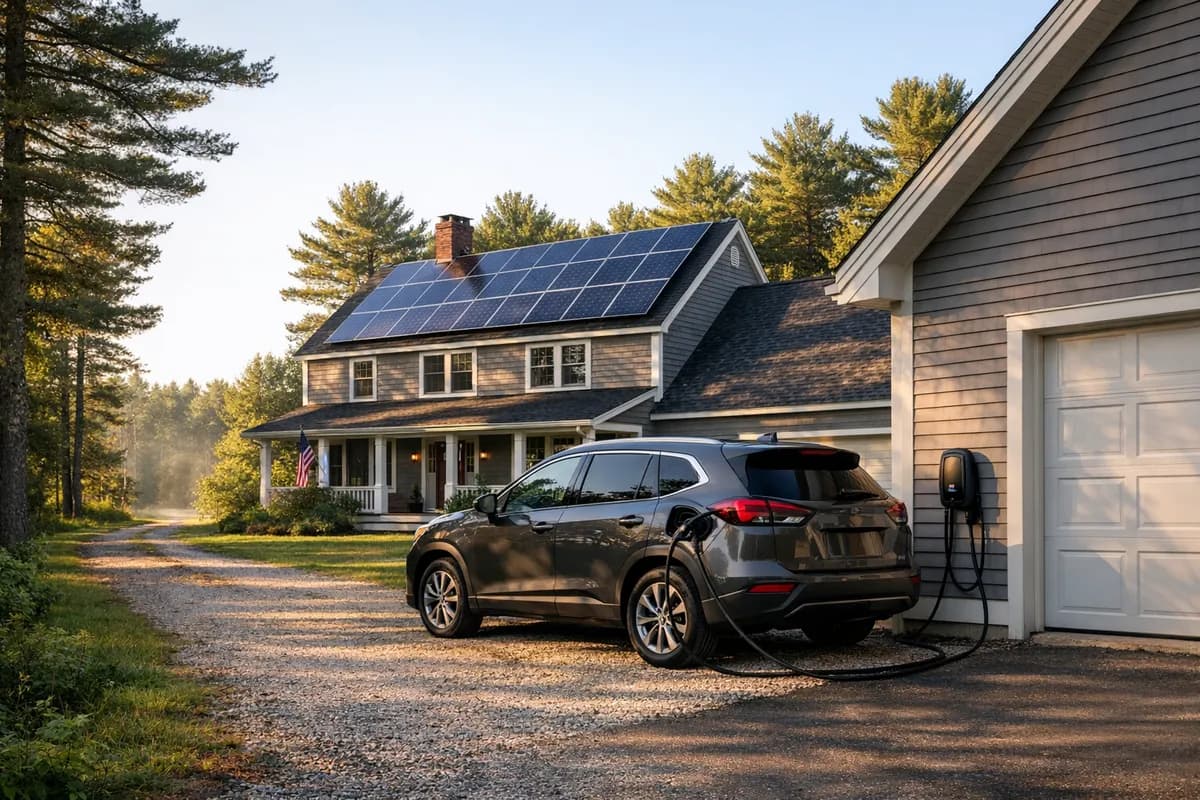
Add 2-3 kW of extra solar to power your EV for free. The Section 30C federal charger credit expired June 30, 2026, but Efficiency Maine rebates and $0/mile solar charging still make the numbers work. Rural Maine commuters save the most: $2,000-$3,000+/year vs gasoline at $3.50/gal.
2-3 kW
Extra Solar for EV
$520/yr
Property Tax Savings
$1,500-$3,000+
Annual Fuel Savings
$0.00
Solar EV Cost/Mile
Based on 12,000 miles per year and Maine's 1,200 kWh/kW/year solar production. Rural commuters driving 15,000-20,000 miles should add 25-65% more.
| Vehicle | Efficiency | Annual kWh | Extra Solar | Extra Panels | Notes |
|---|---|---|---|---|---|
| Tesla Model 3 / Model Y | 3.5-4.0 mi/kWh | 3,000-3,430 kWh | 2.5-2.9 kW | 6-7 panels (440W) | Most popular EVs in Maine. Efficient in cold weather with heat pump cabin. |
| Chevy Equinox EV | 3.2-3.6 mi/kWh | 3,330-3,750 kWh | 2.8-3.1 kW | 7-8 panels | Popular affordable EV. Good range for ME commutes. |
| Ford F-150 Lightning | 2.0-2.5 mi/kWh | 4,800-6,000 kWh | 4.0-5.0 kW | 10-12 panels | Popular in rural ME. Truck efficiency is lower. Needs more solar. |
| Hyundai Ioniq 5 | 3.3-3.8 mi/kWh | 3,160-3,640 kWh | 2.6-3.0 kW | 6-7 panels | Excellent cold-weather efficiency. AWD variant popular in ME. |
| Average (12,000 mi/yr) | 3.0-3.5 mi/kWh | 3,430-4,000 kWh | 2.9-3.3 kW | 7-8 panels | Maine average. Rural commuters may drive 15,000-20,000 mi/yr. |
When you charge your EV from solar panels, your per-mile fuel cost drops to $0. Even grid-charged EVs save significantly vs gasoline at Maine prices.
Gas at $3.50/gal, 25 MPG average. Solar-charged EV = $0 fuel cost.
CMP at $0.27/kWh. Grid-charged EV still saves vs gasoline.
Versant at $0.32/kWh. Higher rates reduce gas savings margin.
Section 30C expired June 30, 2026 under the OBBBA and is no longer available. Bundling a charger with solar still pays off through Efficiency Maine rebates and $0/mile solar-powered driving.
Status: Expired June 30, 2026 (OBBBA) and no longer available for residential installations.
Previously: 30% of charger + installation cost, up to $1,000 residential.
Still available: Efficiency Maine EV charger rebates and $0/mile solar-powered charging.
All three pair well with rooftop solar and may qualify for Efficiency Maine EV charger rebates. Choose based on your EV brand, budget, and whether you need smart features.
Works with all EVs (J1772 adapter included). WiFi connected. Best for Tesla owners.
Universal. Energy Star certified. WiFi/app control. NEMA 6-50 or hardwired.
Budget option. Weatherproof (NEMA 4). Great for outdoor install in ME winters.
The average Maine commute is 24 minutes, but rural communities face 40-60+ minute drives. A 60-mile daily round trip uses 17-20 kWh in an efficient EV. Solar-charging these miles saves $2,000-$3,000+/year vs gasoline at $3.50/gal.
Gas stations in rural Maine often charge $0.20-$0.40 more per gallon than Portland. At $3.70-$3.90/gal, the EV savings advantage grows further. Solar eliminates fuel costs entirely.
Rural Maine has very limited public EV charging. Towns north of Bangor may have zero Level 2 chargers for 30+ miles. Home solar + Level 2 charging eliminates range anxiety by guaranteeing a full charge every morning.
Rural Mainers already value self-sufficiency. Solar + EV charging means you generate your own fuel on your roof. Combined with a battery for backup power, you are resilient against both grid outages and gas price spikes.
Maine's Net Energy Billing (NEB) program provides 1:1 retail-rate credits for excess solar exported to the grid. This is the key mechanism that makes solar EV charging work even when you charge at night.
Here is how it works: During the day, your solar panels produce electricity. What you do not use immediately goes to the grid and earns credits at the full retail rate ($0.27/kWh on CMP, $0.32/kWh on Versant). At night, when you plug in your EV, those credits offset the grid electricity used for charging. Over a billing period, the credits cancel out the nighttime usage.
This means you do not need a battery specifically for EV charging. The grid acts as your battery -- storing daytime solar credits and applying them to nighttime EV charging. A battery is valuable for outage backup (see our outage backup guide), but it is not required for the solar + EV economics to work.
Key insight: Adding 3 kW of solar for your EV shortens overall payback by 2-3 years because the fuel savings ($1,500+/yr) are immediate and substantial. A solar-only 9 kW system has a 15-17 year payback in Maine. A 12 kW system with EV charging has a 6-8 year payback because you are displacing $3.50/gal gasoline in addition to $0.27-$0.32/kWh electricity.
For a typical EV driven 12,000 miles per year in Maine, you need 2.5-3.3 kW of additional solar capacity, or roughly 6-8 extra 440W panels. Maine averages 1,200 kWh/kW/year of solar production. If you drive more (rural commuters at 15,000-20,000 miles), scale up to 3.5-5.0 kW extra. An F-150 Lightning needs about 4-5 kW of extra solar due to lower efficiency.
No. Section 30C expired June 30, 2026 under the OBBBA and is no longer available for residential installations. It previously provided a federal tax credit of 30% of the cost of a home EV charger, up to $1,000. Maine EV owners can still cut charger costs through Efficiency Maine EV charger rebates, and pairing the charger with solar delivers $0/mile driving that outlasts any one-time credit.
On CMP at $0.27/kWh, charging a typical EV costs about $0.07-$0.09 per mile, or roughly $70-$90 per month for 12,000 miles/year. On Versant at $0.32/kWh, it costs $0.08-$0.11 per mile, or $85-$110 per month. With solar panels, your EV charging cost drops to $0/mile for energy produced by your panels. Net Energy Billing (1:1 retail credit) means excess solar production during the day offsets your nighttime EV charging.
Efficiency Maine has offered EV rebates in the past (up to $2,000 for new EVs for income-qualified households) and EV charger rebates. However, the EV rebate program funding fluctuates and may have waitlists or be exhausted. Check efficiencymaine.com for current availability. The federal Section 30C charger credit expired June 30, 2026, so the durable savings now come from Efficiency Maine rebates plus $0/mile solar-powered charging.
Yes, but with reduced capacity. Maine solar panels produce about 30-40% of their summer output in December-January (shorter days, snow coverage, low sun angle). A 9 kW system produces ~15-20 kWh/day in winter vs ~40-45 kWh/day in summer. Thanks to Net Energy Billing (1:1 retail credit), your excess summer production banks credits that offset winter grid charging. Over a full year, a properly sized system covers 100% of your EV charging needs.
Always get a Level 2 (240V) charger if you are installing solar. The included 120V charger adds only 3-5 miles of range per hour (24-40 miles overnight). A Level 2 charger adds 25-35 miles per hour, fully charging any EV overnight. In Maine, where cold weather reduces charging efficiency by 10-20%, the faster Level 2 speed ensures a full charge by morning even on the coldest nights. Plus, Level 2 chargers may qualify for Efficiency Maine EV charger rebates.
Complete bundle guide with Efficiency Maine rebate details
Read moreFull pricing breakdown for Maine solar
Read more1:1 NEB credits offset nighttime EV charging
Read moreHow your utility affects solar + EV economics
Read moreSolar economics after 25D expiration
Read moreAdd battery for EV + home backup
Read moreSolar + EV charging is the fastest-payback solar investment in Maine. Add a Level 2 charger with your solar system for Efficiency Maine rebates and $0/mile fuel from your own roof.