Loading NuWatt Energy...

We use your location to provide localized solar offers and incentives.
We serve MA, NH, CT, RI, ME, VT, NJ, PA, and TX
Loading NuWatt Energy...
NuWatt designs, installs, and manages solar, battery, heat pump, and EV charger systems across 9 states. One company, one warranty, one point of contact.
Get a Free Quote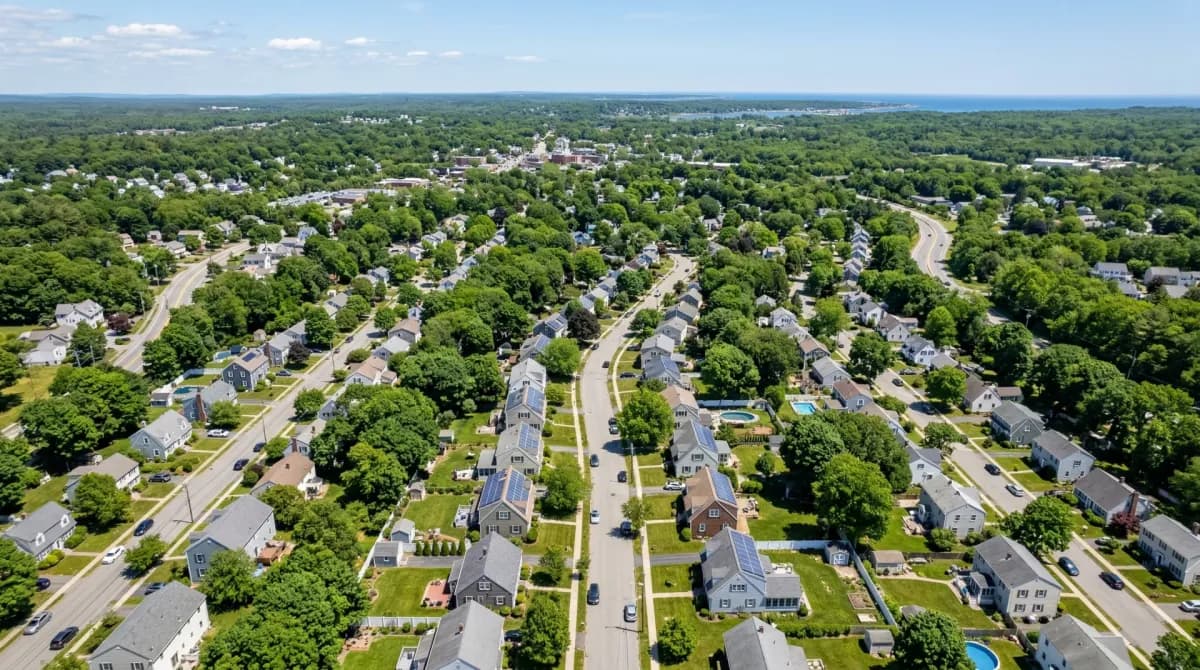
This North Shore town of ~28,100 is served by the town-run Danvers Electric Division at ~$0.1767/kWh -- about 58% below National Grid next door in Beverly. A lower rate stretches the solar payback, but Danvers Electric runs its own $1.20/watt solar rebate. No statewide SMART 3.0 or ConnectedSolutions here -- this is the honest North Shore math.
Danvers Electric Division • ~$0.1767/kWh • $1.20/W town rebate • No SMART/ConnectedSolutions
2026 Reality: The 30% federal tax credit (Section 25D) expired for homeowners December 31, 2025. All costs in this guide reflect $0 federal credit. Full details
Municipal Utility Notice: Your electricity in Danvers comes from the Danvers Electric Division, a town light plant operated by the Danvers Department of Public Works -- not National Grid or Eversource. Because it is a municipal light plant, the statewide SMART 3.0 and ConnectedSolutions programs do not reach Danvers, and net metering is governed by the town rather than the state Department of Public Utilities. What Danvers does offer in their place is a direct, town-funded $1.20-per-watt solar rebate (up to $4,500) plus roughly 1:1 bill credits for what you export -- a structure you will not find in a neighboring Eversource or National Grid town. So in Danvers you trade away two recurring state revenue streams for one large upfront check from the utility.
A 12 kW system in Danvers costs $35,400-$39,600 in 2026. With Danvers Electric Division rates at ~$0.1767/kWh and no SMART income, annual savings are approximately $2,544/yr. Danvers Electric’s own $1.20/watt solar rebate (up to $4,500) trims the upfront cost, but the low rate still puts cash-purchase payback at 14-16 years. Over 25 years, total savings are approximately $64,000.
Cost Range
$2.95-$3.3/W
Fully installed
Avg System
12 kW
Danvers average
Payback
14-16 yrs
Cash purchase
25-Year Savings
~$64K
Estimated total value
Danvers is an Essex County town of ~28,100 on the North Shore, sitting where the Porter River tidal estuary meets the inland suburbs north of Boston. Its housing runs from older coastal homes in Danversport to mid-century ranches in Tapleyville and the Danvers Highlands. Power comes from the Danvers Electric Division -- a municipal light plant the town has operated through its Department of Public Works for decades, completely independent of Eversource and National Grid. That ownership is why Danvers electricity is cheaper than the surrounding National Grid towns (Beverly, Salem) and why its solar incentives look nothing like theirs.
Population
~28,100
Median Home Value
~$520,000
Primary Utility
Danvers Electric Division (MLP)
Electric Rate
~$0.1767/kWh
Town Solar Rebate
$1.20/W (up to $4,500)
Region
North Shore / coastal
Typical System Size
10-15 kW
Solar Irradiance
4.2 kWh/m²/day
Beverly sits directly across the Danvers line on National Grid, which makes it the cleanest head-to-head. Danvers Electric customers pay less for power and get a town solar rebate, but the statewide SMART 3.0 and ConnectedSolutions income that drives the fast National Grid payback simply isn't on the table. Here is the side-by-side.
| Factor | Danvers (Danvers Electric) | Beverly (National Grid) |
|---|---|---|
| Electric Rate | ~$0.1767/kWh | $0.42/kWh |
| Upfront Solar Rebate | $1.20/W town rebate (up to $4,500) | None (relies on SMART instead) |
| Annual Savings (12 kW) | ~$2,544/yr | ~$6,016/yr |
| SMART 3.0 Income | Not eligible ($0) | ~$432/yr |
| ConnectedSolutions | Not eligible ($0) | ~$2,750/yr (10 kW battery) |
| Total Annual Value | ~$2,544/yr | ~$9,198/yr |
| Payback Period | 14-16 years | 7.5-9 years |
| 25-Year Savings | ~$64K | ~$120K+ |
Bottom line: Even with Danvers Electric's $1.20/watt rebate trimming the upfront cost, Danvers homeowners capture roughly 72% less total annual value from solar than a National Grid neighbor in Beverly, because the recurring SMART and ConnectedSolutions income isn't available here. The lower Danvers Electric rate is excellent for your bill today, but it stretches the solar payback period.
Costs for different system sizes in Danvers at $2.95-3.30/W. Annual savings are figured on the Danvers Electric Division rate (~$0.1767/kWh), not National Grid rates -- and before Danvers Electric's $1.20/watt rebate (up to $4,500), which comes off the upfront cost.
| System Size | Low Cost | High Cost | Annual Savings | Best For |
|---|---|---|---|---|
| 7 kW | $20,650 | $23,100 | ~$1,484/yr | Condo / smaller Cape |
| 9 kW | $26,550 | $29,700 | ~$1,908/yr | Mid-size colonial / ranch |
| 12 kW | $35,400 | $39,600 | ~$2,544/yr | Typical Danvers single-family |
| 15 kW | $44,250 | $49,500 | ~$3,181/yr | Large home / EV + battery |
| 18 kW | $53,100 | $59,400 | ~$3,817/yr | High usage / all-electric home |
Prices include equipment, labor, permits, and grid interconnection. No federal tax credit included (expired). $1,000 MA state tax credit and Danvers Electric's $1.20/watt rebate not yet deducted. Annual savings based on Danvers Electric rates (~$0.1767/kWh). No SMART income included (MLP -- not eligible).
The Danvers Electric Division solar rebate pays $1.20 per watt AC on the first 3.75 kW AC of installed capacity. Do the arithmetic and the cap is clear: 3,750 watts AC x $1.20 = $4,500. Because virtually every residential system in Danvers is larger than 3.75 kW AC, a Danvers homeowner almost always earns the full $4,500. It is a flat check that does not scale with system size past that threshold -- so the rebate is proportionally most powerful on a smaller array and shrinks (in percentage terms) as the system grows.
| System Size | Gross Cost (avg) | Danvers Rebate | Net After Rebate | Rebate as % of Cost |
|---|---|---|---|---|
| 7 kW | ~$21,875 | -$4,500 | ~$17,375 | 20.6% |
| 9 kW | ~$28,125 | -$4,500 | ~$23,625 | 16.0% |
| 12 kW | ~$37,500 | -$4,500 | ~$33,000 | 12.0% |
| 15 kW | ~$46,875 | -$4,500 | ~$42,375 | 9.6% |
| 18 kW | ~$56,250 | -$4,500 | ~$51,750 | 8.0% |
The $1.20/watt rebate is a customer-owned incentive. Pay cash or finance with a loan and the rebate is yours; sign a third-party PPA or lease and the system owner -- not you -- holds title, so the rebate is forfeited. In Danvers, where leases are permitted, that is the single biggest reason cash and loan beat a PPA on lifetime value.
The Danvers Electric rebate is separate from the statewide perks you still keep: the $1,000 MA personal income tax credit, the 6.25% sales-tax exemption, and the 20-year property-tax exemption. Stack all four and a typical Danvers system sheds several thousand dollars off the sticker before you count a single kilowatt-hour of bill savings.
Gross figures use the ~$3.13/W midpoint of the $2.95-$3.30/W Danvers range; rounding may vary slightly from quoted system pricing. Rebate terms and funding availability are set by the Danvers Electric Division and should be confirmed before contract. Source: Danvers Electric Division residential rebate schedule (verified May 2026).
Danvers neighborhoods range from coastal Danversport along the Porter River to the inland Highlands and Tapleyville. All sit in Danvers Electric Division territory at the same rate, but the one variable that actually changes by neighborhood here is salt-air exposure: properties closest to the tidal estuary warrant marine-grade racking and corrosion-rated hardware, while the inland blocks face essentially none of that.
Home Types
Colonials, Capes, newer construction
Avg System
11-14 kW
Inland and elevated, well away from the estuary, so salt-air corrosion is a non-issue and standard hardware is fine. Good roof access with moderate tree canopy. A typical 11-14 kW system here comfortably absorbs the full $1.20/watt Danvers Electric rebate on the first 3.75 kW AC.
Home Types
Ranches, split-levels, newer subdivisions
Avg System
12-15 kW
Largest lots in town near the Middleton line, fully inland with no coastal exposure. Newer ranch and split-level roofs sit at favorable south pitches. Larger homes and higher bills here push toward the 12-15 kW end -- the sweet spot for offsetting a low Danvers Electric rate.
Home Types
Older colonials, Capes, smaller homes
Avg System
8-11 kW
The coastal pocket along the Porter River tidal estuary -- the one neighborhood where salt air matters. Specify IEC 61701 salt-mist-tested panels, marine-grade stainless mounting hardware, and aluminum racking with strong corrosion warranties. Open water to the south can mean unobstructed solar access on the right roofs.
Home Types
Mixed residential, Victorian, multi-family
Avg System
8-10 kW
Denser blocks around Danvers Square and Route 1, with closer lot spacing and mature street trees that warrant a shade study. Older roofs may need evaluation before mounting. Smaller systems here still clear the 3.75 kW AC threshold for the maximum town rebate.
Danvers sits along the Porter River tidal estuary on the North Shore, which puts a band of the town -- Danversport and the low-lying streets nearest the water -- in a genuine coastal-exposure zone, while the inland Highlands and Tapleyville are effectively sheltered. For a solar buyer, the practical question is not “will salt air ruin my panels?” (it won't) but “is my installer specifying the right corrosion-rated hardware for where my house actually is?”
Quality modules carry IEC 61701 salt-mist corrosion certification, the same standard used for oceanfront and marine installations worldwide. A panel rated to that test handles decades of North Shore air without degradation -- this is a solved problem at the module level.
The real coastal wear point is the racking and fasteners. Near the estuary, specify marine-grade (316) stainless hardware and anodized aluminum rails rather than plain galvanized steel, and confirm the manufacturer's corrosion warranty explicitly covers coastal placement. This is a small line-item difference, not a major cost driver.
A Danversport roof a few hundred yards from the water and a Tapleyville roof near the Middleton line face very different exposure. Inland Danvers needs no coastal upgrade at all; only the waterfront band warrants the marine spec. Ask your installer to size the hardware to your address, not to “Danvers” as a blanket.
Bonus for coastal roofs: properties with open exposure south over the water -- common in Danversport -- often have unusually clean, unshaded solar windows, since there are no trees or buildings on the water side. The same location that calls for marine hardware can also be one of the better-producing roofs in town.
Because Danvers trades recurring state programs for an upfront utility rebate, the decision here turns on ownership and time horizon more than on incentive-chasing. Here is who the Danvers Electric structure rewards -- and who it doesn't.
You will own the system (cash or loan) -- that is what unlocks the $1.20/watt Danvers Electric rebate
You plan to stay in your home 12+ years to ride out the longer MLP-rate payback
You run an EV, heat pump, or pool that pushes usage high enough to make ~1:1 Danvers Electric credits count
You want a hedge against future Danvers Electric rate increases
You can pay cash or get a low-APR loan (under 5%)
You want the resale-value bump from an owned, transferable system
You want a third-party PPA -- it forfeits the $1.20/watt rebate that makes Danvers math work
You need payback under 10 years (the low Danvers Electric rate makes that hard here)
You expect to move within 8-10 years
You would have to borrow at a high APR (7%+)
Your roof is due for replacement before a 25-year array goes on it
Heavy tree shading would drop production below ~80% of potential
The Danvers Building Department handles the building/electrical permit (typically issued in about 8 business days, fee roughly $50-$100, online applications accepted), and the Danvers Electric Division handles interconnection -- which as a single town-run MLP it turns around quickly, on the order of 12 business days. End to end, Danvers solar projects usually run about 4-9 weeks from signed contract to permission to operate, fast for Massachusetts.
Installer evaluates roof condition, shade, and orientation. On coastal Danversport roofs, salt-air-rated hardware is specified at this stage.
Online application to the Danvers Building Department (~8 business days, ~$50-$100), with electrical and structural plans, plus the Danvers Electric interconnection application filed in parallel.
Typical installation 1-3 days, followed by town electrical and building inspection.
The Danvers Electric Division approves the grid connection and installs the bi-directional meter -- usually within about 12 business days as a single local utility.
Statewide SMART 3.0 and ConnectedSolutions don't reach municipal-utility territory -- but Danvers Electric Division runs its own incentive menu, and you still get the MA state-level exemptions. The headline item is a per-watt solar rebate that IOU customers simply don't have.
Danvers Electric Division pays $1.20/watt AC on the first 3.75 kW AC of installed capacity for its residential customers. Confirm current funding and terms with the utility.
Up to $4,500
Town MLP rebate — not SMART
Danvers Electric offers net metering at approximately a 1:1 credit, with monthly bill credits for excess generation. Terms are set by the utility, not the state -- confirm them directly with Danvers Electric Division (danversma.gov/electric).
~$2,544/yr
Based on ~$0.1767/kWh rate
15% of system cost, capped at $1,000. Available to all MA residents.
$1,000
One-time credit
Solar systems exempt from 6.25% MA sales tax. Available statewide.
~$2,344
Savings on typical system
Solar-added value exempt from property tax for 20 years. Danvers has a 1.109% residential rate.
~$416/yr
20-year exemption (~$8,320 total)
Not available. SMART only applies to IOU customers.
$0/yr
Not eligible
Not available. ConnectedSolutions is Eversource/National Grid only.
$0/yr
Not eligible
Financing matters more in Danvers because the low Danvers Electric rate means monthly loan payments can exceed your bill savings in the early years. Cash is the strongest option here -- and, like a loan, it keeps the system customer-owned so you capture the $1.20/watt town rebate. A third-party PPA forfeits that rebate.
Upfront
~$35,400-$39,600
Monthly
$0
25-yr Savings
~$64K
Ownership
You own it
Best long-term value, and the only path that captures Danvers Electric’s $1.20/watt customer-owned solar rebate. 14-16 year payback given the low Danvers Electric rate. Energy independence and rate-hedge are key drivers.
Upfront
$0 down
Monthly
~$240-335/mo (5.5-8% APR)
25-yr Savings
~$25-40K
Ownership
You own it
You still own the system, so the Danvers Electric rebate still applies. At the low Danvers Electric rate, monthly loan payments likely exceed bill savings for 8-12 years, so a low-APR loan (<5%) is essential for positive cash flow.
Upfront
$0
Monthly
Fixed ~$0.11-0.14/kWh
25-yr Savings
~$12-25K
Ownership
Third party owns
The PPA rate must undercut Danvers Electric’s ~$0.1767/kWh to save you money, and because you don’t own the system you forfeit the $1.20/watt customer-owned rebate. The third-party owner claims the Section 48 ITC. Narrower margin than in National Grid territory.
Section 25D (the 30% residential solar tax credit) expired December 31, 2025 under the OBBBA. Danvers homeowners buying cash or loan receive $0 in federal credit. The commercial Section 48/48E ITC remains available to third-party system owners (PPA/lease) on two pathways: projects that began construction on or before July 4, 2026 locked in the full timing, and projects that begin later still qualify if placed in service by December 31, 2027.
Read: What happened to the solar tax creditExplore the complete library of Massachusetts solar guides, incentive programs, and local energy resources.
MA Solar Guide 2026
Complete guide to going solar in Massachusetts in 2026.
Solar Panel Cost in MA
Statewide cost breakdown: $2.80–$3.50/W by city and utility.
Danvers Electric Solar Guide
Deep dive on the town MLP: net metering, rebate, and how it differs from National Grid.
SMART Program Guide
$0.03/kWh for 20 years. Danvers Electric customers not eligible — IOU only.
Net Metering in MA
IOU 1:1 retail credit vs. Danvers Electric municipal net metering rules.
ConnectedSolutions Battery
Eversource/National Grid demand response — not available to Danvers Electric customers.
Income-Eligible Programs
Free or deeply discounted upgrades for income-qualified homeowners.
Solar Financing Options
Cash, loan, and PPA compared for MA homeowners.
Solar panels in Danvers cost $2.95-3.30 per watt installed in 2026. A typical 12 kW system costs $35,400-$39,600. The federal Section 25D residential tax credit expired December 31, 2025. Danvers Electric Division is a municipal light plant, so the statewide SMART 3.0 and ConnectedSolutions programs do not apply here -- but Danvers Electric runs its own $1.20/watt AC solar rebate (first 3.75 kW AC, up to $4,500) that IOU customers do not get.
Danvers Electric Division charges approximately $0.1767/kWh all-in (R-1 rate with the PP&FA effective November 1, 2025) -- about 58% less than National Grid's $0.42/kWh in neighboring Beverly and Salem. A lower rate is great for your monthly bill, but it means each solar kWh you offset is worth less, so annual savings are lower. As a municipal-utility customer you also can't earn SMART 3.0 or ConnectedSolutions income (those are investor-owned-utility programs). Danvers Electric's own $1.20/watt solar rebate offsets part of the upfront cost, but the net effect is a longer payback (14-16 years) than in National Grid territory (7.5-9 years).
Danvers Electric Division offers a per-watt solar rebate of $1.20/watt AC on the first 3.75 kW AC of installed capacity, capped at $4,500, to its residential customers. It also offers cold-climate heat pump ($1,500/ton up to $6,000), EV charger, e-bike, weatherization, and heat-pump-water-heater rebates. These are municipal-utility programs separate from (and not stackable with) Mass Save, SMART, or ConnectedSolutions, which Danvers customers are not eligible for. Confirm current rebate terms and funding availability with Danvers Electric before signing a contract.
No. SMART 3.0 (the per-kWh generation incentive) and ConnectedSolutions (the battery demand-response program) are administered through the investor-owned utilities -- Eversource, National Grid, and Unitil. Danvers buys and distributes its own power through the town-run Danvers Electric Division, so neither program touches Danvers. The substitute the town offers is its own $1.20/watt upfront solar rebate plus roughly 1:1 net metering -- a one-time check rather than 20 years of SMART payments. Whether that trade favors you depends mostly on whether you own the system and how long you stay.
It can in the most exposed pockets. Danversport and properties near the Porter River and the coast see periodic salt-air exposure, which over many years can accelerate corrosion of unprotected metal. Modern panels are IEC 61701 salt-mist corrosion tested and handle coastal New England conditions well; the practical step is specifying marine-grade stainless mounting hardware and aluminum racking with strong corrosion warranties. Inland Danvers neighborhoods (Tapleyville, the Highlands) face essentially no extra salt-air risk.
It can be, depending on your priorities. With Danvers Electric’s $1.20/watt rebate applied, the cash-purchase payback is roughly 14-16 years -- still well inside the 25-year panel warranty. Solar provides energy independence, a hedge against future Danvers Electric rate increases, a property-value bump, and environmental benefit. For homeowners planning to stay 14+ years, it remains a reasonable investment; over 25 years a typical system saves around $64,000.
Yes -- Danvers Electric Division offers net metering at approximately a 1:1 credit for residential solar, with monthly bill credits for excess generation. Because it is a municipal light plant, those terms are set by the utility (not mandated by the state Department of Public Utilities), so they can differ from investor-owned net metering and can change. Confirm current interconnection requirements, credit treatment, and system-size limits directly with Danvers Electric Division before you size a system.
We'll give you an honest assessment based on Danvers Electric Division rates and the $1.20/watt town rebate -- not inflated numbers based on National Grid pricing. Get real Danvers-specific solar savings.
Complete hub for MA solar, heat pumps, and utility resources.
Read moreStatewide solar costs and city-by-city breakdown.
Read moreHow different MA utilities affect solar economics.
Read moreCash vs loan vs PPA. Critical for municipal utility customers.
Read moreHow to make solar work without the 25D credit.
Read moreSales + property tax exemptions still available.
Read more25D expired. What options remain for homeowners.
Read moreMLP customers are NOT eligible. See who qualifies.
Read moreMLP customers are NOT eligible for this demand response program.
Read moreTrack rate changes across MA utilities and MLPs since 2020.
Read moreLive installation data, capacity trends, and market stats.
Read moreCurrent wait times and how MLP interconnection differs.
Read morePricing: EnergySage Solar Marketplace (January 2026), NuWatt Energy North Shore installations.
Utility rates: Danvers Electric Division R-1 rate schedule (PP&FA effective November 1, 2025), verified June 2026.
Solar rebate & net metering: Danvers Electric Division (Danvers DPW) residential rebate schedule and net metering policy, verified May 2026.
SMART eligibility: MassDOER program rules -- municipal light plant customers excluded.
Tax exemptions: MA Department of Revenue, Danvers Assessor data.