Loading NuWatt Energy...

We use your location to provide localized solar offers and incentives.
We serve MA, NH, CT, RI, ME, VT, NJ, PA, and TX
Loading NuWatt Energy...
NuWatt designs, installs, and manages solar, battery, heat pump, and EV charger systems across 9 states. One company, one warranty, one point of contact.
Get a Free QuoteAir-source heat pumps last 15-20 years. Massachusetts winters and coastal salt air can cut that short. Here is how to know when repair makes sense and when it is time to replace.
Last updated March 2026
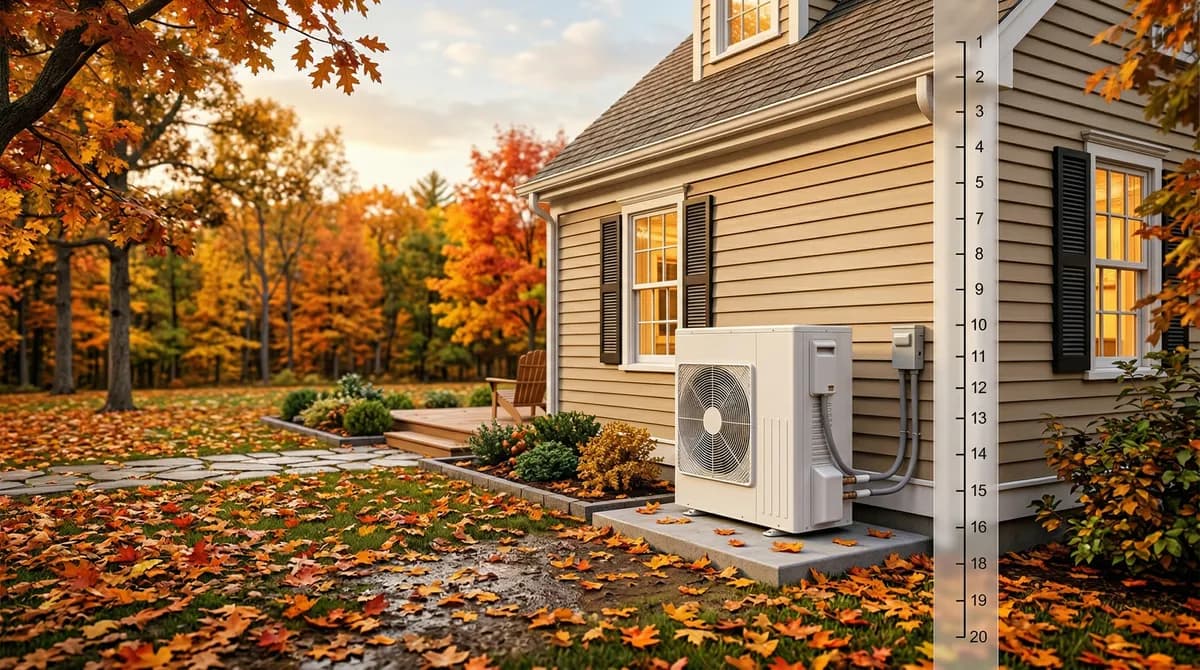
2026 Update: The federal 25C heat pump tax credit expired December 31, 2025. There is no federal tax credit for heat pump replacements in 2026. Mass Save rebates remain available up to $8,500. Current MA heat pump rebates
15-18 yr
Ducted Air-Source
15-20 yr
Ductless Mini-Split
20-25 yr
Geothermal
10-15 yr
HPWH
Ground loops for geothermal systems last 50+ years. Massachusetts harsh winters and coastal salt air can reduce air-source lifespan by 2-5 years compared to milder climates.
Not all heat pumps age the same way. Here is how long each type lasts in Massachusetts real-world conditions, not manufacturer lab estimates.
Central ducted heat pumps with air handler. Compressor life is the limiting factor. Variable-speed inverter models tend to last longer than single-stage units because they cycle less aggressively.
MA-specific: Massachusetts winters push ducted systems harder than southern climates. Expect the lower end of this range on the coast (salt air corrosion).
Wall-mounted or ceiling cassette indoor units with outdoor condenser. Fewer mechanical parts than ducted systems and no ductwork to leak. Multi-zone systems may need individual head replacements.
MA-specific: Mini-splits with Hyper-Heat (Mitsubishi) or XLTH (Fujitsu) cold-climate compressors handle MA winters well. Salt air within 2 miles of the coast can cut lifespan by 2-4 years without protective coatings.
Indoor heat pump unit lasts 20-25 years. The underground ground loop lasts 50+ years and rarely needs replacement. The compressor is protected from outdoor weather because the entire unit is indoors.
MA-specific: Geothermal is ideal for Massachusetts because the ground loop is unaffected by surface weather. Higher upfront cost ($18,000-$30,000) but the longest total system life.
Hybrid water heaters with a heat pump on top. Tank corrosion is the primary failure mode. Anode rod replacement every 3-5 years can extend life significantly.
MA-specific: Hard water areas in western MA (Springfield, Pittsfield) may see shorter tank life. Mass Save offers $750 rebate for HPWH replacement.
Massachusetts is one of the harder environments for air-source heat pumps. Understanding these factors helps you plan maintenance and replacement timing.
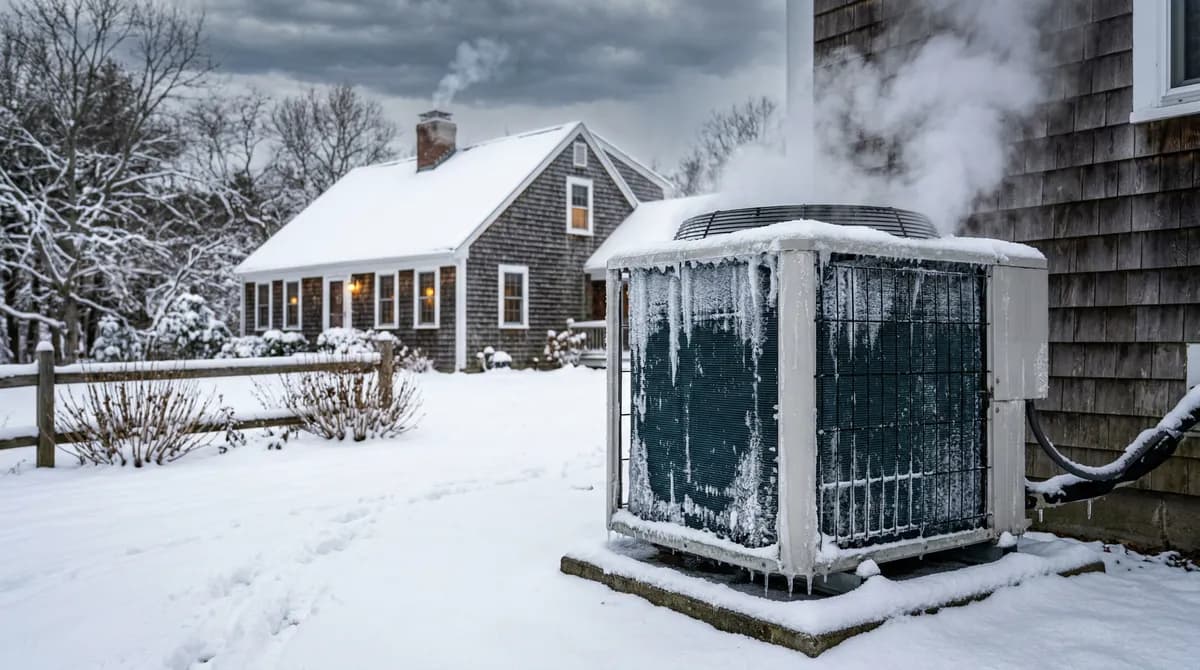
Massachusetts sees 20-40 days below 20 degrees F annually. Each cold snap forces the compressor into maximum output and triggers frequent defrost cycles.
Impact: -1 to -3 years vs. moderate climates (Zone 4-5)
Cape Cod, the Islands, North Shore, and South Shore communities experience salt-laden ocean air that corrodes aluminum fins and copper tubing.
Impact: -2 to -5 years for homes within 2 miles of coast
New England freeze-thaw cycles create ice buildup on outdoor coils. High summer humidity increases cooling-mode strain and condensate production.
Impact: -1 to -2 years; mitigated by proper drainage and defrost settings
Any one of these signals warrants a replacement conversation. Two or more together make the decision clear.
One repair per year is normal. Two or more major repairs per year — especially compressor, reversing valve, or expansion valve issues — signals the system is declining. Track your repair costs annually.
A heat pump that ran $150/month in heating season now costs $220+ for the same comfort level. This indicates refrigerant loss, compressor wear, or failing components. Compare bills year-over-year at the same temperatures.
R-22 (Freon) was banned in 2020. Refrigerant costs $100-$300/lb. If your system uses R-22, replacement is the only financially rational choice — a single recharge can cost $500-$1,500.
R-410A is being phased down under the EPA AIM Act. While still available for service, refrigerant costs are rising. If your R-410A system is 10+ years old, start planning for replacement with an R-32 or R-454B model.
Grinding, squealing, or rattling from the compressor. Excessive vibration. These indicate bearing wear or internal compressor damage. Short cycling (turning on/off every few minutes) is another red flag.
Rooms that used to stay comfortable are now drafty or cold. The system can no longer maintain set temperature on cold days (below 20 degrees F). This often indicates compressor capacity loss.
Even if your system still runs, a 15+ year old heat pump operates at significantly lower efficiency than modern cold-climate models. A replacement can cut your heating costs by 30-50%.
The HVAC industry standard for the repair-vs-replace decision. Simple math that saves you from throwing good money at a dying system.
Repair cost is less than 50% of replacement cost
System is under 10 years old
System is still under manufacturer warranty
Issue is minor: capacitor, fan motor, thermostat
Energy bills have remained stable year-over-year
This is the first major repair in the past 2 years
Repair cost exceeds 50% of new system cost
System is 15+ years old
Annual repair costs exceed $500
System uses R-22 refrigerant (banned, expensive)
Energy bills have increased 30%+ year-over-year
2+ major repairs in the past 12 months
System cannot maintain temperature below 20 degrees F
New System Cost (after Mass Save)
$12,000
$20,500 - $8,500 rebate
50% Threshold
$6,000
If repair exceeds this, replace
Compressor Replacement
$3,500-$5,500
Approaching the threshold
A compressor replacement on a 12-year-old system at $4,500 is 75% of the 50% threshold. Factor in the age and the efficiency gain of a modern system, and replacement usually wins. With a 0% HEAT Loan, you can finance the full amount at zero interest.
If your system uses R-410A refrigerant, it is not broken — but the economics of keeping it are changing. Here is the timeline.
R-22 refrigerant now costs $100-$300/lb. Systems using R-22 should be replaced immediately.
First round of HFC production caps. R-410A still widely available but prices starting to rise.
New installations must use R-32 or R-454B to qualify for rebates. R-410A service is still available.
R-410A refrigerant prices expected to rise significantly as production caps tighten. Plan replacements before this window.
Service and recharge costs may become prohibitive. By this time, any R-410A system will be 10-15+ years old regardless.
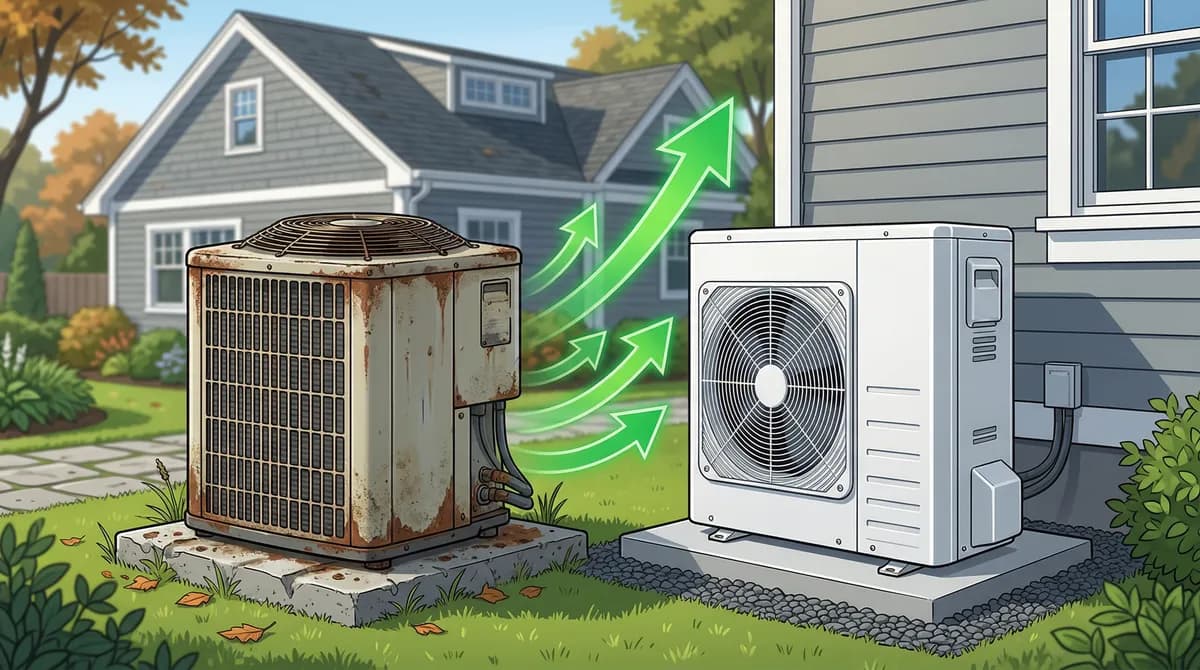
Heat pump technology has improved dramatically. Replacing a 10-year-old system with a modern cold-climate model is not just a replacement — it is an upgrade.
| Specification | 2014-2016 System | 2020-2022 System | 2026 Cold-Climate |
|---|---|---|---|
| Cooling Efficiency | 14-16 SEER | 18-20 SEER | 20-24 SEER2 |
| Heating Efficiency | 8.0-9.0 HSPF | 10-11 HSPF | 11-13 HSPF2 |
| Min Operating Temp | 15-25 degrees F | 5-15 degrees F | -13 to -15 degrees F |
| Refrigerant | R-410A | R-410A | R-32 / R-454B |
| Compressor Type | Single/Two-Stage | Inverter-Driven | Variable-Speed Inverter |
| Est. Annual Cost (MA) | $1,800-$2,200 | $1,300-$1,700 | $900-$1,300 |
Bottom line: A Massachusetts homeowner replacing a 2015-era system with a 2026 cold-climate model can save $500-$900 per yearon heating and cooling costs. Over the new system's 15-20 year life, that is $7,500-$18,000 in energy savings — on top of the Mass Save rebate.
Mass Save treats replacements the same as new installations. You qualify for full rebates when upgrading an old heat pump to a new qualifying model.
$8,500
$2,650/ton
New heat pump must serve as primary heating for entire home. ENERGY STAR Cold Climate certified. R-32 or R-454B refrigerant. Manual J required.
Bonuses: Up to $1,000 in bonuses (sizing $500 + weatherization $500)
$8,500
$1,125/ton
Heat pump supplements existing system. ENERGY STAR Cold Climate certified. R-32 or R-454B refrigerant.
Bonuses: Sizing bonus available ($500)
$2,500
$250/ton
Any qualifying heat pump. ENERGY STAR certified minimum. Single-zone or supplemental.
Bonuses: No additional bonuses
After your Mass Save rebate, the HEAT Loan covers up to $25,000 at 0% APR. Income-tiered terms: 3, 5, or 7 years. No dealer fees. Available through participating Massachusetts lenders.
Every factor below is within your control. Proper installation and maintenance can add 5+ years to your system life.
A single annual tune-up catches small issues before they become compressor-killing problems. Most failures are preventable with regular service.
An oversized system short-cycles, wearing out the compressor prematurely. A Manual J load calculation ensures the right size. Mass Save requires this for whole-home rebates.
Correct refrigerant charge, proper line set routing, adequate drainage, and correct electrical sizing. A bad installation is the #1 cause of premature failure.
Dirty filters restrict airflow, forcing the compressor to work harder and overheat. This is the simplest maintenance task and the most commonly neglected.
Snow piled against the unit, leaves in the coil, or vegetation growing too close restricts airflow and causes the system to overwork.
An undersized system runs at full capacity constantly, especially in Massachusetts winters. The compressor never gets a break, accelerating wear.
Restricted airflow causes the evaporator coil to freeze, the compressor to overheat, and refrigerant pressures to go out of spec.
Salt spray corrodes aluminum coil fins and copper refrigerant lines. Homes within 2 miles of the MA coast need corrosion-resistant coil coatings (Blue Fin, Gold Fin).
Too much or too little refrigerant stresses the compressor. This is an installation error that manifests years later. Always verify the charge is correct at install.
Decks built over outdoor units, fences too close, or snow buildup restrict the airflow the condenser needs to reject heat.
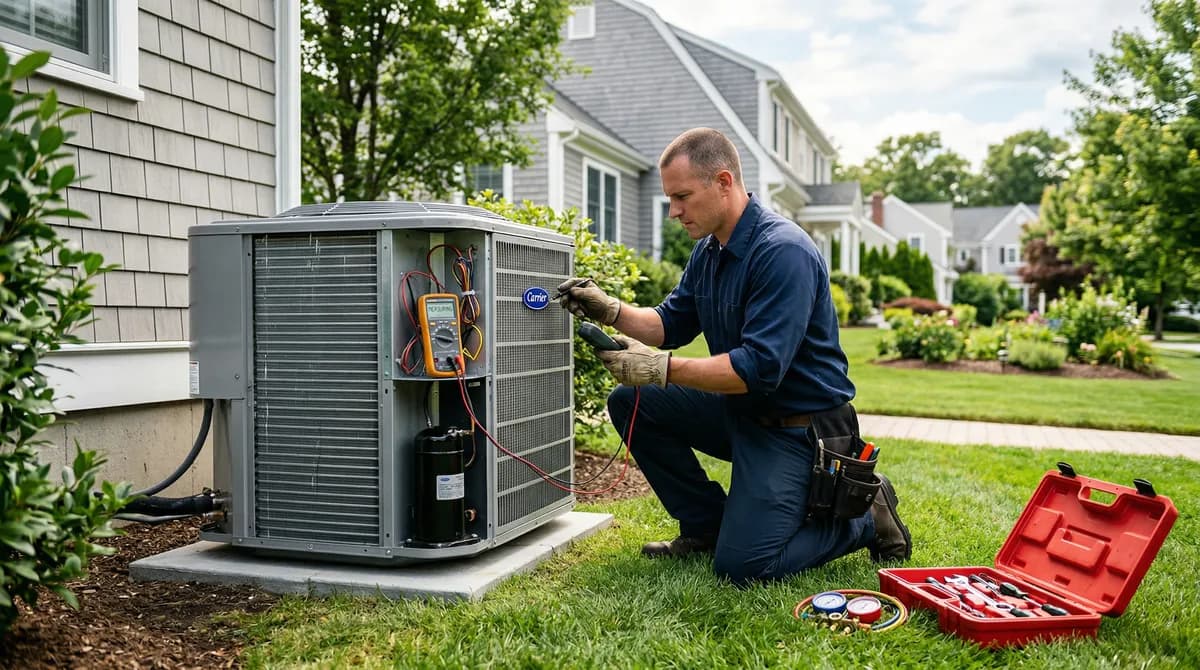
Follow this schedule and your heat pump has the best chance of reaching the upper end of its lifespan range.
Clean or replace air filters (washable mesh on mini-splits, disposable on ducted)
Check outdoor unit for debris, leaves, and snow buildup
Ensure 18-24 inches clearance around outdoor unit
Listen for unusual sounds during startup and operation
Full refrigerant charge check and top-off if needed ($100-$200 service call)
Electrical connection tightening and amp draw measurement
Coil cleaning (indoor evaporator and outdoor condenser)
Condensate drain flush and inspection
Defrost cycle verification (heating mode)
Thermostat calibration check
Deep coil cleaning with chemical coil cleaner
Blower motor and fan blade inspection
Ductwork inspection for leaks (ducted systems)
Refrigerant line insulation check and replacement
Outdoor unit base/pad leveling check
Not every problem warrants a full replacement. Here are situations where repair is the right call.
Capacitor, fan motor, thermostat, or control board failures are common and inexpensive to fix ($150-$500). These are not signs of system-wide failure.
Most heat pumps carry 5-10 year compressor warranties. If your compressor fails under warranty, the part is covered — you only pay labor ($500-$1,000).
A well-maintained R-410A system under 10 years old does not need preemptive replacement. R-410A service will remain available for years. Replace when it makes financial sense.
If your heating/cooling costs have not increased significantly year-over-year (controlling for rate changes), your system is still performing well. Age alone is not a reason to replace.
Mass Save rebate tiers, bonuses, and eligibility
Seasonal care schedule to extend system life
R-32 vs R-454B — the new Mass Save standard
Best models for MA winters down to -15 degrees F
System pricing, installation costs, and financing
0% APR financing up to $25,000
Common questions about heat pump lifespan and replacement in Massachusetts.
Air-source heat pumps typically last 15-20 years in Massachusetts. Ducted central systems average 15-18 years, ductless mini-splits 15-20 years, and geothermal systems 20-25 years (ground loop 50+ years). Massachusetts harsh winters and coastal salt air can reduce lifespan by 2-5 years compared to milder climates.
Apply the 50% rule: if the repair cost exceeds 50% of a new system, replace it. Also replace if your system is 15+ years old and needs a major repair (compressor, reversing valve), uses R-22 refrigerant (banned), or has had 2+ major repairs in the past year. Annual repair costs exceeding $500 are another strong signal.
Yes, by an estimated 2-5 years compared to moderate climates. Massachusetts winters with temperatures below 0 degrees F push compressors harder and increase defrost cycle frequency. Coastal areas face additional salt air corrosion. However, modern cold-climate models (Mitsubishi Hyper-Heat, Fujitsu XLTH) are designed for these conditions and fare better than older units.
The 50% rule states that if a single repair costs more than 50% of a new replacement system, you should replace rather than repair. For example, if a new heat pump system costs $12,000 after Mass Save rebates, any single repair over $6,000 (like a compressor replacement at $3,000-$5,000 plus labor) makes replacement the smarter financial choice.
Not necessarily. R-410A systems are still functional and serviceable. However, R-410A refrigerant costs are rising due to the EPA AIM Act phase-down. If your R-410A system is under 10 years old and running well, keep it. If it is 10-15 years old, start budgeting for replacement. If it needs a major repair, replace with an R-32 or R-454B model to qualify for Mass Save rebates.
Mass Save offers the same rebates for replacement as for new installations: up to $8,500 for whole-home conversion ($2,650/ton), up to $8,500 for partial displacement ($1,125/ton), or up to $2,500 for basic installations ($250/ton). Plus up to $1,000 in bonuses. The 0% HEAT Loan covers up to $25,000 of remaining costs. The federal 25C tax credit expired December 31, 2025.
Replacing a 10-year-old heat pump with a modern cold-climate inverter model typically yields a 30-50% efficiency improvement. A 2016-era system might have a SEER of 16 and HSPF of 9. A 2026 cold-climate model delivers SEER2 of 20+ and HSPF2 of 11+. That translates to roughly $300-$600 per year in energy savings for a typical Massachusetts home.
The three highest-impact maintenance tasks are: (1) monthly filter cleaning or replacement, which prevents airflow restriction and compressor strain; (2) annual professional tune-up ($100-$200) that catches refrigerant leaks and electrical issues early; and (3) keeping the outdoor unit clear of snow, ice, and debris. Together, these can add 3-5 years to your system life.
Do not replace if your system is under 10 years old and the issue is minor (filter, thermostat, capacitor, or fan motor). Do not replace if the system is still under manufacturer warranty — compressor warranties are typically 5-10 years. Do not replace just because it uses R-410A if the system is working efficiently. And do not replace based on age alone if the system runs well and energy bills are stable.
Yes. Homes within 2 miles of the Massachusetts coastline (Cape Cod, North Shore, South Shore, Boston Harbor) experience accelerated corrosion of outdoor unit coil fins and copper refrigerant lines. Salt air can reduce lifespan by 2-5 years. Mitigation strategies include Blue Fin or Gold Fin corrosion-resistant coil coatings, regular outdoor coil rinsing, and positioning the unit on the leeward side of the home.
Get a free assessment from NuWatt. We will evaluate your current system, calculate your Mass Save rebate, and show you the math on repair vs. replace.