Loading NuWatt Energy...

We use your location to provide localized solar offers and incentives.
We serve MA, NH, CT, RI, ME, VT, NJ, PA, and TX
Loading NuWatt Energy...
NuWatt designs, installs, and manages solar, battery, heat pump, and EV charger systems across 9 states. One company, one warranty, one point of contact.
Get a Free QuoteThe #1 surprise for new heat pump owners: winter bills are 3-5x higher than summer. This is normal and expected. At COP 4.0 in July, your heat pump barely sips electricity. At COP 2.0 in January, it works much harder. Here is what to actually expect month by month, and how to minimize the winter spike.
Based on 2,000 sq ft MA home, cold-climate heat pump, all-in residential rate (Eversource $0.38/kWh, National Grid $0.42/kWh).
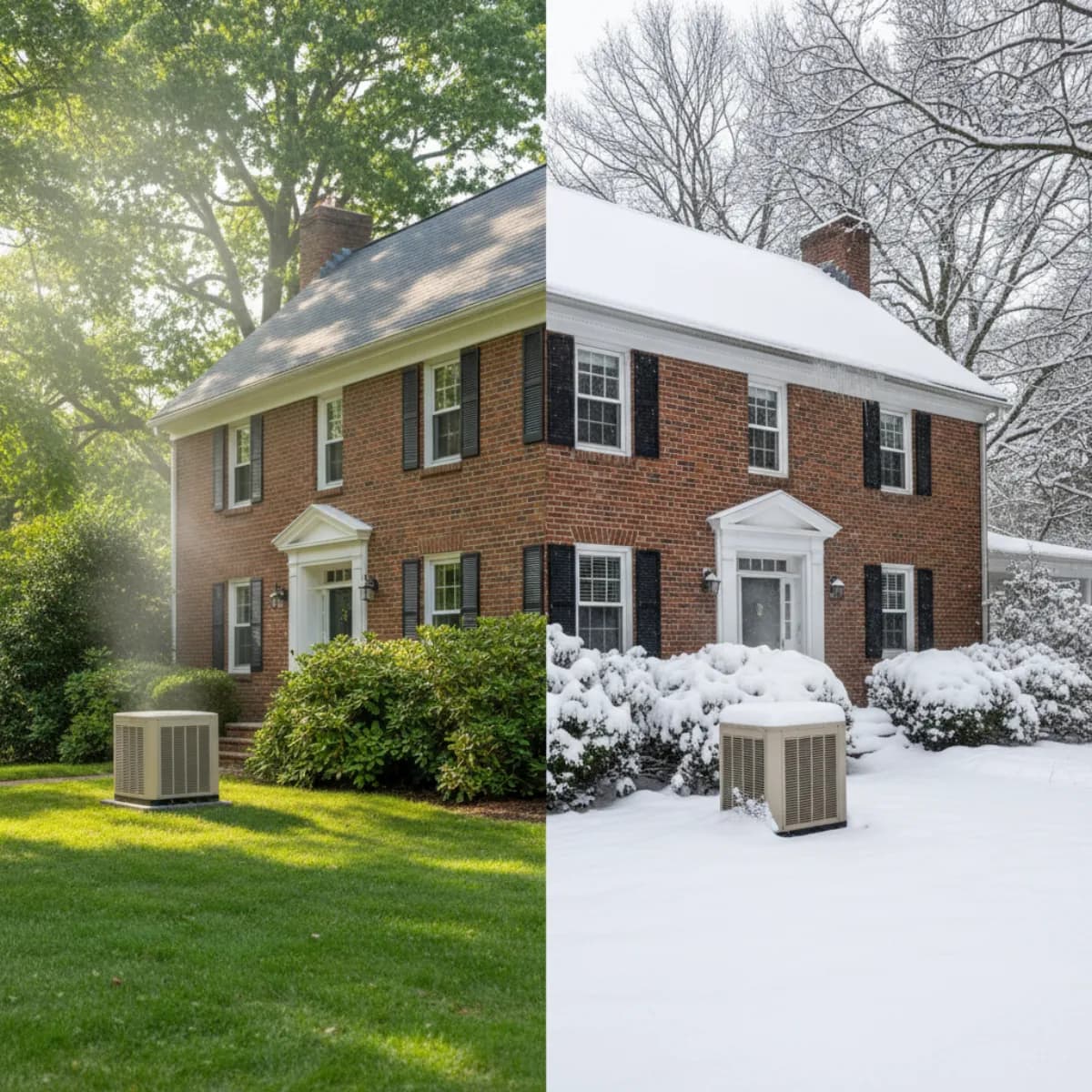
Heat pump efficiency (COP) drops from 4.0 at 47F to 2.0 at 5F, meaning double the electricity per BTU of heat in deep winter. Combined with much higher heating demand (raising indoor temp 40-50F above outdoor vs lowering 5-10F in summer), winter bills run 3-5x higher: $190-$440/month in winter vs $40-$80/month in summer. This is normal. Even with the winter spike, annual heat pump costs ($1,655-$2,670) are lower than oil ($3,200-$4,500) or gas ($2,400-$3,800) plus separate AC. The heat pump electric rate ($0.18/kWh), insulation upgrades, and solar net metering credits can each reduce the winter bill by 20-40%.
Many Massachusetts homeowners switch from oil or gas to a heat pump expecting consistently low electric bills. The first summer confirms this expectation -- cooling costs are tiny. Then January arrives, and the bill is $310-$440. This triggers alarm and calls to the installer. But higher winter bills are not a malfunction -- they are the normal physics of heat pump operation in a cold climate.
COP (Coefficient of Performance) measures efficiency. At 47F, a typical cold-climate heat pump has COP 3.5-4.0 -- meaning 3.5-4.0 units of heat per unit of electricity. At 5F, COP drops to 1.8-2.2. This means at the same heating output, the heat pump uses roughly twice as much electricity in deep winter as in fall. It is still far more efficient than electric resistance (COP 1.0) but uses noticeably more power.
In January, you need to raise indoor temperature 40-50 degrees above outdoor (68F indoor vs 20F outdoor). In July, you only need to lower it 5-10 degrees (72F indoor vs 80F outdoor). The heating BTU requirement in winter is 4-8x the cooling requirement in summer. Even if the heat pump had perfect efficiency, winter bills would be higher simply due to the massive temperature difference.
Lower efficiency x higher demand = 3-5x the electricity consumption. A heat pump that uses 50-80 kWh in July uses 250-400 kWh in January. At the live Eversource all-in rate of $0.38/kWh, that is $19-$30 vs $94-$150 just for the heat pump portion of your bill. Add baseline household usage (lights, appliances, hot water), and January bills of $310-$440 are completely normal for a 2,000 sq ft Massachusetts home.
How heat pump costs compare to oil and gas heating month by month for a 2,000 sq ft Massachusetts home. Heat pump costs include both heating and cooling; oil/gas show heating only (add $150-$400 for separate AC in summer).
| Month | Season | Avg Temp | COP | Heat Pump | Oil | Notes |
|---|---|---|---|---|---|---|
| January | Winter | 28F | 2.0-2.5 | $315-$440 | $400-$600 | Peak heating month. Longest cold stretch. |
| February | Winter | 30F | 2.1-2.6 | $290-$415 | $380-$550 | Still heavy heating. Cold snaps common. |
| March | Shoulder | 38F | 2.5-3.0 | $190-$315 | $280-$420 | Transitional. Warmer days, cold nights. |
| April | Shoulder | 49F | 3.2-3.8 | $75-$150 | $100-$200 | Light heating. Some AC-free days. |
| May | Shoulder | 58F | 3.8-4.2 | $50-$100 | $0 | Minimal heating/cooling. Lowest bills. |
| June | Summer | 68F | 4.0-4.5 | $65-$115 | $0 | Light cooling starts. High efficiency. |
| July | Summer | 74F | 4.2-4.8 | $75-$125 | $0 | Peak cooling. Still moderate vs winter. |
| August | Summer | 72F | 4.0-4.5 | $70-$120 | $0 | Cooling + dehumidification. |
| September | Shoulder | 65F | 3.8-4.2 | $45-$80 | $0 | Light cooling. Approaching free months. |
| October | Shoulder | 54F | 3.5-4.0 | $65-$125 | $80-$160 | Light heating begins. |
| November | Winter | 43F | 2.8-3.3 | $175-$290 | $250-$400 | Heating ramps up. First real cold nights. |
| December | Winter | 33F | 2.2-2.8 | $250-$400 | $350-$520 | Heavy heating. Holiday cooking adds load. |
| Annual Total | $1,655-$2,670 | $1,840-$2,850* | *Oil = heating only, add $300+ for AC | |||
Key insight: The heat pump provides both heating AND cooling in a single bill. Oil/gas costs shown are heating only -- homeowners must add separate AC costs ($300-$600/summer) for a true comparison. When you include cooling, the heat pump saves $1,000-$2,000/year over oil for most homes.
COP drops as outdoor temperature drops. This is the fundamental physics that drives higher winter bills. Cold-climate heat pumps (Mitsubishi Hyper-Heat, Fujitsu XLTH, Daikin Aurora) maintain higher COP at lower temperatures than standard models -- this is why specifying cold-climate rated equipment is critical in Massachusetts.
COP values represent cold-climate heat pump models. Standard (non-cold-climate) heat pumps have lower COP at all temperatures below 32F and may shut off below 15-20F.
At COP 2.0, you need 0.5 kWh of electricity for every kWh of heating output. At COP 4.0 (summer), you only need 0.25 kWh. So heating at COP 2.0 costs exactly twice as much per BTU as at COP 4.0. For context: electric resistance heat (baseboard, space heaters) has COP 1.0 -- even at its worst, your heat pump is still twice as efficient as plugging in a space heater. And oil heat converts at about 80-85% efficiency, making it equivalent to COP 0.85 -- worse than a heat pump at any temperature.
Not all heat pump homes have the same winter bills. Several factors can swing your January bill by $50-$150 in either direction.
A well-insulated home (R-49 attic, R-21 walls, air sealed) can have winter bills 20-30% lower than a poorly insulated home of the same size. Mass Save provides 75-100% subsidized insulation. This is the #1 way to reduce winter bills.
Cold-climate rated models (Mitsubishi Hyper-Heat, Fujitsu XLTH, Daikin Aurora) maintain higher COP at lower temperatures than standard models. The difference is most noticeable below 20F. Always specify cold-climate equipment for Massachusetts.
Electric resistance backup heat strips have COP 1.0 -- drawing 2-3x more electricity than the heat pump. If your system runs on auxiliary heat frequently, your bill will spike dramatically. Check your thermostat for "Aux" or "Em Heat" indicators. Frequent aux heat use often indicates undersizing.
Every degree lower on your thermostat saves approximately 3-5% on heating costs. Setting 68F vs 72F can reduce your January bill by $30-$60. However, avoid deep setbacks (lowering 10+ degrees at night) -- heat pumps are more efficient maintaining steady temperatures than recovering from large drops.
The heat pump electric rate ($0.18/kWh vs the all-in standard rate of $0.38/kWh) can reduce winter bills by 30-50%. This is the single biggest financial lever after insulation. Apply through your utility as soon as your heat pump is installed.
An undersized heat pump runs at maximum capacity for more hours and triggers auxiliary heat more often. An oversized system short-cycles, reducing efficiency. Proper Manual J load calculation ensures the system matches your home.
Here is a real example from a 2,200 sq ft Colonial in Wellesley that switched from oil to a cold-climate heat pump system.
Home
2,200 sq ft Colonial in Wellesley
Heat Pump System
Mitsubishi Hyper-Heat ducted + 2 mini-splits
Previous (Oil + Window AC)
$3,340/year
Heat Pump Annual Total
$2,175/year
Even though January and December bills ($390 and $340) might feel high, the annual total ($2,175) is still lower than the previous oil + AC combination ($3,340). The heat pump costs more than oil in zero months of the year when you compare month-for-month. The summer months with $55-$100 bills are the bonus -- free cooling that oil cannot provide.
Solar production peaks in summer when heat pump costs are lowest. Heat pump costs peak in winter when solar production is lowest. This sounds like a problem, but net metering makes it a non-issue.
April through September, your solar system produces far more electricity than your heat pump uses for cooling. Those excess kWh are sent to the grid and banked as net metering credits at the full retail all-in rate (Eversource $0.38/kWh, National Grid $0.42/kWh). A 14 kW system on a 2,000 sq ft home banks $600-$900 in credits during summer months.
October through March, your heat pump draws more electricity than solar produces. Your utility automatically applies the banked summer credits to offset the winter shortfall. A properly sized system produces enough annual credits to cover the full year. Your residual annual bill is $120-$180 in utility connection charges.
If you add a battery to your solar + heat pump setup, Massachusetts ConnectedSolutions program pays $225-$275 per kW per summer season for dispatching stored energy during grid peak events. A 10 kW battery earns $2,250-$2,750 per summer, which effectively pays for the battery over its lifetime while providing backup power when the grid goes down.
You cannot eliminate the winter/summer bill gap entirely -- it is physics. But you can minimize the winter peak and reduce your annual total significantly.
Apply through Eversource or National Grid for the discounted $0.18/kWh winter rate versus the all-in $0.38/kWh standard rate. On the heating-season portion of usage, that roughly halves the rate-driven cost of every winter kWh.
Mass Save subsidizes 75-100% of attic insulation, wall insulation, and air sealing. Better-insulated homes need less heating, period. This should be done before or simultaneously with heat pump installation.
A properly sized solar system banks summer credits to offset winter bills. Net annual cost drops to $120-$180 in connection charges. See our solar sizing guide for heat pump homes.
Check your thermostat for "Aux" or "Em Heat" indicators. If aux heat runs frequently, your system may be undersized or have a refrigerant issue. Call your installer to investigate.
Heat pumps work most efficiently at steady-state. Instead of lowering from 68F to 58F at night and recovering in the morning (which triggers aux heat), try a modest 2-3 degree setback or maintain constant temperature.
Snow, ice, and debris around the outdoor unit reduce airflow and efficiency. Maintain 18-24 inches of clearance on all sides. Clear snow after storms. Do not cover the unit -- it needs airflow even in winter.
The 0% HEAT Loan ($25,000 over 7 years) can fund insulation, air sealing, and heat pump installation. The monthly savings from reduced heating costs often exceed the loan payment from Day 1.
Want to Minimize Your Winter Heat Pump Bills?
Get a personalized analysis of your home that includes heat pump sizing, insulation recommendations, solar offset, and estimated monthly costs by season.
Winter heat pump bills in Massachusetts typically range from $190-$440 per month from November through March for a 2,000 sq ft home at the all-in residential rate (Eversource $0.38/kWh, National Grid $0.42/kWh). January and February are the most expensive months, with bills of $310-$440. If your utility offers a heat pump electric rate (approximately $0.18/kWh during heating season), winter bills drop to $130-$310. The exact amount depends on your home insulation, thermostat settings, heat pump model efficiency, and how cold the winter is.
Two factors combine to make winter bills 3-5 times higher than summer. First, the COP (efficiency) drops from 4.0-4.5 in summer (mild temperatures) to 2.0-2.5 in winter (below freezing), meaning you need twice as much electricity per BTU of heat. Second, heating demand in Massachusetts winters is far greater than cooling demand in summers -- you need to raise indoor temperature 40-50 degrees above outdoor in January vs only 5-10 degrees below outdoor in July. Together, this means 3-5x more electricity consumption in winter months.
Even at the higher winter bills, heat pumps cost less than oil in every heating month. A typical 2,000 sq ft home spends $310-$440/month on heat pump electricity in January vs $400-$600 for oil. The biggest advantage is in shoulder months (October, March, April) where heat pumps are highly efficient and oil is still expensive per delivery. Over the full year, including summer cooling (which oil cannot provide), heat pumps save $800-$2,000+ compared to oil + window AC.
COP (Coefficient of Performance) measures how much heat a heat pump produces per unit of electricity consumed. A COP of 3.0 means 3 units of heat for every 1 unit of electricity -- effectively 300% efficient. In Massachusetts summers (cooling mode), COP is 4.0-5.0 (very efficient). In winter at 30F, COP is 2.5-3.0 (good). At 5F, COP drops to 1.8-2.2 (still better than electric resistance at 1.0, but using more power). COP directly determines your electricity consumption: lower COP = higher bill for the same amount of heating.
Yes, but not directly in real-time. Solar production in Massachusetts peaks in summer and bottoms in winter -- the opposite of heat pump demand. The solution is net metering: your solar system overproduces in April-September, banking credits at full retail rate. Those credits automatically offset your higher winter bills. A properly sized solar system (14-18 kW for a heat-pump-equipped home) produces enough annual kWh to cover the full year, even though monthly production and consumption do not match. Your annual net bill approaches $120-$180 (just the utility connection charge).
Eversource and National Grid offer a discounted winter electric rate for homes with qualifying heat pumps. The rate is approximately $0.18/kWh during November through April, compared to the all-in residential rate (Eversource $0.38/kWh, National Grid $0.42/kWh). This discount on heating-season electricity significantly reduces heating bills. To qualify, you need a heat pump that meets efficiency requirements and must apply through your utility. The rate applies to your entire household usage during the heating season, not just the heat pump.
The most effective strategies are: (1) Insulate and air seal your home through Mass Save (can reduce heating load 20-30%), (2) Use the heat pump electric rate from your utility ($0.18/kWh vs the all-in $0.38/kWh standard rate), (3) Lower your thermostat 2-3 degrees at night (save 5-10%), (4) Avoid using emergency/auxiliary heat strips unless absolutely necessary, (5) Keep outdoor unit clear of snow and ice for optimal airflow, (6) Maintain consistent temperature rather than frequent setback-recovery cycles (heat pumps are more efficient at steady-state), and (7) Add solar panels to offset electricity costs through net metering credits.
Yes. One of the key advantages of a heat pump is that a single system provides both heating and cooling. Your electricity bill includes all heat pump operation -- heating in winter, cooling in summer, and dehumidification year-round. There is no separate fuel bill (oil, propane, gas) and no separate cooling cost (window AC, central air). When comparing costs, factor in that your oil/gas bill disappears entirely, your window AC cost disappears, and you have a single consolidated energy bill. The annual total is almost always lower than the combined previous heating + cooling costs.
How to get the discounted $0.18/kWh winter rate from your utility.
Detailed monthly cost breakdown by system type and home size.
Installation costs, system types, and Mass Save rebates.
How to get 75-100% subsidized insulation to reduce heat pump bills.
Get a custom estimate showing month-by-month heat pump costs for your specific home, including the impact of the heat pump electric rate, insulation, and solar offset.