Loading NuWatt Energy...

We use your location to provide localized solar offers and incentives.
We serve MA, NH, CT, RI, ME, VT, NJ, PA, and TX
Loading NuWatt Energy...
NuWatt designs, installs, and manages solar, battery, heat pump, and EV charger systems across 9 states. One company, one warranty, one point of contact.
Get a Free QuoteString inverters typically last 10 to 15 years. Microinverters last 25-plus. Here is how to read the failure signs, what replacement actually costs in Massachusetts, and what Eversource and National Grid require before your new unit can legally export to the grid.
10–15
Year String Inverter Life
25+
Year Microinverter Life
$2.5k–$4.2k
Typical String Swap MA
$400–$700
Per-Micro Replacement
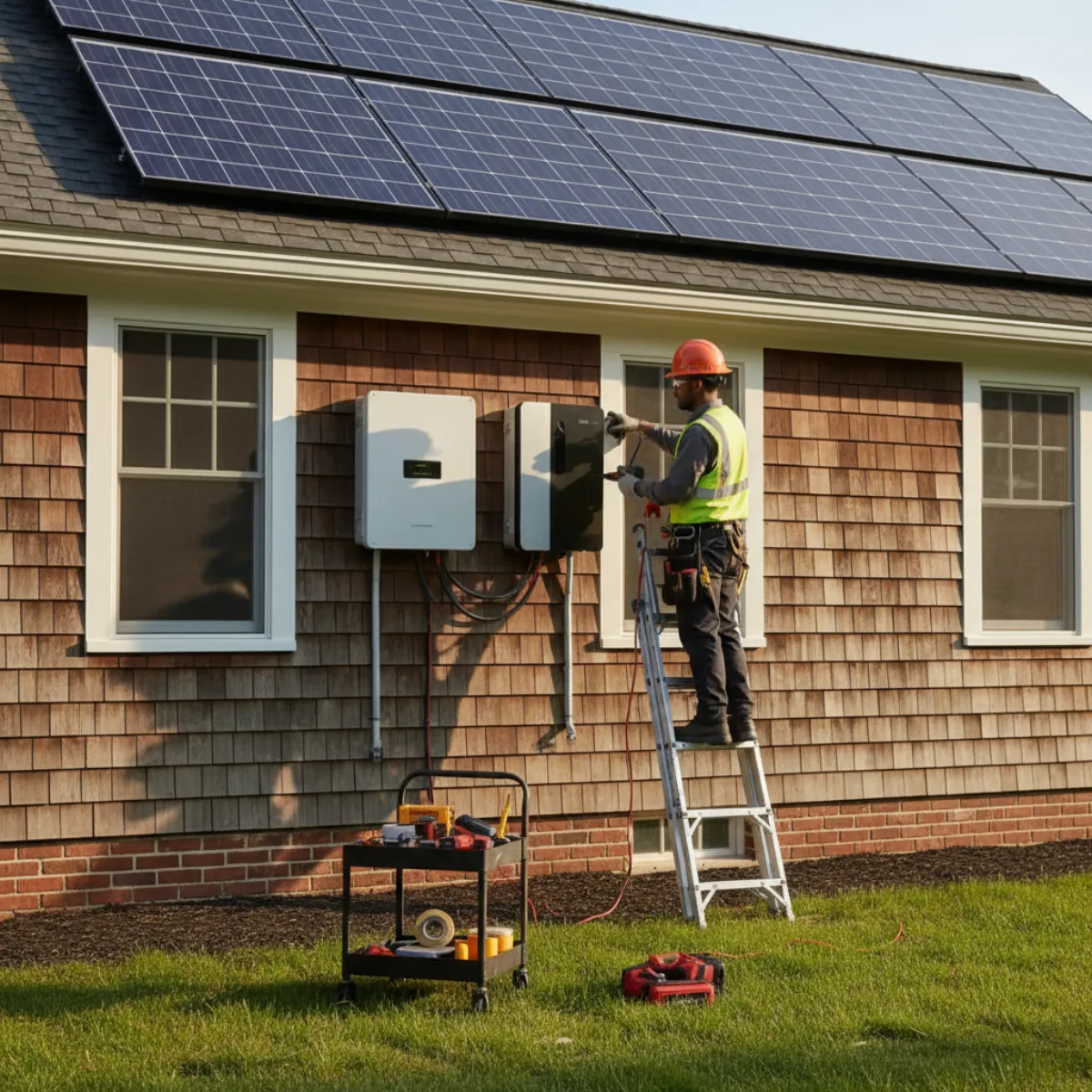
TL;DR for MA homeowners: If your array was installed 2012–2014 with a string inverter, start planning the replacement now. If it's Enphase microinverters or SolarEdge with optimizers, the central parts last 25 years and individual failures are usually warranty-covered. Budget $2,500–$4,200 for a like-for-like string swap and expect Eversource or National Grid to accept a simple notification if the AC nameplate matches.
The four architectures in the MA residential market each have different lifespans, failure patterns, and replacement paths. Knowing which one you have changes the entire service plan.
A single wall-mounted inverter (typically in the garage, basement, or exterior wall) converts DC from every panel in a series string into AC. Common brands in MA: SolarEdge HD-Wave, SMA Sunny Boy, Fronius Primo. Typical service life runs 10 to 15 years for the inverter itself; its capacitors and cooling fans are the usual first failure points.
Key Service-Life Facts
A small inverter mounted under each module (Enphase IQ7, IQ8, and the legacy M-series). Each microinverter carries its own 25-year warranty, and the distributed architecture means a single failure drops one panel rather than the whole array. MA installs since ~2018 skew heavily to Enphase.
Key Service-Life Facts
SolarEdge arrays combine per-panel DC optimizers with a central string inverter. The optimizers carry a 25-year warranty; the HD-Wave inverter is warranted for 12 years standard (extendable to 25). The inverter is the component that typically fails first — optimizers rarely do.
Key Service-Life Facts
Inverters with integrated battery ports (SolarEdge Energy Hub, Enphase IQ8 + IQ Battery, Tesla Powerwall+). Lifespan targets are similar to their standard counterparts, but any battery swap, firmware update, or MA ConnectedSolutions enrollment change can surface compatibility issues that force an earlier replacement than pure-solar arrays see.
Key Service-Life Facts
Why the warranty number is not the whole story
Enphase microinverters are warranted for 25 years. SolarEdge optimizers are warranted for 25 years. SolarEdge HD-Wave inverter bodies are warranted for 12 years standard. Older string inverters from the 2012–2015 wave (Fronius Primo, SMA Sunny Boy, older ABB / Power-One units) were typically warranted 10 years and usually fail within 10 to 15 years. The actual field reliability tracks the warranty closely for the central power stage, and exceeds it substantially for distributed MLPE.
A healthy MA solar array behaves predictably month-over-month. These are the six most reliable signals that the inverter (not the panels, not the wiring) is the problem. Any two together usually means it's time to schedule a swap.
Compare current monthly production to the same month in prior years. A healthy MA array should produce within about 10 percent of the prior-year monthly figure after adjusting for weather. A sustained drop of 15 percent or more over three months — with normal weather — is a strong inverter or string-level failure signal.
The Enphase Enlighten portal, the SolarEdge monitoring dashboard, and the SMA Sunny Portal all log fault codes. Recurring isolation faults, DC over-voltage alerts, or grid-frequency drops point at the inverter rather than the panels. If your fault log is filling up with the same code weekly, the unit is asking to be replaced.
String inverters use small fans to cool the power stage. A loud, rising-pitch fan or a grinding sound is usually a bearing failure. The fan itself can sometimes be replaced, but on most MA installs it is a whole-unit swap because the sealed enclosure was never designed for field service.
An inverter that cycles off during the hottest part of the day — and comes back online an hour later — is thermally overloaded. Capacitors degrade with heat and age, and once they are out of tolerance, the unit protects itself by tripping offline. This is a clear end-of-life signal on a 10+ year string inverter.
A red ground-fault LED or arc-fault alert is a safety stop that pulls the array offline. These can be triggered by wet weather, by rodent damage to conductors, or by the inverter internal fault detection hardware failing on its own. An AFCI indicator that will not clear is a replace-the-unit trigger.
Enphase Envoy S1, SolarEdge legacy gateways, and older SMA Webconnect cards reach software end-of-life before the inverter itself does. When the gateway goes unsupported, you lose remote monitoring even if the hardware keeps producing. Sometimes the fix is a gateway swap; sometimes it forces a full inverter refresh.
NuWatt does not run a 24/7 proactive monitoring service — the homeowner watches their Enphase Enlighten or SolarEdge portal and tells us when something looks off. If you have not logged into your monitoring portal in the last 60 days, do it today. Production trends and fault logs are how you catch an inverter problem before it turns into a multi-month dark period.
If your system is Enphase: Enphase Gateway Offline Troubleshooting.
Ranges below are typical 2026 MA market pricing for a 7–10 kW residential system. Hardware costs reflect retail list prices; labor reflects licensed MA electrician rates for a standard rooftop residential service.
| Scenario | Hardware | Labor | Permits | Total | Notes |
|---|---|---|---|---|---|
| String inverter swap (like-for-like, 7.6 kW residential) | $1,400–$2,200 | $800–$1,600 | $150–$400 | $2,500–$4,200 | Most common MA scenario. Like-for-like swap keeps utility interconnection agreement valid without new application. |
| String inverter upgrade (different brand or larger size) | $1,800–$2,800 | $1,200–$2,400 | $250–$600 | $3,250–$5,800 | Requires new electrical permit. If AC output changes, Eversource or National Grid typically require a revised interconnection application. |
| Single failed microinverter replacement | $220–$380 per unit | $180–$320 (one panel off) | Usually none | $400–$700 per unit | Under Enphase 25-year warranty, hardware cost is often covered — you pay labor only. Panel removal and reinstallation is the cost driver. |
| Full microinverter replacement (legacy M215/M250 to IQ8) | $220–$380 per unit x array size | $3,500–$6,500 for full array | $300–$700 | $8,000–$18,000 (20–28 panel array) | Legacy M-series units on 2012–2016 MA installs are out of warranty and end-of-support. Full refresh is usually the right economic call if multiple have failed. |
| DC optimizer replacement (SolarEdge) | $70–$110 per unit | $180–$320 (one panel off) | None | $250–$430 per unit | Under warranty, hardware is typically covered. Failure is rare — most SolarEdge service calls are the inverter itself. |
| SolarEdge HD-Wave inverter swap | $1,600–$2,400 | $800–$1,400 | $150–$400 | $2,550–$4,200 | Firmware version of the new inverter must match the generation of the existing optimizers — see swap logistics below. |
Costs are approximate 2026 MA market ranges. Actual pricing depends on unit size, roof access, panel count, and whether existing balance-of-system hardware (disconnects, load-side taps, production meters) meets current code.
Not every inverter swap is a clean substitution. Brand-to-brand architecture changes are expensive and sometimes physically impossible without replacing everything on the roof. Here are the six most common swap scenarios, ranked from cleanest to messiest.
You cannot convert an Enphase microinverter array to a SolarEdge string + optimizer architecture without replacing every optimizer on the roof. Enphase arrays do not have DC optimizers at all — each panel outputs AC already. SolarEdge optimizers are a different product class, not a retrofit onto microinverter racking. Any installer who quotes this as a clean swap is missing the hardware reality.
Going from SolarEdge to Enphase means removing every optimizer, installing microinverters under every panel, pulling new AC trunk cabling, replacing the load-side equipment, and submitting a new interconnection application. Hardware cost alone usually runs $6,000 to $12,000 on top of labor. Rarely worth it unless the existing SolarEdge inverter has already failed and multiple optimizers are also out.
A direct HD-Wave-to-HD-Wave swap is the cleanest path on a SolarEdge array. But firmware generations matter: the new inverter must be able to talk to the optimizer generation on your roof. Mixing a current-generation HD-Wave with 2016-era optimizers can cause communication failures. Always verify optimizer model numbers before ordering the replacement inverter.
Moving from legacy Enphase M215 / M250 to modern IQ7 or IQ8 microinverters works, but the AC trunk cable system changed between generations. You cannot drop IQ units onto an Engage cable — the connectors are incompatible. A full M-series-to-IQ refresh replaces both microinverters and trunk cabling together.
Some MA homeowners with original 2012–2015 string inverter installs (Fronius Primo, SMA Sunny Boy) are now converting to microinverters when the central unit dies. Economics: about $8,000 to $16,000 extra versus a like-for-like string swap. Upside: 25-year warranty horizon, per-panel monitoring, and easier battery integration later. Best done only if the existing inverter has actually failed, not as a preemptive upgrade.
If the new inverter matches the AC output of the old one within tolerance, Eversource and National Grid treat it as maintenance — no new interconnection application required. This is the fastest path back online. Any change in AC rating, addition of a battery, or change in export behavior triggers a revised interconnection filing.
The Enphase-to-SolarEdge myth
Every few months a MA homeowner asks whether they can replace a dead Enphase Envoy and some failing microinverters with a SolarEdge string inverter and call it a day. The answer is no. There are no DC optimizers on an Enphase roof — the panels are wired for AC output. A SolarEdge string inverter needs DC optimizers to talk to. Converting the array means removing every panel, installing 20–28 optimizers, pulling new DC home runs, and filing a fresh interconnection application. Any quote that pretends otherwise is missing the hardware reality.
You cannot legally energize a replacement inverter in MA without notifying the utility. A like-for-like swap is simple paperwork; an upgrade to a different AC output or architecture is a full interconnection review, same queue as a new install. Here is how each MA utility handles it.
| Utility | Like-for-Like Swap | Different Size / Type | Review Time | Notes |
|---|---|---|---|---|
| Eversource (MA East / West) | No new application required if AC output is within manufacturer tolerance of original unit. | New Form-A (Simplified) or Form-B (Expedited) required depending on system size. | 10–20 business days for Form-A; 30–60 days for Form-B. | Submit through the Eversource interconnection portal. Include inverter UL 1741 SB listing. |
| National Grid (MA) | Notification-only filing acceptable if AC nameplate matches. | Full interconnection review required; same queue as new install. | 15–25 business days for notification; 45–75 days for full review. | National Grid runs a separate MA queue from RI — confirm the form maps to your state. |
| Unitil (MA North) | Email notification and updated one-line diagram. | New interconnection application through Unitil portal. | 15–30 business days. | Smaller utility; response times vary. Call the interconnection desk before submitting. |
| Municipal light plants (Belmont, Concord, Taunton, etc.) | Varies by municipality — some accept notification, others require full re-review. | Usually a full application; terms are municipal-utility-specific. | Varies widely (some muni systems operate outside standard MA DPU rules). | Check with your specific municipal light department before ordering the new inverter. |
The current MA interconnection tariff requires inverters to be listed to UL 1741 SB — the newer standard that includes grid-support functions like ride-through and volt-var. Any inverter made before roughly 2019 is probably listed to the older UL 1741 SA and will not be accepted for a new filing. If you are replacing a 2012-era string inverter, the new unit must be SB-listed. Enphase IQ8, SolarEdge HD-Wave with current firmware, SMA Sunny Boy 3.0 US and newer, and most current-generation units all meet this.
Related reading: MA Net Metering Guide and SMART 3.0 Program.
Some faults are worth repairing. Others are signals that the unit is past its service life and replacement is the cheaper long-term call. Here is how a NuWatt engineer walks through the decision on a service visit.
A useful heuristic: if the cost of the repair exceeds 50 percent of the cost of a full replacement, replace instead. A $1,400 fan replacement on an 11-year-old string inverter that costs $3,000 to replace is almost always a bad trade — you will get another 2 to 4 years from the repair, then have to replace anyway, having spent the cost of a full replacement plus labor twice.
NuWatt services orphaned systems from defunct installers, out-of-warranty string inverters, and legacy Enphase M-series arrays across Massachusetts. We start with a diagnostic — sometimes the fix is a $200 part, not a $3,000 swap.
Fully licensed MA electricians. UL 1741 SB compliant inverter inventory. Interconnection paperwork handled end-to-end with Eversource, National Grid, and Unitil.
Last updated: April 2026
Sources: UL 1741 SB inverter listing standard, Enphase IQ8 and legacy M-series datasheets, SolarEdge HD-Wave and optimizer technical manuals, MA DPU 20-75 interconnection tariff, Eversource and National Grid MA interconnection portals, manufacturer warranty documentation