Loading NuWatt Energy...

We use your location to provide localized solar offers and incentives.
We serve MA, NH, CT, RI, ME, VT, NJ, PA, and TX
Loading NuWatt Energy...
NuWatt designs, installs, and manages solar, battery, heat pump, and EV charger systems across 9 states. One company, one warranty, one point of contact.
Get a Free QuoteModern solar arrays add roughly 2.5 to 4 pounds per square foot — usually within the reserve of a healthy Massachusetts roof. But snow load, rafter size, roof material, and home age all change the answer. Here is the full engineering picture, written for MA homeowners, contractors, and building inspectors.
2.5–4
PSF Array Dead Load
45–50
lb Per Tier-1 Module
30–60
PSF MA Ground Snow
$500–$2k
Typical PE Letter Cost
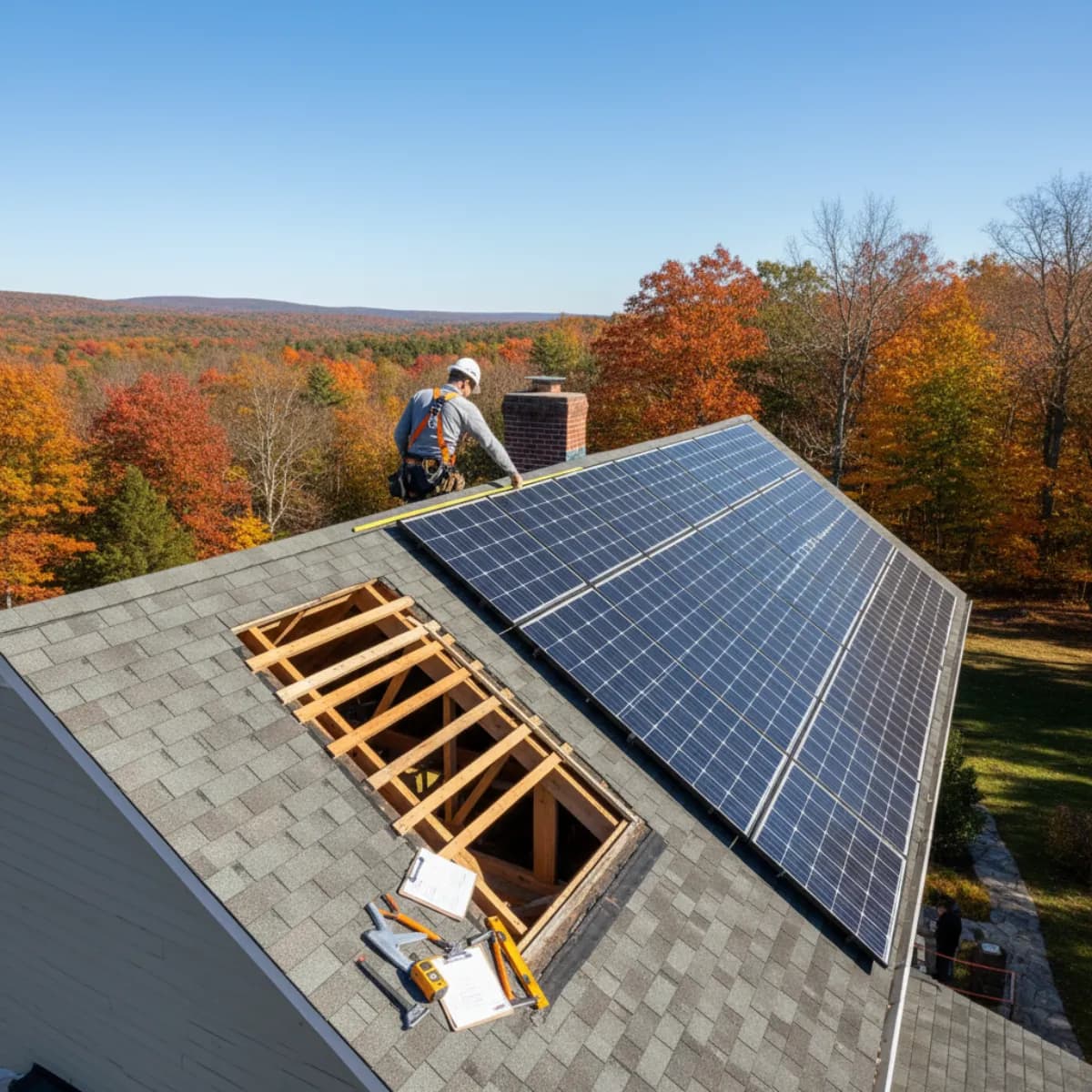
TL;DR for MA homeowners: If your home was built after ~1990 with 2x8 rafters at 16 inches on center or better, on a single-layer asphalt shingle roof, and it is not in a historic district or a drift-loading zone — your roof almost certainly handles modern solar without a PE letter. If any of those boxes do not check, budget $500–$2,000 for a structural letter and possibly a few thousand more for sistering. When in doubt, pay for the letter.
The single most common homeowner question. Short version: less than you think, but the real structural question is never about weight alone.
To put 3 PSF of PV in perspective, here is what other common roof elements weigh in PSF:
The punchline: solar adds roughly the same weight as a second layer of shingles, but is distributed rather than continuous, and is designed to be engineered-in rather than dropped on top. The bigger structural variable is almost always the snow load your roof already has to handle.
Permit reviewers do not just look at the array weight. They look at the array weight combined with snow, wind, and maintenance loads under IBC Chapter 16 load combinations. Understanding this changes how you read a structural report.
The constant weight of the solar array itself — modules, mounting rails, flashings, attachments, and any electrical conduit. Dead load is what most homeowners think about when they worry about “solar weight” — but it is only one piece of the structural picture a permit reviewer is looking at.
Typical Values / Components
Loads that change over time — snow accumulation, wind uplift, the weight of an installer walking the array during maintenance, and in rare cases ice. MA building code requires rafters to carry the dead load of the array plus combined live loads per IBC Chapter 16 load combinations.
Typical Values / Components
Code does not evaluate dead and live loads separately — it evaluates combinations. Under IBC 2021 and 780 CMR, the governing case on a snowy MA roof is usually D + S (dead plus snow), not D alone. That is why adding ~3 PSF of array weight to an already snow-loaded roof is a bigger deal than the raw number suggests.
Typical Values / Components
Why this matters in plain English
Your roof was designed to hold itself up under the worst MA snow storm plus a little margin. Solar does not just add its own weight — it rides on top of that snow load. If the original structure had only a thin reserve above the snow case, even a ~3 PSF PV array can consume most of that reserve. That is why two roofs with the same rafter size can get different answers: one had more reserve to begin with.
Rafter size is the single biggest variable. This table is a rough field guide — not a substitute for a PE calc — but it captures how MA building departments typically react to each configuration.
| Rafter & Spacing | Typical Era | Max Span | Reserve | MA Permit-Review Verdict |
|---|---|---|---|---|
| 2x6 @ 24" OC | Pre-1970, some pre-1990 | Up to ~10 ft | Often minimal | PE letter usually required. Sistering to 2x8 or 2x10 is common. |
| 2x6 @ 16" OC | 1960s–1980s | Up to ~11 ft | Modest | Marginal. Many reviewers request a PE letter if the home is >40 years old. |
| 2x8 @ 24" OC | 1970s–1990s | Up to ~13 ft | Usually OK for flat roof snow | Typically acceptable with standard array loading; drift zones may still need letter. |
| 2x8 @ 16" OC | 1980s+ | Up to ~14 ft | Good reserve for ~3 PSF PV | Generally clears MA AHJ review without a PE letter for standard arrays. |
| 2x10 @ 16" OC | 1990s+ | Up to ~17 ft | Strong | Almost never requires a structural letter for a standard PV array. |
| 2x12 @ 16" OC | 2000s+ | Up to ~20 ft | Very strong | Code-compliant for virtually any residential PV scope. |
| Engineered trusses | 1980s+ | Varies | Designed to spec — no generic reserve | Truss-specific letter often required; original design loads must be checked. |
These are generalizations based on typical MA AHJ behavior, not a code substitute. An actual project needs either a prescriptive-code check by the installer’s engineer or a stamped PE letter sized to the specific house. When in doubt, get the letter.
Ground snow load varies dramatically across MA. Under ASCE 7-22 (adopted through IBC 2021 / 780 CMR), roof snow load is typically about 0.7x the ground snow load, plus drift and slide effects. A project in the Berkshires is literally designing for double the Cape Cod load.
| County / Region | Ground Snow | Roof Snow (0.7x) | Structural Notes |
|---|---|---|---|
| Barnstable (Cape Cod) | 25–30 PSF | ~20 PSF | Lowest snow loads in MA; wind uplift is often the governing case here. |
| Bristol | 30 PSF | ~21 PSF | Standard SE MA loading; few pre-1990 homes flag for snow. |
| Plymouth | 30–35 PSF | ~21–25 PSF | Moderate; coastal wind becomes the bigger factor near the shore. |
| Norfolk / Suffolk | 30–40 PSF | ~21–28 PSF | Boston metro; triple-deckers and row-house drift conditions are common review flags. |
| Middlesex | 40–45 PSF | ~28–32 PSF | Substantial snow zone; sistering older rafters is frequently required. |
| Essex | 40–50 PSF | ~28–35 PSF | Higher loading north of Boston; coastal salt air also shortens hardware life. |
| Worcester | 45–55 PSF | ~32–39 PSF | Central MA averages the highest sustained snowpack; drift conditions common on triple-wide homes. |
| Hampden / Hampshire / Franklin | 45–55 PSF | ~32–39 PSF | Pioneer Valley; heavy loads plus lots of 1800s housing stock = frequent PE letter requests. |
| Berkshire | 50–60+ PSF | ~35–42 PSF | Highest snow loads in the Commonwealth; structural review should be assumed, not hoped for. |
Ranges shown are approximate and should be confirmed against the current ASCE 7-22 ground snow load map and any MA 780 CMR amendments for the specific project location. Drift and sliding snow loads on irregular roofs can exceed the flat-roof design values by 2–3x.
Slightly — the array itself blocks some of the natural slide-off that would otherwise clear the roof. On shallow-pitch Cape Cod and colonial roofs this rarely matters. On steep roofs where heavy snow normally sheds itself, solar can extend the time snow sits on the roof, effectively raising the governing snow load. Good engineering accounts for this.
These are the six conditions that most consistently get MA building inspectors to slow a solar permit and ask for additional structural documentation. If any apply to your home, plan ahead.
Older MA homes — especially 1800s triple-deckers, farmhouses, and Victorians — were often framed with 2x6 rafters at 24 inches on center. Those rafters can be marginal even without solar, particularly if the home has ever been re-roofed with a second layer of shingles. Any MA home built before ~1990 should expect the AHJ to ask about the structural plan.
Cedar shake roofs are light (~1 PSF) but they typically sit on skip sheathing that makes attachment planning harder. Slate is heavy (~8–10 PSF) on its own — adding 3+ PSF of PV on top of an aging slate roof frequently pushes the review into “show us the math” territory. Most MA AHJs flag slate and cedar installs for structural review regardless of age.
Cathedral or vaulted ceilings mean rafters span long distances with no collar-tie or ceiling-joist reinforcement. These assemblies deflect more under load and have less redundancy. Most structural reviewers will require sistering or a PE letter before signing off on solar over a cathedral section.
Modern trusses are engineered for a specific load. Many were designed with little or no reserve for added solar. If your home is post-1980 stick-framed trusses, the original truss tag or manufacturer spec should be reviewed. Some MA AHJs require a truss-specific engineer letter rather than a general rafter calc.
Lower roofs adjacent to taller walls or dormers collect drifted snow that can exceed 60–80 PSF locally. The snow that slides off an upper roof also piles on the lower. If your planned array sits in a drift zone, snow load calcs have to account for the drift — not just the flat-roof snow number — and this almost always triggers a structural letter.
Homes in a MA local historic district (Beacon Hill, Back Bay, Cambridge, Salem, and many town districts) have a double hurdle: the Historic District Commission reviews the aesthetic impact, and the building department still reviews the structural scope. Many historic homes have 19th-century framing that was never designed for modern loads — a PE letter is effectively automatic.
The existing roofing material contributes its own dead load — sometimes substantial. Here is how common MA roof types change the combined structural picture when solar is added.
| Roof Material | Existing PSF | With Solar | Risk Level | Engineering Note |
|---|---|---|---|---|
| Asphalt shingle (single layer) | ~2.5 PSF | ~5.5 PSF total | Low | The most common MA roof. Adding ~3 PSF of PV is usually well within the reserve of any 2x8+ framed house. |
| Asphalt shingle (double layer) | ~5 PSF | ~8 PSF total | Medium | A layover roof plus solar starts eating into reserve. Many installers require the layover be stripped before mounting PV. |
| Cedar shake | ~1 PSF | ~4 PSF total | Medium (not weight) | Weight is fine. The problem is attachment — skip sheathing and brittle shakes make flashing and waterproofing the real engineering challenge. |
| Slate | ~8–10 PSF | ~11–13 PSF total | High | Slate is heavy and fragile. Always requires a PE letter and, often, removal of slate under the array footprint to mount directly to deck. |
| Clay tile | ~10–12 PSF | ~13–15 PSF total | High | Rare in MA but present on some historic homes. Structural letter required; specialty mounting hardware needed to avoid cracking tile. |
| Standing seam metal | ~1.5 PSF | ~4.5 PSF total | Low | Ideal for PV. S-5 clamps attach to seams with no roof penetrations; most metal roofs have plenty of reserve. |
| EPDM / TPO (flat roof) | ~0.5 PSF | ~4.5 PSF total (ballasted) or ~3 PSF (attached) | Medium | Ballasted flat-roof arrays can approach 5–6 PSF locally. Triple-decker flat roofs often need a letter due to age and drift loading. |
If your asphalt shingles are within ~5 years of end of life, re-roof first. It is far cheaper than removing and re-installing a PV array later. And if your roof currently has two layers of shingles, strip both before solar — a layover roof plus PV almost always triggers a structural letter, and layovers void some module warranties.
See our detailed guide: Roof Replacement Before Solar in MA.
A PE (professional engineer) letter is a stamped document confirming the roof can carry the combined loads of the proposed solar array. Under 780 CMR, MA AHJs have broad discretion to require one. These are the six most common triggers.
Standard residential PV is 2.5–4 PSF. Once the installed dead load exceeds ~4.5 PSF (heavier modules, ballasted tilt frames, or tile-roof hardware), MA AHJs typically want a PE to sign off that combined loads still pass IBC load combinations.
Below this threshold, the rafter reserve is usually too thin to absorb ~3 PSF of PV plus MA snow load without a documented engineering check. Expect a letter request, or plan on sistering.
Homes built before ~1950 predate modern engineered-lumber conventions. Original framing may be rough-sawn, irregular sizes, and cumulatively fatigued. A letter protects the homeowner, the installer, and the AHJ equally.
Any array placed on a lower roof that sits beside a taller wall, dormer, or upper roof plane is exposed to drift snow. Drift loads can be 2–3x the flat-roof snow load locally and almost always require explicit engineering sign-off.
Local historic-district review plus vintage framing is a combination that almost guarantees a letter. Budget for it from the start of the project rather than discovering the requirement mid-permit.
Long clear-span rafters with no collar ties deflect more under load. Permit reviewers treat these sections as default-flagged for a PE letter, whether or not the rafter dimension alone would have cleared.
The “when in doubt, pay for the letter” principle
A typical MA structural letter runs $500 to $2,000, depending on complexity and whether on-site inspection is needed. A delayed permit costs far more — lost SMART 3.0 queue position, missed installation windows, extra mobilization charges, and in some cases loss of a utility interconnection slot. If there is any serious question about your framing, pay for the letter up front. Every experienced MA installer will tell you the same thing.
Undersized rafters are a solvable problem. Here are the five most common paths when a PE letter identifies the existing framing as marginal.
Adding a second rafter nailed alongside the original — usually with a larger dimension (e.g., 2x10 sister on an existing 2x6). Cost-effective when attic access is open. Typical cost: $2,000–$6,000 for a full-array footprint.
When to use: Most common remediation for 1960s–1980s MA homes with undersized rafters.
Using laminated veneer lumber for the sister when dimensional lumber cannot span the required distance or when depth is constrained. Higher material cost but much higher strength. Typical cost: $4,000–$10,000.
When to use: Cathedral ceilings, long clear spans, or where dimensional 2x10/2x12 cannot fit.
Horizontal members added between rafters to share load across multiple framing bays. Useful where point-load concerns (array attachment clustering) dominate over global deflection.
When to use: When the structural concern is local attachment rather than overall capacity.
Ridge or upper-third ties keep opposing rafters from spreading outward under load. Often a cheap add compared to full sistering and solves specific failure modes.
When to use: Cathedral or vaulted roofs where rafter thrust is the main structural concern.
If the roof simply cannot be reinforced cost-effectively (historic slate with fragile sheathing, unusual framing, or a homeowner who refuses interior ceiling work), a ground-mount array on the property sidesteps the structural question entirely.
When to use: Historic homes with untouchable framing, or properties with sufficient yard space and sun exposure.
For homeowners and contractors who want to understand the paper trail behind the structural review — here is the code framework MA building inspectors are enforcing.
Massachusetts adopts the International Building Code (IBC) and International Residential Code (IRC) with state amendments. The current MA code is based on the 2021 IBC / IRC family with the 10th edition of 780 CMR amendments. This is what governs every residential solar permit in the state.
The MA code pulls its load values and combinations from IBC 2021 Chapter 16, which in turn references ASCE 7-22 (Minimum Design Loads for Buildings and Other Structures). This is where the specific PSF values, combination formulas, and snow/wind maps live.
A typical MA residential solar permit packet includes: site plan, electrical one-line diagram, module and inverter spec sheets, racking manufacturer engineering (Unirac, IronRidge, etc. — these come pre-stamped for standard configurations), attachment layout, and if required, a home-specific PE letter. The racking manufacturer’s letter covers the hardware; the home-specific PE letter covers whether your individual framing can accept it.
NuWatt’s engineering team handles the structural analysis before the permit — rafter survey, snow-load check, PE letter coordination where needed, and reinforcement design if your framing is marginal. No surprises at the permit desk.
We work across all MA counties — from Cape Cod through the Berkshires — and know which AHJs flag which conditions.
Last updated: April 2026
Sources: 780 CMR (MA State Building Code, 10th edition), IBC 2021 Chapter 16, ASCE 7-22 snow / wind / seismic load maps, AWC National Design Specification for Wood Construction, module manufacturer datasheets, Unirac / IronRidge engineering reports