Loading NuWatt Energy...

We use your location to provide localized solar offers and incentives.
We serve MA, NH, CT, RI, ME, VT, NJ, PA, and TX
Loading NuWatt Energy...
NuWatt designs, installs, and manages solar, battery, heat pump, and EV charger systems across 9 states. One company, one warranty, one point of contact.
Get a Free Quote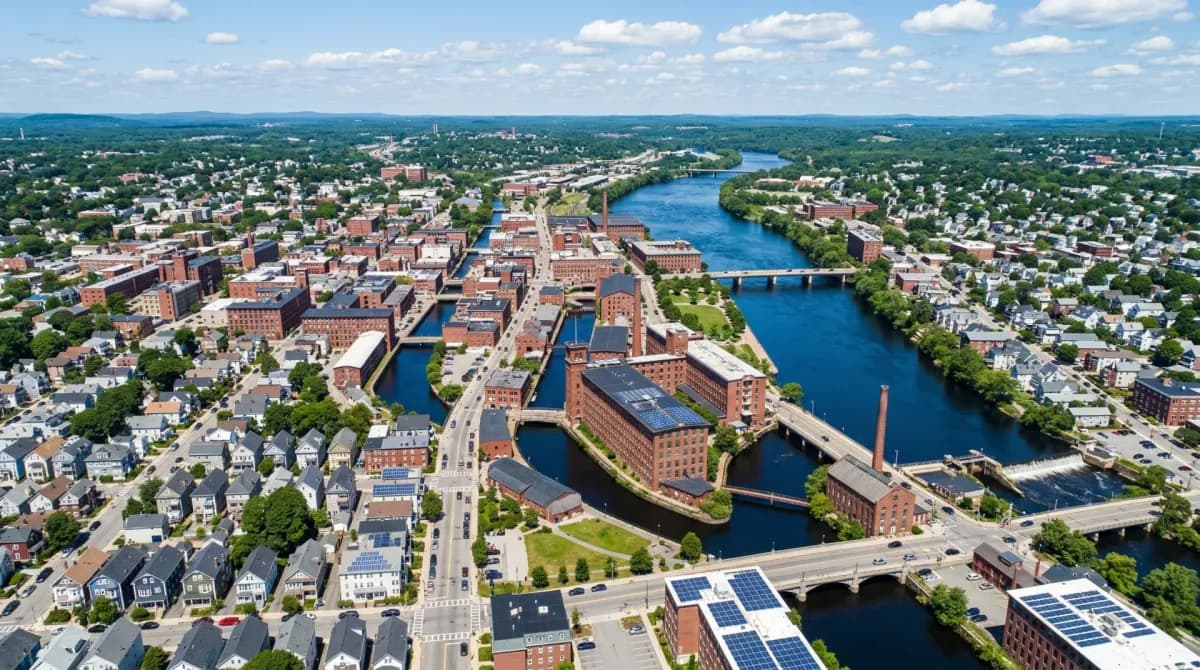
Historic mill city with ~115,000 residents. National Grid territory at $0.42/kWh. Gateway city and environmental justice community with high SMART low-income eligibility. Triple-deckers and multi-family homes make Lowell a unique solar market.
National Grid territory • SMART 3.0 • Gateway City • Environmental Justice
2026 Reality: The 30% federal tax credit (Section 25D) expired for homeowners December 31, 2025. All costs in this guide reflect $0 federal credit. Full details
A 10.5 kW solar system in Lowell costs $30,450-$34,125 in 2026. In National Grid territory at $0.42/kWh, with SMART income of ~$378/yr (or ~$756/yr low-income eligible) and full retail net metering, the investment pays for itself in 5.4-6 years.
Cost Range
$2.9-$3.25/W
Fully installed
Avg System
10.5 kW
Lowell average
Payback
5.4-6 yrs
Cash purchase
25-Year Savings
~$139K
Estimated total value
Lowell is the fourth-largest city in Massachusetts, a historic textile mill city on the Merrimack River. As a designated gateway city and environmental justice community, Lowell has significant access to enhanced SMART 3.0 incentives. The housing stock includes many triple-deckers and multi-family buildings alongside single-family neighborhoods.
Population
~115,000
Median Home Value
~$380,000
Primary Utility
National Grid
Electric Rate
$0.42/kWh
Typical System Size
8-13 kW
Solar Irradiance
4.2 kWh/m²/day
Costs for different system sizes in Lowell at $2.90-3.25/W. Lowell systems tend to be smaller than affluent suburbs due to typical home sizes and triple-decker roof areas, but SMART low-income rates compensate.
| System Size | Low Cost | High Cost | SMART 3.0 | Best For |
|---|---|---|---|---|
| 6 kW | $17,400 | $19,500 | ~$216/yr | Condo / small home |
| 8 kW | $23,200 | $26,000 | ~$288/yr | Triple-decker unit / small Cape |
| 10.5 kW | $30,450 | $34,125 | ~$378/yr | Typical Lowell single-family |
| 13 kW | $37,700 | $42,250 | ~$468/yr | Larger home / EV + battery |
| 16 kW | $46,400 | $52,000 | ~$576/yr | High usage / multi-unit building |
Prices include equipment, labor, permits, and grid interconnection. No federal tax credit included (expired). $1,000 MA state tax credit not deducted. SMART income shown at standard $0.03/kWh rate -- low-income eligible households earn double ($0.06/kWh).
Lowell is designated as both a gateway city and an environmental justice community. Many neighborhoods qualify for the SMART 3.0 low-income adder, which doubles the per-kWh payment from $0.03 to $0.06. This is one of the most impactful solar incentives available in Massachusetts.
$0.03/kWh
20-year fixed contract
$0.06/kWh
20-year fixed contract
Who qualifies? Households at or below 80% of area median income, or those receiving certain public assistance (SNAP, MassHealth, LIHEAP, etc.). Multiple Lowell neighborhoods are designated environmental justice areas, which increases eligibility. Your installer can verify qualification through MassCEC.
Lowell is in National Grid territory, which has some differences from Eversource areas. Here are the key details for Lowell solar customers.
Electric Rate
$0.42/kWh
Higher net-metering value than Eversource ($0.37)
Net Metering
1:1 Retail
Full retail rate credit for systems ≤25 kW
True-Up Month
March
Annual credit settlement (Eversource is April)
ConnectedSolutions
$225/kW summer
$50/kW winter (lower than Eversource $275)
SMART Eligibility
Full access
Same $0.03/kWh (or $0.06 low-income)
Interconnection
2-4 weeks
Standard NGrid interconnection timeline
Key difference: National Grid's bundled rate ($0.42 vs. Eversource $0.37/kWh) means net-metering credits offset power at a higher value for Lowell homeowners. National Grid ConnectedSolutions battery rates are $225/kW summer vs. Eversource $275/kW. SMART income is identical regardless of utility.
Lowell's neighborhoods range from the dense historic mill district to more suburban areas like Belvidere and Pawtucketville. Solar conditions and housing types vary significantly.
Home Types
Multi-family, triple-deckers, mixed use
Avg System
8-11 kW
Dense historic core with many triple-deckers and multi-family buildings. Environmental justice community with high SMART low-income eligibility. Flat roofs on multi-family buildings can be excellent for solar. Many residents are renters -- community solar is a strong option.
Home Types
Colonials, Capes, ranches
Avg System
10-13 kW
More suburban character with larger single-family homes. Good roof access with moderate tree cover. Post-war homes with ideal roof angles for solar. Strong ROI due to higher energy consumption.
Home Types
Single-family, some multi-family
Avg System
10-12 kW
Residential neighborhood across the Merrimack River. Mix of older and renovated homes. Good solar access with manageable tree canopy. Growing solar adoption among homeowners.
Home Types
Triple-deckers, multi-family, some single
Avg System
8-11 kW
Dense neighborhood with many multi-family homes. Environmental justice designated area with high SMART low-income eligibility ($0.06/kWh). Building owners can install solar on flat roofs to offset tenant electricity costs.
The City of Lowell's Department of Development Services handles solar permits. Timeline is typically 2-4 weeks. Lowell is supportive of solar, particularly for environmental justice communities.
Installer evaluates roof condition, orientation, and structure. Special attention to triple-decker flat roofs, mill building conversions, and multi-family properties.
Application to Lowell Development Services. Multi-family and commercial buildings may require additional review. Historic district properties may need design review.
Typical installation 1-3 days. Electrical and building inspection by the City of Lowell.
National Grid approves grid connection. 2-4 weeks. Net metering activated once approved. True-up settles in March.
Lowell homeowners access the full MA incentive package. The SMART low-income adder makes Lowell one of the best cities in MA for solar ROI among qualifying households.
$0.03/kWh standard or $0.06/kWh low-income. A 10.5 kW system earns ~$378/yr (standard) or ~$756/yr (low-income).
~$378-$756/yr
Environmental justice eligible
1:1 credit at full retail rate of $0.42/kWh. Credits roll over monthly, true up in March.
~$5,264/yr
Annual electricity savings (10.5 kW)
National Grid demand response. Earn $225/kW summer + $50/kW winter.
$2,750/yr
Typical 10 kW battery
15% of system cost, capped at $1,000. Claimed on your MA state tax return.
$1,000
One-time credit
Solar systems are exempt from the 6.25% MA sales tax.
~$2,018
Savings on typical system
Solar-added value is exempt from property tax for 20 years.
~$416/yr
20-year exemption
Section 25D (the 30% residential solar tax credit) expired December 31, 2025 under the OBBBA. Lowell homeowners buying cash or loan receive $0 in federal credit. However, third-party system owners (PPA/lease) can still claim the commercial Section 48/48E ITC -- which translates to lower PPA rates for you.
Read: What happened to the solar tax creditThree ways to pay for solar in Lowell. PPAs are especially popular in gateway cities where homeowners prefer $0 upfront.
Upfront
~$30,450-$34,125
Monthly
$0
25-yr Savings
~$139K
Ownership
You own it
Best long-term ROI. 5.4-6 year payback. Full SMART income + net metering yours. NGrid true-up in March.
Upfront
$0 down
Monthly
~$205-290/mo (5.5-8% APR)
25-yr Savings
~$55-75K
Ownership
You own it
10-25 year terms. Monthly loan payments offset by electricity savings and SMART income.
Upfront
$0
Monthly
Fixed ~$0.13-0.17/kWh
25-yr Savings
~$30-45K
Ownership
Third party owns
Third-party owner claims Section 48 ITC. Particularly attractive in Lowell where many homeowners prefer zero upfront cost.
How Lowell solar costs compare to neighboring Merrimack Valley communities.
| City/Town | Cost/W | Avg System | Utility | Notes |
|---|---|---|---|---|
| Lowell | $2.90-3.25 | 10.5 kW | National Grid | Gateway city, EJ community, SMART low-income |
| Lawrence | $2.85-3.20 | 10 kW | National Grid | Gateway city, highest SMART low-income eligibility |
| Chelmsford | $3.00-3.35 | 11.5 kW | National Grid | Suburban, larger homes, higher costs |
| Dracut | $2.95-3.30 | 11 kW | National Grid | Suburban, good solar access |
| Tewksbury | $3.00-3.35 | 11 kW | National Grid | Suburban residential, newer construction |
Solar panels in Lowell cost $2.90-3.25 per watt installed in 2026. A typical 10.5 kW system costs $30,450-$34,125 before MA state incentives. The federal Section 25D residential tax credit expired December 31, 2025 -- homeowners receive $0 in federal credit. Lowell is in National Grid territory at $0.42/kWh, and as a gateway city with environmental justice designations, many households qualify for SMART 3.0 low-income rates.
Yes. Lowell is a designated gateway city and environmental justice community. Many Lowell households qualify for the SMART 3.0 low-income rate of $0.06/kWh -- double the standard $0.03/kWh rate. This means a 10.5 kW system could earn approximately $756/year instead of $378. Check eligibility through MassCEC or your installer.
Lowell is in National Grid territory, with an average residential rate of $0.42/kWh. National Grid handles net metering, with credits rolling over monthly and an annual true-up in March (not April like Eversource). ConnectedSolutions battery rates for National Grid are $225/kW summer + $50/kW winter.
Yes. Triple-deckers are actually well-suited for solar because of their flat roofs and larger surface area. The building owner can install solar and offset electricity for the building, or each unit owner can participate in community solar. The SMART low-income adder makes solar on multi-family buildings especially attractive in Lowell. Many installers have experience with Lowell triple-deckers specifically.
Yes. While Lowell has slightly lower property values than suburban communities, the combination of reasonable installation costs ($2.90-3.25/W), SMART 3.0 income (potentially $0.06/kWh for qualifying households), and full net metering makes solar a strong investment. A typical system saves approximately $139,160 over 25 years. For SMART low-income eligible households, the payback period can be as short as 5.1-5.7 years.
Gateway city pricing with environmental justice incentives. We will check your SMART low-income eligibility, assess your property type, and provide an exact cost and savings estimate.
Complete hub for MA solar, heat pumps, and utility resources.
Read moreStatewide solar costs and city-by-city breakdown.
Read more$0.03/kWh for 20 years. $0.06 for low-income.
Read moreEarn $225-$1,500/yr per battery. Demand response.
Read moreCompare utility rates and solar programs.
Read moreCash, loan, and PPA options compared.
Read more25D expired. What options remain for homeowners.
Read moreTrack rate changes across MA utilities since 2020.
Read moreLive installation data, capacity trends, and market stats.
Read moreCurrent wait times, bottlenecks, and how to get connected faster.
Read morePricing: EnergySage Solar Marketplace (January 2026), NuWatt Energy Merrimack Valley installations.
Utility rates: National Grid residential rate schedule, effective February 2026.
SMART 3.0: MassDOER / MassCEC, SMART program guidelines PY2026, low-income adder rates.
ConnectedSolutions: National Grid demand response program rates, 2026 season.
Tax exemptions: MA Department of Revenue, Lowell Assessor data.
Environmental justice: MA Executive Office of Energy and Environmental Affairs, EJ population data.