Loading NuWatt Energy...

We use your location to provide localized solar offers and incentives.
We serve MA, NH, CT, RI, ME, VT, NJ, PA, and TX
Loading NuWatt Energy...
NuWatt designs, installs, and manages solar, battery, heat pump, and EV charger systems across 9 states. One company, one warranty, one point of contact.
Get a Free Quote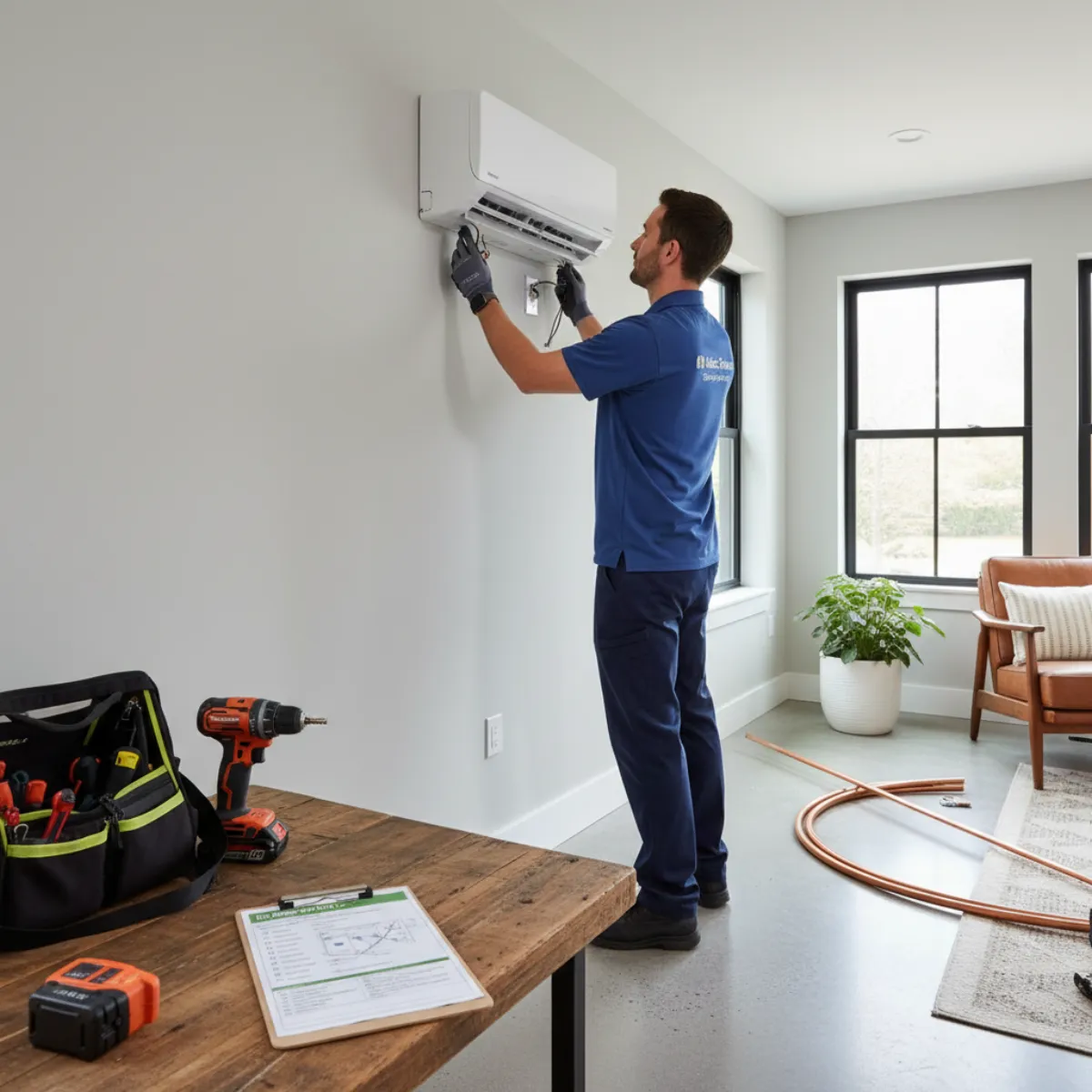
Everything you need to know about Mass Save heat pump rebates in 2026. Up to $8,500 standard, $16,000 income-eligible or no-cost pathways, plus 0% HEAT loan financing. Step-by-step process, qualified models, common mistakes, and utility-specific differences.
Enter your zip to see exactly which rebates you qualify for.
Mass Save offers $2,650/ton up to $8,500 for whole-home and $1,125/ton up to $8,500 for partial-home heat pump installations in 2026. Basic systems receive $250/ton up to $2,500. Income-eligible households get up to $16,000 or no-cost pathways. Add the $500 sizing bonus for eligible partial-home projects with a Manual J calculation. The HEAT loan provides 0% financing for qualifying improvements. To qualify: (1) get a free Mass Save energy assessment, (2) choose a cold-climate, QPL-listed heat pump, (3) submit pre-approval BEFORE installation, (4) use an HPC network contractor. The total process takes 8-16 weeks.
Mass Save heat pump rebates were restructured, and several widely-cited guides published in 2024 are now out of date. If you're comparing pages, here's what to double-check — we verified every figure below directly against masssave.com in June 2026.
A common right-sized cold-climate system for a typical MA home is about 4 tons. Here is how the per-ton math and the $8,500 cap actually play out — and why keeping a fossil-fuel primary system costs you.
The uncapped math ($10,600) exceeds the $8,500 ceiling, so the rebate lands at the cap. Anything 3.2 tons or larger hits the $8,500 maximum on this pathway.
Same 4 tons, but because a fossil-fuel system stays as primary heat, the per-ton rate is lower and you land at $4,500— $4,000 less than the whole-home pathway for identical equipment.
Complete displacement of fossil fuel heating. The heat pump becomes the primary heating source for the whole home, with the old system removed or demoted to backup only.
Heat pump covers part of the home (some zones) while an existing system stays as primary heat for the rest.
Supplemental heat pump (e.g. a single room or shoulder-season comfort) that does not displace the primary heating system.
Enhanced incentive for qualifying households — up to $16,000 toward a whole-home heat pump, or a no-cost installation through Mass Save Turnkey Services for the lowest-income tier.
Qualifying households can receive significantly higher support — up to $16,000 toward a whole-home heat pump installation, or a no-cost installation through Mass Save Turnkey Services for the lowest-income tier. This can cover the majority, or all, of a typical heat pump system cost. Verified June 2026 against masssave.com.
Income-eligible households may also receive free weatherization (insulation and air sealing) as part of the energy assessment. Eligibility is determined by Mass Save income thresholds that vary by household size and utility sponsor, and it is confirmed at application — not at the quote stage. Contact Mass Save at 866-527-7283 to check your eligibility before signing a heat pump contract; the process is confidential.
Equipment must still meet ENERGY STAR Cold Climate spec and appear on the Mass Save heat pump QPL.
| Incentive | Amount | Status |
|---|---|---|
| Mass Save Whole-Home Rebate | $2,650/ton, up to $8,500 | Available 2026 |
| Mass Save Income-Eligible Pathway | Up to $16,000 (or no-cost Turnkey) | Income-qualified |
| HEAT Loan (0% APR) | Up to $25,000 / 7 yrs | Available 2026 |
| Heat Pump Winter Electric Rate | Utility-specific savings | Where offered |
| Federal 25C / 25D credits | Expired Dec 31, 2025 | No longer available |
Follow these six steps in order to maximize your rebate and avoid common pitfalls. The total timeline is 8-16 weeks from scheduling your energy assessment to receiving your rebate check.
This FREE home energy assessment is required before applying for heat pump rebates. An auditor evaluates your home's insulation, air sealing, windows, and heating system. They recommend improvements and may provide free weatherization services (air sealing, insulation). Schedule at masssave.com or call 866-527-7283.
Get quotes from at least 2-3 contractors in the Mass Save Heating and Cooling (HPC) network. These contractors are trained on Mass Save requirements and can handle the rebate paperwork. Using a non-HPC contractor may disqualify your rebate or require additional verification steps.
Your contractor (or you) submits the rebate application BEFORE installation begins. The application includes: energy assessment completion ID, proposed heat pump model and size, Manual J calculation (for sizing bonus), and estimated project cost. Pre-approval ensures your rebate is reserved before you invest in the installation.
Once pre-approved, your HPC contractor installs the heat pump system. Installation includes: outdoor unit placement, indoor unit mounting (wall-mount, ceiling cassette, or ducted), refrigerant line running, electrical connections, and thermostat/controls setup. The contractor ensures the system meets Mass Save specifications.
Mass Save may schedule a post-installation inspection to verify the system matches the approved application. Not every installation is inspected, but it's common for whole-home conversions and income-eligible projects. The inspector checks: correct model installed, proper sizing, quality of installation, and functioning controls.
After approval (or after waiving inspection), Mass Save processes your rebate. Payment is typically issued as a check mailed to your address, or in some cases as a credit on your utility bill. The timeline is 4-8 weeks from final approval to receiving the rebate check. Income-eligible rebates may follow a slightly different timeline.
May lose entire rebate. Always get pre-approval FIRST.
critical riskRebate denied. Verify model on Mass Save QPL before purchasing.
critical riskCannot submit rebate application. Assessment is a prerequisite.
critical riskMay require additional verification, delays, or rebate reduction.
high riskMiss the $500 sizing bonus. Ensure contractor performs load calculation.
medium riskCould miss $6,000-$8,000 in additional rebates. Check income thresholds.
high riskLonger processing times (12-16 weeks vs 8-12 weeks).
low riskYour heat pump must be on the Mass Save Qualified Products List (QPL) to receive rebates. Here are the most commonly installed qualifying brands and models in Massachusetts.
Always verify on the QPL before purchasing. The Mass Save QPL is updated periodically. A model that qualified last year may have been removed, or a newer version may be required. Check the current list at masssave.com/en/saving/residential-rebates/heating-and-cooling or ask your contractor to confirm QPL eligibility.
While the rebate amounts are consistent across utilities, the application process, timeline, and additional benefits vary. Here's what to expect from each utility.
Eastern MA, Greater Boston, Cape Cod, South Shore
Online portal for application submission. Generally fastest processing times. Most HPC contractors in their territory.
Offers additional weatherization incentives that stack with heat pump rebates. Strong income-eligible program outreach.
Central MA, Western MA, parts of Greater Boston
Similar online portal. Slightly longer processing times in peak season. Good contractor network in Worcester and Springfield areas.
Offers the heat pump winter electric rate discount in addition to installation rebates. Strong rural outreach.
North-central MA (Fitchburg, Lunenburg area)
Smaller territory means fewer contractors but also faster processing. May require phone/mail applications for some rebate types.
More personalized service due to smaller customer base. May offer additional local incentives.
The Mass Save HEAT Loan is one of the best home improvement financing offers in the country: 0% APR, up to a $25,000 maximum, over a maximum 7-year term. No 25C federal tax credit is needed (it expired Dec 31, 2025) — the HEAT Loan and the Mass Save rebate stack are what carry a 2026 project. Verified June 2026 against masssave.com.
Heads up: the maximum dropped from $50,000 to $25,000 on January 1, 2025. The loan can cover the net cost after rebates — a $20,000 whole-home system minus an $8,500 Mass Save rebate leaves $11,500, which at 0% over 84 months is about $136.90/month. A typical home improvement loan at 7-9% APR would cost noticeably more per month plus thousands in total interest.
The HEAT Loan requires that you are the homeowner, hold a utility account, and have completed a Mass Save Home Energy Assessmentbefore you apply — the assessment is the gateway to both the rebate and the loan. Final approval is subject to the participating lender. Book the assessment first, then line up the rebate pre-approval and the loan in parallel.
0% APR, 84-month (7-year) term — principal ÷ 84.
The $25,000 row is the program maximum. Shorter terms raise the monthly payment but keep the 0% APR.
Mass Save offers $2,650 per ton for whole-home heat pump installations, capped at $8,500, and $1,125 per ton for partial-home installations, also capped at $8,500, in 2026. Basic (supplemental) heat pump rebates are $250 per ton, capped at $2,500. These three air-source pathways are mutually exclusive. Income-based enhanced incentives can reach up to $16,000, or a no-cost installation through Mass Save Turnkey Services for the lowest-income tier. Equipment must meet the ENERGY STAR Cold Climate spec and appear on the Mass Save heat pump Qualified Products List. The 2026 install window runs January 1 through December 31, 2026, and rebate forms are due by February 28, 2027. Figures verified June 2026 against masssave.com.
Income-eligible households receive significantly higher rebates — up to $16,000 for whole-home heat pump installation or up to no-cost turnkey service pathways for qualifying homes, compared with the $8,500 standard whole-home cap. You qualify if your household income falls within Mass Save enhanced incentive thresholds, which vary by household size and utility sponsor. Contact Mass Save at 866-527-7283 to check eligibility before signing a heat pump contract.
The Mass Save HEAT Loan provides 0% APR financing for qualifying energy improvements, including heat pumps, up to a maximum of $25,000 with a maximum term of 7 years. Note: the maximum dropped from $50,000 to $25,000 effective January 1, 2025 — many older guides still quote the dead $50,000 figure. The HEAT Loan can cover the net cost after rebates — so if your system costs $18,000 and you receive an $8,500 rebate, you can finance the remaining $9,500 at 0%. To qualify you must be the homeowner, have a utility account, and complete a Mass Save Home Energy Assessment first; final approval is subject to the participating lender. Figures verified June 2026 against masssave.com.
Yes, a Mass Save home energy assessment is required before you can apply for heat pump rebates. The assessment is FREE and takes 2-3 hours. An auditor evaluates your home's insulation, air sealing, and heating systems. They may provide free air sealing and insulation during the visit. The assessment also identifies any weatherization improvements that should be done before or alongside heat pump installation for optimal performance. Schedule at masssave.com or call 866-527-7283.
This is the #1 mistake homeowners make. While some retroactive applications are processed, you risk losing your entire rebate if you install before pre-approval. Mass Save explicitly recommends getting pre-approval BEFORE installation begins. The pre-approval process takes 1-2 weeks and reserves your rebate amount. Once pre-approved, you have a window (typically 6-12 months) to complete the installation. Always get pre-approval first.
The heat pump must be ENERGY STAR certified, cold-climate rated (efficient at 5 degrees F), and listed on the Mass Save Qualified Products List (QPL). The most commonly installed qualifying brands in MA are: Mitsubishi (Hyper-Heat series — most popular), Fujitsu (XLTH series), Daikin (Aurora/Fit series), Carrier/Bryant (Greenspeed series), Bosch (IDS 2.0), and LG (Red series). Check the current QPL at masssave.com before purchasing — the list is updated periodically.
The total timeline from first contact to receiving your rebate check is typically 8-16 weeks: Schedule energy assessment (1-4 weeks wait), assessment visit (2-3 hours), get contractor quotes (1-3 weeks), submit pre-approval application (1-2 weeks processing), installation (1-3 days), post-installation inspection if required (1-3 weeks), and rebate payment (4-8 weeks). To minimize the timeline, schedule your energy assessment and get contractor quotes simultaneously, apply during off-peak months (spring/early summer), and have all documentation ready.
The 2026 Mass Save heat pump rebate structure changed from the older $10,000 whole-home headline. Current 2026 air-source heat pump rebates are $2,650 per ton up to $8,500 for whole-home systems, $1,125 per ton up to $8,500 for partial-home systems, $250 per ton up to $2,500 for basic systems, and up to $16,000 or no-cost pathways through income-based enhanced incentives. The QPL has been updated with newer qualifying models, and the heat pump winter electric rate makes the rebate plus operating-cost stack more valuable.
NuWatt is a Mass Save participating contractor. We handle the entire rebate process — energy assessment coordination, pre-approval, installation, and rebate filing.