Loading NuWatt Energy...

We use your location to provide localized solar offers and incentives.
We serve MA, NH, CT, RI, ME, VT, NJ, PA, and TX
Loading NuWatt Energy...
NuWatt designs, installs, and manages solar, battery, heat pump, and EV charger systems across 9 states. One company, one warranty, one point of contact.
Get a Free QuoteMassachusetts has over 200,000 multi-family buildings with 4+ units — condos in Cambridge, apartment complexes in Worcester, and everything in between. These buildings are ideal for solar: large flat roofs, high combined electricity loads, and access to SMART commercial rates that pay 9x more than residential. With virtual net metering, one system offsets costs for every unit. This guide covers everything building owners, condo associations, and property managers need to know about going solar in 2026.
Looking for triple-decker solar? This guide covers 4+ unit buildings, condos, and apartment complexes. For 2-3 unit triple-deckers, see our Triple-Decker Solar Guide.
How you structure solar ownership determines who captures the tax benefits, who receives SMART income, and how credits flow to tenants. Choose the model that matches your building type and financial goals.
The building owner purchases the solar system outright and enrolls in net metering. Credits are allocated across all tenant meters via VNM under M.G.L. c.164 §139. The owner receives SMART income directly. No federal tax credit is available for individual landlords since Section 25D expired Dec 31, 2025.
The condo association votes to install solar on common roof area. Credits are allocated proportionally to each unit's ownership percentage. Requires a 2/3 supermajority vote under MA condo law (M.G.L. c.183A). A recorded solar easement protects the investment. SMART income flows to the association account.
A solar developer installs and owns the system on your building. They claim the Section 48/48E commercial ITC (30% base + potential adders for FEOC, energy community, or low-income). You buy power at a below-market rate, typically 10-20% less than your current utility rate. Projects that began construction on or before July 4, 2026 locked in the full credit timing; projects that start later still qualify if placed in service by December 31, 2027.
Tenants or building owners subscribe to a community solar farm. No rooftop installation needed. Credits appear on each subscriber's electric bill at a 10-20% discount. Building owners can subscribe on behalf of common area meters. Ideal when the roof is too small, shaded, or structurally inadequate for on-site solar.
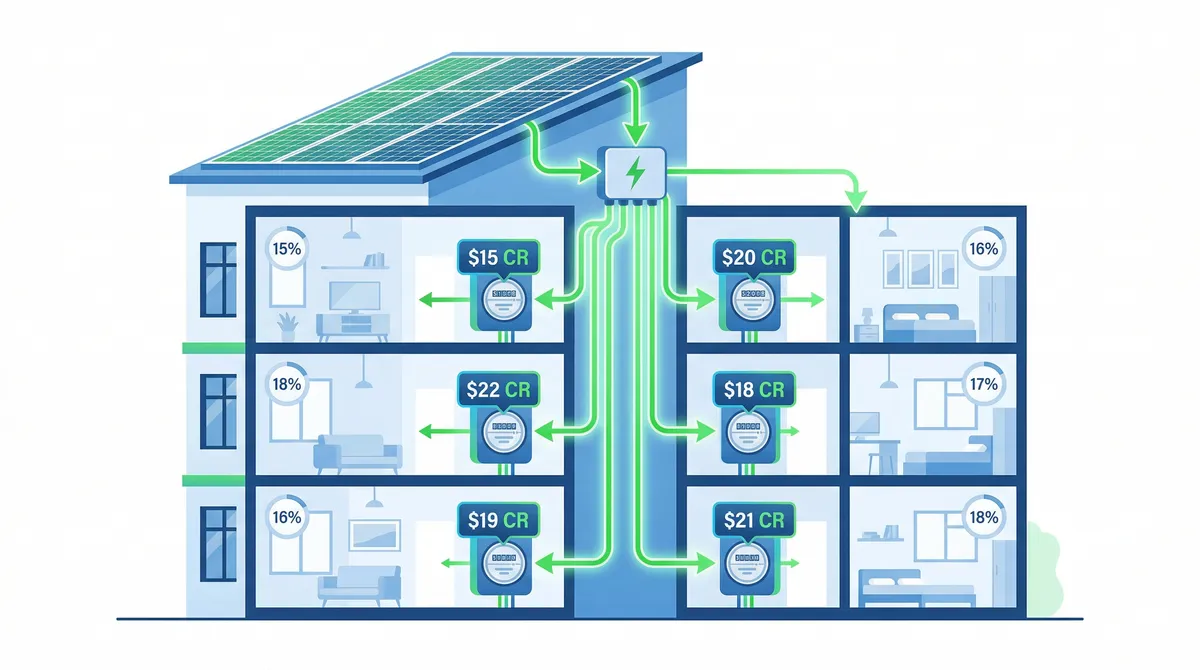
Virtual net metering (VNM) is the mechanism that makes multi-family solar work in Massachusetts. Under M.G.L. c.164 §139, a single solar system can generate credits for every meter in a building — tenants see lower bills without installing anything in their own units.
The SMART 3.0 program pays building owners for every kWh their solar system produces — and the commercial rates are dramatically higher than residential. A system over 25 kW qualifies for commercial rates, making larger multi-family systems significantly more profitable.
Key insight: The jump from residential ($0.03/kWh) to commercial Tier 1 ($0.2807/kWh) is a 9.4x increase. This makes sizing above 25 kW extremely valuable for qualifying buildings.
| SMART Tier | Rate | Term | Notes |
|---|---|---|---|
| Residential (≤25 kW) | $0.03/kWh | 20 years | 4-6 unit buildings with small roof — residential rate applies |
| Commercial Tier 1 (≤250 kW) | $0.2807/kWh | 20 years | Most 8-20 unit buildings fall here — significantly higher rate |
| Commercial Tier 2 (250-500 kW) | $0.243/kWh | 20 years | Large complexes — still very attractive production-based income |
| Commercial Tier 3 (500 kW-1 MW) | $0.2317/kWh | 20 years | Large-scale multifamily or campus installations |
| Building-Mounted Adder | +$0.03/kWh | 20 years | Stacks with commercial rate for rooftop systems on buildings |
The residential 25D tax credit expired December 31, 2025 — it is $0. But the commercial Section 48/48E ITC remains available for third-party system owners through PPA or lease structures. For multi-family buildings, this is the primary federal incentive path.
Must meet prevailing wage & apprenticeship (projects >1 MW)
Panels & components manufactured in US. Sourcing rules apply.
Located in qualifying energy community census tract
Located in low-income census tract or serving low-income tenants
Timing: Section 48/48E projects that began construction on or before July 4, 2026 locked in the full credit timing; projects that start later still qualify if they are placed in service by December 31, 2027. Signing a contract and placing equipment orders typically satisfies the "begin construction" standard. For multi-family buildings, start conversations with solar developers now to keep the December 31, 2027 placed-in-service window comfortable.
Installing solar as a condo association requires navigating governance rules, cost-sharing, and credit allocation. Here is the step-by-step process for Massachusetts condo buildings.

Under M.G.L. c.183A, capital improvements require a 2/3 supermajority vote of unit owners. Some condo documents may specify a higher threshold. The board should present: total cost, per-unit assessment, projected savings, SMART income allocation, and payback timeline. A solar-specific amendment to the master deed may be needed.
Costs are typically split by ownership percentage (same as condo fees). A 6-unit building with equal shares would assess ~$10,000 per unit for a 20 kW system. Alternatively, the association can use reserves, take a commercial loan, or structure a PPA where the solar company owns the system and the association pays nothing upfront.
VNM credits are allocated to each unit meter based on ownership percentage. A unit owning 16.7% of a 6-unit building receives 16.7% of solar credits on their electric bill. Common area meters (hallways, laundry, exterior lighting) receive a separate allocation. SMART income flows to the association account and can offset condo fees.
Solar economics scale dramatically with building size. Larger systems access higher SMART commercial rates, qualify for Section 48E through PPA structures, and have shorter payback periods due to economies of scale.
Typical Somerville/Cambridge wood-frame. Flat rubber roof. Each unit pays $10K via special assessment. VNM credits split equally across 6 meters.
Landlord-owned brick building. SMART commercial rate ($0.2807/kWh for ≤250 kW). Section 48E via PPA reduces effective cost to ~$75,600. VNM distributes credits to all 12 meters.
Multi-building complex. SMART commercial rate ($0.243/kWh for 250-500 kW). C-PACE financing spreads cost over 25 years on property tax bill. Section 48E through PPA structure. ConnectedSolutions battery adds ~$4,000/yr revenue.
C-PACE (Commercial Property Assessed Clean Energy) is an underutilized financing tool that makes large multi-family solar projects cash-flow positive from day one. Administered by MassDevelopment, C-PACE attaches the solar loan to the property tax bill — not your personal credit.
Solar is not just a building owner investment — it directly benefits tenants and transforms property management economics. In the Greater Boston rental market, solar is increasingly a competitive advantage.
VNM credits reduce each tenant's electric bill by $50-$150/month depending on unit size and credit allocation. Tenants pay nothing for this benefit.
Boston-area apartments with solar command 3-7% higher rents. "Solar-powered building" in listings attracts environmentally conscious tenants.
Tenants with lower utility costs stay longer. Each vacancy costs $2,000-$4,000 in lost rent, cleaning, and re-letting. Solar cuts turnover by 15-25%.
Adding building-scale battery keeps common area lights, fire systems, and elevators running during outages — a safety and marketing feature.
Before installing solar, take advantage of the Mass Save Multifamily Program. A free comprehensive energy assessment identifies insulation, air sealing, and lighting improvements that reduce building energy use — which directly affects how you size your solar system.
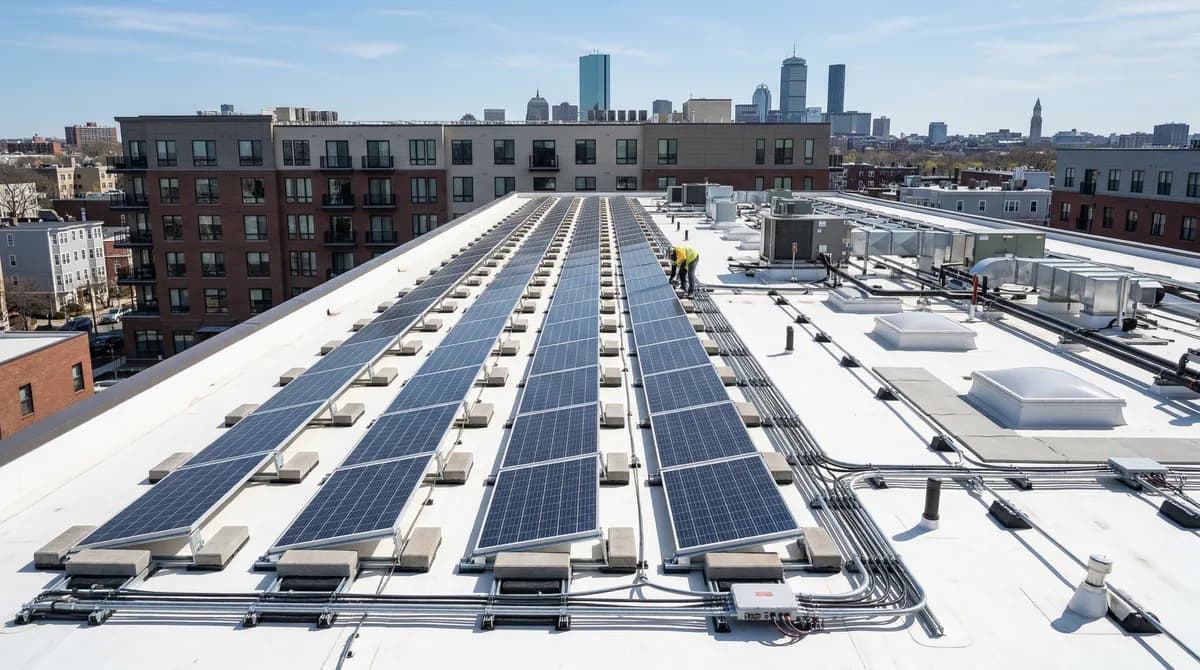
Multi-family flat roofs require specialized planning. Address these factors before signing a solar contract.
If EPDM, TPO, or modified bitumen has fewer than 7 years remaining, re-roof first. Removing and reinstalling solar panels adds $3,000-$8,000 for larger systems.
Ballasted systems add 5-8 lbs/sq ft. Post-1950 masonry buildings typically can handle this. Pre-1950 wood-frame buildings need closer review. Budget $500-$2,000 for structural engineering.
Massachusetts IFC requires 3 ft clear from all roof edges and 3 ft pathways to access points. For larger buildings, NFPA 1 may require additional access corridors, reducing usable area by 25-35%.
Flat roofs on apartment buildings often have rooftop HVAC units, vents, and elevator penthouses. Panels must maintain clearance around all mechanical equipment. This reduces usable area but panel layout can work around obstacles.
Multi-family buildings with battery storage earn demand response revenue through Eversource or National Grid ConnectedSolutions. Larger buildings can install multiple batteries for proportionally more income.
Battery storage also provides backup power for common areas during outages — fire alarms, emergency lighting, elevators, and security systems remain operational.
Multi-family solar projects take longer than single-family due to structural review, larger permits, and utility interconnection complexity. Here is the typical 20-30 week timeline.
Free building energy assessment identifies weatherization needs before solar sizing.
Get 2-3 proposals. Evaluate PPA vs. direct ownership vs. C-PACE.
For condos: schedule meeting, present financials, conduct 2/3 vote.
Licensed PE inspects roof, provides load letter for permit application.
Building + electrical permits. Boston ISD may add fire department review.
File interconnection application with Eversource/NGrid during permitting.
Racking, panels, inverters, wiring. Larger systems may take a full week.
Final inspection, utility meter swap, Permission to Operate issued.
File allocation schedule. Credits start flowing to tenant meters.
Yes. Massachusetts condo associations can install solar on common roof areas. Under M.G.L. c.183A, a 2/3 supermajority vote of unit owners is typically required to approve a capital improvement like solar. The association should record a solar easement to protect the system and include maintenance responsibilities in the governing documents. Credits from the system are allocated to each unit proportionally based on ownership percentage via virtual net metering. A 6-unit condo with a 20 kW system would save approximately $9,000/year in combined electricity costs.
Virtual net metering (VNM) under M.G.L. c.164 §139 allows a single solar system to generate credits that are distributed across multiple electric meters at the same property or within the same utility territory. For apartment buildings, the system owner (landlord or condo association) designates how credits are split among tenant meters. Each tenant sees a credit on their monthly electric bill. The building owner files a VNM allocation schedule with the utility (Eversource, National Grid, or Unitil) and can adjust percentages when tenants change. VNM activation typically takes 30-60 days after Permission to Operate (PTO).
The SMART rate depends on system size. Systems ≤25 kW receive the residential rate of $0.03/kWh. Systems 26-250 kW receive the commercial Tier 1 rate of $0.2807/kWh — significantly higher. This means a 40 kW system on a 12-unit building earns approximately $0.2807 per kWh produced, or ~$13,475/year. The building-mounted adder (+$0.03/kWh) stacks on top of commercial rates for rooftop installations. All SMART payments are guaranteed for 20 years at the rate locked in at enrollment.
Yes, through community solar. Massachusetts tenants can subscribe to an off-site community solar farm and receive credits on their electric bill — typically a 10-20% discount on their current rate. No installation, no rooftop access needed. Building owners can also subscribe common area meters. Community solar subscriptions require no upfront cost and can be canceled with notice. This is the primary path for tenants in buildings with inadequate roof space or shading issues.
C-PACE (Commercial Property Assessed Clean Energy) is a financing mechanism administered by MassDevelopment for commercial properties with 5+ units. The solar loan is repaid through an assessment on the property tax bill over 20-30 years. C-PACE requires no personal guarantee, stays with the property if sold, and does not affect existing mortgage terms. The minimum project size is $50,000. For a 12-unit apartment building with a $108,000 solar installation, C-PACE payments would be approximately $7,200/year — less than the $18,100 in annual electric savings, creating positive cash flow from day one.
The residential Section 25D tax credit expired December 31, 2025 — it is $0 for individual homeowners and condo owners. However, the commercial Section 48/48E Investment Tax Credit (ITC) is available to third-party system owners (solar companies) through PPA or lease structures. The base ITC is 30%, with potential adders for domestic content (+10%), energy community (+10%), and low-income community (+10-20%) bringing it up to 70%. The third-party owner passes savings to the building through reduced electricity rates. Projects that began construction on or before July 4, 2026 locked in the full credit timing; projects that start later still qualify if placed in service by December 31, 2027.
System sizing for multi-family buildings is based on combined building load. A typical MA apartment uses 500-700 kWh/month per unit. For a 12-unit building consuming 7,200 kWh/month total, a 40 kW system producing ~48,000 kWh/year would offset approximately 55% of total building usage. Roof area determines the maximum size: expect 4-5 watts per square foot of usable roof area after fire setbacks. A 2,800 sq ft flat roof yields approximately 35-45 kW. Shared loads (hallway lights, elevators, laundry, HVAC) should be included in the sizing calculation.
Flat-roof apartment buildings require structural engineering review before solar installation. Key considerations include: roof membrane condition (EPDM, TPO, or built-up — 7+ years remaining life recommended), dead load capacity (ballasted systems add 5-8 lbs/sq ft), IFC fire setbacks (3 ft from all edges, 3 ft pathways), drainage (panels must not block roof drains), and parapets (may reduce wind uplift requirements). Most post-1950 masonry apartment buildings in MA can support solar. The structural review costs $500-$2,000 and is typically included in the installer proposal.
Yes. Mass Save has a dedicated Multifamily Program for buildings with 5+ units. It includes a free comprehensive energy assessment, incentives for air sealing and insulation (75% covered for market-rate buildings, 100% for income-eligible buildings at 60% AMI), common area lighting upgrades, and boiler/heating system rebates. Completing a Mass Save assessment before solar installation is recommended because improved insulation reduces energy usage, which affects optimal solar system sizing. Contact Mass Save at 1-866-527-SAVE to schedule a multifamily assessment.
The total timeline from contract to Permission to Operate (PTO) is typically 20-30 weeks for multi-family buildings. This includes: structural engineering review (2-4 weeks), permitting with local building department (4-8 weeks — longer in Boston), utility interconnection application (2-4 weeks), installation (3-7 days depending on system size), final inspection (1-2 weeks), and utility interconnection approval (6-12 weeks). VNM setup adds 4-6 weeks after PTO. Larger systems (>25 kW) may require additional utility review and potentially a transformer upgrade.
Specific guide for 3-unit triple-deckers in Boston & MA.
Community solar options and VNM for condo owners.
Section 48E, MACRS depreciation, large-scale systems.
Earn $225-$275/kW/season with demand response.
Enrollment guide for SMART 3.0 residential and commercial.
How C-PACE works for commercial solar in MA.
We specialize in multi-family solar across Massachusetts — condo associations, apartment buildings, and complexes. Virtual net metering, SMART enrollment, and C-PACE financing support included.
Section 48E timing: projects that began construction on or before July 4, 2026 locked in the full credit timing; later starts still qualify if placed in service by December 31, 2027.
