Loading NuWatt Energy...

We use your location to provide localized solar offers and incentives.
We serve MA, NH, CT, RI, ME, VT, NJ, PA, and TX
Loading NuWatt Energy...
NuWatt designs, installs, and manages solar, battery, heat pump, and EV charger systems across 9 states. One company, one warranty, one point of contact.
Get a Free Quote
Stack National Grid R-4 TOU arbitrage, ConnectedSolutions demand response, and SMART 3.0 battery income into one optimized revenue system. Here is how the math works for the 1.3 million MA customers on National Grid.
National Grid's R-4 time-of-use rate charges $0.3155/kWh during peak hours (Mon–Fri 12–8 PM) and just $0.2104/kWh off-peak. That $0.1051/kWh spread is money your battery can earn every single day — charge cheap, discharge expensive.
But TOU arbitrage is just one layer. When you stack it with ConnectedSolutions ($225/kW summer + $50/kW winter) and SMART 3.0 battery adder ($0.04/kWh), a single Powerwall 3 paired with 11 kW of solar generates over $4,923/year in combined revenue — before counting net metering bill credits.
Understanding when electricity is expensive versus cheap is the foundation of every battery optimization strategy.
$0.3155/kWh
Strategy: Discharge battery and export solar during these hours. Avoid grid consumption.
$0.2104/kWh
Strategy: Charge battery from solar or grid. Run heavy appliances (laundry, EV, dishwasher).
Peak Rate
NGrid: $0.3155 vs Eversource: $0.3284
Off-Peak Rate
NGrid: $0.2104 vs Eversource: $0.2201
TOU Spread
NGrid: $0.1051 vs Eversource: $0.1083
The spreads are nearly identical. National Grid's slightly lower rates mean marginally less TOU arbitrage, but the ConnectedSolutions and SMART programs make up the difference.
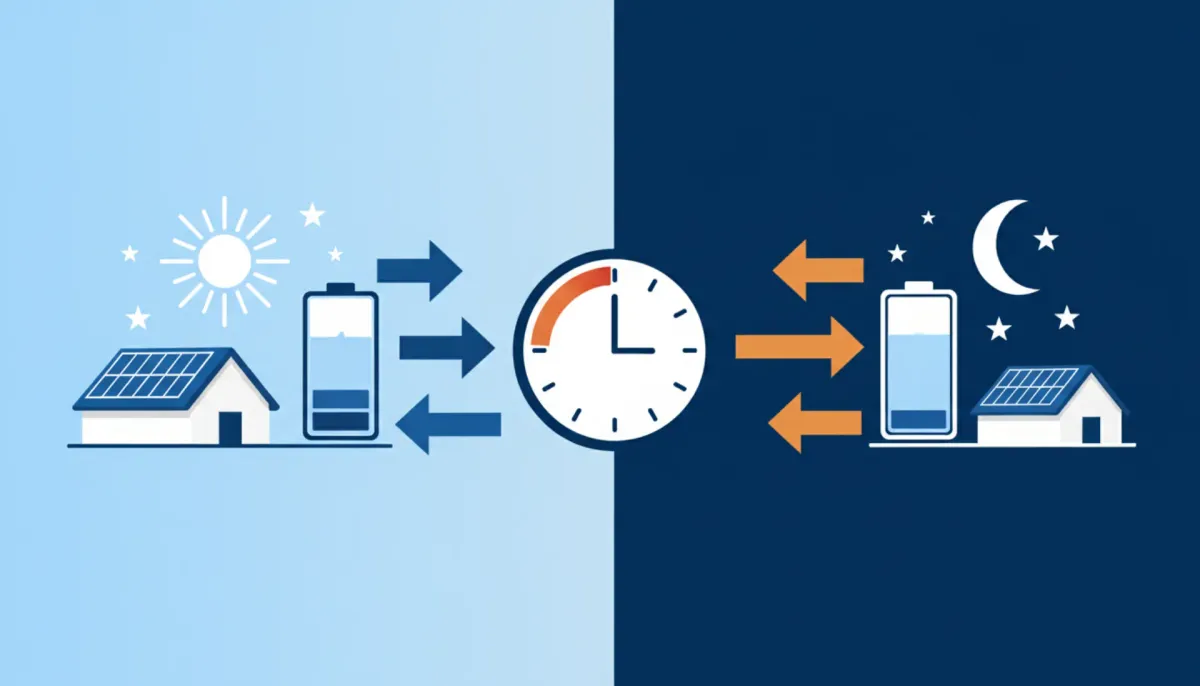
With the right battery settings, this runs automatically. No daily intervention needed.
6 AM – 12 PM
Solar panels generate electricity. Battery charges from free solar production. Home consumption runs on solar directly.
12 PM – 4 PM
Peak hours begin. Battery fully charged. Excess solar exports to grid at peak TOU rate ($0.3155/kWh). Net metering credits accumulate.
4 PM – 8 PM
Solar fades as sun sets. Battery discharges to power home during remaining peak hours, avoiding $0.3155/kWh grid purchases.
8 PM – 6 AM
Off-peak rates kick in. Battery tops off from grid at $0.2104/kWh if solar did not fully charge it. Heavy appliances run now.
Four independent revenue streams that stack together for maximum annual return on a National Grid solar + battery system.
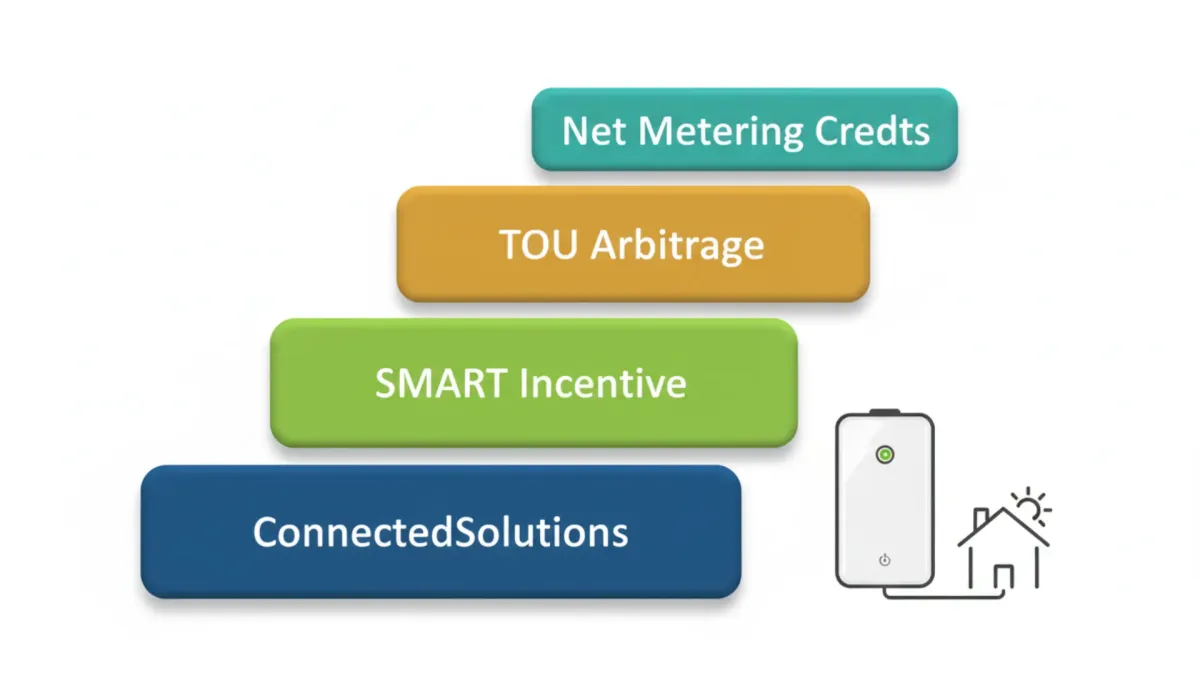
ConnectedSolutions
$225/kW summer + $50/kW winter × 11.5 kW
$3,738/yr
SMART Battery Adder
$0.04/kWh × 11 kW × 1,200 kWh/kW
$528/yr
TOU Arbitrage
10.8 kWh × $0.1051 × 250 days × 92% eff.
$261/yr
SMART Base
$0.03/kWh × 11 kW × 1,200 kWh/kW
$396/yr
Battery-Only Revenue
$4,527/yr
Total System Revenue
$4,923/yr
This is incentive + arbitrage revenue only. Additional savings from net metering bill credits (1:1 retail at ~$0.42/kWh ≈ $5,014/yr for 11 kW) are on top of this.
Adjust solar size, battery, and ConnectedSolutions enrollment to see your personalized revenue breakdown on National Grid.
Estimate your total annual revenue from TOU arbitrage, ConnectedSolutions, and SMART 3.0 with a National Grid solar + battery system.
Peak Rate
$0.3155/kWh
Mon–Fri 12–8 PM
Off-Peak Rate
$0.2104/kWh
All other hours
Spread
$0.1051/kWh
Battery
13.5 kWh / 11.5 kW
Annual Revenue
$4,923
/yr
10-Year Total
$47,753
est. w/ degradation
Estimates based on National Grid R-4 TOU rates (Feb 2026), SMART 3.0 $0.03/kWh base + $0.04/kWh battery adder, ConnectedSolutions $225/kW summer + $50/kW winter. TOU arbitrage assumes 250 weekdays, 80% depth of discharge, and 92% round-trip efficiency. Section 25D ITC expired Dec 31, 2025.
$0.42/kWh
$0.2104 – $0.3155/kWh
Verdict: If you have solar + battery, TOU wins. Your battery automates the load shifting that makes TOU profitable. Without a battery, stay on flat rate.
These programs are not competing — they are complementary. Your battery automatically switches between the two modes to maximize revenue:
Battery runs TOU arbitrage: charges off-peak, discharges during peak hours. Earns ~$0.1051/kWh on every kWh shifted. This is your daily baseline revenue.
ConnectedSolutions dispatches during peak grid demand (hot summer afternoons, 3–8 PM). Payment per event is higher than TOU arbitrage. Battery prioritizes CS on these days.
The result: you earn TOU arbitrage on most days, and get a higher ConnectedSolutions payment on the ~30–50 event days per year. No revenue conflicts — the battery management system handles the switching automatically.
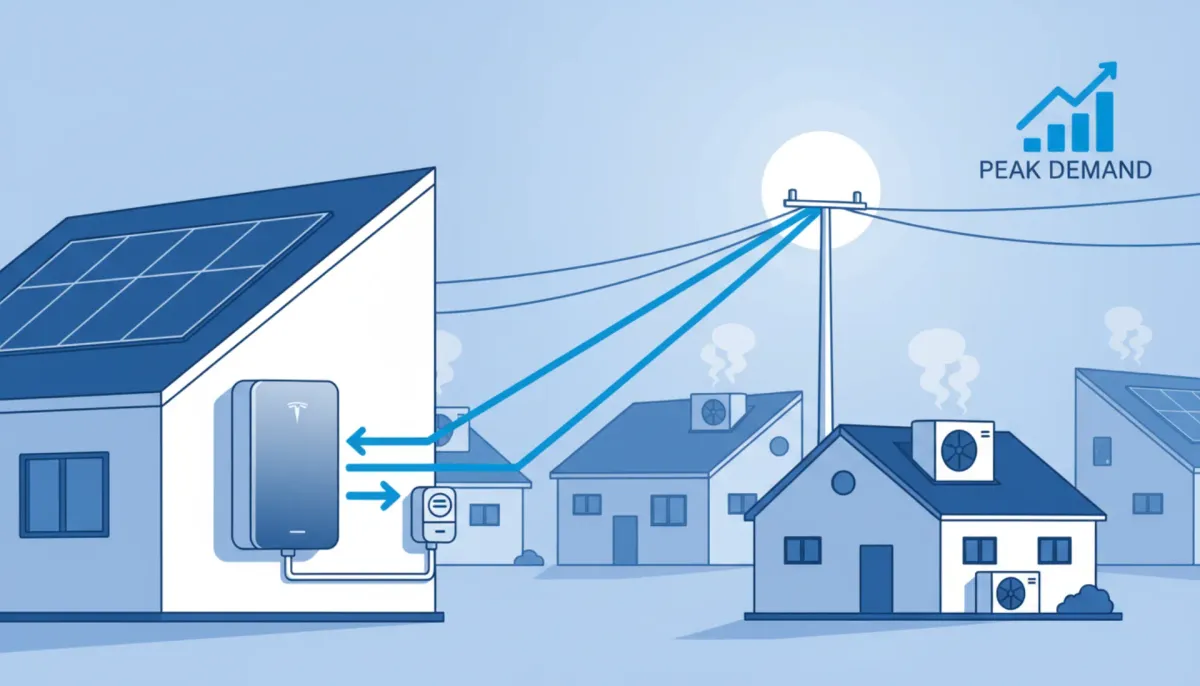
National Grid offers a seasonal heat pump rate that cuts winter delivery charges from $0.0668/kWh to $0.0244/kWh (November–April). This is not TOU — it applies to all winter usage. If you have solar + battery + heat pump, you stack three advantages:
Lower Winter Bills
~$540
estimated annual savings
TOU Arbitrage
Year-Round
R-4 spread remains active
ConnectedSolutions
$50/kW
winter DR payment bonus
Enrollment is automatic if you received a Mass Save heat pump rebate since January 2019. Otherwise, self-enroll at nationalgridus.com/MA-Home/Rates/Heat-Pump-Rate-Form.
Revenue breakdown for each battery option paired with 11 kW solar on National Grid R-4 TOU.
| Battery | TOU Arb. | CS | SMART Adder | Total | Est. Cost |
|---|---|---|---|---|---|
Enphase IQ 5P 5 kWh / 3.84 kW | $97 | $1,248 | $528 | $2,269/yr | $5,500–$7,000 |
Enphase IQ 10T 10 kWh / 5 kW | $193 | $1,625 | $528 | $2,742/yr | $10,000–$13,000 |
Tesla Powerwall 3 13.5 kWh / 11.5 kW | $261 | $3,738 | $528 | $4,923/yr | $12,500–$15,000 |
2× Enphase IQ 10T 20 kWh / 10 kW | $387 | $3,250 | $528 | $4,561/yr | $19,000–$24,000 |
Recommendation: The Tesla Powerwall 3 (13.5 kWh / 11.5 kW) offers the best revenue-to-cost ratio. Its high power rating (11.5 kW) maximizes ConnectedSolutions revenue, while 13.5 kWh provides solid TOU arbitrage capacity. The 2× Enphase IQ 10T setup earns more total but costs significantly more upfront.
Central MA
Worcester, Shrewsbury, Leominster, Fitchburg
Southeast MA
Brockton, Fall River, New Bedford, Plymouth
Greater Boston (West)
Framingham, Wellesley, Natick, parts of metro west
Western MA
Springfield, Pittsfield, Greenfield, Berkshires
The federal residential clean energy tax credit (Section 25D) expired December 31, 2025. Homeowners who purchase a solar + battery system with cash or a loan receive $0 in federal tax credits in 2026.
If you finance through a solar lease or PPA, the third-party system owner (financing company) can still claim the 30% ITC under Section 48/48E for projects beginning construction before July 4, 2026. The ITC savings are passed through to you as a lower monthly payment. The third-party owner claims the credit — not you and not the installer.
Compare the Eversource R-2 TOU rate and ConnectedSolutions at $275/kW
Read guideDeep dive into demand response program enrollment and earnings
Read guideHow SMART production incentives and battery adders work
Read guideCompare utility rates and solar economics across MA
Read guideCompare financing options and Section 48 TPO advantages
Read guideHow MA solar still works without the federal ITC
Read guideYes. National Grid offers the R-4 time-of-use rate for residential customers. Peak hours are Monday through Friday, 12:00 PM to 8:00 PM. The peak rate is $0.3155/kWh and the off-peak rate is $0.2104/kWh, giving a $0.1051/kWh spread for battery arbitrage. You can request a rate switch by contacting National Grid customer service — there is no fee, and a smart meter is installed for free if needed.
Your battery charges during off-peak hours ($0.2104/kWh) from solar or the grid, then discharges during peak hours ($0.3155/kWh) when electricity is most expensive. The $0.1051/kWh spread is your profit per kWh shifted. With a 13.5 kWh battery at 80% depth of discharge, that is roughly $480/year in arbitrage alone — and it stacks on top of ConnectedSolutions and SMART 3.0 income.
National Grid ConnectedSolutions pays $225/kW for summer demand response events (June–September) compared to Eversource's $275/kW. Both pay $50/kW for winter events. For a Powerwall 3 (11.5 kW), this means $2,588/year on Eversource vs. $2,588/year on National Grid at the same kW. The winter payment is identical. ConnectedSolutions runs up to 60 event hours per summer, with events between 3–8 PM on non-holiday weekdays.
Yes, and you should. On normal days (roughly 300 per year), your battery runs TOU arbitrage automatically. During ConnectedSolutions demand response events (capped at 60 hours/year, mostly summer afternoons), your battery dispatches for the higher ConnectedSolutions payment instead. The two programs complement each other perfectly — no conflicts.
National Grid offers a seasonal heat pump rate that reduces winter delivery charges from $0.0668/kWh to $0.0244/kWh (November through April). This is not a TOU rate — it applies to all usage during winter months. If you have solar + battery + heat pump, you benefit from lower winter operating costs on top of your TOU arbitrage and ConnectedSolutions revenue. Enrollment is automatic if you received a Mass Save heat pump rebate since 2019, or you can self-enroll online.
National Grid serves approximately 1.3 million customers across Central and Southeast Massachusetts, including Worcester, Brockton, New Bedford, Fall River, Plymouth, parts of greater Boston (western suburbs), the Berkshires, and Springfield. If you are unsure of your utility, check your electric bill — it will say "National Grid" or "Massachusetts Electric Company" (National Grid's regulated entity name).
Generally no. Without a battery to shift consumption, TOU can increase your bill if you use a lot of electricity during peak hours (12–8 PM weekdays). The TOU rate is designed to reward flexible consumption. A solar + battery system makes TOU clearly superior because you can export during peak and consume during off-peak.
No. The residential clean energy tax credit (Section 25D) expired December 31, 2025. Homeowners who purchase a battery with cash or a loan receive $0 in federal tax credits. However, if you finance through a solar lease or PPA, the third-party system owner can claim Section 48/48E (available for projects beginning construction before July 4, 2026) and pass savings through as a lower monthly payment.
National Grid performs the annual net metering true-up in March. Any excess credits accumulated over the year are settled at the avoided cost rate (much lower than retail). This means you should size your solar system to produce roughly what you consume annually — oversizing leads to wasted credits. Battery storage helps by self-consuming more of your solar production, reducing exports that might otherwise be lost at true-up.
Yes. National Grid has a DPU-approved $487 million AMI (Advanced Metering Infrastructure) deployment budget for 2023–2027, and the Electric Sector Modernization Plan (ESMP) covers 2025–2030. The Worcester Smart Energy Solutions pilot is the first residential TOU deployment. Statewide residential TOU is expected to follow AMI rollout, but no firm launch date exists yet for non-Worcester customers.
Find out how much you can earn by stacking TOU arbitrage, ConnectedSolutions, and SMART 3.0. We design systems optimized for maximum National Grid revenue.
Free consultation. No obligation. NABCEP certified installers.