Loading NuWatt Energy...

We use your location to provide localized solar offers and incentives.
We serve MA, NH, CT, RI, ME, VT, NJ, PA, and TX
Loading NuWatt Energy...
NuWatt designs, installs, and manages solar, battery, heat pump, and EV charger systems across 9 states. One company, one warranty, one point of contact.
Get a Free Quote28% of Massachusetts homes still heat with oil — the highest rate in the nation. Heating-oil prices stay volatile while a cold-climate heat pump runs on a stable, rate-capped utility bill. Mass Save pays $2,650/ton, up to $8,500 to displace your oil boiler. Figures verified June 2026 against masssave.com.
28%
MA oil-heated homes
$2,650/ton
Whole-home rebate
Up to $8.5K
Rebate cap
Up to $25K
0% HEAT Loan
Three factors put Massachusetts at the front of the national oil-conversion wave: the highest oil-heating density in the US, the most generous state rebate program, and the most aggressive Climate Act decarbonization targets.
Massachusetts leads the nation in oil-heated homes. Over 750,000 MA households still burn #2 fuel oil — concentrated in homes built before 1990 and the South Shore, Cape Cod, and Central MA. No other state is close.
Heating-oil prices swing with global crude markets and have trended sharply higher since 2020. The Massachusetts DOER (mass.gov) publishes recent MA heating-oil survey prices — check them for the current figure. That volatility is exactly what makes oil an unreliable long-term heating source.
Mass Save pays $2,650/ton, up to $8,500, to displace your oil boiler with a whole-home heat pump. Combined with the 0% HEAT Loan (up to $25,000) and the income-eligible pathway (up to $16,000 or no-cost Turnkey), many MA homeowners cover most or all of a full oil-to-HP conversion.
Heat pump operating cost is driven by your utility's actual electricity rate— not a single statewide number. Below we use the live all-in bundled residential rate on file for each Massachusetts utility (verified primary sources) against an illustrative ~6,000 kWh heating-season draw for a typical 1,500 sq ft home. The oil side is hedged because heating-oil prices move constantly.
Current all-in bundled residential rates on file for Massachusetts utilities. Your heat pump runs on whichever one serves your address — these are the numbers that actually drive your operating cost.
| Utility | Type | Residential rate | As of |
|---|---|---|---|
| South Hadley Electric Light Department | Municipal | $0.13/kWh | Jan 2025 |
| Chester Electric Light Department | Municipal | $0.14/kWh | Jan 2025 |
| Russell Municipal Light Department | Municipal | $0.14/kWh | Jan 2025 |
| Holden Municipal Light Department | Municipal | $0.14/kWh | May 2025 |
| Littleton Electric Light & Water Department | Municipal | $0.15/kWh | Jan 2025 |
| Paxton Municipal Light Department | Municipal | $0.15/kWh | Jan 2025 |
| Groveland Electric Light Department | Municipal | $0.15/kWh | Jan 2025 |
| Templeton Municipal Light Plant | Municipal | $0.15/kWh | Jan 2025 |
| Sterling Municipal Light Department | Municipal | $0.15/kWh | Jan 2025 |
| West Boylston Municipal Light Plant | Municipal | $0.15/kWh | Jan 2025 |
| Boylston Municipal Light Department | Municipal | $0.15/kWh | Jan 2025 |
| Middleton Electric Light Department | Municipal | $0.15/kWh | Jan 2025 |
| Hardwick Electric Department | Municipal | $0.15/kWh | Jan 2025 |
| Merrimac Municipal Light Department | Municipal | $0.15/kWh | Jan 2025 |
| Princeton Municipal Light Department | Municipal | $0.16/kWh | Jan 2025 |
| Groton Electric Light Department | Municipal | $0.16/kWh | Jan 2025 |
| Hudson Light and Power Department | Municipal | $0.1609/kWh | Jun 2026 |
| Wellesley Municipal Light Plant | Municipal | $0.1616/kWh | Jan 2023 |
| North Attleborough Electric Department | Municipal | $0.1633/kWh | Feb 2026 |
| Braintree Electric Light Department | Municipal | $0.1693/kWh | Mar 2025 |
| Norwood Municipal Light Department | Municipal | $0.1714/kWh | Sep 2025 |
| Mansfield Municipal Electric Department | Municipal | $0.1717/kWh | Mar 2026 |
| Middleborough Gas & Electric Department | Municipal | $0.1737/kWh | May 2024 |
| Shrewsbury Electric & Cable Operations | Municipal | $0.1765/kWh | Mar 2026 |
| Chicopee Electric Light Department | Municipal | $0.1765/kWh | Feb 2026 |
| Danvers Electric Division | Municipal | $0.1767/kWh | Nov 2025 |
| Westfield Gas & Electric Light Department | Municipal | $0.191/kWh | May 2026 |
| Holyoke Gas & Electric Department | Municipal | $0.1933/kWh | Jan 2026 |
| Hingham Municipal Lighting Plant | Municipal | $0.194/kWh | Mar 2026 |
| Peabody Municipal Light Plant | Municipal | $0.1976/kWh | Apr 2024 |
| Georgetown Municipal Light Department | Municipal | $0.1985/kWh | Mar 2026 |
| Taunton Municipal Lighting Plant | Municipal | $0.2047/kWh | May 2026 |
| Hull Municipal Lighting Plant | Municipal | $0.2094/kWh | May 2025 |
| Reading Municipal Light Department | Municipal | $0.2163/kWh | Jun 2026 |
| Marblehead Municipal Light Department | Municipal | $0.2203/kWh | Jan 2024 |
| Wakefield Municipal Gas & Light Department | Municipal | $0.2275/kWh | Apr 2026 |
| Ashburnham Municipal Light Plant | Municipal | $0.235/kWh | May 2026 |
| Ipswich Electric Light Department | Municipal | $0.2352/kWh | Mar 2026 |
| Rowley Municipal Lighting Plant | Municipal | $0.2434/kWh | Mar 2026 |
| Concord Municipal Light Plant | Municipal | $0.2435/kWh | Apr 2026 |
| Belmont Municipal Light Department | Municipal | $0.267/kWh | Mar 2026 |
| Eversource Western Massachusetts | IOU | $0.3624/kWh | Sep 2026 |
| Eversource | IOU | $0.3762/kWh | Sep 2026 |
| Cape Light Compact | IOU | $0.3833/kWh | Sep 2026 |
| National Grid | IOU | $0.4168/kWh | Oct 2026 |
| Unitil | IOU | $0.4814/kWh | Aug 2026 |
At an illustrative 6,000 kWh heating-season draw, the annual electricity cost works out to roughly:
Computed from each utility's live bundled rate × 6,000 kWh. Enrolling in a discounted heat-pump or off-peak rate where your utility offers one lowers this further during the heating season — ask your utility which rate you qualify for.
A typical 1,500 sq ft MA home burns roughly 800 gallons a season. The dollar figure depends entirely on the delivered price, which is volatile.
We deliberately avoid quoting a single oil price — it would be a guess. Your actual delivery history is the honest input.
Your actual savings depend on house size, insulation, oil consumption, and which utility serves you. Our calculator models your specific case using your oil delivery history and your utility's electricity rate — no statewide averages.
Open the MA Fuel Cost CalculatorMost oil-heated MA homes use hydronic distribution — baseboards or radiators heated by hot water. That means no existing ductwork. Your conversion path depends on what you have and what you're willing to modify.
Best for: Homes with baseboard or radiator heat (no existing ducts)
The most common path for MA oil-heated homes since 70%+ have hydronic distribution. Each head serves one zone; no ductwork needed.
Best for: Homes with existing forced-air ductwork (rare in oil-heated homes)
Cheaper when ducts already exist, but oil-heated MA homes rarely have them. Retrofitting ducts adds $10K-$20K.
Best for: Homes with existing radiators or radiant floor
Let you keep existing radiators and baseboards. Fewer installer options in MA. Ideal for historic homes where mini-splits would be visually intrusive.
Best for: Large homes, open main floor + bedrooms upstairs
Common for 2,000+ sq ft homes where mini-splits alone leave hot/cold spots.
70%+ of MA oil-heated homes were built before forced-air HVAC became standard (pre-1970s) and use cast-iron baseboards or radiators. Retrofitting ductwork into a finished home is invasive — dropped ceilings, soffits, wall chases. Ductless mini-splits install with a 3-inch hole per zone and are the fastest, least disruptive conversion path. That's why 85% of MA oil conversions use ductless or hybrid systems.
Mass Save prioritizes oil-to-HP conversions because displacing oil as your primary heat is exactly what qualifies the top whole-home rate. Here's the 2026 stack — note the income-eligible pathway replaces the standard rebate rather than stacking on top of it. Verified June 2026 against masssave.com.
The pathway that fits oil conversions best: it requires removing or demoting the oil boiler so the heat pump is the primary heat. Displacing oil as your main heat source is exactly what unlocks the top $2,650/ton rate.
Applies if you keep the oil boiler as primary heat for part of the home (dual-fuel). Lower per-ton rate because the home is not fully electrified.
Enhanced incentive for qualifying households — up to $16,000, or a no-cost install via Mass Save Turnkey Services for the lowest-income tier. Eligibility is confirmed at application, not at quote.
Finances the balance after rebates at 0% APR. Maximum dropped from $50,000 to $25,000 on Jan 1, 2025. Requires homeowner status, a utility account, a completed Home Energy Assessment, and lender approval.
The federal Section 25C heat pump / efficiency credit and the Section 25D residential credit both expired December 31, 2025. Any guide that still treats them as active for 2026 is out of date. MA homeowners should focus entirely on the Mass Save rebate stack and the 0% HEAT Loan — these are the active 2026 programs. For planning, the 2026 install window runs January 1 through December 31, 2026, and rebate forms are due by February 28, 2027.
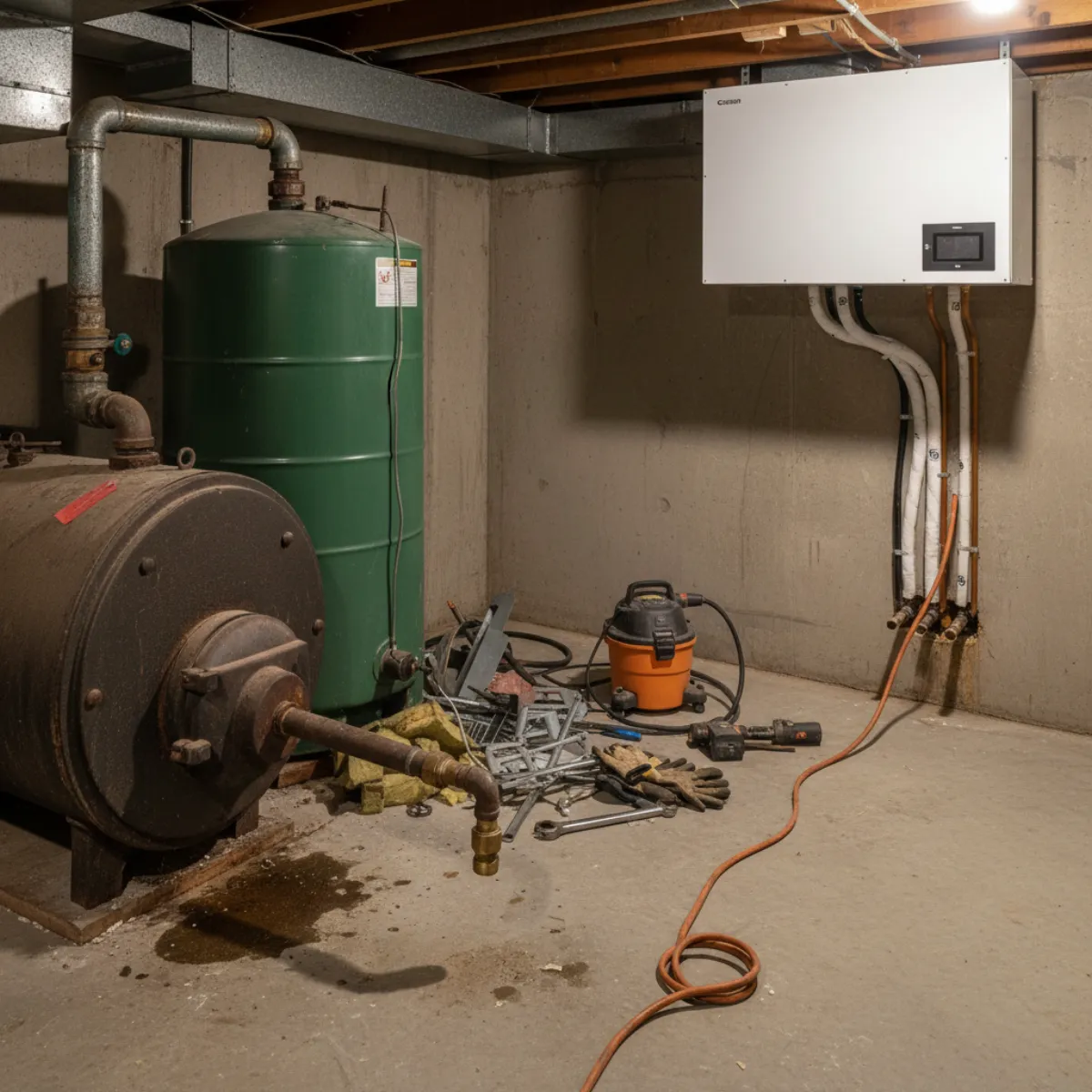
Your old tank doesn't need to come out on day one of the heat pump install, but it should within the first year. Left in place, aging tanks leak, insurers drop coverage, and resale value drops.
| Tank Type | Cost | Process | Time |
|---|---|---|---|
| Aboveground (basement) | $200-$500 | Pump remaining oil, cut tank in pieces, remove through basement door | 3-4 hours |
| Aboveground (outdoor) | $300-$700 | Pump oil, disconnect fill pipe, haul away intact | 2-3 hours |
| Underground (USTs) | $500-$1,500+ | Soil testing, excavation, tank removal, fill with clean material | 1-2 days |
| Underground with contamination | $3,000-$15,000+ | Full MassDEP-compliant remediation; report to DEP if over threshold | 1-3 weeks |
Roughly 15-20% of underground oil tanks in MA show some level of soil contamination during removal. If contamination exceeds MassDEP reportable concentrations (50 ppm for most volatile organics), a 21E assessment is required — remediation costs range from $3,000 for minor spills to $15,000+ for significant plumes. Homeowners insurance sometimes covers a portion; check your policy before excavation.
When the oil boiler comes out, several supporting systems need attention. Skip these and you can create drafting problems, air quality issues, or code violations.
If the oil boiler was your only combustion appliance, seal the chimney at top and bottom. Cap costs $200-$600. An unsealed unused flue pulls cold air into the basement year-round and invites water damage and animal intrusion.
If a gas water heater or dryer still vents through the same chimney, the flue is now oversized for the remaining load. This can cause backdrafting (CO risk) and condensation damage. An HVAC pro should evaluate and resize or reline the flue.
If the oil boiler heated both space and domestic hot water (tankless coil or indirect tank), you now need a separate water heater. Heat pump water heaters (HPWH) qualify for $750-$1,500 in Mass Save rebates and use 70% less energy than electric-resistance tanks.
If you go ductless, cast-iron radiators and copper fin baseboard stay in place, empty. You can leave them as is, remove them for usable floor space ($150-$400 per unit), or repurpose them if you keep a dual-fuel setup.
Some MA homeowners keep their oil boiler as a polar-vortex backup. It can make sense — but the economics rarely do once you run the math.
For an illustrative 4-ton system, the pathway you choose changes the rebate by thousands — the equipment is identical.
Plus you keep paying ~$250/yr in oil-boiler maintenance if you hold onto the boiler. Most homeowners find full displacement wins even after valuing emergency backup. Rebate figures verified June 2026 against masssave.com.
Mass Save-certified auditor evaluates insulation, air leakage, and existing heating load. Delivers a report that unlocks rebate eligibility and often includes free or discounted air sealing and attic insulation.
Your installer runs an ACCA Manual J load calculation room by room, confirms mini-split head placement, sizes line sets, and inspects electrical panel. Many MA homes need a 200A upgrade; plan for this.
Town building and electrical permits filed. Equipment ordered (cold-climate multi-zone systems often have 2-3 week lead times). Mass Save rebate pre-application submitted.
Day 1: electrical work and outdoor unit pad. Days 2-3: indoor head mounting, line set runs, refrigerant charge. Day 4: commissioning, defrost cycle test, thermostat programming. Day 5: inspections.
After HP commissioning is verified over a full heating day, the oil boiler is decommissioned (drained, electrical disconnected) and the tank is pumped and removed. Chimney capped if no other combustion appliance.
Installer completes Mass Save Quality Installation Verification form. Rebate check arrives in 4-8 weeks. HEAT Loan (if used) finalizes separately through your bank.
Total project time: 6-10 weeks from first call to rebate check.
Across many MA heat pump installs, these are the oil-to-HP conversion pitfalls we see most often. Knowing them in advance saves thousands on your retrofit.
Oil boilers are typically oversized by 30-50%. Installers who copy the boiler BTU spec to the heat pump end up 40% too small for actual load. Always require an ACCA Manual J load calc — not a rule-of-thumb sizing.
Standard mini-splits shut off below 5°F. They cannot heat an MA home in January. Only NEEP-listed cold-climate models (Mitsubishi Hyper-Heat, Fujitsu XLTH, Daikin Aurora) are acceptable.
The free Mass Save home energy assessment unlocks insulation rebates (often 75-100% covered) that reduce heat pump sizing and lifetime operating cost by 20-30%. Never skip it.
Unused oil tanks leak, void insurance, and drop home resale value. Budget tank decommissioning — typically $500-$3,000 depending on tank location and condition, confirmed in your quote — into your original project scope rather than as a surprise later.
Sealing and capping the now-orphaned chimney prevents backdrafting, water damage, and animal intrusion. A modest cap avoids far larger masonry and moisture repairs down the road.
Where your utility offers a discounted heat-pump or off-peak electricity rate, it can meaningfully lower heating-season operating cost versus the standard bundled rate. Ask your utility which rate you qualify for and enroll right after commissioning — do not assume you are on it automatically.
Massachusetts has the highest oil-heating rate in the US — 28% of households still heat with #2 fuel oil (vs 4% nationally). Heating-oil prices are volatile; recent MA heating-oil surveys (tracked by the Massachusetts DOER at mass.gov) have run several dollars per gallon, and a typical 1,500 sq ft MA home burns roughly 800 gallons a season. A cold-climate heat pump displaces that oil entirely, and where utilities offer a discounted heat-pump or off-peak electricity rate the operating cost can land below the equivalent oil bill. Combined with up to $8,500 in Mass Save whole-home rebates ($2,650/ton) and 0% HEAT Loan financing, that is why MA oil-to-heat-pump conversions have grown sharply since 2022. Run your own oil delivery history and utility rate through the calculator for an exact figure.
A typical 1,500 sq ft MA home with ductless mini-splits costs $18,000-$30,000 installed before rebates. After the Mass Save whole-home rebate ($2,650/ton, capped at $8,500), net cost is roughly $9,500-$21,500. Income-eligible households can instead take the enhanced pathway worth up to $16,000, or a no-cost installation through Mass Save Turnkey Services for the lowest-income tier — these replace the standard rebate rather than stacking on top of it. Tank decommissioning adds $500-$3,000 depending on tank location and condition, confirmed in your quote. The remaining balance can be financed at 0% APR with the Mass Save HEAT Loan (up to $25,000). Figures verified June 2026 against masssave.com.
Not immediately, but we strongly recommend it. Abandoned oil tanks can leak, especially in basements that flood. Decommissioning typically runs $500-$3,000 depending on tank location and condition (confirmed in your quote): a simple aboveground basement tank sits at the low end, while an underground tank requiring excavation sits at the high end. If soil contamination is found during an underground removal, MassDEP reporting and remediation can cost significantly more. Some insurers will not renew homeowners policies with unused oil tanks left in place.
Yes, and many MA homeowners do. This is called a dual-fuel or hybrid setup. The heat pump handles 90-95% of the heating season, and the oil boiler only fires during polar vortex events (below -5°F) when the heat pump efficiency drops. However, keeping the oil boiler as primary heat for part of the home means you qualify for the partial-home Mass Save rebate ($1,125/ton, capped at $8,500) instead of the whole-home rebate ($2,650/ton, capped at $8,500). Removing or demoting the oil boiler to backup-only is exactly what unlocks the higher whole-home per-ton rate — so the math usually favors full displacement even after accounting for the value of emergency backup.
Yes, cold-climate heat pumps (NEEP-listed models from Mitsubishi Hyper-Heat, Fujitsu XLTH, Daikin Aurora) are rated to maintain 100% of rated capacity down to 5°F and usable heating output down to -15°F. Massachusetts design temperatures range from 5°F (coastal) to -5°F (Berkshires). A properly sized cold-climate heat pump meets this load. The real issues appear with under-sizing (common mistake) or using non-cold-climate equipment — never accept a standard mini-split for MA whole-home heating.
If the oil boiler was your only combustion appliance, the chimney becomes unused and should be sealed at the top and cleaned out. Leaving it open invites water damage, animal nesting, and cold air infiltration that drafts through the basement. Chimney capping costs $200-$600. If you still have a gas water heater, gas dryer, or fireplace vented through the same chimney, sizing must be recalculated — the reduced flue load can cause backdrafting. A certified HVAC professional should evaluate the chimney after boiler removal.
Most MA homes with 100A service can handle a whole-home heat pump conversion, but it depends on existing load (electric range, dryer, EV charger). Many installers recommend upgrading to 200A service as a precaution — especially if you plan to add an EV charger, induction range, or heat pump water heater. A panel upgrade typically runs a few thousand dollars; confirm the exact figure in your quote, and ask your contractor whether any current electrification incentive applies to your project before assuming one does.
A typical project runs 3-8 weeks from contract signing to commissioning: 2-3 weeks for permits and equipment ordering, 3-5 days for installation (electrical, mini-split mounting, line sets, commissioning), 1 day for tank decommissioning, and 1-2 weeks for Mass Save inspection and rebate approval. Most MA homeowners schedule conversions in spring or fall when heat is not actively needed and installer schedules are less packed.
Our Massachusetts-licensed installers handle the Mass Save paperwork, electrical upgrades, tank decommissioning, and commissioning — start to finish.
Interactive calculator: oil vs propane vs gas vs HP for your specific home.
Read guideFull breakdown of heat pump costs in Massachusetts after rebates.
Read guideWhy cold-climate models are non-negotiable for Massachusetts winters.
Read guidePre-1940 and historic homes have unique conversion challenges.
Read guideEversource-specific bonuses and off-peak rate programs.
Read guideNational Grid rebates, HEAT Loan, and off-peak rates for MA.
Read guide