Loading NuWatt Energy...

We use your location to provide localized solar offers and incentives.
We serve MA, NH, CT, RI, ME, VT, NJ, PA, and TX
Loading NuWatt Energy...
NuWatt designs, installs, and manages solar, battery, heat pump, and EV charger systems across 9 states. One company, one warranty, one point of contact.
Get a Free QuoteCombine solar canopies with EV charging for shared infrastructure, stacked incentives, and maximum ROI. SMART canopy adder + MOR-EV + federal ITC + MACRS.
SMART Canopy Adder
$0.06/kWh
20-year payments
MOR-EV Rebate
Up to $50K
Per site
MACRS Bonus
100%
First-year depreciation
Federal ITC
30-70%
On carport + solar
Combining solar carports with EV charging in MA is the smartest commercial clean energy investment in 2026 because of stacked incentives and shared infrastructure. The SMART 3.0 canopy adder pays an additional $0.06/kWh for 20 years ($288,000 on a 200 kW system). MOR-EV provides up to $50,000 for commercial EV charger installations. The 30-70% federal ITC applies to the carport and solar equipment. Plus, shared electrical infrastructure (conduit, switchgear, transformer) reduces total project cost compared to building solar and EV charging separately.
Solar carports and EV charging stations are a natural pairing that offers compelling advantages over installing each system independently. The fundamental insight is that both systems require the same electrical infrastructure — conduit, switchgear, transformers, and utility interconnection. By building them together as a single project, you share these infrastructure costs and avoid duplicate construction, permitting, and engineering expenses.
In Massachusetts specifically, the incentive stack for the combined system is extraordinary. The SMART 3.0 canopy adder of $0.06/kWh is one of the highest-value SMART adders, paid for 20 years on top of the base SMART rate. This single adder can add $250,000-$300,000 in lifetime revenue to a 200 kW carport system. Layer on the MOR-EV rebate (up to $50,000) and the Section 48/48E ITC (30-70% of the solar and carport costs), and the combined project achieves superior economics compared to either system alone. The federal Section 30C charger credit expired June 30, 2026 and is no longer available for new installs.
There are also significant operational advantages. Solar carports generate the electricity that EV chargers consume, creating a self-sustaining energy ecosystem. Covered parking is a valuable amenity that increases property value and customer satisfaction. And for businesses with corporate sustainability goals, the combined system delivers a dramatic reduction in scope 1 and scope 2 emissions that looks great in ESG reporting. For detailed carport ROI analysis, see our Solar Carport Canopy ROI Calculator.
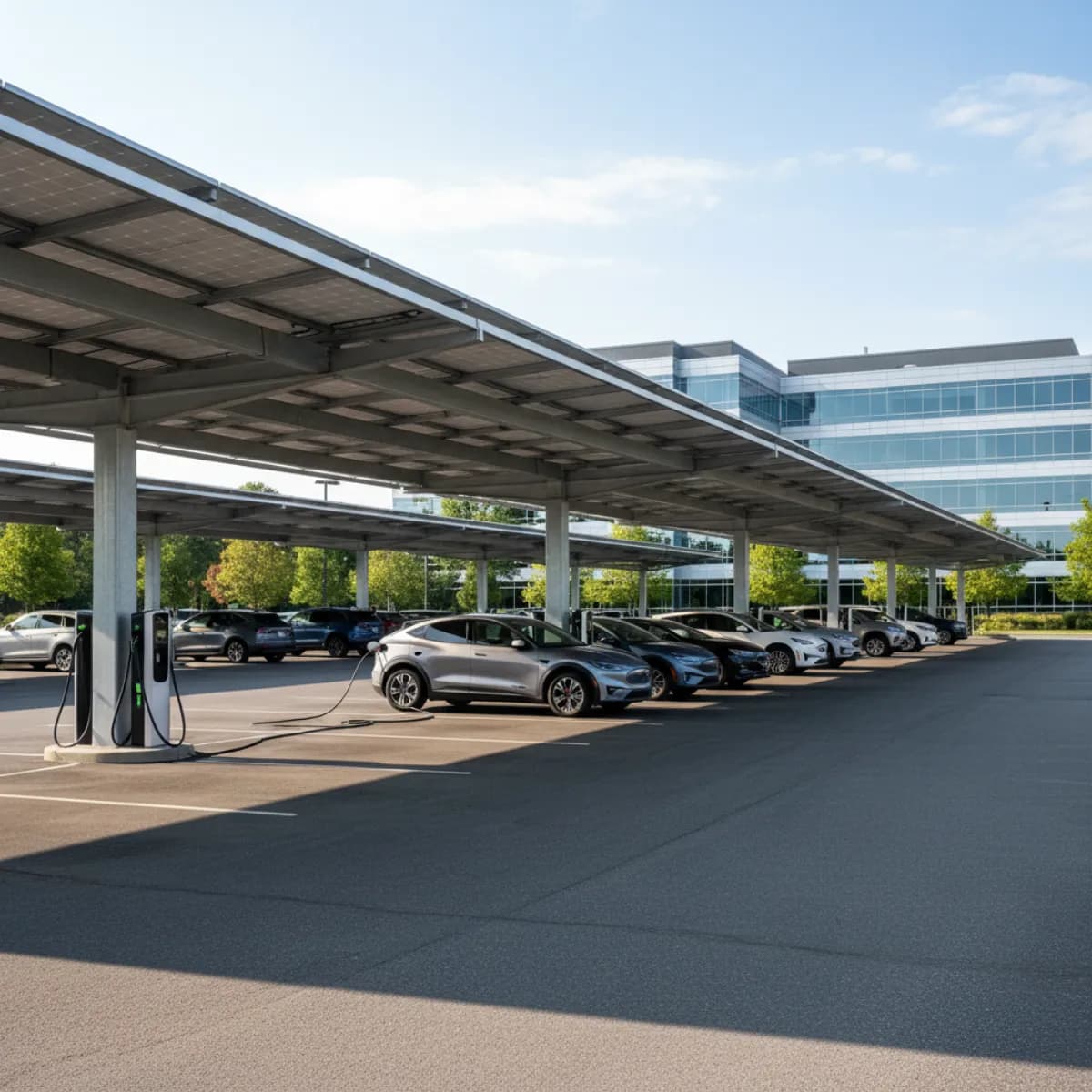
The combined solar carport and EV charging project qualifies for an extraordinary number of federal, state, and utility incentives. Here is every available incentive and how they stack together.
30% base ITC on total carport + solar cost. +10% domestic content, +10% energy community, +10-20% low-income bonus adders.
Additional $0.06/kWh on top of base SMART rate for 20 years. One of the highest-value SMART adders. Specific to canopy/carport installations.
Massachusetts Offers Rebates for EVs program provides rebates for commercial EV charging station installations. Up to $50,000 per site.
The federal Alternative Fuel Vehicle Refueling Property Credit expired June 30, 2026 and is no longer available for new installations. Projects placed in service on or before that date can still claim it on IRS Form 8911; carport + charging projects deploying now rely on the ITC, SMART canopy adder, MOR-EV, and MACRS above.
Both the carport structure and solar equipment qualify for 5-year MACRS. OBBBA permanently restored 100% first-year bonus depreciation, expensing the entire depreciable basis in year one.
National Electric Vehicle Infrastructure formula program for DCFC stations along Alternative Fuel Corridors. Covers up to 80% of costs for qualifying locations.
Carport + Solar Cost: $900,000
EV Charging Cost: $175,000
Total Project: $1,075,000
ITC 30% (solar+carport): -$270,000
MOR-EV: -$50,000
Year 1 MACRS Tax Savings: -$221,850
Effective Net Cost: $533,150
Plus 20-year SMART revenue with canopy adder: ~$14,400/year = $288,000 lifetime. See our Commercial Solar 2026 guide for full ITC stacking details.
The choice between Level 2 (L2) and DC Fast Charging (DCFC) depends on your use case, customer dwell time, budget, and electrical capacity. Most commercial carport projects benefit from a mix of both. Here is a detailed comparison.
For most Massachusetts commercial properties, the optimal configuration is a mix of L2 and DCFC stations. L2 chargers serve employees and customers with longer dwell times (2-8 hours) at low cost per station. DCFC stations serve customers who need a quick charge (20-30 minutes) and generate higher per-session revenue. The solar carport offsets the energy consumption of both, while battery storage buffers the demand spikes from DCFC stations.
The electrical service requirement is the main differentiator. L2 chargers work on standard 208/240V circuits with 40-80A breakers. DCFC stations require 480V 3-phase service with 400A+ capacity — often requiring a dedicated transformer. Since the solar carport installation already involves transformer and switchgear work, adding DCFC capacity to the same project is significantly cheaper than adding it later. For EV charger selection guidance, see our Best Solar EV Chargers guide.
How you monetize EV charging significantly affects the financial return of the combined project. There are three primary revenue models, each suited to different business types and customer profiles.
Pros
Attracts talent and customers, simple management, no billing infrastructure
Cons
No direct revenue, higher electricity costs, potential abuse
Best For
Employers competing for talent, retail destinations, mixed-use properties
Pros
Revenue stream, recovers electricity cost, manageable with network providers
Cons
Requires billing infrastructure, network fees (15-20% of revenue), lower utilization
Best For
Public-facing locations, standalone charging businesses, parking garages
Pros
Balances customer value with revenue, encourages long dwell times at L2
Cons
More complex management, two different user experiences
Best For
Retail plazas, shopping centers, hotels, mixed-use developments
A retail plaza in suburban Massachusetts with 80 parking spaces installed a 200 kW solar carport system covering 60 spaces, paired with 8 Level 2 charging stations and 1 DC fast charger. The project demonstrates the financial power of bundling solar and EV infrastructure under the full incentive stack.
Simple Payback: $533,150 / $112,800 = 4.7 years. With 100% first-year bonus depreciation front-loading the MACRS benefit into year one, plus the property tax exemption, the effective payback is roughly 4.5 years. For a comprehensive 25-year financial analysis, see our Commercial Solar IRR Calculator.
Designing a solar carport with EV charging requires careful coordination between structural engineers, electrical engineers, and parking lot designers. The carport structure must support the weight of solar panels while maintaining adequate clearance for vehicles (minimum 14 feet for standard spaces, 16+ feet for van-accessible spaces and service vehicles).
ADA compliance is critical and often overlooked. Massachusetts requires accessible EV charging spaces in proportion to total spaces, with at least one van-accessible space per charging area. Charging connectors must be within accessible reach ranges (48 inches maximum forward reach from a wheelchair). The charging equipment must be mounted at ground level with level, firm surfacing around the base. Plan for wider access aisles (8 feet minimum) adjacent to accessible charging spaces.
The parking lot layout should optimize solar production while maintaining efficient traffic flow. South-facing carport rows generate the most energy, but east-west rows may better match parking lot geometry. Consider stormwater management — carport canopies change drainage patterns, and some municipalities require retention basins or permeable surfaces to offset the new impervious area. Snow management is also important in Massachusetts; design carport slopes to direct snow melt away from parking areas and pedestrian paths.
For EV charger selection and installation best practices, see our EV Charger Installation Guide. For SMART program adder details, see our SMART Adders guide.
The SMART 3.0 canopy adder provides an additional $0.06/kWh on top of the base SMART rate for solar installations on canopy or carport structures. This adder is paid for the full 20-year SMART contract term. For a 200 kW carport system producing approximately 240,000 kWh per year, the canopy adder alone is worth $14,400/year or $288,000 over 20 years. The canopy adder stacks with other SMART adders (battery storage, community solar, etc.) and the federal ITC. It is one of the most valuable SMART adders available.
We design and install integrated solar carport and EV charging systems across Massachusetts. Stack every available incentive.