Loading NuWatt Energy...

We use your location to provide localized solar offers and incentives.
We serve MA, NH, CT, RI, ME, VT, NJ, PA, and TX
Loading NuWatt Energy...
NuWatt designs, installs, and manages solar, battery, heat pump, and EV charger systems across 9 states. One company, one warranty, one point of contact.
Get a Free QuoteComplete guide to solar carport installations: structure costs, SMART canopy adder (+$0.08/kWh for 20 years, PY2026), EV charging integration, snow load engineering, and interactive ROI comparison vs rooftop.
Carport Premium
$3-5/W
Over rooftop cost
SMART Canopy Adder
+$0.08
Per kWh, 20 yr (PY2026)
EV Charger
$2K-$8K
Per L2 station
Typical Payback
6-9 Years
With SMART adder
A 200 kW solar carport in Massachusetts costs approximately $900,000-$1,100,000 (including the $3-5/W structural premium over rooftop) but earns the valuable SMART canopy adder of +$0.08/kWh (Program Year 2026), generating $19,200/year in additional SMART revenue ($384,000 over 20 years). The canopy adder pays on top of the base SMART compensation rate; for a behind-the-meter system the base rate nets the Value of Energy your bill offset already captures, so the adder is the true incremental SMART value of choosing a canopy. With the 30% ITC ($270,000-$330,000) layered in, typical carport payback is 6-9 years. Additional benefits include shaded parking, EV charging integration, and snow/weather protection. Carport solar is ideal when rooftops cannot support panels or are already maxed out.
Enter your parking size (or system kW), your installed cost, and the electricity rate from your own utility bill. The model returns a live net cost after the ITC and MACRS, simple payback, 25-year cumulative value, and cost per parking space — with the SMART canopy adder toggled in. The worked-example tables below stay as reference cases.
Enter your parking size and your own electricity rate for a live result.
Spaces and kW are linked at ~2.2 kW per covered space (a 200 kW canopy covers roughly 91 spaces at that density). Edit either field.
Published carport range $4.20-$7.55/W — carports run higher than rooftop for the steel structure. Adjust to your quote.
Enter the blended rate from your own utility bill — the placeholder is only an example, not a default.
Payback
—
Net cost
$578,865
25-yr value
—
Total installed cost
$1,110,000
91 spaces · 200 kW
Federal ITC (30%)
$333,000
on full carport cost
MACRS tax value
$198,135
Cost per space (net)
$6,361
$12,198 before incentives
Annual SMART canopy adder (yrs 1-20)
$19,200
240,000 kWh × $0.08/kWh
Cumulative net cash position (25 yr)
Enter your electricity rate to see payback, 25-year value, and the cash-flow curve.
The carport premium over rooftop is not pure cost: it converts otherwise idle parking into covered, EV-charging-ready space you already own — value this model does not monetize.
These results are estimates driven entirely by the values you enter above — not a quote. Cash flows assume 0.5% annual panel degradation, upfront ITC and MACRS present value netted into the cost, and 25-year straight electricity escalation. The MACRS shield assumes a taxable owner; state conformity to federal bonus depreciation varies (Massachusetts, for example, decouples), and tax-exempt entities use Direct Pay for the ITC and cannot claim MACRS. The SMART canopy adder (+$0.08/kWh for 20 years) is the DOER-published Program Year 2026 Massachusetts figure and requires SMART enrollment. Confirm structural cost, bonus eligibility, ITC adders, interconnection, and your actual tax position with a professional.
Turn this model into an engineer-reviewed carport proposal
We size the canopy to your lot, confirm the structural cost, and build your 25-year cash flow on your real utility tariff.
Solar carports transform underutilized parking lot space into revenue-generating assets. In Massachusetts, the SMART 3.0 canopy adder makes carport installations uniquely attractive — paying an additional $0.08/kWh for 20 years (Program Year 2026) on top of the base SMART compensation rate. This is one of the highest-value location-based SMART adders available and exists specifically to incentivize canopy-mounted solar over cheaper ground-mount configurations.
Beyond the financial incentives, solar carports provide tangible operational benefits that rooftop systems cannot: shaded parking reduces vehicle cabin temperatures by 40-50°F in summer (a significant customer and employee amenity), weather protection from rain, snow, and hail, and integrated EV charging that turns your parking lot into a modern energy hub. For businesses with aging roofs, structural limitations, or insufficient roof area, carports offer an alternative path to solar without touching the building envelope.
The Massachusetts commercial landscape is particularly suited for carport solar. Retail parking lots, hospital campuses, corporate office parks, school lots, and warehouse facilities all have extensive paved areas that produce zero value today. Converting even a portion of these areas to solar canopies generates revenue, reduces electricity costs, and demonstrates visible sustainability commitment — all while vehicles continue to park underneath as usual.
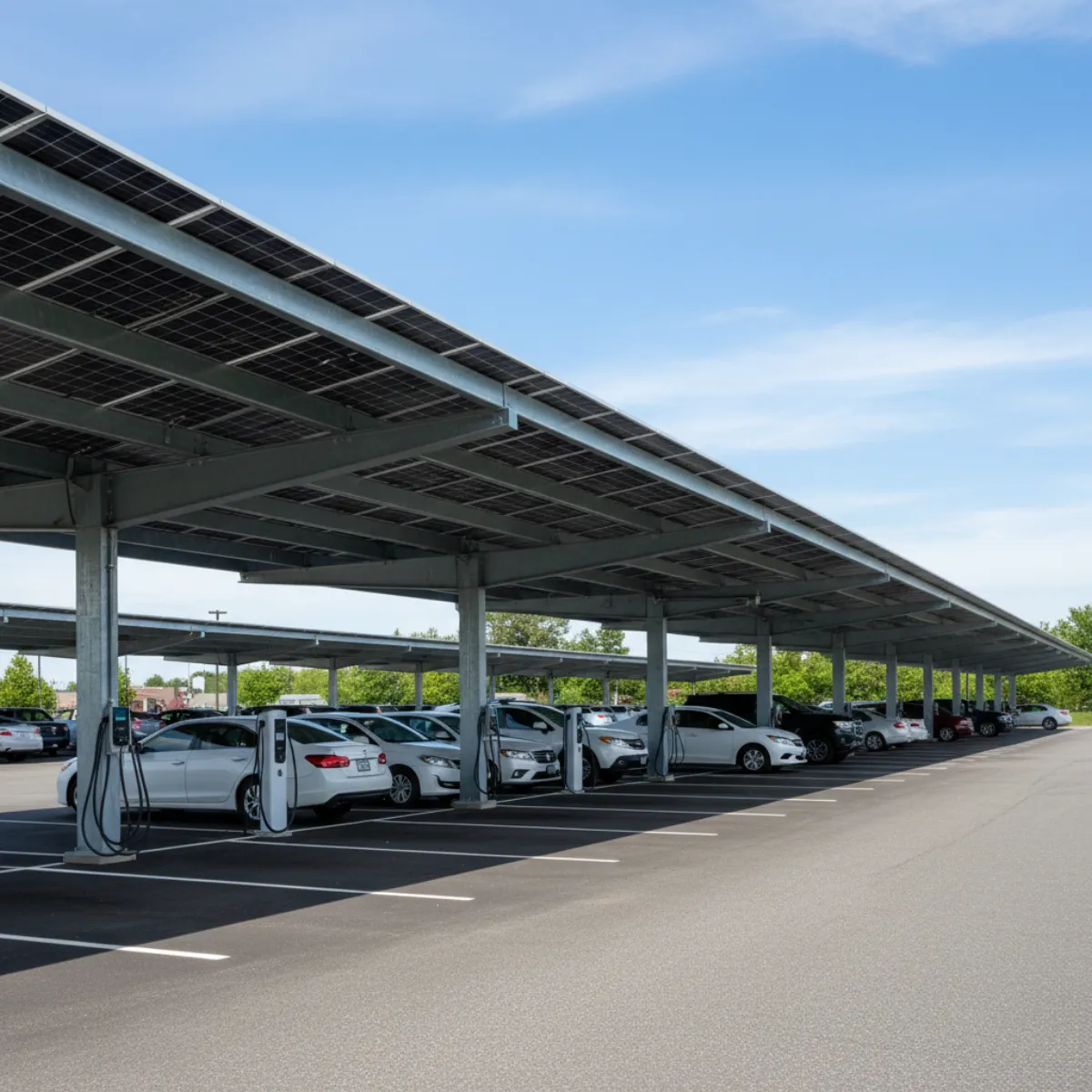
Solar carport structures come in three primary configurations, each with different cost, coverage, and structural characteristics. The right choice depends on your parking lot layout, wind/snow load requirements, and budget.
One center column per section. Most cost-effective for standard parking. Spans one row of parking.
Advantages
Considerations
Best For
Small lots, employee parking, single-row configurations
Two columns per section with cantilevered overhang. Covers two parking rows from columns placed between them.
Advantages
Considerations
Best For
Large retail lots, hospital parking, corporate campuses
Heavy steel frame spanning wide parking areas. Maximum coverage per structure. Commercial-grade engineering.
Advantages
Considerations
Best For
Large commercial, EV charging stations, high-wind coastal areas
The key question for carport ROI: does the SMART canopy adder justify the structural premium? Below is a head-to-head comparison for a 200 kW system using dual-column cantilever carport structure.
| Metric | Rooftop (200 kW) | Carport (200 kW) | Difference |
|---|---|---|---|
| System Cost | $350,000 | $1,110,000 | +$760,000 |
| ITC (30%) | $105,000 | $333,000 | +$228,000 |
| SMART Base Rate (PY2026, >25–≤250 kW) | $0.2807/kWh | $0.2807/kWh | — |
| SMART Canopy Adder | $0.00/kWh | +$0.08/kWh | +$0.08/kWh |
| Total SMART Rate (gross) | $0.2807/kWh | $0.3607/kWh | +$0.08/kWh |
| Annual SMART Revenue (gross) | $67,368 | $86,568 | +$19,200 |
| 20-Year SMART Revenue (gross) | $1,347,360 | $1,731,360 | +$384,000 |
| Net Cost After ITC | $245,000 | $777,000 | +$532,000 |
SMART figures are Program Year 2026 statewide base compensation rates (DOER Table 5) plus the +$0.08/kWh canopy adder, gross of the Value of Energy. A behind-the-meter canopy nets the Value of Energy out of the base rate (your bill offset already captures it), so the base row is not additive with electricity savings; the +$0.08 canopy adder is the true incremental SMART value of going with a canopy.
The $760,000 structural premium is partially offset by:
Total offset: ~$703,340 of the $760,000 premium
Solar carports are the ideal platform for commercial EV charging. The structural columns provide mounting points for chargers, the electrical conduit is already in place, and the solar generation can directly power vehicle charging during peak daytime hours. Massachusetts is aggressively pushing EV adoption, making this combination increasingly valuable.
| Charger Type | Power | Cost Per Station | Charge Time (50 kWh) | Best Application |
|---|---|---|---|---|
| Level 2 (240V) | 7.7-19.2 kW | $2,000-$8,000 | 2.5-6.5 hours | Employee parking, long-term customer parking, fleet overnight |
| DC Fast (DCFC) | 50-150 kW | $30,000-$80,000 | 20-60 minutes | Retail destinations, highway-adjacent, fleet rapid turnaround |
| DC Ultra-Fast | 150-350 kW | $80,000-$150,000 | 10-30 minutes | High-traffic retail, dedicated charging stations |
Adding battery storage to a solar carport creates a complete energy management system. The battery stores excess solar generation during peak production, then discharges for EV charging, demand charge reduction, or ConnectedSolutions payments ($200-$400/kW/year). The SMART energy storage adder (+$0.045/kWh) further improves the economics. A 200 kW solar carport with a 100 kWh battery and 10 L2 EV chargers represents the state of the art in commercial energy infrastructure. See our demand charge & battery calculator for storage ROI details.
Massachusetts offers the MassEVIP (Massachusetts Electric Vehicle Incentive Program) for workplace and fleet EV charging: up to $50,000 per site for workplace charging installations and up to $75,000 for fleet installations. This incentive stacks with the solar ITC and SMART program, further reducing the net cost of the combined carport + EV charging project.
Different industries benefit from solar carports in different ways. The common thread: any commercial property with a significant parking area and daytime electricity consumption is a strong carport candidate.
100-500 kW typical
Shaded customer parking increases foot traffic. SMART canopy adder + high daytime consumption = excellent ROI. Visible sustainability branding.
Estimated annual savings: $25,000-$120,000/year
200-1,000 kW typical
Critical load backup when paired with battery storage. Employee/patient parking shade. 24/7 facility operations maximize self-consumption.
Estimated annual savings: $50,000-$250,000/year
50-500 kW typical
Tax-exempt entities benefit from PPA pricing that passes SMART + ITC savings through lower rates. Student safety (covered walkways). Educational value.
Estimated annual savings: $15,000-$100,000/year
200-2,000 kW typical
ESG compliance and sustainability reporting. Employee amenity (shade/weather protection). EV charging integration for fleet and employees.
Estimated annual savings: $50,000-$500,000/year
Solar carports in Massachusetts must meet rigorous structural requirements due to snow and wind loads. Understanding these requirements early in the design process prevents costly redesigns and permitting delays.
Commercial solar carport permitting in Massachusetts typically takes 3-6 months due to structural review requirements. Add 2-4 months for installation of a 200+ kW system. Projects that began construction on or before the July 4, 2026 milestone locked in the full Section 48E credit timing (alongside the permanent 100% first-year bonus depreciation); projects that begin construction later still qualify if they are placed in service by December 31, 2027. Because the placed-in-service deadline for new starts is December 31, 2027, begin the permitting process well ahead of that date. Some municipalities may require a special permit or variance for carport structures above certain heights, adding additional review time.
Complete guide: ITC stacking, SMART 3.0, financing, and ROI for MA businesses.
Calculate SMART rates by utility, block, and adders including canopy.
Peak shaving, ConnectedSolutions revenue, and battery storage ROI.
Full IRR/NPV calculator with ITC, MACRS, SMART, and electricity savings.
A solar carport in Massachusetts typically costs $4.50-$7.00 per watt installed, which includes both the solar system ($1.50-$2.00/W) and the structural carport ($3.00-$5.00/W premium). A 200 kW carport system would cost approximately $900,000-$1,400,000 total. The structural premium is the primary cost driver and varies by carport configuration: single-column T-frames are cheapest ($3.00-$3.50/W premium), dual-column cantilever is mid-range ($3.50-$4.50/W), and full-span steel frames are highest ($4.50-$5.00/W).
We will evaluate your parking lot for carport solar potential — including SMART canopy adder value, EV charging integration, and structural requirements.