Loading NuWatt Energy...

We use your location to provide localized solar offers and incentives.
We serve MA, NH, CT, RI, ME, VT, NJ, PA, and TX
Loading NuWatt Energy...
NuWatt designs, installs, and manages solar, battery, heat pump, and EV charger systems across 9 states. One company, one warranty, one point of contact.
Get a Free Quote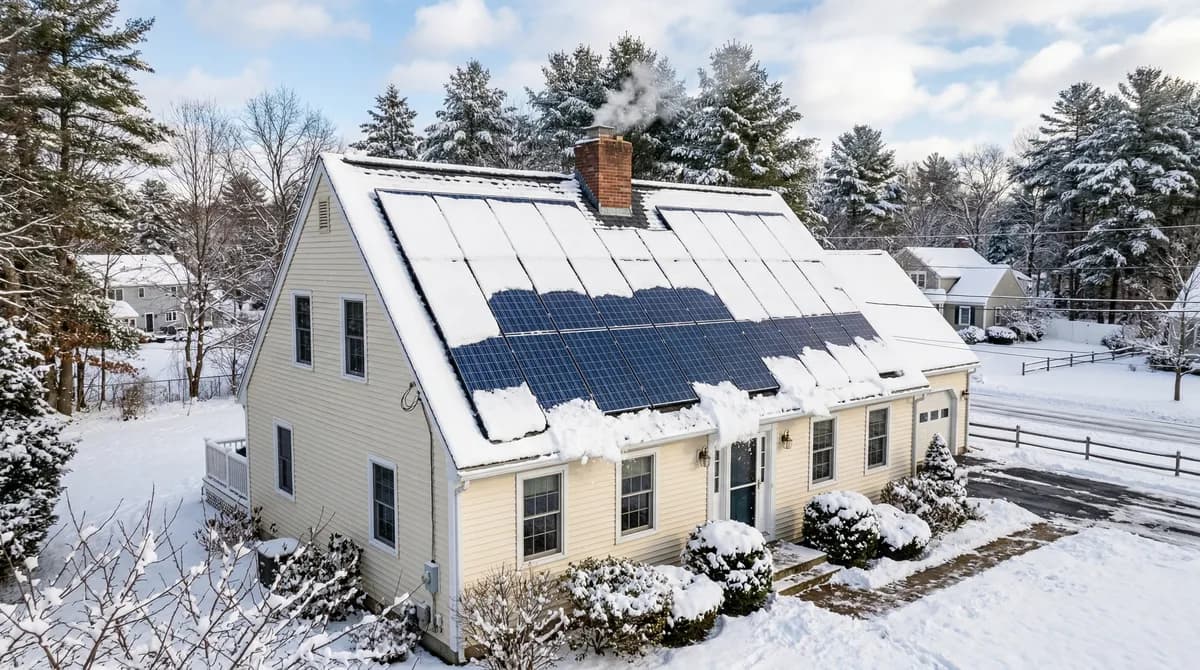
Massachusetts averages 50+ inches of snow annually. Most of the time, your panels handle it on their own. This guide explains when to intervene, what tools are safe, and how to maximize production through every New England season.
2-5%
Annual production loss from snow
15°+
Tilt angle for self-shedding
$150-$300
Professional cleaning cost
1-2x/yr
Recommended cleaning frequency
Do you need to clean snow off solar panels in Massachusetts? Usually no. Solar panels tilted 15 degrees or more shed snow naturally within 1-2 days. The annual production loss from snow in MA averages only 2-5%. Removing snow with improper tools can scratch panels and void your warranty. Only intervene during extended storms or with very low-tilt installations.
For cleaning, once or twice per year (spring and fall) is sufficient for most MA homes. Professional cleaning costs $150-$300 per visit.
Massachusetts homeowners often panic after a snowstorm, but your solar panels are engineered for New England winters. Here is when to let nature take its course versus when to act.
Snowfall
45-50 inches/yr
Annual Loss
2-4%
Coastal moderation, snow melts faster. Most systems self-clear in 1-2 days.
Snowfall
60-70 inches/yr
Annual Loss
4-5%
Higher elevation, colder temps. Extended cover possible in January-February.
Snowfall
70-90 inches/yr
Annual Loss
5-7%
Lake-effect and elevation snow. Consider higher tilt angle to improve shedding.
Tilt angle is the single biggest factor in whether your panels self-clean from both rain and snow. Massachusetts roof pitches typically provide a natural advantage.
Snow: Snow accumulates, must be cleared manually
Rain: Water pools, debris collects
Snow: Snow slides off within 1-2 days in most conditions
Rain: Rain rinses most debris effectively
Snow: Snow slides off quickly, often same day
Rain: Excellent self-cleaning from rain
Snow: Snow slides immediately, may need snow guards for safety below
Rain: Self-cleaning, but suboptimal sun angle for MA latitude
If you must remove snow, use only tools designed for solar panels. One scratch from a metal rake can permanently reduce a panel's efficiency and void your warranty.
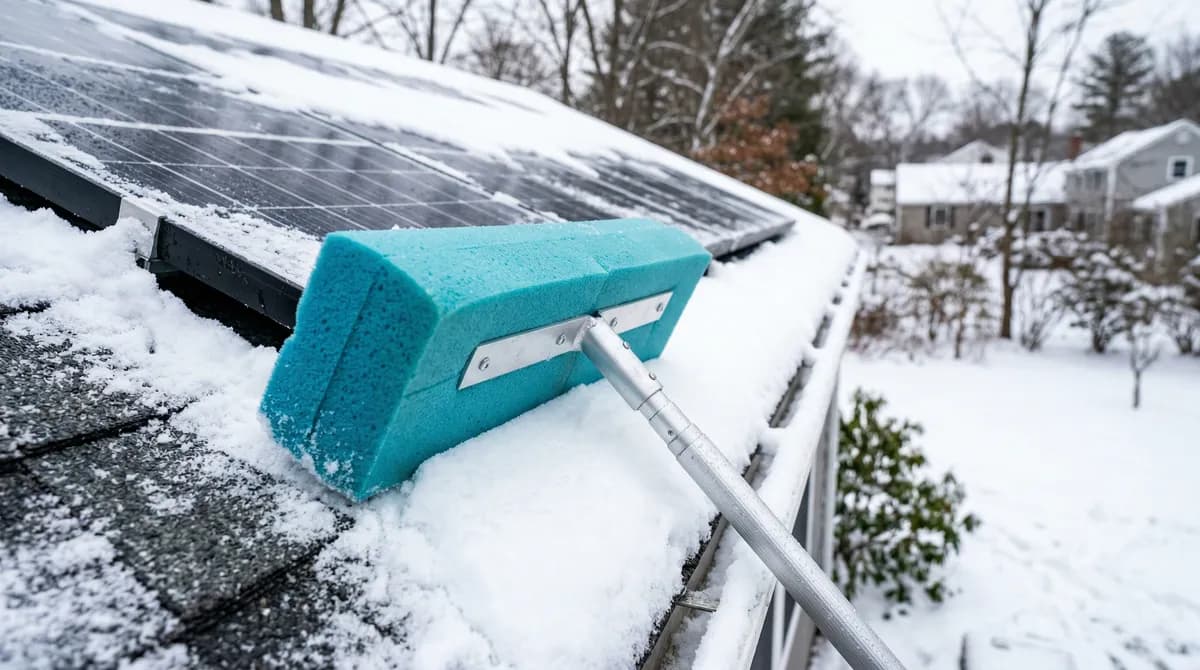
Telescoping pole with foam head. Garelick, Snow Joe, and Avalanche brands make solar-specific models. Push snow off the bottom edge — never scrape across the surface.
Gentle water stream to loosen ice-snow bond. Use only when air temp is above 32°F to prevent refreezing. Never use hot water on cold panels — thermal shock cracks glass.
For ground-mount panels you can reach from the ground. Soft bristles only. Angle the broom to push snow off the edge, not scrub across the surface.
Effective for light, dry powder snow. Works from the ground on single-story installations. Not useful for wet, heavy snow or ice.
Metal edges scratch the anti-reflective coating, permanently reducing efficiency by 2-5% per scratch zone. Most common cause of cleaning-related warranty voidance.
Concentrated pressure on a small area can crack tempered glass, especially in cold temperatures when glass is more brittle. One crack means the entire panel must be replaced.
High-pressure water forces moisture past gaskets and seals into the panel laminate, causing delamination and electrical faults. Every major panel manufacturer prohibits pressure washing.
Pouring hot water on a frozen panel creates extreme thermal stress. Tempered glass can shatter instantly from the temperature differential. Only use lukewarm water above 32°F.
Ammonia-based cleaners (like Windex), bleach, and abrasive cleaners damage the anti-reflective coating and junction box seals. Use only plain water or manufacturer-approved solutions.
Massachusetts has four distinct seasons, each presenting different challenges for solar panel maintenance. Follow this calendar to keep your system performing optimally.

Follow these six steps for safe, effective solar panel cleaning that will not void your warranty or damage your system.
Before climbing a ladder, check your Enphase or SolarEdge monitoring app. Compare current production to expected output for the time of year. If panels are producing within 5% of expected, cleaning is unnecessary. Look for individual panels underperforming — these may have localized debris.
Clean panels in the early morning or late afternoon when they are cool. Never spray cold water on hot panels in midday sun — thermal shock can crack tempered glass. Overcast days are ideal. For snow removal, late morning is best when the sun has started warming the panel surface.
Use a soft foam-head snow rake (for snow), a garden hose with a spray nozzle, a soft microfiber cloth or sponge, and a bucket of lukewarm water with a few drops of dish soap. Never use metal scrapers, abrasive pads, pressure washers, or chemical cleaners not approved by your panel manufacturer.
Use your garden hose to rinse loose dirt, pollen, and bird droppings from the panel surface. Start at the top and work down. This removes 60-80% of surface grime without any contact, eliminating the risk of scratching. For snow, use the foam rake to gently push snow off the bottom edge — never scrape.
For baked-on bird droppings, tree sap, or pollen film that remains after rinsing, use a soft microfiber cloth or sponge with soapy water. Apply light pressure only. Work in straight lines (not circles) to avoid creating swirl marks on the anti-reflective coating. Never stand on panels.
Give all panels a final rinse with clean water to remove soap residue. While you are up there, visually inspect for cracked glass, loose wiring, corroded connectors, or damaged mounting hardware. Check that no branches are newly shading your array. Note any issues and contact your installer for service.
Panel manufacturers include specific maintenance guidelines in their warranty terms. Violating these voids coverage for any resulting damage — even if the panel had a pre-existing defect.
Voids Warranty
Manufacturer Approved
Soft cloth, plain water, non-abrasive sponge
Voids Warranty
Manufacturer Approved
De-ionized water, soft brush, mild detergent
Voids Warranty
Manufacturer Approved
Lukewarm water, soft cloth, gentle rinse
Your inverter type dramatically affects how your system handles partial snow cover. This is one of the most important factors in Massachusetts winter performance.
Example: 20-panel system with 5 panels snow-covered. Microinverters: 15 panels produce at full capacity (75% output).
Example: Same 20-panel system with 5 panels snow-covered. String inverter: entire string drops to 25-50% output (even uncovered panels are throttled).
Ice dams form when heat escapes through your roof, melting snow that refreezes at the cold eaves. Solar panels actually help reduce ice dams — but only if your attic insulation is adequate.
Before installing solar, NuWatt recommends a Mass Save Home Energy Assessment (free for all MA homeowners). Mass Save provides:
Expected monthly output for a typical 8 kW system in eastern Massachusetts. Understanding normal seasonal variation prevents unnecessary worry about winter production dips.
| Month | Est. kWh | % of Peak | Notes |
|---|---|---|---|
| Jan | 65 | 32% | Shortest days, snow events, lowest output |
| Feb | 80 | 39% | Snow cover common, days lengthening |
| Mar | 120 | 59% | Spring equinox, remaining snow melts fast |
| Apr | 150 | 74% | Pollen season begins, rain cleans panels |
| May | 180 | 88% | Near-peak production, longer days |
| Jun | 200 | 98% | Peak sun hours, longest days |
| Jul | 205 | 100% | Peak month — highest irradiance |
| Aug | 185 | 90% | Strong output, occasional heat derating |
| Sep | 145 | 71% | Fall equinox, steady production |
| Oct | 110 | 54% | Leaf fall can block panels temporarily |
| Nov | 70 | 34% | First snow possible, short days |
| Dec | 55 | 27% | Winter solstice, lowest sun angle |
| Annual Total | ~1,565 kWh | 8 kW system, 30\u00b0 tilt, south-facing, eastern MA | |
Winter context: December through February accounts for only ~12% of annual production. Even a week of snow cover in January reduces your annual output by less than 0.5%. Your system is designed for New England seasonality — the summer surplus more than compensates.
Professional cleaning is recommended for multi-story homes, steep roofs, or anyone uncomfortable working at height. Here is what to expect.
$150-$300
$250-$400/yr
$100-$200
For most Massachusetts homeowners: yes, once per year in spring. A $200 cleaning that recovers 5% production on an 8 kW system generating $2,000/year in SMART payments and electricity savings is a $100/year net gain. It also catches mounting hardware issues early, before they become expensive repairs.
For systems on steep roofs with good tilt (25\u00b0+), rain does most of the work, and you may only need professional cleaning every 2-3 years.
In most cases, no. Snow typically slides off panels tilted 15 degrees or more within 1-2 days as the dark surface heats up. The annual production loss from snow in MA averages only 2-5%. Removing snow risks scratching panels or voiding your warranty if you use metal tools. Only intervene during extended multi-day storms or if your panels are mounted at a very low tilt angle (under 10 degrees).
Most Massachusetts solar panels need cleaning once or twice per year. The best times are early April (after pollen season starts and winter grime has accumulated) and late October (after fall leaves drop). Panels tilted 15 degrees or more self-clean significantly from rain. If you live near a highway, construction site, or under heavy tree cover, you may benefit from an additional mid-summer cleaning.
Only use soft foam-head snow rakes designed specifically for solar panels, such as the Snow Joe or Garelick models. Never use metal shovels, ice scrapers, roof rakes with metal edges, or pressure washers. The panel glass has a protective anti-reflective coating that metal tools will scratch, reducing efficiency permanently. A garden hose with lukewarm (never hot) water can help loosen stubborn ice.
Massachusetts solar panels typically lose 2-5% of annual production to snow cover. This varies by location: Boston averages 49 inches per year (3-4% loss), Worcester averages 65 inches (4-5% loss), and the Berkshires can see 80+ inches (5-7% loss). Most snow events last 1-2 days before panels clear naturally. Your system is designed to account for this seasonal variation.
Dirty panels can lose 5-10% efficiency in Massachusetts, primarily from spring pollen, bird droppings, and fall leaf residue. A single cleaning in spring can recover most of this loss. However, rain naturally cleans panels tilted 15 degrees or more, so the benefit of manual cleaning depends on your tilt angle and local debris conditions. Most homeowners see a 3-5% improvement after cleaning heavily soiled panels.
Professional solar panel cleaning in Massachusetts costs $150-$300 per visit for a typical residential system (20-30 panels). This includes inspection of connections and mounting hardware. Some companies offer annual maintenance packages for $250-$400 that include two cleanings plus an electrical inspection. NuWatt customers can schedule maintenance visits through our service team.
Yes. Microinverters (like Enphase IQ8) optimize each panel independently, so partially snow-covered panels do not drag down the rest of the system. With string inverters, one snow-covered panel can reduce output of the entire string by 50% or more. This is one reason NuWatt installs Enphase microinverters as standard — they recover production faster as snow melts unevenly across your roof.
Yes, if done improperly. Using pressure washers, abrasive cleaners, metal tools, or hot water on cold panels can crack glass or damage the anti-reflective coating, voiding the manufacturer product warranty. Silfab, REC, and Hyundai all specify that damage from improper cleaning is not covered. Stick to soft cloths, foam rakes, and plain water or manufacturer-approved cleaning solutions.
How Massachusetts weather affects solar production year-round
Read GuideProtect your investment — product, performance & workmanship warranties
Read GuideKeep your home powered during Massachusetts nor'easters
Read GuideHow proper insulation prevents ice dams and saves energy
Read GuideTrack panel-level production with Enphase and SolarEdge apps
Read GuideCompare microinverters and string inverters for MA winters
Read GuideNuWatt installs Enphase microinverters as standard — optimized for Massachusetts winters with panel-level snow recovery. Get a free quote or schedule a maintenance visit.