Loading NuWatt Energy...

We use your location to provide localized solar offers and incentives.
We serve MA, NH, CT, RI, ME, VT, NJ, PA, and TX
Loading NuWatt Energy...
NuWatt designs, installs, and manages solar, battery, heat pump, and EV charger systems across 9 states. One company, one warranty, one point of contact.
Get a Free QuoteMassachusetts requires module-level rapid shutdown on every new rooftop solar installation. Here is what the code says, what equipment qualifies, and what it means for your system.
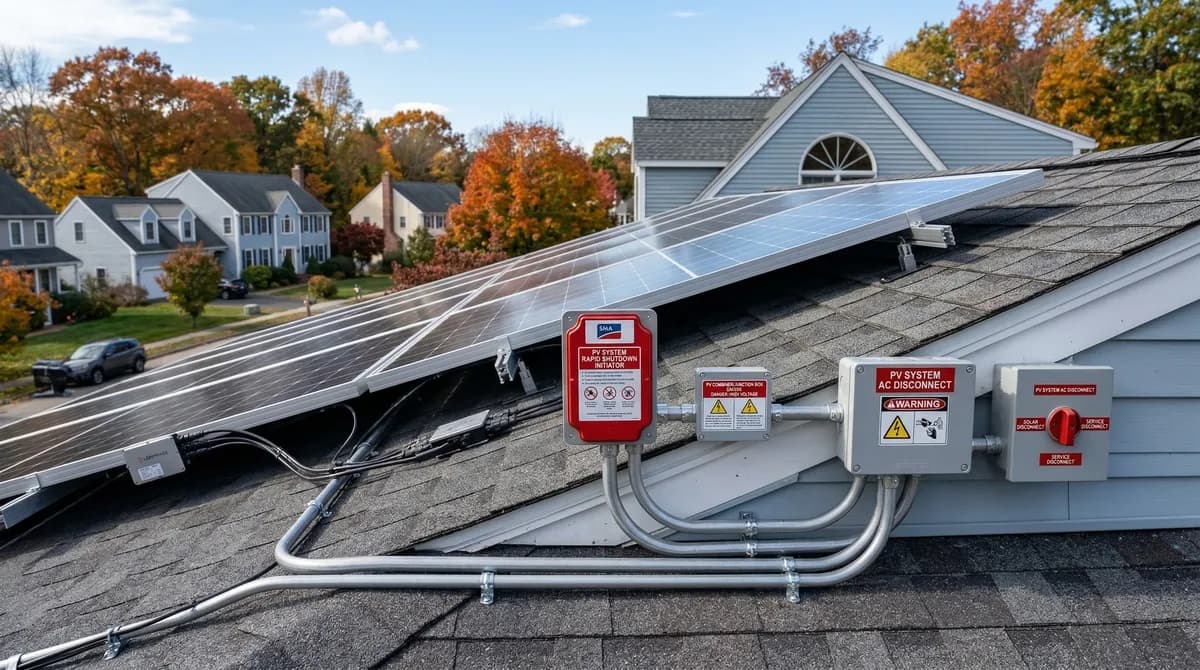
Massachusetts adopted NEC 2020, which requires module-level rapid shutdown (MLRSD) for all new rooftop solar installations. Every panel must reduce voltage to 80V or less within 30 seconds of initiator activation. This is a firefighter safety requirement enforced through local electrical inspections. All NuWatt installations use Enphase IQ8 microinverters, which are inherently MLRSD-compliant with no additional hardware needed.
Rapid shutdown is a National Electrical Code (NEC) requirement under Section 690.12 that mandates rooftop PV systems reduce DC voltage to safe levels quickly after a shutdown command is initiated. The primary purpose is firefighter safety: when first responders arrive at a structure fire, they need to work on the roof without risk of electrocution from energized solar panels.
Without rapid shutdown, a string of solar panels in series can produce 300-600V DC whenever sunlight hits them — even if the inverter is turned off. DC arcs are harder to extinguish than AC and can deliver lethal shocks through firefighter protective equipment.
Older NEC 2014 standard. Disconnects power at the inverter, but panels on the roof remain energized with high DC voltage. Firefighters still face electrocution risk at the array. No longer sufficient in Massachusetts.
Current NEC 2020 standard. Each individual panel de-energizes independently, reducing to 80V or less within 30 seconds. The entire roof surface becomes safe for emergency work.
Massachusetts adopted the NEC 2020 electrical code through 527 CMR(Code of Massachusetts Regulations), the state's electrical code framework. The NEC 2020 requirements — including Section 690.12(B)(2) module-level rapid shutdown — became effective January 1, 2023.
This means every new rooftop solar installation permitted after January 1, 2023 must include module-level rapid shutdown capability. Compliance is enforced at the local level: your town's electrical inspector verifies rapid shutdown during the post-installation inspection that precedes utility Permission to Operate (PTO).
NEC 2014 (§690.12)
Array-level shutdown — conductors outside the array boundary must de-energize within 10 seconds.
Superseded
NEC 2017 (§690.12)
Boundary-level — all conductors >1 foot from array must drop to ≤30V within 30 seconds.
Superseded
NEC 2020 (§690.12)
Module-level (MLRSD) — each individual module must reduce to ≤80V within 30 seconds and ≤1V within 30 seconds in the conductor zone.
Current MA Standard (since Jan 1, 2023)
The rapid shutdown system has two main components: the initiator and the module-level devices (MLDs). Here is the sequence when rapid shutdown is triggered:
The rapid shutdown initiator — typically located at the main electrical panel, meter, or a dedicated exterior disconnect — is activated. This can happen manually (firefighter flips the switch) or automatically (grid power loss, inverter shutdown).
The initiator sends a shutdown signal to every module-level device in the array. With Enphase microinverters, this happens through loss of AC grid reference — when the grid goes down or the inverter is disconnected, each microinverter automatically enters a safe shutdown state.
Each module or MLD responds by reducing output voltage. NEC 2020 requires voltage to drop to 80V DC or less within 30 seconds at the module level. In the conductor zone (wiring between panels and the array junction), voltage must drop to 1V or less within 30 seconds.
When the emergency is resolved and the initiator is reset (grid power restored, switch flipped back), the system automatically restores normal operation. No technician visit is required — panels resume producing power.
Key Voltage Thresholds
Several equipment platforms satisfy NEC 2020 module-level rapid shutdown. NuWatt uses Enphase IQ8 microinverters as our standard because they provide inherent compliance with no additional hardware.
Microinverter — NEC 2020 — Full Module-Level (Inherent)
Each microinverter pairs 1:1 with a panel and converts DC to AC at the module level. When the system shuts down, each microinverter ceases operation independently, dropping panel voltage to safe levels immediately. No additional rapid shutdown hardware needed.
DC Optimizer + String Inverter — NEC 2020 — Full Module-Level (SafeDC)
SolarEdge SafeDC technology reduces each optimizer output to 1V when the inverter shuts down or loses grid connection. Optimizers at each panel act as module-level shutdown devices, satisfying NEC 2020.
Third-Party Module-Level Device (MLD) — NEC 2020 — Full Module-Level (Retrofit)
Retrofit or add-on DC optimizers that attach to each panel in a string inverter system. They provide module-level shutdown capability to systems that would otherwise only have array-level disconnect.
Microinverter — NEC 2020 — Full Module-Level (Inherent)
Similar to Enphase, APsystems microinverters convert DC to AC at the module level. Each unit ceases operation independently on shutdown, providing inherent module-level rapid shutdown compliance.
The good news: you do not need to worry about rapid shutdown compliance personally. Your solar installer handles equipment selection, code compliance, and inspection. However, it is smart to verify a few things when choosing an installer:
Installer uses MLRSD-compliant equipment
Ask your installer what equipment provides the rapid shutdown function. The answer should be microinverters (Enphase, APsystems) or DC optimizers (SolarEdge). If the answer is "the inverter handles it" with no mention of module-level devices, that is a red flag.
System will pass town electrical inspection
Every MA solar installation requires a post-installation electrical inspection by the local Authority Having Jurisdiction (AHJ) — typically the town building department. The system cannot receive utility PTO until it passes.
Rapid shutdown initiator is properly labeled
NEC requires a clearly labeled rapid shutdown initiator accessible to first responders at the service entrance. Required placards must also be placed on the inverter and the array. Ask your installer to show you where these will be located.
Rapid shutdown compliance cost depends entirely on the inverter platform your installer uses. For the two dominant residential platforms in Massachusetts — Enphase microinverters and SolarEdge optimizers — there is no additional cost because module-level shutdown is built into the hardware.
| Inverter Platform | Additional Cost for MLRSD | Notes |
|---|---|---|
| Enphase IQ8 Microinverters | $0 | Inherent — NuWatt standard |
| SolarEdge + Optimizers | $0 | SafeDC built into optimizers |
| String Inverter + Tigo MLDs | $50–$100/panel | Adds $1,250–$2,500 for 25 panels |
| String Inverter Only (no MLDs) | Non-compliant | Will fail MA electrical inspection |
Why Microinverters Are the MA Standard
Microinverter adoption in Massachusetts residential solar exceeds 85%. Beyond rapid shutdown compliance, microinverters provide panel-level monitoring, eliminate single-point-of-failure risks, and optimize production on roofs with partial shading — common on New England homes with mature trees.
If your solar system was installed before Massachusetts adopted NEC 2020 (January 1, 2023), it is grandfathered under the code version in effect at the time of installation. No retrofit is required, and your system remains legal to operate.
Systems installed before January 1, 2023 operate legally under the code that was in effect at installation. The state does not mandate retrofitting older systems with MLRSD equipment.
If you add panels to an existing system, the new portion must meet current NEC 2020 requirements — including module-level rapid shutdown. The original grandfathered portion can remain as-is, but many homeowners upgrade the entire system for uniform safety.
Home inspectors increasingly check for rapid shutdown compliance. While a grandfathered system is legal, a buyer may request an upgrade. Systems with modern microinverters are easier to sell.
Some insurers now ask about NEC compliance during underwriting. A non-compliant system is legal to operate but could affect claims processing. Contact your insurer to understand their stance.
Every MA solar installation must pass a local electrical inspection before the utility grants Permission to Operate. Here is what inspectors verify for rapid shutdown compliance:
Rapid shutdown initiator switch properly labeled at service entrance
Each panel has a compliant module-level device (microinverter or optimizer)
Shutdown initiator triggers within 30 seconds to ≤80V at each module
Conductor zone voltage drops to ≤1V within 30 seconds
Required placards/labels on service panel, inverter, and array
Fire department notification completed (required by some MA municipalities)
What if Inspection Fails?
If the system fails inspection for a rapid shutdown deficiency, the installer must correct the issue and schedule a re-inspection. The system cannot connect to the grid until it passes. At NuWatt, our systems pass on first inspection because MLRSD compliance is built into the Enphase platform we use as standard.
Complete overview of solar in Massachusetts — costs, incentives, and how to get started.
Panel comparisons, performance data, and what works best for New England weather.
Current pricing: $3.00–$3.40/W. System costs by size with payback timelines.
National guide covering NEC rapid shutdown across all states we serve.
Do you need a panel upgrade for solar? Cost, timeline, and when it is required.
Adding panels to an existing system? Code compliance rules for expansions.
Every NuWatt installation uses Enphase IQ8 microinverters — inherently compliant with NEC 2020 module-level rapid shutdown. No extra hardware. No extra cost.