Loading NuWatt Energy...

We use your location to provide localized solar offers and incentives.
We serve MA, NH, CT, RI, ME, VT, NJ, PA, and TX
Loading NuWatt Energy...
NuWatt designs, installs, and manages solar, battery, heat pump, and EV charger systems across 9 states. One company, one warranty, one point of contact.
Get a Free Quote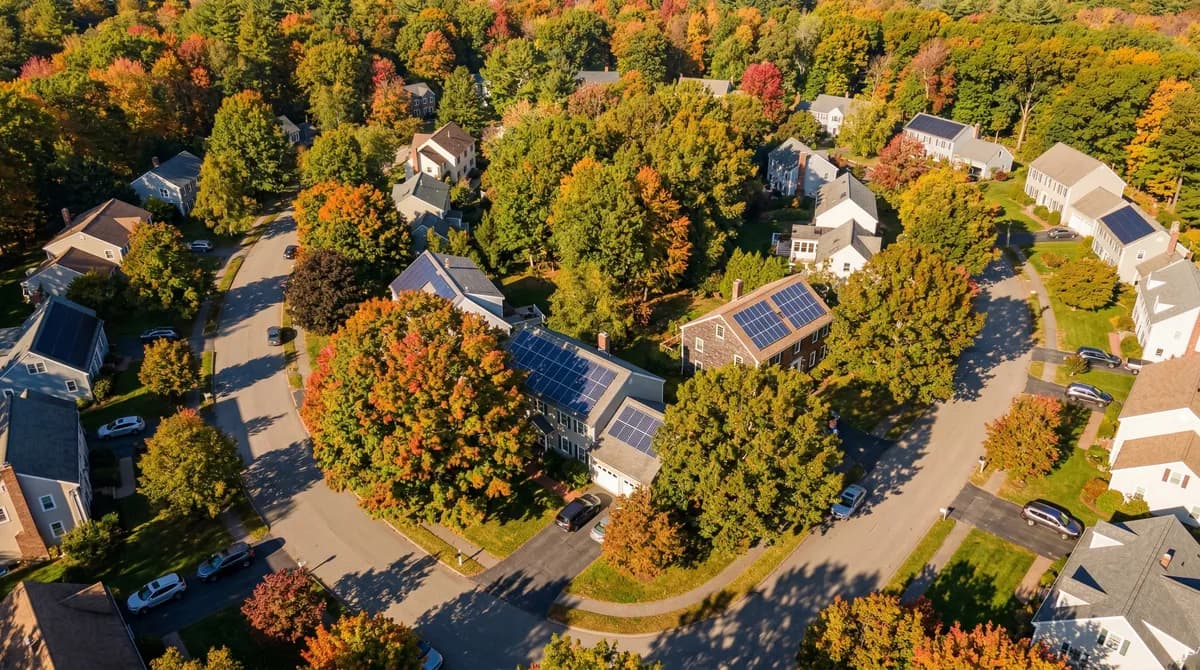
Massachusetts is 62% forested — the most heavily treed state in the Northeast. Shade is the #1 production killer for solar panels. Learn how to analyze shade, when tree trimming pays for itself, and which technology handles shade best.
Shade reduces solar panel output disproportionately. With traditional string inverters, 10% shade can cause 25-40% production loss because one shaded panel drags down the entire string. With microinverters (Enphase IQ8), the same shade only causes 12-18% loss since each panel operates independently. In Massachusetts, where electricity costs $0.33/kWh, even 15% production loss means $250-$500/year in lost savings.
Not all shade is created equal. The type of shading on your roof determines how much production you lose and what mitigation strategies work best. Massachusetts homes contend with both types — and understanding the difference saves you from overspending on tree work or underestimating your production loss.
Solid, permanent obstructions that completely block direct sunlight. These cast dark, defined shadows with sharp edges.
Impact: 100% production loss in the shadowed area. Cannot be mitigated by trimming. Panel placement must avoid these zones entirely.
Partial obstructions that filter, scatter, or intermittently block sunlight. These create diffuse, shifting shadows.
Impact: 20-80% production loss in affected area depending on density. Can be mitigated by trimming, and deciduous trees shed leaves in winter. Microinverters help significantly.
MA is dominated by deciduous hardwoods — oaks, maples, and birch trees make up 70%+ of the forest canopy. These trees are fully leafed May through October (your highest production months), creating maximum shade exactly when your panels should be producing the most. A leafless oak tree in winter still has branches dense enough to reduce production by 5-15%. This makes shade analysis particularly important in Massachusetts compared to states with more conifers or open terrain.
A proper shade analysis is the single most important step before installing solar in Massachusetts. Here are the tools professional installers use — and one free option you can try yourself.
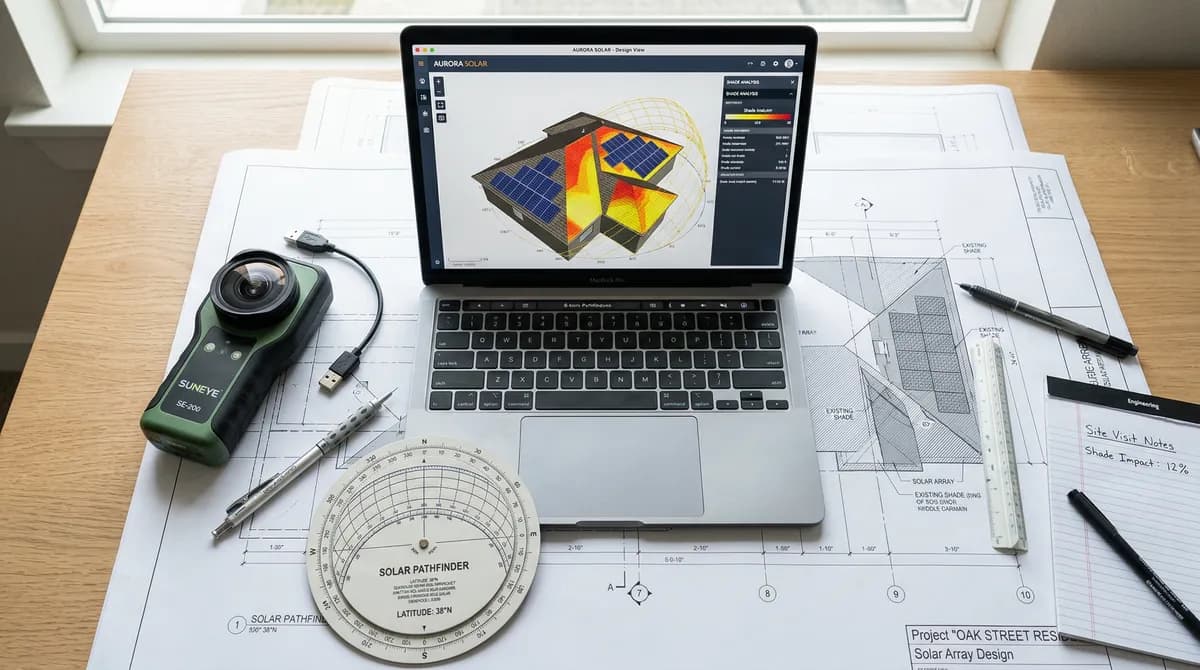
Industry-standard 3D modeling platform using LiDAR, satellite imagery, and sun path simulation. Creates hour-by-hour shade maps for every day of the year.
Handheld fisheye camera that captures the entire sky dome from the roof surface. Calculates Total Solar Resource Fraction (TSRF) — the gold standard for shade measurement.
Reflective dome device placed on the roof that shows obstructions against a sun path diagram. Analog but reliable and has been used for 40+ years.
Google Maps-based tool that estimates solar potential using aerial imagery. Good for initial screening but lacks the precision of professional tools.
TSRF is the industry-standard measurement for solar site suitability. It represents the percentage of available solar energy that actually reaches your roof after accounting for shade, tilt, and orientation. Here is what the numbers mean for MA:
Massachusetts sits at approximately 42 degrees north latitude. The sun angle changes dramatically through the year, which means shade from the same tree can be negligible in June and devastating in December. Understanding this is critical for accurate shade analysis.
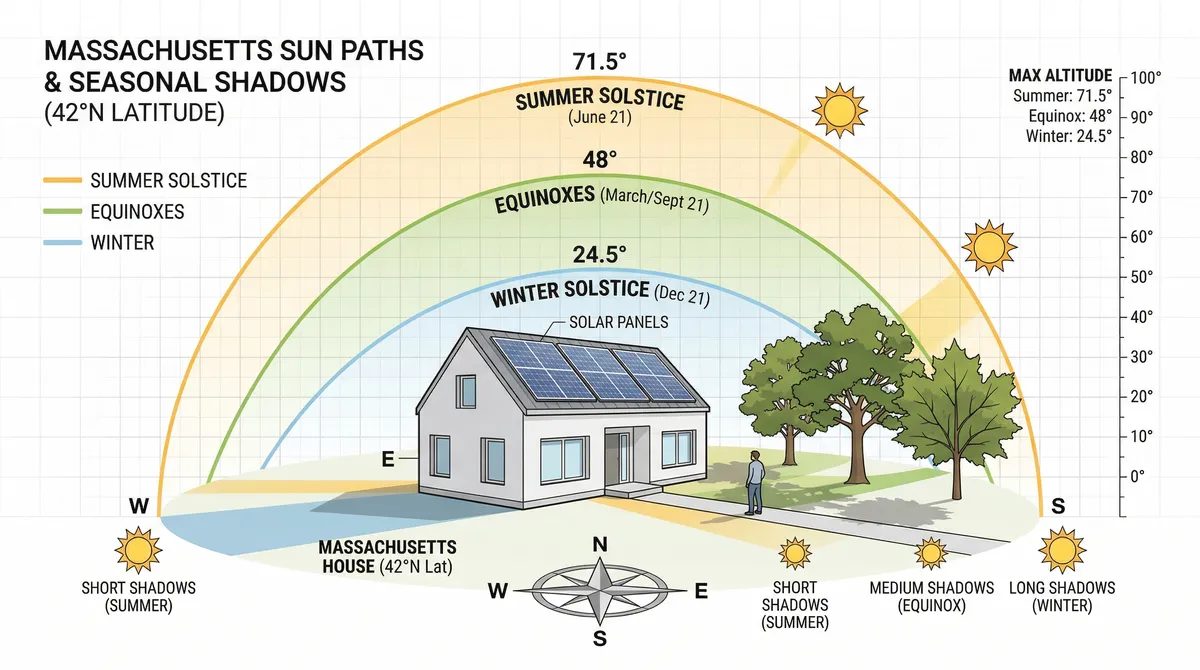
| Season | Solar Noon Angle | Shadow Length | % of Annual Production |
|---|---|---|---|
| December | 25° | 2.1x object height | 4% per month |
| March / September | 48° | 0.9x object height | 9% per month |
| June | 71° | 0.3x object height | 14% per month |
A 40-foot oak tree located 30 feet south of your roof (common in MA suburbs):
This is why shade analysis must simulate all 12 months. A tree that appears harmless during a summer site visit can devastate your winter production.
Your inverter choice is the single biggest factor in how much shade affects your system. For Massachusetts homes with any shade, the right inverter can mean the difference between a system that works and one that underperforms for 25 years.
| Feature | Enphase IQ8 Microinverters | SolarEdge + Optimizers | String Inverter (no optimizers) |
|---|---|---|---|
| Loss from 10% shade | 12-18% | 15-22% | 25-40% |
| Loss from 25% shade | 30-40% | 35-48% | 50-70% |
| Panel-level optimization | |||
| Monitoring | Per-panel | Per-panel | String-level only |
| Warranty | 25 years | 12-25 years | 10-12 years |
| Cost vs base | +$0.10-0.15/W | Base price | -$0.08-0.12/W |
Tree trimming is the most common shade mitigation strategy for MA solar installations. But it is not always the right move — and it is never free. Here is how to decide whether tree work makes financial sense for your solar project.
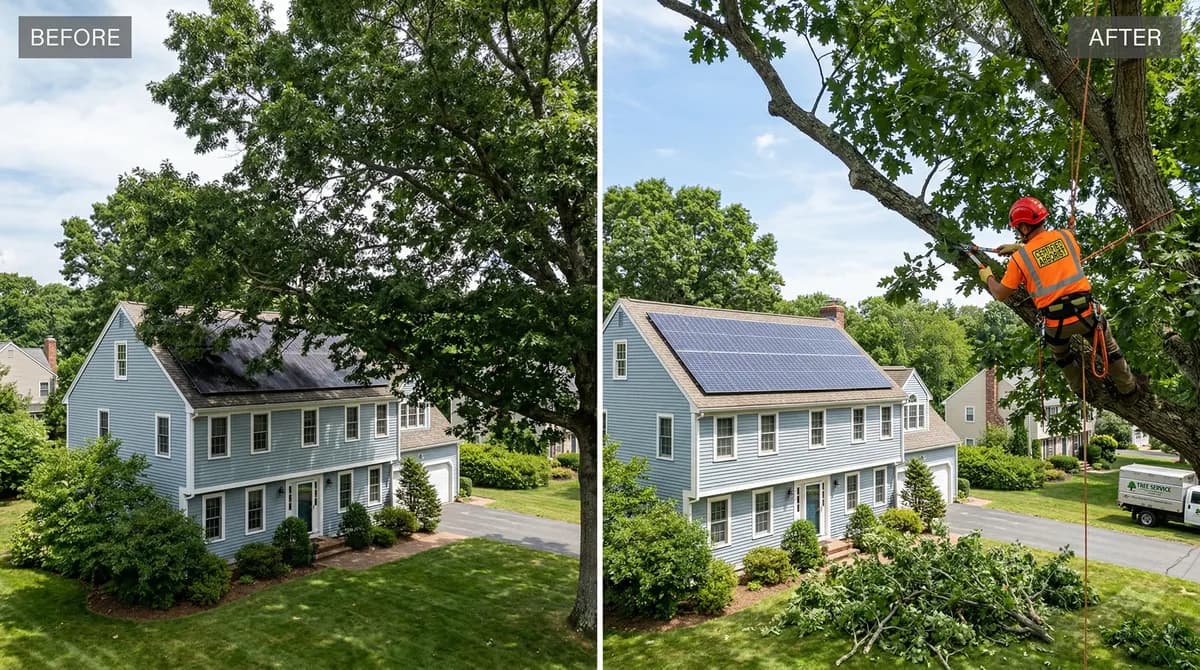
At Massachusetts' average electric rate of $0.33/kWh, the math often favors tree work. Here is a real-world example:
Rule of thumb: if tree trimming costs less than 3 years of recovered production value, it is almost always worth doing.
Many Massachusetts towns require permits before removing or significantly trimming trees. Violating these bylaws can result in fines of $500-$5,000 per tree. Always check with your local tree warden before starting any tree work for solar.
| Town | Permit Threshold | Permit Required? | Fine | Notes |
|---|---|---|---|---|
| Boston | 6" DBH | Required (public + some private) | Up to $500/tree | Boston Parks Dept approval needed |
| Cambridge | 8" DBH | Required | Up to $2,000/tree | Heritage tree list, strict enforcement |
| Brookline | 6" DBH | Required | Up to $1,000/tree | Tree Preservation Bylaw (Article 5.9) |
| Newton | 10" DBH | Required for protected species | Up to $1,000/tree | Shade tree protection ordinance |
| Concord | 8" DBH | Required | Up to $500/tree | Historic district extra review |
| Wellesley | 6" DBH | Required | Up to $500/tree | Public shade tree bylaw |
| Lexington | 8" DBH | Required | Up to $1,000/tree | Tree committee review for large removals |
| Worcester | 10" DBH | Recommended | Varies | Urban forestry division oversight |
Estimate how much production and money you are losing to shade based on your system size and inverter type. Adjust the sliders to see how different scenarios compare.
Estimate production loss from roof shading
Your shade level is manageable. Microinverters will handle this well with minimal production loss. No tree trimming needed.
Estimates based on 33¢/kWh MA average rate and 4.2 peak sun hours/day. Actual production loss depends on shade timing (morning vs. afternoon), seasonal sun angles, and specific panel placement. Get a professional shade analysis for precise numbers.
Beyond choosing the right inverter, experienced solar designers use several strategies to maximize production on shaded Massachusetts roofs.
Microinverters or DC optimizers on every panel ensure shade on one panel does not reduce output from unshaded panels. This is the #1 design decision for shaded roofs.
Skip shaded roof areas entirely rather than installing underperforming panels. A smaller system with 95% TSRF produces more than a larger system with 70% TSRF — and costs less.
Split panels across multiple roof faces (south + west, south + east) to capture sun as it moves across the sky. Shade hitting one plane does not affect panels on the other.
Premium panels (like REC 460W or Silfab 440W) produce more in limited space. If you can only use 60% of your roof due to shade, higher-wattage panels maximize the usable area.
If morning shade is unavoidable (east-side trees), prioritize west-facing panels. Afternoon production is often more valuable for MA homeowners on TOU rates.
If you have yard space, a ground-mount system ($0.20-$0.50/W more) can be placed in the sunniest spot on your property, completely avoiding roof shade. Requires setback permits.
Honest assessment saves you money. Here are the shade thresholds where rooftop solar stops making sense — and the better alternatives for heavily shaded Massachusetts properties.
Minimal shade impact. Any inverter type works, but microinverters still recommended for panel-level monitoring.
Manageable with Enphase microinverters. Consider selective trimming if trees are the source. ROI remains strong at MA rates.
Get a professional shade analysis. Tree trimming ($500-$2,000) will likely pay for itself. Design around the sunniest roof sections. Microinverters are mandatory.
Rooftop solar is likely impractical even with microinverters. Explore ground-mount systems, community solar subscriptions, or a third-party PPA/lease where the owner absorbs production risk.
Install panels in the sunniest part of your yard. Costs $0.20-$0.50/W more but gets 100% sun exposure. Ideal if you have 400+ sq ft of open yard.
Ground mount guideSubscribe to a local solar farm and receive bill credits — no panels on your roof needed. Savings of 10-20% on your electric bill. No upfront cost.
Community solar guideA financing company owns the system and claims the Section 48E commercial ITC. They absorb the production risk — you pay a fixed rate lower than your utility.
PPA/lease guideNuWatt performs a comprehensive Aurora Solar shade analysis on every project — before you commit. We will tell you honestly whether your roof works for solar, or if a ground mount or community solar is the better path.
The production loss depends on the shade percentage and your inverter type. With microinverters (Enphase IQ8), 10% shade causes roughly 15% production loss because only the shaded panels are affected. With traditional string inverters, the same 10% shade can cause 25-35% production loss because one shaded panel drags down the entire string. Massachusetts homes lose an average of $200-$800 per year from tree shade depending on severity.
Not always. First, get a professional shade analysis to quantify the actual production impact. If shade reduces production by less than 15%, microinverters can compensate and tree removal is unnecessary. If shade exceeds 25%, selective trimming ($500-$2,000) or removal ($1,500-$5,000) often pays for itself within 2-3 years through increased solar production. Many MA towns require tree removal permits, and heritage trees may be protected.
Professional installers use several tools: Aurora Solar (satellite-based 3D modeling with LiDAR data), SunEye 210 (handheld fisheye lens device that captures the entire sky dome), Solar Pathfinder (analog device with reflective dome), and satellite imagery analysis through Google Project Sunroof or EagleView. Aurora Solar is the industry standard for remote assessments, while SunEye provides the most accurate on-site measurements.
Hard shade comes from solid, permanent obstructions like chimneys, dormers, vent pipes, and neighboring buildings — these cast dark, defined shadows that completely block direct sunlight. Soft shade comes from trees, leaves, and branches that filter and scatter light rather than blocking it entirely. Hard shade is more damaging per square foot because it creates complete dead zones. Soft shade from deciduous trees in MA is seasonal — worst in summer when trees are fully leafed, but these trees lose leaves in winter when sun angles are lowest.
It depends on your town. Most MA municipalities require permits for removing trees over a certain diameter (typically 6-10 inches DBH). Towns like Cambridge, Brookline, Newton, and Concord have strict tree preservation bylaws with heritage tree protections. Boston requires a permit for any tree removal on public property and trees over 6 inches on private property in some zones. Always check your local tree warden office before cutting. Fines for unauthorized removal can reach $500-$5,000 per tree.
Microinverters (like Enphase IQ8) are significantly better for shaded roofs. They optimize each panel independently, so a shaded panel only affects its own output. With string inverters, one shaded panel reduces the output of every panel on that string — a single panel with 50% shade can reduce the entire string output by 30-40%. SolarEdge power optimizers offer a middle ground, mitigating shade impact at the panel level while using a central inverter. For MA roofs with any shade, NuWatt installs Enphase microinverters as standard.
Massachusetts sits at 42 degrees N latitude, so sun angles vary dramatically. In summer (June), the sun reaches 71 degrees above the horizon — trees and buildings cast short shadows and shade is minimal. In winter (December), the sun only reaches 25 degrees, casting shadows 2-3 times longer than the object height. A 40-foot tree 30 feet south of your roof casts virtually no shade in summer but can shade your entire roof in winter. This is why a shade analysis must account for all 12 months.
If more than 30% of your usable roof area is shaded during peak sun hours (10 AM - 2 PM), rooftop solar becomes impractical even with microinverters. At that point, consider a ground-mount system in a sunnier part of your property ($0.20-$0.50/W more than rooftop but much better production), community solar (subscribe to a local solar farm for bill credits), or a third-party owned PPA/lease where the financing company absorbs the production risk.
Selective tree trimming in MA costs $500-$2,000 depending on tree size, access, and number of trees. Full tree removal runs $1,500-$5,000 per tree for large hardwoods (oaks, maples). Stump grinding adds $150-$400. Some solar installers partner with arborists and can coordinate tree work as part of your solar project. The cost is almost always worth it — removing a tree that causes 20% production loss on a 10 kW system recovers $500-$700/year at MA electric rates.
Yes, significantly. Winter shade is more impactful for two reasons: the sun sits lower (25 degrees in December vs. 71 degrees in June), making shadows longer, and deciduous trees without leaves still cast shade from branches that can reduce production by 5-15%. However, winter also has fewer peak sun hours and shorter days, so winter shade has a proportionally smaller impact on annual production. Summer shade from fully leafed trees is more costly because summer months produce 60-65% of your annual solar energy.