Loading NuWatt Energy...

We use your location to provide localized solar offers and incentives.
We serve MA, NH, CT, RI, ME, VT, NJ, PA, and TX
Loading NuWatt Energy...
NuWatt designs, installs, and manages solar, battery, heat pump, and EV charger systems across 9 states. One company, one warranty, one point of contact.
Get a Free Quote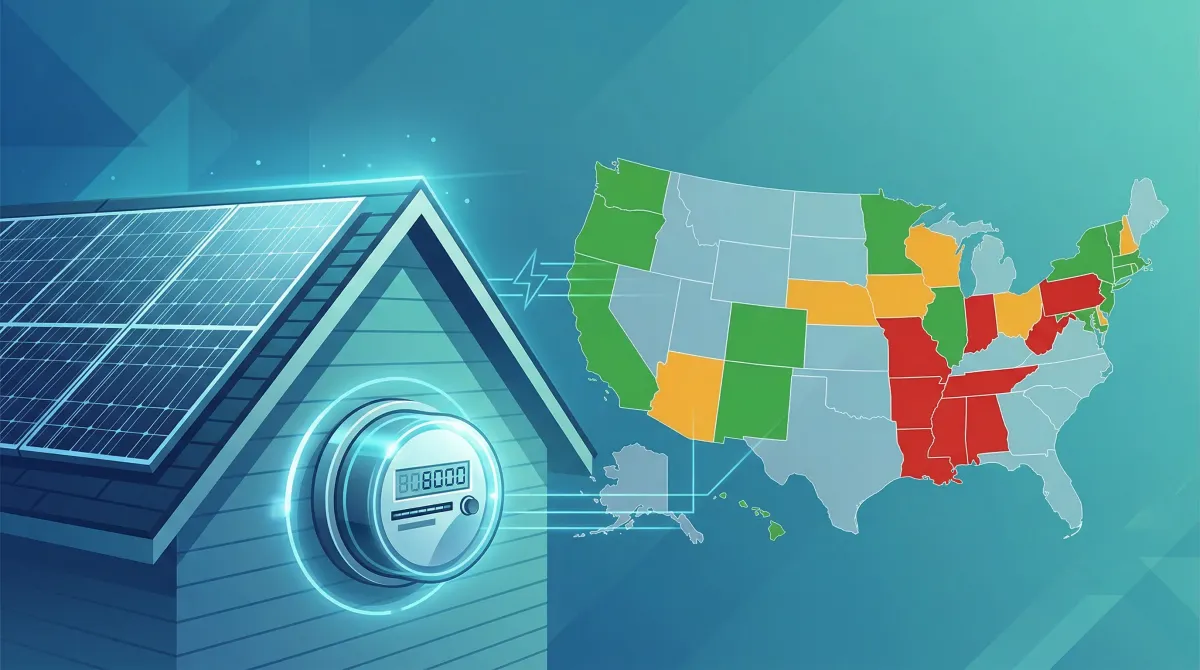
Net metering is under pressure in multiple states. Vermont has cut rates 7 years in a row. Pennsylvania's PPL utility is proposing a 60-80% reduction. Rhode Island already slashed credits in 2023. Here's what changed, what's at risk, and how to lock in current rates before the next round of cuts.
Quick Answer
Net metering remains available in all 9 NuWatt service states as of March 2026, but credit rates are declining in several. Vermont has reduced its Cat I adjustor 7 consecutive years. PA's PPL utility is proposing a shift to hourly wholesale (LMP) credits that would cut value by 60-80%. Rhode Island already reduced to a tariff-specific renewable-credit schedule in 2023. Connecticut added a $0.0402/kWh Solar Energy Adjustment for new 2026 interconnections. New Jersey, Maine, and New Hampshire remain stable with strong policies.
Net metering is the billing arrangement that makes residential solar financially viable. When your solar panels produce more electricity than your home uses during the day, the excess flows to the grid and your utility credits you for each kilowatt-hour exported. At night, you draw from the grid normally. Your bill reflects only the net difference between what you consumed and what you produced.
In states with 1:1 retail credit (like NJ, MA, ME, and PA), each kWh exported is worth exactly the same as each kWh consumed. Your meter effectively runs backward at the full retail rate. This is the gold standard — it means a properly sized solar system can offset close to 100% of your annual electricity bill.
In 2026, with the federal residential solar tax credit (Section 25D) expired, net metering is more important than ever. It is now the single largest financial driver of residential solar ROI in most states. Every dollar of net metering credit value directly impacts your payback period. A state that cuts net metering from 1:1 retail to 50% retail could double your payback period overnight.
Solar panels produce excess electricity during peak sun hours (10am-3pm). Surplus flows to the grid and earns credits.
Your utility calculates the net difference between exports and imports each billing period. Credits roll forward monthly.
With right-sized solar and 1:1 credit, annual electric bills can be near $0. Even at 80% credit, savings are substantial.
As of March 2026, here is the net metering status across all 9 NuWatt service states. Click any state for the full guide.
| State | Credit Rate | Rep Utility Rate | Cap | What Changed | Risk |
|---|---|---|---|---|---|
| Massachusetts Net Metering | 1:1 retail | $0.38/kWh (Eversource Eastern MA) | 10 MW system cap | SMART 3.0 adds $0.03/kWh for 20 years on top of net metering credits. | Watch |
| New Jersey Net Metering + ADI | 1:1 retail | $0.26/kWh (PSE&G) | No cap | ADI payments ($85.00/MWh for 15 years) stack on top of 1:1 net metering. | Stable |
| Connecticut RRES Netting Tariff | ~1:1 retail | $0.25/kWh (Eversource CT) | 25 kW residential | New $0.0402/kWh Solar Energy Adjustment reduces effective credit for 2026 interconnections. | Watch |
| Rhode Island Net Metering | tariff-specific renewable credit | $0.34/kWh (Rhode Island Energy) | 125% annual usage | REG program ($0.27/kWh guaranteed 15-20 years) may be better than net metering for new installs. | Watch |
| New Hampshire NEM 2.0 | utility-specific component credit | $0.29/kWh (Eversource NH) | 100% of usage | Locked through 2041 by legislation. Most secure NM policy in NuWatt service area. | Stable |
| Maine Net Energy Billing | 1:1 retail | $0.24/kWh (Central Maine Power) | No cap | LD 1777 confusion cleared: rooftop solar still gets full 1:1 retail credit. | Stable |
| Texas Utility-Specific | Varies by REP | $0.15/kWh (Oncor) | Varies | No mandatory NM. Economics depend on self-consumption, not export credits. | At Risk |
| Vermont Net Metering (Cat I-IV) | ~$0.22/kWh (Cat I) | $0.21/kWh (Green Mountain Power) | 500 kW | 7 consecutive years of PUC rate cuts. Lock in current Cat I adjustor before next reduction. | At Risk |
| Pennsylvania Net Metering | 1:1 retail | $0.23/kWh (PECO Energy) | 50 kW residential | PPL proposing LMP switch (~July 2026). Could reduce credit value by 60-80%. | At Risk |
Data as of March 2026. Risk assessment reflects pending legislation, utility proposals, and PUC proceedings. "Stable" means no active proposals to reduce credit rates. "Watch" means recent or upcoming changes. "At Risk" means active proposals or sustained annual reductions.
Full retail credit up to 10 kW. 60% of retail for 10-25 kW systems. SMART program adds $0.03/kWh on top.
DPU 25-200 proposed tiered structure: full 1:1 retail for systems up to 10 kW, but only 60% for 10-25 kW. SMART 3.0 pays flat $0.03/kWh residential.
Full 1:1 retail credit with no aggregate cap. ADI adds $85.00/MWh (EY2025-26).
No material changes. NJ maintains the strongest net metering policy in the NuWatt service area. ADI rates increased slightly for EY2026-27.
Residential Renewable Energy Solutions (RRES) netting tariff provides approximately 1:1 credit. New 2026 interconnections face a Solar Energy Adjustment of $0.0402/kWh deducted from the credit.
The Solar Energy Adjustment ($0.0402/kWh) is new for 2026 interconnections. This effectively reduces the net metering credit by about 15% compared to pure 1:1 retail for new systems.
Post-April 2023 systems receive the current tariff-specific renewable credit. Grandfathered pre-April 2023 systems retain 1:1 credit. 125% annual usage cap.
Already reduced in April 2023. The REG program ($0.27/kWh for 15-20 years) is the stronger alternative for new installations. ConnectedSolutions adds $225/kW for batteries.
100% of supply + 100% of transmission + 25% of distribution charges. Legislatively locked through 2041.
No changes. NH NEM 2.0 rates are legislatively locked through 2041, providing the strongest long-term certainty of any NuWatt service state. SB 303 repealed the state rebate in 2024.
Full 1:1 retail credit for rooftop solar. LD 1777 only changed community solar billing, not residential rooftop net metering.
LD 1777 caused confusion but only impacted community solar. Residential rooftop NEB remains 1:1 retail. Versant territory ($0.32/kWh) provides even higher credit value.
No statewide mandate. Deregulated ERCOT market. Austin Energy VOS ~$0.097/kWh. Oncor territory REPs offer $0.05-0.10/kWh buyback. Some REPs offer promotional 1:1.
Several REPs have reduced or eliminated solar buyback programs. Austin Energy VOS rate was recalculated lower. Self-consumption remains the primary economic driver, not exports.
Category-based system. Cat I (residential, up to 15 kW) gets positive adjustor of ~$0.04/kWh above blended rate for 10 years. But PUC has cut rates 7 consecutive years.
Vermont PUC has reduced the Cat I adjustor 7 consecutive years. Blended base rate is $0.1839/kWh. Cat I effective rate ~$0.22/kWh still positive but declining annually. GMP battery program adds $0.01/kWh.
State-mandated 1:1 retail credit under the AEPS Act for systems up to 50 kW. All PA utilities must participate.
PPL Electric Utilities has proposed replacing 1:1 retail net metering with hourly LMP-based (wholesale) credits, expected around July 2026. This would reduce credit value by 60-80% for PPL customers. Systems installed before the change may be grandfathered.
Find out what net metering is worth at your address
Enter your address and electric bill. We will calculate your net metering savings using your state's actual credit rate.
Three states in our service area face significant net metering risk. If you live in one of these states, the window to lock in current rates is narrowing.
What's proposed: PPL Electric Utilities has filed to replace 1:1 retail net metering with hourly LMP-based (wholesale) credits. The expected implementation date is around July 2026.
Impact:LMP rates average $0.04-0.08/kWh, compared to PPL's retail rate of $0.18-0.21/kWh. This represents a 60-80% reduction in net metering credit value. A system that saves $1,400/year under current net metering would save only $400-560/year under LMP.
Action: Systems installed before the change takes effect are expected to be grandfathered under current 1:1 rates for the life of the system. PECO and Duquesne Light customers are not affected by this proposal.
What's happening: The Vermont PUC has reduced the Category I net metering adjustor 7 consecutive years. Each year, the positive adjustor shrinks, reducing the effective credit rate for new installations.
Current status: Cat I adjustor is ~$0.04/kWh above the blended base rate of $0.1839/kWh, giving an effective rate of ~$0.22/kWh. The adjustor is locked for 10 years from interconnection, so earlier installation locks in a higher rate.
Action: Every year you wait, the adjustor decreases. It could turn negative within 2-3 years based on the current trajectory. Install now to lock in the current positive $0.04/kWh adjustor for a decade.
Outside our service area, net metering is under heavier pressure. California eliminated 1:1 net metering in 2023 (NEM 3.0 cut export credits by ~75%). Florida defeated a net metering rollback ballot measure in 2024 but utility lobbying continues. Several Midwestern states are exploring "avoided cost" replacements.
The pattern is clear: utilities are systematically lobbying to reduce net metering compensation. While Northeast states have been more protective of solar customers, the national trend creates political pressure on all state PUCs. Locking in current rates before the next legislative session is the safest strategy.
In most states, the net metering rate you receive when your system is interconnected is the rate you keep for the life of your system. This is called grandfathering. If your state reduces net metering credits next year, systems already connected under the current policy typically retain their original rates. Here is the timeline to protect yourself:
Start with a free solar estimate. We will analyze your roof, usage, and state-specific net metering value to calculate your exact payback.
In PA PPL territory, the July 2026 deadline is approaching. In VT, every month of delay means a potentially lower Cat I adjustor at your next PUC filing.
Once your system is installed and the utility approves interconnection, you are locked in under the current net metering policy. This is the date that matters for grandfathering.
Your grandfathered rate typically applies for 20-25 years. Even if the state cuts net metering next year, your credits stay at the rate in effect when you interconnected.
Lock in today's net metering rates
The sooner you interconnect, the more secure your net metering credits. Get a free assessment today.
Even in states where net metering is declining, solar remains financially viable. Here is how three strategies compare for maximizing solar value when export credits fall below 1:1 retail.
Subscribe to a share of a remote solar farm. You receive bill credits at a 10-20% discount off retail. No installation required, no roof suitability needed. Available in MA, NJ, CT, RI, ME, and VT. In states where net metering has been reduced below 1:1, community solar can be competitive because the credit rate is negotiated in the subscription agreement.
Best for: Renters, unsuitable roofs, or as a supplement to rooftop solar.
Instead of exporting excess solar at a reduced credit rate, store it in a battery and use it at night. This shifts your solar value from the export credit rate (which may be declining) to the full retail rate (which you avoid paying by using stored solar). In states with ConnectedSolutions (MA, CT, RI, VT), batteries also earn $225-275/kW/year through demand response events.
Best for: Homeowners in states with reduced net metering (RI, VT) or time-of-use rates.
Several states offer production-based payments that are independent of net metering. These pay you for every kWh your system produces, regardless of whether you export it or use it yourself. They stack on top of whatever net metering credit you receive.
$0.03/kWh for 20 years
$85.00/MWh for 15 years
$0.27/kWh for 15-20 years
~$0.05/kWh for 15 years
| Strategy | Savings Mechanism | Roof Required? | Best When |
|---|---|---|---|
| Net Metering | Export credits offset import charges | 1:1 retail credit states (NJ, MA, ME, PA) | |
| Community Solar | Subscription bill credits (10-20% off) | Renters, shaded roofs, or as supplement | |
| Battery Self-Consumption | Store solar for night use at full retail | Reduced NM states (RI, VT) or TOU rates |
The Section 25D residential solar investment tax credit expired December 31, 2025. There is no federal tax credit for homeowner-purchased solar in 2026. This makes net metering and state-level incentives (SMART in MA, ADI in NJ, REG in RI) even more critical to solar economics. The commercial ITC (Section 48/48E) remains available for third-party-owned systems (leases and PPAs) where the financing company claims the credit.
Net metering is a billing arrangement where your utility credits you for excess solar electricity you send to the grid. When your solar panels produce more than you use (typically midday), the excess flows to the grid and your meter effectively runs backward. At night, you draw from the grid normally. Your bill reflects the net difference. In states with 1:1 retail credit, each kWh exported is worth the same as each kWh consumed.
No state in the NuWatt service area has eliminated net metering entirely. However, several states have reduced credit rates or are proposing changes. Vermont has cut its Category I adjustor 7 consecutive years. PA's PPL utility is proposing a shift to LMP-based credits. Rhode Island already reduced credits to a tariff-specific renewable-credit schedule in 2023. The trend is toward modification, not elimination.
New Jersey has the strongest policy: full 1:1 retail credit with no cap, plus ADI payments of $85.00/MWh for 15 years. Massachusetts offers 1:1 retail plus SMART program payments ($0.03/kWh). Maine provides 1:1 retail credit at high electric rates ($0.27-0.32/kWh). New Hampshire's NEM 2.0 is locked through 2041 using a utility-specific component credit.
Most states grandfather existing solar customers under the net metering rules that were in effect when they interconnected. For example, Rhode Island grandfathered pre-April 2023 customers at 1:1 retail even though new installations only get ~80%. PA's PPL proposal would grandfather existing systems. This is why installing before policy changes is critical.
No. The Section 25D residential solar investment tax credit expired December 31, 2025. There is no federal tax credit for homeowner-purchased solar in 2026. The commercial ITC (Section 48/48E) remains available for third-party-owned systems (leases and PPAs) where the financing company claims the credit. Net metering and state incentives are now the primary financial drivers.
Net metering requires rooftop panels and typically provides higher savings (70-100% bill offset). Community solar requires no installation — you subscribe to a share of a remote solar farm and receive bill credits, usually at a 10-20% discount off retail. In states where net metering has been reduced (like RI), community solar may be competitive. The choice depends on whether your roof is suitable for solar and your state's specific programs.
With 1:1 (full retail) net metering, each kWh you export to the grid is worth exactly the same as each kWh you consume. Your meter effectively runs backward at the same rate. With reduced credit (like RI's ~80% or NH's ~85%), exports are worth less than consumption. This means your solar savings are lower even with the same system size, and payback periods extend by 1-3 years.
Yes. A battery lets you store excess solar for evening use instead of exporting at a reduced credit rate. In states with time-of-use rates, batteries can shift consumption to avoid high-cost peaks. ConnectedSolutions programs (MA, CT, RI, VT) pay $225-275/kW annually for battery demand response, adding $1,100-1,375/year for a 5 kW battery. This revenue stream is independent of net metering.
If you live in a state with proposed net metering reductions (PA PPL territory, VT with annual cuts), yes. Systems installed before changes take effect are typically grandfathered under current rates for the life of the system. In PA's PPL territory, the July 2026 proposed LMP switch could reduce credit value by 60-80%. Every month of delay risks losing current rates.
PPL Electric Utilities has proposed replacing 1:1 retail net metering ($0.18-0.21/kWh credit) with hourly LMP-based wholesale credits ($0.04-0.08/kWh). This would reduce net metering value by 60-80% for PPL customers in the Lehigh Valley, Harrisburg, Scranton, and central PA. The change is expected around July 2026. Systems installed before the change are expected to be grandfathered under current 1:1 rates.
Yes, but Vermont's PUC has cut net metering rates 7 consecutive years. The current Category I (residential, up to 15 kW) rate includes a positive adjustor of ~$0.04/kWh above the blended base rate ($0.1839/kWh) for 10 years. The effective rate is ~$0.22/kWh. The adjustor has decreased every year and may turn negative in future PUC proceedings. Installing sooner locks in the current positive adjustor for 10 years.
Annual savings depend on your electric rate and system size. In high-rate states like MA ($0.28/kWh) with 1:1 credit, a typical 8 kW system saves $1,500-2,200/year. In RI ($0.29/kWh) with ~80% credit, savings are $1,300-1,900/year. In lower-rate states like PA ($0.18/kWh), savings are $900-1,400/year. These savings compound over the 25+ year life of the system.
Systems installed before policy changes are typically grandfathered at the current rate. Get your free solar assessment today and find out what net metering is worth at your address before the next round of cuts.