Loading NuWatt Energy...

We use your location to provide localized solar offers and incentives.
We serve MA, NH, CT, RI, ME, VT, NJ, PA, and TX
Loading NuWatt Energy...
NuWatt designs, installs, and manages solar, battery, heat pump, and EV charger systems across 9 states. One company, one warranty, one point of contact.
Get a Free Quote
Without the federal tax credit, batteries lost their biggest subsidy. But demand response programs like ConnectedSolutions change the equation entirely. Here is the honest, state-by-state battery math for 2026.
Quick Answer
A home battery costs $12,000-$15,000 in 2026 without any federal tax credit. On energy savings alone, payback is 12-15 years — marginal at best. But in states with demand response programs like ConnectedSolutions (Massachusetts, Rhode Island, Connecticut), batteries earn $1,125-$1,375 per year in utility payments, cutting payback to 6-8 years. Alternatively, leasing a battery through Section 48E lets a third-party claim the 30% commercial ITC, reducing effective cost to ~$9,100.
As of March 2026, a home battery system costs $12,000 to $15,000 installed for 10 to 13.5 kWh of usable storage capacity. This is the full, out-of-pocket price — there is no federal residential tax credit to reduce it. The Section 25D Investment Tax Credit expired on December 31, 2025, eliminating what used to be a $3,600-$4,500 discount.
Battery prices have dropped roughly 8-12% from 2024 levels thanks to increased manufacturing capacity and competition, but the loss of the 30% ITC more than offsets those gains for homeowners who buy outright. The net cost to the consumer is higher in 2026 than it was in 2024.
No Federal Tax Credit for Battery Purchases
The Section 25D residential ITC expired on December 31, 2025. Homeowners who purchase a battery with cash or a loan receive $0 in federal tax credits. The only path to a federal credit is through a Section 48E third-party lease structure (see below).
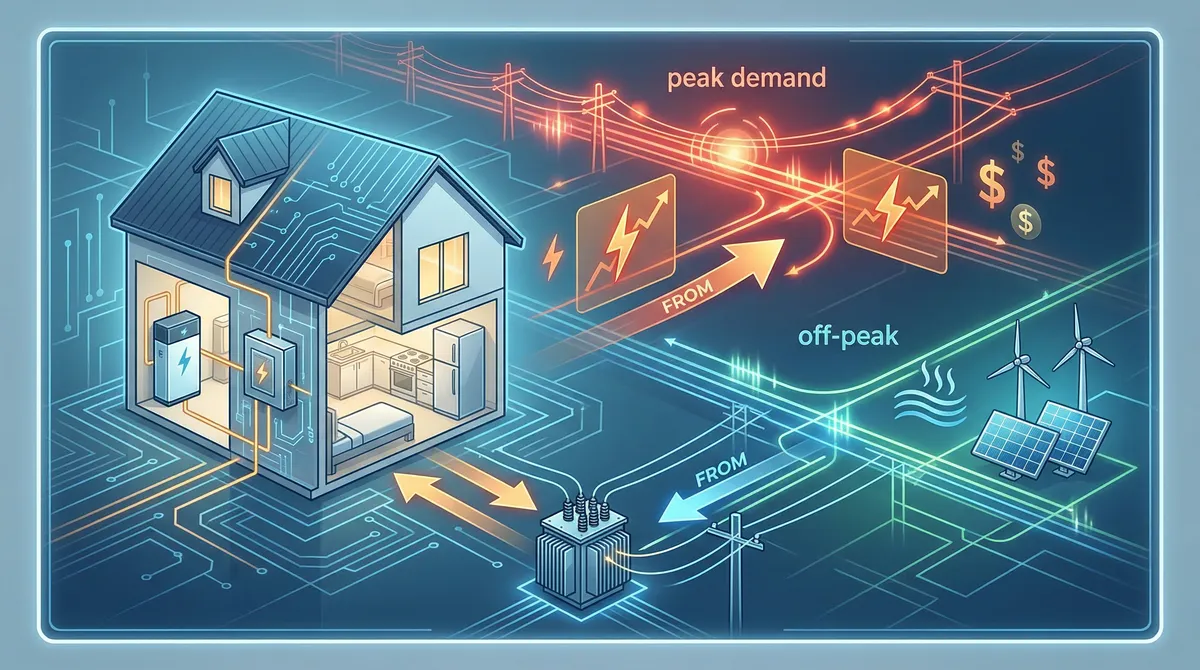
Without a demand response program, home batteries pay for themselves through energy arbitrage — charging when electricity is cheap (off-peak or from solar) and discharging when rates are high (peak hours). The problem is that most utility rate structures do not have enough spread between peak and off-peak to make the math work quickly.
Assumptions
Result
Annual arbitrage savings
$800 — $1,200
Simple payback
12 — 15+ years
Most battery warranties are 10-15 years. Payback exceeding warranty = poor investment.
The verdict on arbitrage alone: marginal at best. A 12-15 year payback on a product with a 10-15 year warranty means you may never fully recoup your investment before the battery degrades. This is why demand response programs are the single biggest factor in whether a battery makes financial sense.
Demand response programs pay you to let the utility discharge your battery during peak grid demand — typically hot summer afternoons when air conditioning strains the grid. The largest program in the Northeast is ConnectedSolutions, operated by Eversource and National Grid across Massachusetts, Rhode Island, and Connecticut. These payments transform the battery economics.
| Utility | Summer Rate | Winter Rate | Annual (5 kW) |
|---|---|---|---|
| MA Eversource | $275/kW | $50/kW | $1,375/yr |
| MA National Grid | $225/kW | $50/kW | $1,125/yr |
| RI Energy | $225/kW | — | $1,125/yr |
| CT Eversource | $160-200/kW | varies | $800-$1,000/yr |
Based on 5 kW discharge capacity (typical for 10-13.5 kWh battery). Actual payments vary by event participation. Unitil does not participate in ConnectedSolutions.
| Scenario | Annual Revenue | Payback | Verdict |
|---|---|---|---|
| Energy arbitrage only | $800-$1,200 | 12-15+ years | Marginal |
| ConnectedSolutions (MA/RI) | $1,525-$1,975 | 6-8 years | Strong |
| TOU arbitrage (CA/AZ) | $1,200-$1,800 | 6-10 years | Good |
| Section 48E lease | N/A (30% lower cost) | 5-7 years effective | Best financial |
The difference is dramatic. ConnectedSolutions nearly doubles the annual revenue from a battery compared to arbitrage alone. In Massachusetts with Eversource, a 13.5 kWh battery earning $1,375/yr in demand response plus $500/yr in arbitrage generates $1,875 annually — a 7-year payback on a $13,000 system, well within the warranty period.
Whether a battery is worth it depends almost entirely on your state. The presence or absence of demand response programs is the deciding factor.
ConnectedSolutions
Annual Revenue
$1,125-$1,375
Payback
6-8 years
Eversource $275/kW + $50 winter, NGrid $225/kW + $50 winter
State battery guideConnectedSolutions
Annual Revenue
$1,125
Payback
7-9 years
RI Energy $225/kW summer
State battery guideESS Program
Annual Revenue
$800-$1,000
Payback
8-10 years
Eversource CT battery demand response
State battery guideTOU + SGIP
Annual Revenue
$1,200-$1,800
Payback
6-8 years
Aggressive TOU spreads ($0.15-0.55/kWh) + SGIP rebates
Demand charges
Annual Revenue
$900-$1,200
Payback
8-10 years
SRP/APS demand charges $8-13/kW peak
VDER + potential DR programs expanding
No demand response program, flat rates
No DR program, moderate rates ($0.27-0.32/kWh)
Green Mountain Power offers leased Powerwalls but limited DR revenue
Low rates (~$0.12-0.16/kWh), no statewide DR program
In states without demand response, batteries are still worth considering if backup power is critical for your household. The financial payback alone does not justify the investment, but outage protection may.
There is one remaining path to a federal credit on battery storage: the Section 48E commercial Investment Tax Credit. When a third-party company owns the battery and leases it to you, that company claims the 30% ITC. They pass the savings through as lower monthly lease payments.
Financing company installs and owns the battery
Company claims 30% ITC ($3,900 on $13K system)
You pay lower monthly lease ($80-$120/mo)
Option to buy at end of lease (7-10 years)
Safe harbor: July 4, 2026. Beginning construction on or before this date locks in the full Section 48E timing pathway (placed in service through roughly 2030). Beginning after still qualifies for the 30% credit, but the system generally must be placed in service by December 31, 2027 — the credit does not phase down at July 4.
For homeowners who do not have $13,000 in cash, the Section 48E lease is the most cost-effective way to add battery storage in 2026. Projects that began construction on or before the July 4, 2026 safe harbor locked in the widest timing window, though later starts still qualify for the 30% credit if placed in service by December 31, 2027. For more on how Section 48E works, see our Section 48E guide.
Financial payback is only part of the equation. Home batteries provide backup power during grid outages — something a generator does but with zero fuel costs, zero maintenance, silent operation, and automatic failover. In the Northeast, where winter storms routinely knock out power for 1-3 days, this has real value.
10-16 hours on a full charge: fridge, lights, Wi-Fi, phone charging, medical equipment
A battery + heat pump keeps your home heated during winter outages (in short bursts)
With solar panels, the battery recharges daily — potentially lasting days during an outage
We do not include backup value in our payback calculations because it is subjective. But for households with medical equipment, remote workers, or families with young children, the peace of mind during a 3-day nor'easter is worth thousands. For a deeper look at sizing your battery for backup, see our whole-home backup sizing guide.
Bundling a battery with your solar installation saves $1,000-$2,000 in combined labor compared to adding one later. The electrician is already on-site, the panel is already open, and the permitting is consolidated. But whether it makes sense depends on where you live.
The one exception: if you are using a Section 48E lease structure, bundling the battery with solar under the same lease maximizes the 30% credit. Projects that began construction on or before the July 4, 2026 safe harbor locked in the widest timing window; starting after still qualifies if the system is placed in service by December 31, 2027. For details on solar financing options, see our solar financing guide for 2026.
Without Demand Response
12-15 yr
payback — marginal investment
With ConnectedSolutions
6-8 yr
payback — strong investment
Section 48E Lease
5-7 yr
effective payback — best value
In 2026, a home battery is unambiguously worth it in Massachusetts, Rhode Island, and Connecticut — where ConnectedSolutions provides $1,125-$1,375 per year in demand response revenue on top of energy arbitrage savings. In California and Arizona, aggressive TOU rate structures make batteries viable through pure arbitrage.
In states without demand response programs, the financial case is weak. Batteries are a 12-15 year payback on energy savings alone — barely breaking even before the warranty expires. In those states, the decision comes down to how much you value backup power. If outage protection matters to your family, a battery has value that spreadsheets cannot capture.
A home battery system costs $12,000-$15,000 installed for 10-13.5 kWh of usable capacity in 2026. The Tesla Powerwall 3 costs approximately $12,500 installed, the Enphase IQ Battery 10C runs $13,000-$14,000, and the Franklin aPower2 costs $13,500-$15,000. These prices do not include any federal tax credit because the residential ITC (Section 25D) expired on December 31, 2025.
Not through the residential ITC. Section 25D expired on December 31, 2025, so homeowners who purchase a battery outright receive no federal tax credit. However, you can access the 30% commercial ITC (Section 48E) by leasing a battery system through a third-party owner. The financing company claims the credit and passes savings to you through lower monthly payments. July 4, 2026 was a begin-construction safe harbor, not a cutoff: projects that started on or before that date locked in the full timing pathway, and starting now still qualifies for the 30% credit if the system is placed in service by December 31, 2027.
ConnectedSolutions is a demand response program run by Eversource and National Grid in Massachusetts, Rhode Island, and Connecticut. You enroll your home battery and allow the utility to discharge it during peak demand events (typically summer afternoons). In Massachusetts, Eversource pays $275/kW summer plus $50/kW winter. National Grid pays $225/kW plus $50/kW winter. A typical 5 kW battery earns $1,125-$1,375 per year.
Without a demand response program, battery payback is 12-15+ years based on energy arbitrage alone (charging cheap, discharging expensive). In most states outside California and Arizona, the spread between peak and off-peak rates is not large enough to justify the $12,000-$15,000 investment. Time-of-use rate arbitrage alone typically saves $800-$1,200 per year, making the math difficult without additional revenue streams.
With ConnectedSolutions in Massachusetts or Rhode Island, battery payback drops to 6-8 years. A 13.5 kWh battery (5 kW discharge) earns $1,125-$1,375 per year in demand response payments, plus $400-$600 in energy arbitrage savings, totaling $1,525-$1,975 annually. On a $13,000 system, that is a 7-8 year payback — well within the 15-year warranty period of most batteries.
Massachusetts, Rhode Island, and Connecticut are the strongest due to ConnectedSolutions demand response payments ($1,125-$1,375/yr). California and Arizona have aggressive time-of-use rates and demand charges that make batteries financially viable. New Jersey and New York have developing programs. States without demand response programs — New Hampshire, Maine, Vermont, and Texas — make batteries harder to justify on economics alone.
Yes. Under Section 48E, a third-party company can own and lease a battery system to you, claiming the 30% commercial Investment Tax Credit. This reduces the effective cost from $13,000 to roughly $9,100. You pay a monthly lease fee that is lower than it would be without the credit. Projects that began construction on or before July 4, 2026 locked in the full §48E timing pathway; starting after that safe-harbor date still qualifies for the 30% credit as long as the system is placed in service by December 31, 2027. After the lease term (typically 7-10 years), you may have the option to purchase the system at fair market value.
Battery backup provides real value that is hard to quantify in dollars. A 13.5 kWh battery can power essential loads (refrigerator, lights, Wi-Fi, phone charging, medical equipment) for 10-16 hours during an outage. In the Northeast, winter storms regularly cause 1-3 day outages. If you work from home, have medical equipment, or simply want peace of mind during storm season, the backup value may justify the investment even when the pure financial math is marginal.
It depends on your state. If you live in Massachusetts, Rhode Island, or Connecticut, adding a battery at solar installation time saves $1,000-$2,000 in combined installation labor and qualifies you for ConnectedSolutions immediately. The bundled payback is 6-8 years. In states without demand response, consider installing solar first and adding a battery later when prices drop or programs launch. Adding battery to an existing solar system typically costs $1,000-$2,000 more than a combined install.
Most home batteries come with a 10-15 year warranty and are rated for 4,000-6,000 cycles. The Tesla Powerwall 3 has a 10-year warranty. Enphase IQ batteries carry a 15-year warranty. In practice, lithium-ion batteries retain 70-80% of their original capacity after 10 years. A battery installed in 2026 should remain functional through 2036-2041, though its capacity will gradually decrease over time.
Home Battery Guide 2026
Complete guide to home battery storage systems, brands, and sizing
Battery Storage Cost 2026
Detailed cost breakdown by brand, capacity, and installation
ConnectedSolutions Program
How to enroll and maximize demand response revenue
How Solar Financing Changed in 2026
PPA, lease, cash, and loan options after the ITC expired
Section 48E Solar Guide
How the commercial ITC works for residential solar and batteries
Best Home Battery 2026
Side-by-side comparison of top battery systems
Whole-Home Backup Sizing Guide
How to size a battery for full or partial home backup
MA ConnectedSolutions Battery Guide
Massachusetts-specific ConnectedSolutions enrollment and payments
Our IQ assessment considers your state, utility, rate structure, and available demand response programs to give you an honest battery recommendation.
Elena helps homeowners plan whole-home electrification projects — solar, heat pumps, batteries, and EV charging. She focuses on financing strategies and long-term energy savings. Questions about battery storage for your home? Contact our team for a personalized recommendation.