
Loading NuWatt Energy...
We use your location to provide localized solar offers and incentives.
We serve MA, NH, CT, RI, ME, VT, NJ, PA, and TX
Loading NuWatt Energy...
NuWatt designs, installs, and manages solar, battery, heat pump, and EV charger systems across 9 states. One company, one warranty, one point of contact.
Get a Free Quote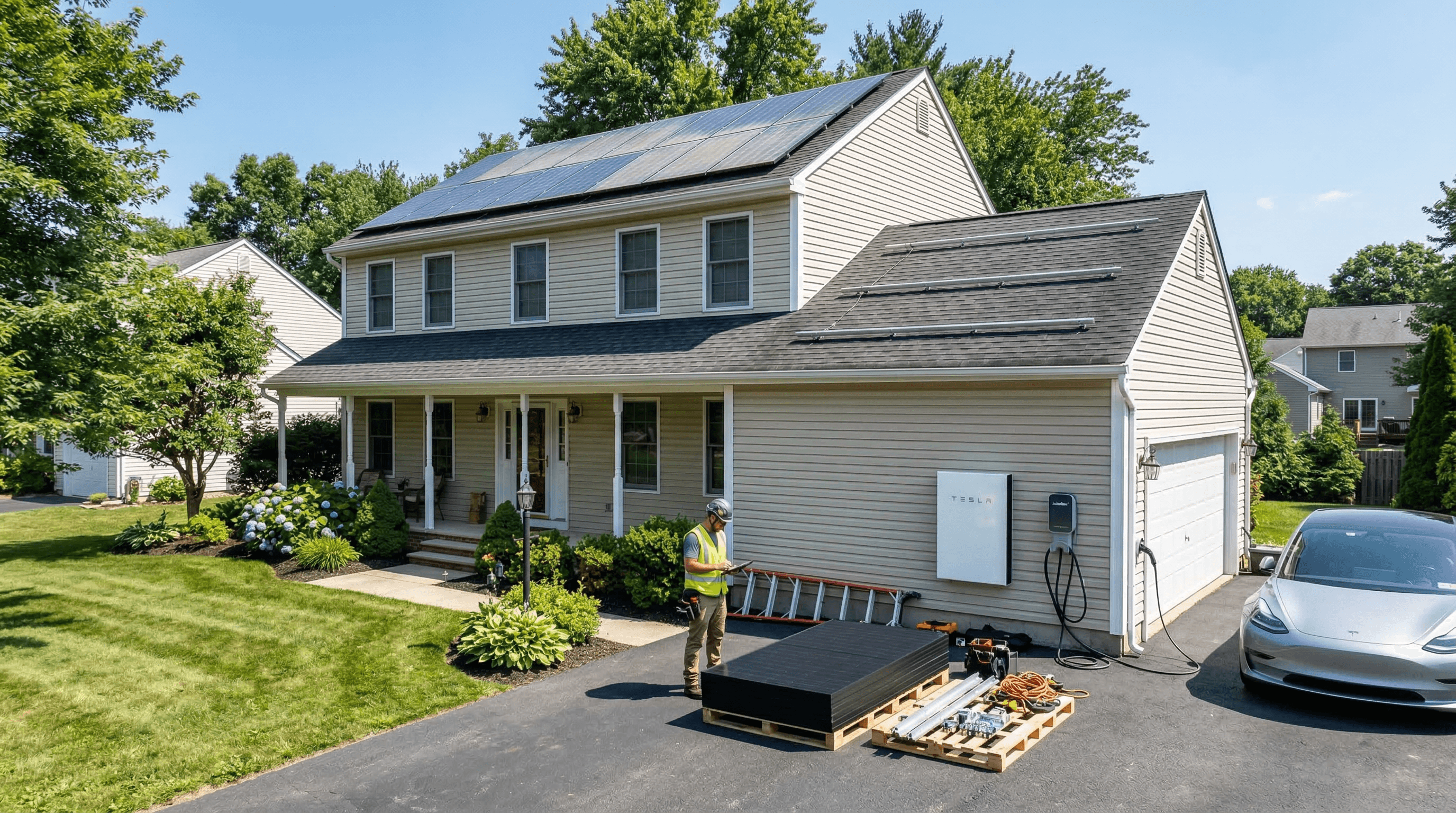
NJ installed 5+ GW of solar from 2012-2024. If your system is not keeping up with your EV, heat pump, or growing family, here is exactly how to expand it — and what it costs in 2026 without the federal residential tax credit.

$3.00-3.30/W
Expansion Cost
$85.00/MWh
ADI Income
1:1 Retail
Net Metering
7/4/2026
48E Deadline
New Jersey had the second-largest residential solar boom in the Northeast from 2012-2018. Those homeowners are now electrifying their homes — and their original 6-10 panel systems cannot keep up.
A typical EV adds 3,000-5,000 kWh/year to your home consumption. Your original system was not sized for that.
Switching from gas to a heat pump shifts heating load to electricity, adding 2,000-4,000 kWh/year.
Home addition, finished basement, or kids growing up means more appliances, screens, and AC usage.
Many 2012-2018 systems were designed conservatively, or utility rates have risen enough that a larger offset makes sense.
Grid outages from storms are increasing. A battery + expanded solar keeps critical loads running.
Induction cooktop, heat pump water heater, electric dryer. Full electrification can double electricity use.
The approach depends on your existing inverter type. Microinverter systems are the easiest to expand. String inverters require a bit more planning.
Each panel has its own inverter. Add new panels with current-generation microinverters (e.g., Enphase IQ8+) alongside your existing array. Old and new microinverters do not need to match. Your monitoring system shows both old and new panels.
If your SolarEdge or string inverter has unused string inputs, new panels can connect to the same inverter. Panels should be similar voltage characteristics. Check inverter max DC input capacity.
If your existing inverter is maxed out, the expansion gets its own inverter. This works well and is treated as a separate system by the utility. Two inverters, two monitoring views.
String inverters last 10-12 years. If yours is from 2012-2016, it may fail soon. Replacing with microinverters or a new hybrid inverter during expansion is often the smartest move.
Check your existing equipment:
What your installer will assess:
The expansion portion qualifies for NJ's ADI (Administratively Determined Incentive) program at the current rate — separate from your original SREC registration.
EY2025-26 rate..
Quarterly payments based on actual production from expansion meters.
Your expansion enrolls as a new ADI system or an amendment to the existing one. Either way, the new capacity earns at current ADI rates.
Your existing SREC or SREC-II income from the original system continues on its own schedule. The expansion does not retroactively change your original contract.
Expansion size
3 kW (7-8 panels)
Annual production
~3,390 kWh (1,130 kWh/kW)
Annual ADI income
~$291/year at $85.00/MWh
15-year ADI income
~$4,200 (with 0.5%/yr degradation)
NJ's 1:1 net metering applies to your entire system — original and expansion. No separate agreement needed.
Every kWh your expanded system sends to the grid earns a credit at the full retail rate. PSE&G: $0.26/kWh. JCP&L: $0.26/kWh. ACE: $0.25/kWh.
Excess credits roll to the next month. In summer, your expanded system builds credits that offset winter shortfalls — and the balance is larger with more panels.
File an amended interconnection application with your utility. Your installer handles this. Processing takes 1-2 weeks. The 1:1 credit structure does not change.
Policy watch: NJ net metering policy discussions are ongoing. Systems installed under current rules are grandfathered. Expanding now locks in the 1:1 retail rate for the new capacity before any potential restructuring.
Even though you already have a permitted system, the expansion requires its own electrical permit. Here is what to expect.
3-5 days
Your installer creates an expansion plan showing new panel placement, wiring, and updated single-line diagram.
1-3 weeks
Filed with your municipality. Includes structural letter, electrical plans, and site plan. Cost: $100-$500.
1 day
Expansion installation is typically a single-day job. New panels mounted, wired, and connected to inverter(s).
1-2 weeks
Municipal electrical inspection, followed by utility Permission to Operate (PTO). Then your expanded system is live.
Total timeline: 4-8 weeks from signed contract to power-on. Faster than a new install because the utility relationship and metering infrastructure already exist. Your installer handles all permitting and interconnection paperwork.
Solar expansion costs $3.00-$3.30/W — slightly cheaper than new installations because the interconnection and metering are already in place. No federal 25D residential tax credit is available (expired December 31, 2025).
| Item | Cost Range |
|---|---|
| Expansion panels (installed) | $3.00-$3.30/W |
| Battery addition (Tesla Powerwall 3) | $12,000-$16,000 |
| EV charger (Level 2, installed) | $800-$2,000 |
| Electrical panel upgrade (if needed) | $2,000-$4,000 |
| New interconnection fee | $0-$150 |
| Permitting | $100-$500 |
With the residential 25D tax credit expired, a Section 48E lease or PPA lets the financing company claim the 30% commercial ITC on the expansion portion — and pass savings to you as a lower rate.
Best for: Homeowners with available capital who want maximum long-term return.
Deadline: Construction must begin before July 4, 2026 for Section 48E eligibility. This means signing and starting installation by late May 2026 at the latest.
Sometimes a new system makes more sense than expanding an old one. Here are the red flags.
If your roof is 20+ years old, replace it before adding panels. Removing and reinstalling solar during a roof replacement costs $2,000-$5,000.
Not a dealbreaker, but a different installer may void your existing warranty if they modify the original system. Expansion as a separate system avoids this.
Mixing panel brands and wattages works fine with microinverters. With string inverters, mismatched panels cause production losses. A separate string or new inverter solves this.
Solar panels add 3-4 lbs/sqft. If your roof is already at structural limits (flat roofs, older construction), a structural engineer assessment is needed before adding more.
Resolve any existing warranty or performance issues before adding new equipment. A new installer will not want to take responsibility for the old system problems.
We evaluate your existing system, design the expansion, and handle all permitting and interconnection. Here is exactly what happens.
We review your existing inverter, panel layout, electrical panel, and 12-month production data to understand your current capacity and identify the best expansion approach.
We analyze your updated electricity needs — EV charging patterns, heat pump load, seasonal usage — and size the expansion to match your actual consumption.
Custom design for new panel placement, inverter strategy (add microinverters, second string, or full upgrade), battery placement, and EV charger location.
Single-day installation for most expansions. We handle permitting, inspection, utility interconnection amendment, and ADI enrollment for the new capacity.
NuWatt evaluates your existing system, designs the expansion, and handles all permitting. Section 48E lease deadline: July 4, 2026.
Full pricing breakdown for new NJ solar installations
$85.00/MWh income for 15 years — how to enroll
Stack Section 30C + NJ incentives for EV charging
How third-party ITC works for NJ solar leases
Compare ownership vs. third-party financing in NJ
1:1 retail credits and grandfathering rules
How batteries earn money with time-of-use rates
How tariffs affect panel prices and FEOC rules