Loading NuWatt Energy...

We use your location to provide localized solar offers and incentives.
We serve MA, NH, CT, RI, ME, VT, NJ, PA, and TX
Loading NuWatt Energy...
NuWatt designs, installs, and manages solar, battery, heat pump, and EV charger systems across 9 states. One company, one warranty, one point of contact.
Get a Free Quote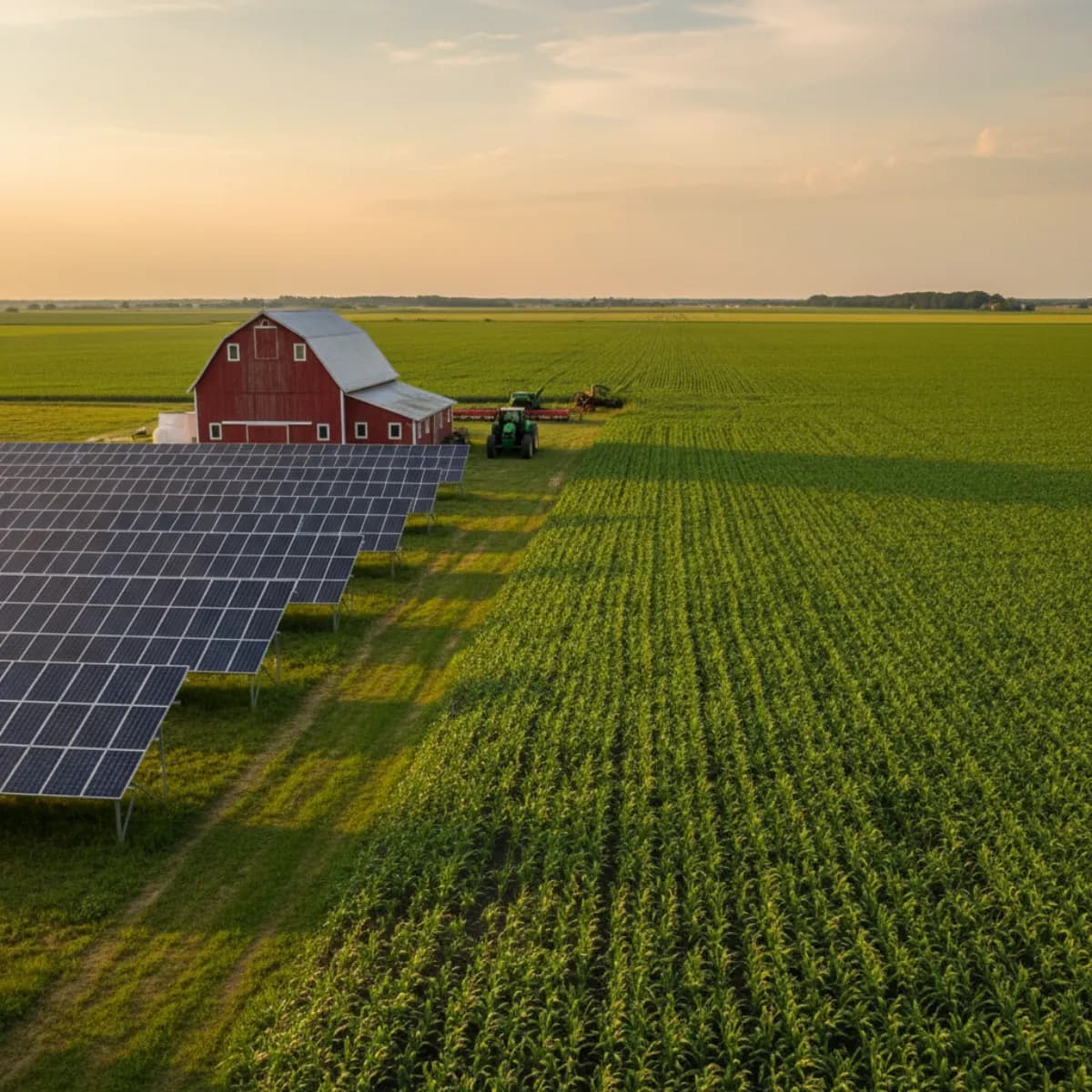
New Jersey farmers can dramatically reduce operating costs with solar — stacking USDA REAP grants (25%), Section 48E ITC (30%), MACRS depreciation, NJ ADI income ($85.00/MWh for 15 years), and net metering to achieve payback in as little as 2-4 years. This guide covers incentive stacking, farm-specific installation considerations, Pinelands restrictions, and case studies for dairy, poultry, equestrian, and vineyard operations.
Up to 25%
USDA REAP Grant
30%+
Section 48E ITC
15 Years
ADI Income
2-4 Years
Typical Payback
Quick Answer
NJ farms can stack USDA REAP grants (25% of cost), Section 48E ITC (30%), MACRS depreciation, and NJ ADI income to offset 70-85% of solar installation costs. A 200 kW dairy farm system can generate over $1.8 million in total value over 25 years including energy savings, incentives, and tax benefits.
Agriculture is energy-intensive. NJ farms spend thousands of dollars annually on electricity for irrigation pumps, refrigeration, ventilation, milking equipment, lighting, and heating. Rising utility rates — NJ commercial rates average $0.14-$0.18/kWh and have increased 30%+ over the past decade — squeeze already-thin farm margins. Solar energy eliminates this variable cost with a fixed, predictable alternative.
But what makes 2026 uniquely compelling for NJ farm solar is the unprecedented stack of incentives available. No other category of solar customer can combine this many programs: USDA REAP grants covering up to 25% of cost, the Section 48E ITC at 30% (with potential adders to 40-50%), MACRS 5-year depreciation with 20% bonus (only available in 2026), NJ ADI income for 15 years, NJ sales tax exemption, NJ property tax exemption, and full retail net metering. When properly stacked, these incentives can reduce the effective cost of a farm solar system by 65-80%, delivering payback in 2-4 years.
The Section 48E ITC requires construction to begin by July 4, 2026. MACRS bonus depreciation drops from 20% to 0% after 2026. USDA REAP funding is competitive and allocated in cycles. The window to maximize all of these incentives simultaneously is narrow. NJ farmers who act in early-to-mid 2026 capture the full value; those who wait risk losing bonus depreciation and potentially REAP funding in their preferred cycle.
Understanding your farm's energy profile is the first step in sizing a solar system. Farms have diverse energy needs that vary by operation type and season:
Irrigation Pumps
15-30 kW per pump, seasonal high demand in summer months
Refrigeration / Cold Storage
10-50 kW continuous, critical for dairy, produce, and wine storage
Ventilation & Fans
5-25 kW per building, critical for poultry and livestock operations
Milking Equipment
15-40 kW per parlor, twice-daily peak loads align with solar
Lighting (Barns & Arenas)
10-50 kW depending on facility size, LED upgrades reduce base load
Equipment Charging
10-30 kW for electric UTVs, forklifts, and equipment, ideal daytime load
NJ farmers have access to more solar incentives than any other customer category. Here is every program available and how they stack together.
Rural Energy for America Program provides grants covering up to 25% of total project cost. Combined REAP grant + loan can cover up to 75%. Applications through USDA Rural Development NJ state office.
Federal Investment Tax Credit for commercial/agricultural solar. Construction must begin by July 4, 2026. Prevailing wage requirements for >1 MW systems. Bonus adders for domestic content (+10%) and energy communities (+10%).
Accelerated depreciation with 20% bonus in 2026. Farm operations with sufficient tax liability benefit significantly. Depreciable basis reduced by half the ITC claimed.
Administratively Determined Incentive provides guaranteed income per MWh produced. Agricultural installations qualify for commercial ADI rates. Paid as Solar Renewable Energy Certificates.
Solar energy equipment is exempt from NJ sales and use tax. On a $400,000 farm solar system, this saves $26,500 at purchase.
Solar installations are exempt from NJ property tax assessment. Farm property tax benefits remain intact.
Agricultural operations net meter against their full electric consumption. Credits at the full retail rate roll over monthly with annual true-up.
Here is how all incentives stack on a real-world scenario: a 200 kW ground-mount + barn-roof system on a NJ dairy farm. Installed cost: $380,000.
| Income Source | Year 1 | Years 2-15 | Years 16-25 | 25-Year Total |
|---|---|---|---|---|
| USDA REAP Grant | $95,000 | $0 | $0 | $95,000 |
| Section 48E ITC | $114,000 | $0 | $0 | $114,000 |
| MACRS Tax Savings | $16,000 | $22,000 | $0 | $38,000 |
| NJ ADI Income | $21,450 | $300,300 | $0 | $321,750 |
| Net Metering Savings | $42,000 | $630,000 | $504,000 | $1,176,000 |
| Property Tax Savings | $3,200 | $48,000 | $35,200 | $86,400 |
| TOTAL | $291,650 | $1,000,300 | $539,200 | $1,831,150 |
* REAP grant reduces ITC basis. MACRS spread over years 1-6. Net metering assumes 3% annual rate increase. Property tax savings based on avoided assessment increase. ADI rates subject to annual adjustment.
Every farm is different. Here is what solar looks like for four common NJ agricultural operations, with system sizing, cost breakdowns, and payback calculations.
Dairy farms have high consistent energy loads that align well with solar production. Bulk tank cooling is the largest single load, and daytime milking schedules overlap peak solar hours.
System Size
200 kW
Installed Cost
$380,000
Net Cost (After Incentives)
$133,000
Payback Period
2.1 years
Incentive Breakdown:
Energy Loads:
Milking equipment, bulk tank cooling, lighting, ventilation, water heating
Mounting:
Barn roof (standing seam metal) + ground-mount in adjacent pasture
Poultry houses have excellent roof geometry for solar — long, narrow metal-roofed buildings with minimal shading. Ventilation is the primary energy load, peaking in summer when solar production is highest.
System Size
150 kW
Installed Cost
$285,000
Net Cost (After Incentives)
$99,750
Payback Period
2.1 years
Incentive Breakdown:
Energy Loads:
Ventilation fans, heating lamps, automated feeders, lighting, egg processing
Mounting:
Poultry house rooftops (long, unobstructed metal roofs ideal for solar)
Equestrian facilities have moderate energy loads but often large roof areas on barns and indoor arenas. Arena lighting for evening lessons and events creates evening demand that can be paired with battery storage.
System Size
75 kW
Installed Cost
$150,000
Net Cost (After Incentives)
$52,500
Payback Period
2.2 years
Incentive Breakdown:
Energy Loads:
Barn lighting, arena lighting, water pumps, heated tack rooms, electric fencing
Mounting:
Barn roof + indoor arena roof
NJ wineries (especially in the Outer Coastal Plain AVA) benefit from solar carport installations that serve dual purposes: energy generation and visitor shade. Refrigeration loads for barrel rooms and cold stabilization peak in summer.
System Size
50 kW
Installed Cost
$105,000
Net Cost (After Incentives)
$36,750
Payback Period
2.3 years
Incentive Breakdown:
Energy Loads:
Refrigeration, barrel rooms, tasting room HVAC, irrigation pumps, bottling equipment
Mounting:
Winery building roof + ground-mount carport over parking area
NJ farms often have both options available — large roof areas on barns, poultry houses, and equipment buildings, plus open land suitable for ground-mount arrays. Each approach has trade-offs that affect cost, production, land use, and farmland assessment status.
Agrivoltaics — combining solar energy production with agricultural activity on the same land — is increasingly supported in NJ. Elevated solar panels allow sheep grazing, pollinator habitat, or shade-tolerant crop production underneath. NJ's dual-use pilot program encourages these installations, and dual-use designs can preserve farmland tax assessment when agricultural activity is maintained on at least 80% of the panel area.
Common NJ agrivoltaic configurations include sheep grazing under elevated ground-mount panels (panels at 8+ feet), pollinator meadow plantings beneath standard-height arrays, shade-tolerant crops (leafy greens, herbs) in inter-row spacing, and beekeeping/apiary operations using pollinator habitat beneath panels. These dual-use approaches can generate additional agricultural income while preserving the farmland character of the property.
The Pinelands Commission regulates development across 1.1 million acres in seven South Jersey counties: Atlantic, Burlington, Camden, Cape May, Cumberland, Gloucester, and Ocean. Many NJ farms — especially in Burlington, Atlantic, and Cumberland counties — fall within Pinelands boundaries. Understanding your Pinelands management area designation is critical before investing in solar planning.
Preservation Area & Forest Area
Solar development is generally prohibited in these most-protected zones. Ground-mount and large roof-mount solar are not permitted.
Agricultural Production Area
Limited solar permitted. Dual-use/agrivoltaic installations may qualify. Standard ground-mount requires Pinelands Commission review and may not be approved. Roof-mount on existing structures is generally permitted.
Regional Growth Area & Pinelands Villages/Towns
Solar development permitted subject to standard Pinelands application, comprehensive management plan compliance, and environmental review.
All ground-mount solar projects on NJ farmland require NJ DEP review for freshwater wetlands, flood hazard areas, threatened and endangered species habitat, and stormwater management. NJ has extensive wetland coverage, and even farms that appear dry may have jurisdictional wetlands. A wetland delineation by a certified professional is typically the first step in the environmental review process. The developer handles this, but delays of 3-6 months for DEP review are common.
The NJ Right to Farm Act (N.J.S.A. 4:1C-1 et seq.) provides important protections for farm solar installations. Agricultural operations have a right to conduct farming activities free from unreasonable local government restrictions. Solar energy production on farmland is increasingly recognized as a protected agricultural activity, particularly for dual-use installations where solar coexists with ongoing farming. Farms facing local zoning opposition to solar should engage an agricultural attorney familiar with Right to Farm protections.
NJ net metering allows farms to offset their entire electric consumption with solar production. When your solar system produces more electricity than your farm uses during sunny hours, the excess is exported to the grid and you receive credits at the full retail electricity rate. Credits roll over month-to-month and are trued up annually in April.
Agricultural operations often have multiple electric meters — main farm operations, barns, irrigation pumps, worker housing, farm stands, and equipment buildings. NJ allows aggregated net metering for accounts at the same property, meaning a single large solar system can offset consumption across multiple meters. This simplifies system design and maximizes economic benefit.
Systems should be sized to offset 100% of annual consumption across all eligible meters. Over- sizing beyond 100% is not recommended because annual true-up credits for excess generation are compensated at a lower avoided-cost rate rather than the full retail rate. Your solar installer will analyze 12 months of bills for all meters to optimize system sizing.
NJ farms served by different utilities (PSE&G, JCP&L, ACE) have slightly different net metering application processes, but the economic treatment is the same. All three NJ utilities provide full retail rate net metering credits for agricultural customers.
Common questions about solar for New Jersey farms and agricultural operations.
The USDA Rural Energy for America Program (REAP) provides grants of up to 25% of the total project cost for renewable energy systems on agricultural operations and rural small businesses. NJ farmers qualify if they are agricultural producers (any size operation generating agricultural income) in eligible rural areas. Most of NJ outside major metro areas qualifies. Applications are submitted through the USDA Rural Development NJ state office, with multiple funding cycles per year. REAP grants are competitive, so early application and strong energy audits improve approval odds.
Yes. NJ farmers can stack USDA REAP grants with the Section 48E ITC, but the ITC is calculated on the net cost after subtracting the REAP grant. For example, on a $380,000 system with a $95,000 REAP grant, the ITC applies to $285,000 (resulting in an $85,500 credit at 30%). You still receive both benefits, and the combined value covers 47% of the installed cost before adding MACRS depreciation and ADI income.
It depends on the installation type. Dual-use (agrivoltaic) installations that maintain agricultural activity on at least 80% of the panel area can preserve the NJ farmland tax assessment. Standard ground-mount solar may cause the leased or installed portion to lose farmland assessment designation, increasing property taxes on that acreage. However, solar income typically far exceeds any tax increase. Roof-mounted solar on farm buildings has no effect on farmland assessment because it does not change land use.
The Pinelands Commission regulates development in the 1.1-million-acre Pinelands National Reserve across seven South Jersey counties. Solar development is generally prohibited in Preservation and Forest Areas. Limited solar is permitted in Agricultural Production Areas (subject to dual-use requirements), and standard solar is allowed in Regional Growth Areas and Pinelands Villages/Towns. Before planning a solar project on Pinelands land, check your parcel designation through the NJ Pinelands Commission mapping tool and consult their application requirements.
The NJ Right to Farm Act (N.J.S.A. 4:1C-1 et seq.) protects agricultural operations from unreasonable local restrictions. Solar energy production on farmland is increasingly recognized as an agricultural activity, especially for dual-use installations. The Right to Farm Act can protect farm solar from restrictive local zoning ordinances, though this area of law is still evolving. Farms should engage an agricultural attorney if facing local opposition to solar installation.
System size depends on your farm energy consumption. Dairy farms with milking equipment, bulk tank cooling, and ventilation typically need 150-250 kW. Poultry operations with ventilation, heating, and automated feeders typically need 100-200 kW. Horse farms with barn lighting, arena lighting, and water pumps typically need 50-100 kW. Vineyards and small specialty farms typically need 30-75 kW. Your solar installer will analyze 12 months of utility bills to size the system to your actual consumption.
Yes, and this is common on NJ farms. Roof-mount solar on barns, equipment sheds, and indoor arenas maximizes existing structures. Ground-mount solar in adjacent fields or pastures provides additional capacity. A hybrid approach often yields the best economics because roof-mount avoids land-use complications while ground-mount allows optimal panel orientation. Ground-mount systems should be designed with agricultural coexistence in mind, whether grazing sheep under panels or maintaining pollinator habitat.
Typical timeline for NJ farm solar: USDA REAP application (2-6 months for approval), system design and engineering (2-4 weeks), local permitting and NJ DEP review (4-12 weeks depending on environmental factors), utility interconnection application (4-12 weeks for PSE&G, JCP&L, or ACE), equipment procurement (4-8 weeks), installation (2-6 weeks depending on system size), and final inspection and PTO (2-4 weeks). Total from decision to power: 6-14 months, with REAP application timing being the variable.
NuWatt specializes in agricultural solar for NJ farms. We handle USDA REAP applications, incentive stacking, permitting, and installation. Free site assessment and financial modeling — no obligation.
Related: Solar Land Lease Guide • Agrivoltaics Guide • Commercial Solar NJ