Loading NuWatt Energy...

We use your location to provide localized solar offers and incentives.
We serve MA, NH, CT, RI, ME, VT, NJ, PA, and TX
Loading NuWatt Energy...
NuWatt designs, installs, and manages solar, battery, heat pump, and EV charger systems across 9 states. One company, one warranty, one point of contact.
Get a Free Quote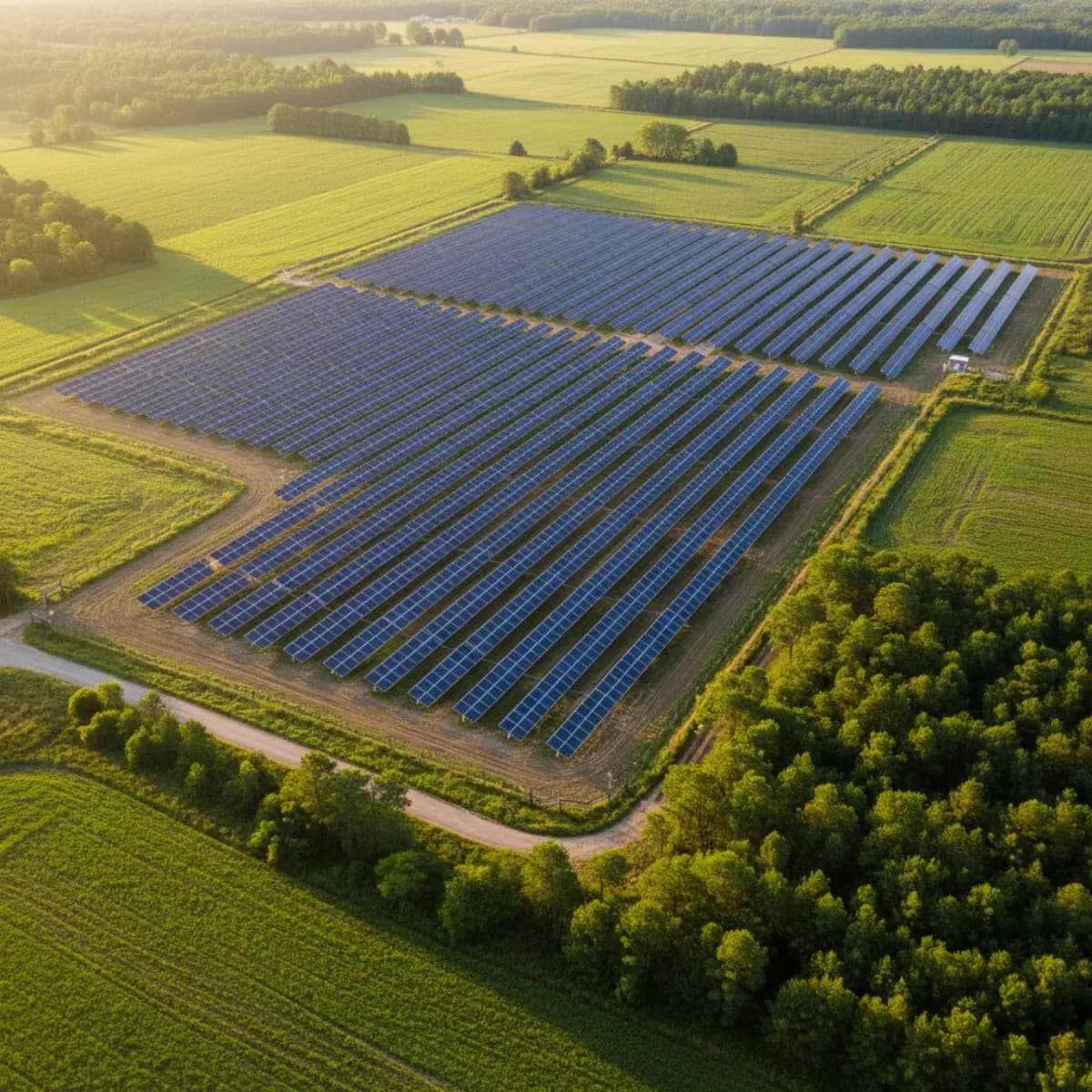
New Jersey landowners can earn $500-$1,000 per acre per year leasing farmland for solar — two to four times more than traditional crop farming, with zero labor and guaranteed escalating payments over 20-25 years. This guide covers lease rates, NJ farmland assessment rules, agrivoltaics regulations, Pinelands restrictions, and how to negotiate the best deal.
$500-$1,000/acre/yr
Typical Lease Rate
20-25 Years
Lease Duration
5-10 Acres
Min. Acreage
Yes
NJ Farm Tax Preserved
Quick Answer
NJ landowners can earn $500-$1,000 per acre per year by leasing farmland for solar development. Lease terms typically run 20-25 years with 1.5-2% annual escalators. NJ farmland assessment tax benefits are preserved for dual-use agrivoltaic installations under state regulations.
A solar land lease is a long-term agreement where a landowner grants a solar developer the right to install, operate, and maintain a solar energy system on their property. The landowner retains ownership of the land and receives guaranteed annual lease payments.
New Jersey is one of the top solar markets in the country, ranked fourth nationally for installed solar capacity. The state's dense population, high electricity rates ($0.17-$0.22/kWh across utilities), strong net metering policies, and ambitious clean energy goals create enormous demand for solar development land. For landowners with 5+ acres of suitable land, solar leasing offers a compelling alternative to traditional agriculture.
The process begins when a solar developer identifies your property as a candidate. They evaluate sun exposure (south-facing, minimal shading), acreage (minimum 5-10 acres for commercial projects), terrain (relatively flat, well-drained), proximity to utility infrastructure (transmission lines, substations), and zoning compatibility. If your land qualifies, they present a lease proposal.
Once terms are agreed, the developer handles all permitting, construction, and ongoing maintenance. Your role as landowner is minimal after lease signing. The developer pays you a fixed annual rate per acre, typically with an escalation clause that increases payments 1.5-2.5% each year. Most NJ solar leases also include a one-time signing bonus of $1,000-$5,000 depending on project size.
Construction typically takes 6-12 months after all permits are secured. The permitting process itself can take 6-18 months in New Jersey due to NJ DEP environmental review, local zoning approvals, and utility interconnection studies. During construction, expect temporary disruption — but once operational, a solar installation requires minimal maintenance and generates no noise, emissions, or traffic.
Utility-Scale Solar (2+ MW):Large installations of 15-50+ acres selling power directly to utilities or through NJ's wholesale electricity market. These projects offer the highest total lease payments due to scale but are limited to areas with sufficient grid capacity. NJ utilities (PSE&G, JCP&L, ACE) have interconnection queues that can delay large projects.
Community Solar (CSEP):Mid-size projects of 2-5 MW (typically 5-15 acres) that subscribe local residents who receive bill credits. NJ's Community Solar Energy Program (CSEP) has allocated significant capacity and created strong demand for land near population centers. CSEP projects may offer slightly higher lease rates because community solar subscribers pay a premium over wholesale electricity prices.
Agrivoltaic/Dual-Use: Projects that combine solar panels with continued agricultural activity — livestock grazing under elevated panels, pollinator habitat beneath standard-height panels, or crop production between rows. NJ encourages dual-use through its farmland assessment preservation rules, making this particularly attractive for landowners who want to maintain their agricultural tax status.
Understanding lease economics is critical before signing any agreement. Here are the key financial terms NJ landowners should expect and negotiate.
$500-$1,000 per acre per year in New Jersey. Rates depend on location, acreage, grid proximity, and sun exposure. South Jersey parcels near PSE&G or ACE transmission lines command the highest rates.
Most NJ solar leases include a 1.5-2.5% annual escalator to keep pace with inflation. Over a 25-year lease, a $750/acre base rate with a 2% escalator yields $1,170/acre in year 25.
Standard terms are 20-25 years with one or two 5-year renewal options. NJ BPU approvals for community solar projects require demonstrating a 20-year minimum operating commitment.
Require the developer to post a decommissioning bond (typically $25,000-$50,000 per MW) to cover equipment removal at lease end. NJ DEP may require this as a permit condition. Do not accept a lease without this provision.
Define access corridors, construction staging areas, and ongoing maintenance access. Restrict developer access to only the leased area. Retain agricultural use rights on unleased portions.
The developer should carry general liability ($2M+), property insurance on equipment, and environmental liability. Your property taxes on leased acreage remain your responsibility unless negotiated otherwise.
A side-by-side comparison of income potential per acre in New Jersey. Solar leasing provides guaranteed income without the weather risk, labor costs, or input expenses of farming.
| Land Use | Income/Acre/Year | Notes |
|---|---|---|
| Field Corn | $150-$300 | Volatile commodity pricing, high input costs |
| Soybeans | $100-$250 | Weather-dependent, tight margins |
| Hay/Alfalfa | $200-$400 | Labor-intensive harvesting |
| Solar Lease | $500-$1,000 | Guaranteed, escalating, zero labor |
| Agrivoltaics (Solar + Grazing) | $600-$1,200 | Dual income: lease + livestock |
New Jersey's Farmland Assessment program provides dramatically lower property taxes for qualifying agricultural land. Without farmland assessment, an acre of land in central NJ might be assessed at $50,000-$150,000 for property tax purposes. With farmland assessment, that same acre is assessed at $100-$500 — a reduction of 99%+. Losing this assessment would be devastating financially, so understanding how solar affects it is critical.
NJ law (P.L. 2021, c.170) allows solar installations on farmland-assessed parcels while preserving the agricultural assessment, provided the installation qualifies as "dual-use." Under NJ rules, dual-use means the land continues to be devoted to agricultural or horticultural use while simultaneously producing solar energy. At least 80% of the area under the solar panels must remain in active agricultural use — including livestock grazing, pollinator habitat, or shade-tolerant crops.
The State Agriculture Development Committee (SADC) oversees dual-use standards. Projects must demonstrate ongoing agricultural activity through annual certification. Grazing sheep under elevated solar panels is the most common dual-use approach in NJ, as it requires minimal labor and the sheep also reduce vegetation maintenance costs for the solar developer.
Standard (non-dual-use) ground-mount solar installations on farmland-assessed land will cause the leased acreage to lose its farmland assessment for property tax purposes. The affected acreage is reclassified at market value. However, for most NJ landowners, the solar lease income far exceeds the additional property tax. Example: 10 acres reclassified at $100,000/acre with a 3% tax rate adds $30,000/year in taxes, but a $750/acre lease on 10 acres generates only $7,500/year — so for standard installations, the math must be done carefully. Dual-use avoids this problem entirely.
New Jersey provides a property tax exemption for the solar energy system itself (N.J.S.A. 54:4-3.113a). This means the solar panels, racking, inverters, and related equipment installed on your property will not increase your property tax assessment. This exemption applies regardless of whether you own the system or a developer owns it under a lease. The exemption covers only the solar equipment — not the underlying land value change if you lose farmland assessment status.
New Jersey's environmental regulations are among the strictest in the nation for land development, including solar projects. Two agencies impose the most significant requirements: the Pinelands Commission and the NJ Department of Environmental Protection (DEP).
The New Jersey Pinelands covers 1.1 million acres across portions of seven counties in southern NJ (Atlantic, Burlington, Camden, Cape May, Cumberland, Gloucester, Ocean). Solar development rules depend on the specific Pinelands management area designation of your parcel:
Preservation Area & Forest Area
Solar development is generally prohibited. These are the most protected zones.
Agricultural Production Area
Limited solar permitted if dual-use/agrivoltaic. Standard ground-mount requires special approval.
Regional Growth Area & Pinelands Villages/Towns
Solar development permitted subject to standard Pinelands application and CMP compliance.
All solar projects on undeveloped land in NJ require NJ DEP review for wetlands, flood hazard areas, threatened and endangered species habitat, and stormwater management. Freshwater wetlands are prevalent throughout NJ, and even small wetland incursions require permits that can take 6-12 months to obtain. The developer typically hires environmental consultants to conduct wetland delineations, threatened species surveys, and stormwater design before submitting permit applications.
Stormwater management is a major consideration. NJ DEP requires that solar projects manage stormwater runoff to pre-development conditions. This typically means designing ground cover (grass, pollinator mix) and grading to prevent erosion and manage water flow. Projects in flood hazard areas face additional restrictions and may not be feasible.
Small Farm
$240,227
25-year total income
10 acres at $750/acre/yr
Year 1 income: $7,500
2% annual escalator
Mid-Size Farm
$640,606
25-year total income
25 acres at $800/acre/yr
Year 1 income: $20,000
2% annual escalator
Large Farm
$1,441,363
25-year total income
50 acres at $900/acre/yr
Year 1 income: $45,000
2% annual escalator
A solar lease is a 20-25 year commitment. Negotiating the right terms upfront protects your financial interests and property rights for decades. Here are the key areas NJ landowners should focus on during negotiations.
Never accept a flat-rate lease without annual escalation. Inflation erodes the purchasing power of fixed payments over 25 years. A $750/acre rate with no escalation is worth $456/acre in today's dollars by year 25 (assuming 2% inflation). Insist on at least 1.5-2% annual escalation, or tie escalation to CPI. Some developers initially propose flat rates — push back.
The lease must require the developer to post a decommissioning bond or establish an escrow fund that covers full equipment removal and land restoration at lease end. Without this, you could be left with thousands of solar panels on your land with no legal or financial recourse for removal. NJ DEP increasingly requires decommissioning plans as a permit condition, but your lease should go further with specific dollar amounts and third-party escrow.
Include a clause allowing lease termination if construction does not begin within 18-24 months of signing. Solar developers sometimes lease land speculatively and sit on it while pursuing permits or financing. Meanwhile, your land is encumbered and you cannot use it. A construction start deadline protects against indefinite tie-ups.
Solar projects frequently change ownership as developers sell completed projects to long-term investors. Your lease should require notice and consent for any assignment, plus a guarantee that the new owner assumes all lease obligations including decommissioning bonds. Include a provision that lease terms survive ownership changes.
Solar leases are complex legal documents drafted by the developer's attorneys. They are written to favor the developer. Hire an attorney experienced in NJ solar land leases — not a general real estate attorney. The cost ($2,000-$5,000 for review) is trivial compared to the 25-year financial impact of unfavorable terms. The NJ Farm Bureau maintains referral lists for attorneys experienced in agricultural solar leases.
New Jersey's Community Solar Energy Program (CSEP) creates a specific and growing demand for land suitable for mid-size solar installations. Community solar allows residents who cannot install rooftop solar — renters, condo owners, those with shaded roofs — to subscribe to a local solar farm and receive credits on their electric bill.
CSEP projects are typically 2-5 MW in capacity and require 5-15 acres of land. Projects must be located in the same utility territory as their subscribers. The NJ Board of Public Utilities (BPU) approves CSEP applications in annual solicitation rounds, evaluating projects on community benefit, low-income subscriber commitment, and environmental impact.
For landowners, community solar projects can offer slightly higher lease rates than utility-scale projects because CSEP projects command premium pricing from subscriber bill credits. The trade-off is a more complex permitting process (BPU approval required) and the project's dependence on maintaining a subscriber base. Developers experienced in NJ CSEP handle subscriber management — the landowner's lease payments are not affected by subscriber enrollment.
Key CSEP requirements for land: proximity to the utility distribution network (not just transmission), location within the utility territory where subscribers reside, environmental compliance, and local zoning approval. Land near suburban areas served by PSE&G is in highest demand due to the large subscriber base in northern and central NJ.
Common questions about solar land leasing in New Jersey.
NJ solar land lease rates typically range from $500 to $1,000 per acre per year, depending on location, acreage, proximity to transmission infrastructure, and solar irradiance. A 20-acre parcel at $750/acre generates $15,000/year in guaranteed income with annual escalators. Over a 25-year lease with 2% escalation, total income exceeds $480,000.
Not necessarily. New Jersey updated its Farmland Assessment Act (N.J.S.A. 54:4-23.1 et seq.) to allow solar installations on qualifying farmland while preserving the agricultural tax assessment. Dual-use (agrivoltaic) installations that maintain agricultural activity on at least 80% of the panel area qualify. Standard ground-mount solar may affect farmland assessment on the leased portion, but the lease income typically far exceeds any tax increase.
Most solar developers require a minimum of 5-10 contiguous acres for a commercial ground-mount solar project in New Jersey. Community solar projects under the NJ Community Solar Energy Program (CSEP) typically need 5+ acres for a viable project. Larger utility-scale installations (2+ MW) prefer 15-30 acres. Smaller parcels (2-5 acres) may qualify for smaller community solar installations.
The Pinelands Commission imposes strict limitations on solar development within the Pinelands National Reserve. Solar installations are generally prohibited in Preservation Areas and Forest Areas. Limited solar development is permitted in Regional Growth Areas and Pinelands Villages/Towns, subject to Pinelands Commission approval and comprehensive management plan compliance. Always check your parcel's Pinelands designation before pursuing a solar lease.
Solar farm development in NJ requires: (1) local zoning and land use approval, (2) NJ DEP environmental review for wetlands, threatened species, and stormwater management, (3) local building and electrical permits, (4) utility interconnection approval from PSE&G, JCP&L, or ACE, (5) NJ BPU registration for community solar projects, and (6) Pinelands Commission approval if in the Pinelands region. The developer typically handles all permitting, but the landowner should understand what is required.
Agrivoltaics (dual-use solar) combines solar energy production with agricultural activity on the same land. In NJ, this includes elevated solar panels with livestock grazing underneath, pollinator-friendly ground cover beneath panels, or crop production between panel rows. NJ encourages agrivoltaics through its dual-use pilot program and farmland assessment preservation rules. Dual-use installations can preserve your farmland tax assessment while generating solar lease income.
NJ CSEP creates additional demand for land near population centers. Community solar projects (typically 2-5 MW) subscribe local residents who receive bill credits. CSEP projects need BPU approval, utility interconnection, and subscriber management. For landowners, CSEP projects may offer slightly higher lease rates because of the premium subscribers pay. NJ has allocated significant capacity to CSEP through 2026.
Key negotiation points: (1) Insist on annual escalators of at least 1.5-2% to protect against inflation. (2) Require a decommissioning bond or escrow for equipment removal. (3) Retain agricultural use rights on unleased portions. (4) Define access corridors and restrict developer access to leased areas only. (5) Include a landowner right to terminate if the developer fails to begin construction within 24 months. (6) Get an independent appraisal before signing. (7) Have an attorney experienced in NJ solar leases review any agreement.
NuWatt helps NJ landowners evaluate their property for solar leasing, negotiate fair terms, and connect with qualified developers. Get a free land assessment — no obligation.
Related: NJ Agrivoltaics Guide • Community Solar CSEP • Commercial Solar NJ