Loading NuWatt Energy...

We use your location to provide localized solar offers and incentives.
We serve MA, NH, CT, RI, ME, VT, NJ, PA, and TX
Loading NuWatt Energy...
NuWatt designs, installs, and manages solar, battery, heat pump, and EV charger systems across 9 states. One company, one warranty, one point of contact.
Get a Free Quote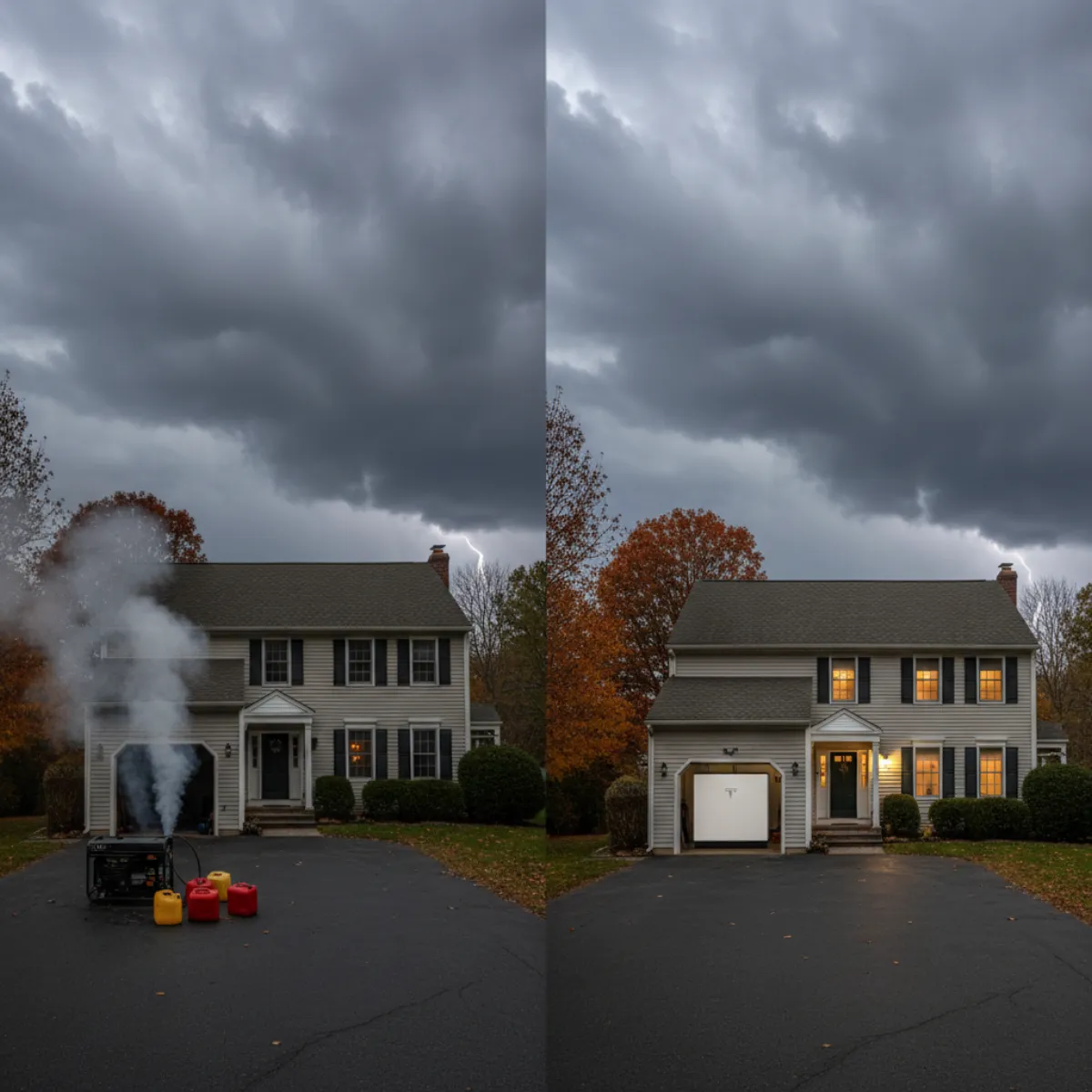
NJ averages 3-5 major outage events per year from nor'easters, coastal storms, and aging infrastructure. Should you install a standby generator or a battery backup? Here's an honest, side-by-side comparison with NJ-specific factors most guides miss.
Quick Answer
For most NJ homeowners, a battery backup is superior to a generator. Batteries auto-activate in under 200ms, produce zero emissions, require no fuel, and generate $200-600 per year in TOU savings. A generator costs less upfront ($3,000-$5,000) but costs more over 10 years when factoring in fuel, maintenance, and lost TOU revenue.
We compared 14 critical factors between a standby generator (22 kW Generac/Kohler) and a home battery system (Tesla Powerwall 3, 13.5 kWh). Battery wins 10 of 14 categories. Generator wins on upfront cost, runtime without solar, whole-home power, and lifespan.
| Feature | Battery Backup | Standby Generator |
|---|---|---|
| Installed Cost Generator is cheaper upfront | $12,000-$18,000 | $5,000-$15,000 |
| Fuel Required No fuel runs, no delivery | None (solar or grid recharges) | Natural gas or propane |
| Activation Speed Critical for sump pumps | <200 milliseconds | 10-30 seconds |
| Noise Level NJ townships have noise ordinances | Silent (0 dB) | 65-75 dB (loud conversation) |
| CO Risk 80+ NJ CO deaths since 2005 | Zero emissions | Carbon monoxide risk |
| Annual Maintenance Oil changes, spark plugs, filters | $0/year | $200-$500/year |
| Runtime (No Power) Generator wins for multi-day | 8-12 hrs (single battery) | Unlimited (with fuel) |
| Runtime (With Solar) Solar recharges battery daily | Indefinite | Unlimited (with fuel) |
| Daily Savings Battery earns money every day | $350-$600/yr TOU savings | $0 — backup only |
| VPP Income Grid services payments | $100-$400/year | $0 |
| Whole-Home Power 22-24 kW generator runs everything | Essential loads or 2 batteries | Full whole-home capable |
| Lifespan Both outlast most NJ homeowners | 15+ years (10-yr warranty) | 20-30 years |
| Permit Required NJ generator permits take 4-8 weeks | Electrical permit only | Electrical + gas + construction |
| Installation Time Generator needs concrete pad + gas line | 1 day | 2-5 days |
National comparison guides don't account for New Jersey's unique conditions: coastal storms, high water tables, dense neighborhoods, strict noise ordinances, and a history of deadly carbon monoxide incidents during outages.
NJ gets 3-5 nor'easters per winter. These storms can knock out power for 1-7 days. A generator has unlimited runtime with fuel, but a solar + battery system recharges daily for indefinite backup. During Sandy, many generators ran out of fuel because gas stations lost power too.
NJ homes have high water tables and rely on sump pumps. A power outage during a storm means no sump pump and potential basement flooding ($5,000-$20,000+ damage). Battery activates in <200ms — before your sump pump misses a cycle. Generators take 10-30 seconds, which can allow water rise.
NJ has had 80+ carbon monoxide deaths since 2005 from improper generator use during outages. Portable generators in garages and basements are the leading cause. Even standby generators produce CO and must be installed 5+ feet from windows. Batteries produce zero emissions.
Most NJ municipalities restrict noise to 65 dB at the property line. A standby generator produces 65-75 dB and may violate local ordinances, especially in densely packed neighborhoods (North Jersey, Shore towns). Batteries are completely silent.
NJ has the densest housing in the US. Standby generators need a concrete pad with 5-foot clearance from structures and require gas line installation. Many NJ lots don't have space for proper generator installation. Wall-mounted batteries fit in a garage or basement.
NJ summers bring pop-up thunderstorms that cause brief 4-24 hour outages. For these common short outages, a single battery provides more than enough power. Running a 22 kW generator for a 4-hour outage wastes fuel and generates unnecessary noise and emissions.
Generators win on upfront cost but lose badly on total cost of ownership. A battery system that saves money daily and earns VPP income has a dramatically lower 10-year net cost than a generator that sits idle 99% of the time.
| Cost Item | Battery | Generator |
|---|---|---|
| Equipment & Installation | $14,000 | $10,000 |
| Fuel (10 years) | $0 | $2,000-$4,000 |
| Maintenance (10 years) | $0 | $3,000-$5,000 |
| TOU Savings (10 years) | -$4,000 | $0 |
| VPP Payments (10 years) | -$2,500 | $0 |
| Net Metering Benefit | -$2,000 | $0 |
| 10-Year Net Cost | $5,500 | $15,000-$19,000 |
After accounting for TOU savings ($4,000), VPP payments ($2,500), and net metering optimization ($2,000), the battery's $14,000 upfront cost drops to just $5,500 net. The generator's $10,000 upfront cost grows to $15,000-$19,000 with fuel and maintenance — and provides zero daily value.
We're not anti-generator. There are specific scenarios where a standby generator is the better choice for NJ homeowners.
Some NJ homeowners install both systems for maximum protection. This hybrid approach uses the battery for instant activation, daily savings, and VPP income, while the generator provides extended whole-home backup during multi-day nor'easters.
This is not hypothetical risk. New Jersey has experienced over 80 carbon monoxide deaths from generator misuse since 2005, with spikes during every major storm event. After Hurricane Sandy, NJ emergency rooms treated hundreds of CO poisoning cases.
For most NJ homeowners, a battery backup is the better choice. Batteries activate instantly (protecting sump pumps), produce zero emissions (no CO risk), are silent (NJ noise ordinances), save money daily through TOU rate optimization, and earn VPP income. The 10-year total cost of ownership for a battery ($5,500 net) is lower than a generator ($15,000-$19,000). Generators only win on upfront cost and whole-home power for multi-day outages without solar.
A whole-home standby generator (22-24 kW, Generac or Kohler) costs $10,000-$15,000 installed in NJ, including the concrete pad, automatic transfer switch, and gas line connection. A smaller 12-16 kW unit for essential loads costs $5,000-$8,000 installed. Add $200-$500/year for maintenance (oil, filters, annual service) plus fuel costs during outages.
A home battery system costs $12,000-$18,000 installed in NJ. The Tesla Powerwall 3 (13.5 kWh) runs $12,000-$15,000. Two batteries for whole-home backup cost $22,000-$28,000. The federal residential tax credit (Section 25D) expired December 31, 2025 — there is no federal credit in 2026. NJ GSESP Phase 2 residential incentives are expected but amounts are not yet published.
A single 13.5 kWh battery can power essential loads (refrigerator, lights, Wi-Fi, phone chargers, sump pump, gas furnace fan) for 8-12 hours. Two batteries (27 kWh) can power a typical NJ home's full load for 6-8 hours. With solar panels recharging during the day, a single battery can run essential loads indefinitely. For full whole-home backup without solar, a 22 kW generator is the better choice.
A battery backup activates in under 200 milliseconds — essentially instantaneous. Your lights won't even flicker. A standby generator takes 10-30 seconds to detect the outage, start the engine, and transfer power. This 10-30 second gap is critical in NJ: your sump pump stops pumping for 10-30 seconds during a storm, which can allow water to rise in your basement.
Permanently installed standby generators (Generac, Kohler) with proper outdoor installation are safe. They must be placed 5+ feet from windows, doors, and vents per NJ building code. The danger comes from portable generators used indoors or in garages — NJ has had 80+ CO-related deaths from improper generator use since 2005. Never run any generator in an enclosed space.
Some NJ homeowners install both: a battery for instant backup and daily TOU savings, plus a smaller generator for extended multi-day outages. This hybrid approach costs more upfront ($18,000-$25,000 total) but provides the best of both worlds: instant battery activation for sump pump protection, plus generator runtime for week-long nor'easter outages.
Natural gas generators rely on continuous gas supply, which typically stays on during electrical outages. Propane generators use on-site tanks (250-500 gallons) and are not affected by gas outages. However, during Hurricane Sandy, some NJ areas lost natural gas service for days. Propane generators ran out of fuel because delivery trucks couldn't operate. Solar + battery has no fuel dependency.
Over 10 years, a battery backup costs $5,500 net vs $15,000-$19,000 for a generator — and protects your sump pump 150x faster. Get a custom battery system design for your NJ home.