Loading NuWatt Energy...

We use your location to provide localized solar offers and incentives.
We serve MA, NH, CT, RI, ME, VT, NJ, PA, and TX
Loading NuWatt Energy...
NuWatt designs, installs, and manages solar, battery, heat pump, and EV charger systems across 9 states. One company, one warranty, one point of contact.
Get a Free Quote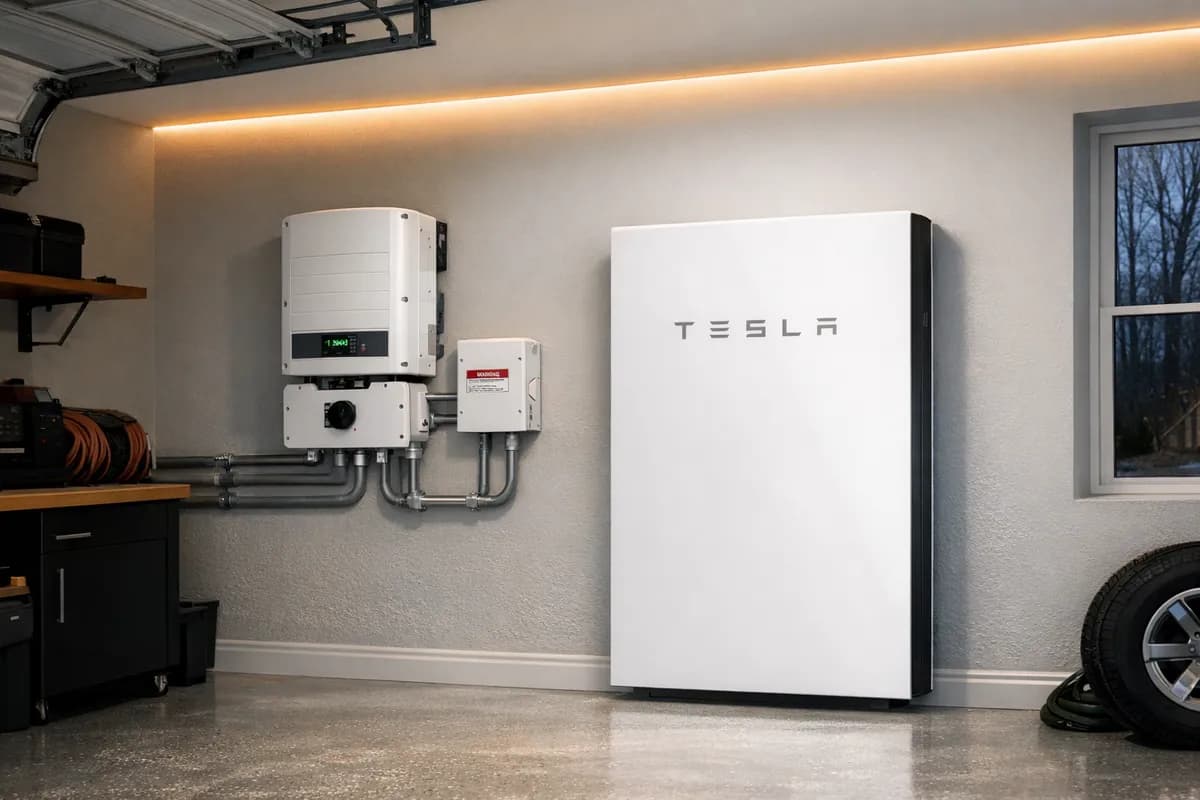
Keep the lights on when the grid goes down. NuWatt installs Tesla Powerwall 3, Enphase IQ, and Franklin aPower2 batteries across New Jersey. Backup power, TOU optimization, and solar+storage systems designed for NJ homeowners.
Battery storage in New Jersey is primarily about backup power and maximizing your solar investment — not demand response programs.
NJ experiences 3-5 significant storms per year. A battery keeps your lights, refrigerator, and sump pump running when the grid goes down.
Some NJ utilities offer time-of-use rates. A battery charges when electricity is cheap and discharges when rates peak, saving $200-$500/year.
Store excess daytime solar production and use it at night instead of drawing from the grid. Batteries increase your solar self-consumption from ~40% to 80%+.
Solar+storage systems qualify for the NJ ADI program ($85.00/MWh for 15 years). The battery does not add to ADI income directly, but paired solar systems earn full incentives.
Homes with solar+battery sell for 4-6% more than comparable homes. In NJ, the added value is 100% property tax exempt.
Unlike Massachusetts and Rhode Island, New Jersey does not have a ConnectedSolutions demand response program. Battery value in NJ comes from backup power, TOU optimization, and solar self-consumption.
Whole-home backup, integrated solar inverter, storm protection.
Scalable storage, pairs with Enphase microinverters, modular expansion.
Automatic whole-home backup, outdoor rated, smart load management.
Federal 25D tax credit is $0 in 2026. Prices include equipment, installation, permits, and monitoring setup.
Battery storage in New Jersey costs $6,000-$14,000 per unit depending on brand and capacity. A Tesla Powerwall 3 (13.5 kWh) runs $12,000-$14,000 installed. An Enphase IQ 5P (5 kWh) costs $6,000-$8,000 per unit. Most NJ homes need 1-3 batteries. The federal Section 25D credit is $0 in 2026.
New Jersey does not currently have a standalone battery storage rebate or a ConnectedSolutions-style demand response program. Solar+storage systems qualify for the ADI/SREC-II program on the solar portion. The primary financial value of a battery in NJ comes from backup power, TOU optimization, and solar self-consumption.
No. The Section 25D residential clean energy tax credit expired December 31, 2025. Batteries purchased with cash or a loan in 2026 receive $0 federal credit.
A battery is not required but adds significant value. Without a battery, solar panels shut off during grid outages. NJ has strong net metering, so financially you can do well with solar alone. A battery makes sense if you want backup power, have TOU rates, or want to maximize solar self-consumption.
A single 13.5 kWh battery typically powers essential loads (lights, fridge, Wi-Fi, sump pump) for 12-24 hours. With solar panels producing during the day, a battery can sustain essential loads indefinitely during sunny conditions.
ConnectedSolutions is a program specific to New England utilities (Eversource, National Grid). NJ utilities (PSE&G, JCP&L, ACE) do not currently offer an equivalent program. Battery value in NJ comes from backup power, TOU savings, and solar self-consumption instead.
Yes. NuWatt installs batteries as retrofits to existing solar systems. If you have Enphase microinverters, adding an Enphase IQ battery is straightforward. For other inverter types, we install a Tesla Powerwall 3 or Franklin aPower2 as AC-coupled storage.
NuWatt installs Tesla Powerwall 3, Enphase IQ Battery 5P, and Franklin aPower2 in New Jersey. All three brands offer whole-home backup, smart load management, and app-based monitoring.
Free consultation to design the right backup system for your home.