Loading NuWatt Energy...

We use your location to provide localized solar offers and incentives.
We serve MA, NH, CT, RI, ME, VT, NJ, PA, and TX
Loading NuWatt Energy...
NuWatt designs, installs, and manages solar, battery, heat pump, and EV charger systems across 9 states. One company, one warranty, one point of contact.
Get a Free Quote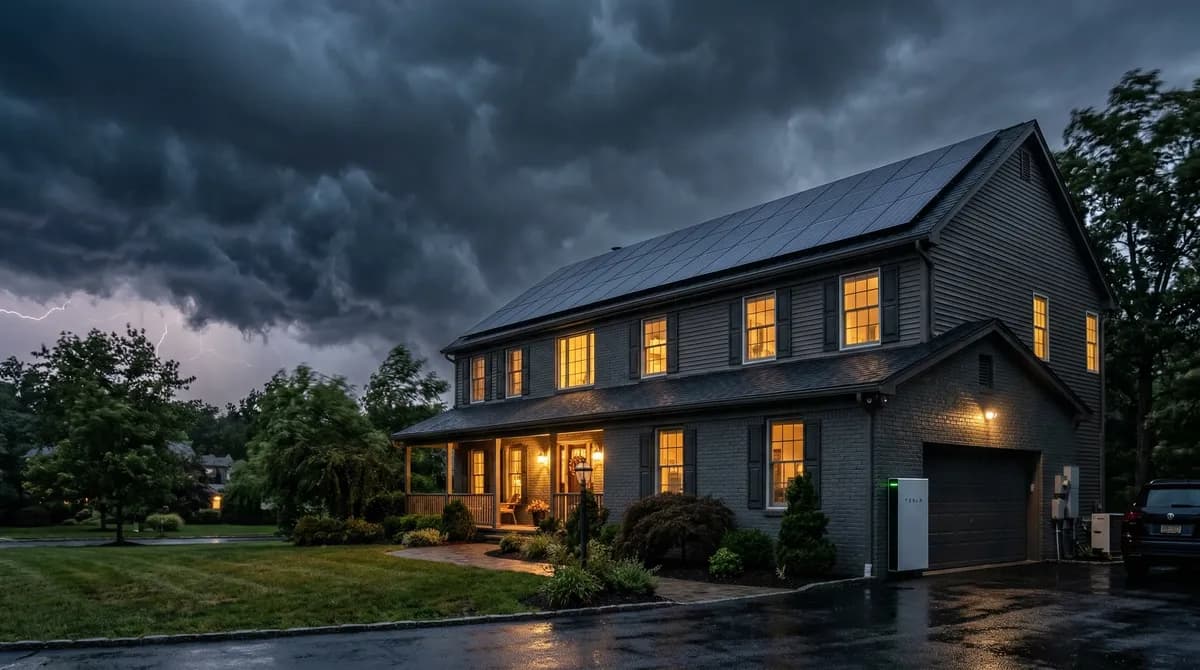
Hurricane Sandy left 2.5 million New Jersey residents without power. Nor'easters knock out power every winter. Solar + battery backup keeps your home running when the grid goes down.
New Jersey is uniquely vulnerable to extended power outages. Coastal storms, aging infrastructure, and high population density create a perfect storm for grid failures.
130 miles of coastline, nor'easters 3-5x per winter, hurricane risk every season. NJ ranks in the top 10 states for storm-related power outages.
PSE&G, JCP&L, and ACE serve 3.6M customers on infrastructure averaging 40+ years old. Tree contact causes 35% of NJ outages.
NJ homes rely heavily on sump pumps. A power outage during a storm means no sump pump — and potential basement flooding costing $5,000-$20,000+.
| Year | Event | Duration | Homes Affected |
|---|---|---|---|
| 2012 | Hurricane Sandy | 1-14 days | 2.5M homes |
| 2018 | March Nor'easter Triple | 1-7 days | 1.8M homes |
| 2021 | Tropical Storm Ida | 1-5 days | 500K homes |
| 2023 | Summer Heat Storms | 4-24 hours | 200K homes |
| 2024 | December Nor'easter | 1-3 days | 350K homes |
Understanding the difference between solar-only and solar + battery is critical. Solar panels alone shut down during grid outages.
Anti-islanding is a safety requirement (IEEE 1547). If panels kept producing power during a grid outage, they would send electricity into downed power lines — endangering utility workers repairing the grid. A battery creates a "microgrid" that safely isolates your home from the grid.
These are the leading residential battery systems available in New Jersey in 2026. All prices are installed cost. The federal Section 25D residential tax credit expired December 31, 2025 — there is no federal credit for residential batteries.
A typical NJ essential load backup requires approximately 11.0kWh per day. Here's the breakdown for common household loads.
| Load | Watts | Hrs/Day | Wh/Day | Essential? |
|---|---|---|---|---|
| Refrigerator | 150 | 24 | 3,600 | |
| LED Lighting (10 bulbs) | 100 | 8 | 800 | |
| Wi-Fi Router | 15 | 24 | 360 | |
| Phone Chargers (4) | 40 | 4 | 160 | |
| Sump Pump | 800 | 2 | 1,600 | |
| Gas Furnace Fan | 500 | 8 | 4,000 | |
| Medical Device (CPAP) | 60 | 8 | 480 | |
| TV / Entertainment | 150 | 6 | 900 | Nice to have |
| Essential Total | 11,000 | 11.0 kWh |
Many NJ homeowners debate between a battery system and a standby generator. Here's an honest comparison.
| Feature | Battery + Solar | Standby Generator |
|---|---|---|
| Upfront Cost | $12,000-$18,000 | $3,000-$8,000 |
| Fuel Required | None (solar recharges) | Natural gas or propane |
| Ongoing Cost | $0/year | $200-$500/year (maintenance + fuel) |
| Activation Time | <200 milliseconds | 10-30 seconds |
| Noise | Silent | 65-75 dB (loud) |
| Emissions | Zero | CO, NOx (carbon monoxide risk) |
| Daily Savings | TOU rate optimization year-round | None — backup only |
| Run Duration | Indefinite with solar | Limited by fuel supply |
| Whole-Home Power | 1-2 batteries for essentials | Full whole-home capable |
| Lifespan | 15+ years, 10-yr warranty | 20-30 years with maintenance |
The federal residential tax credit (Section 25D) expired December 31, 2025. However, NJ is developing state-level battery incentives through the Garden State Energy Storage Program.
Beyond backup, batteries save money every day through time-of-use rate optimization. PSE&G is launching TOU rates (RS-TOU-3P) with estimated $0.08-$0.12/kWh spreads.
The federal residential solar/battery tax credit (Section 25D) expired December 31, 2025. There is no federal credit for residential battery installations in 2026. Commercial properties may still qualify for Section 48/48E credits through the third-party system owner.
Solar panels alone shut down during a grid outage for safety (anti-islanding protection). To use solar during an outage, you need a battery backup system or a hybrid inverter with islanding capability. With solar + battery, your panels charge the battery during the day and the battery powers your home day and night — even when the grid is down.
A home battery system in NJ costs $10,000 to $18,000 installed depending on the model and capacity. The Tesla Powerwall 3 (13.5 kWh) runs $12,000-$15,000. Enphase IQ 5P (5 kWh) starts at $6,000-$8,000 per unit. The federal Section 25D residential tax credit expired December 31, 2025 — there is no federal credit for residential batteries in 2026.
A single 13.5 kWh battery (like Tesla Powerwall 3) powers essential loads (refrigerator, lighting, Wi-Fi, phone chargers, sump pump) for 8-12 hours. With solar panels recharging the battery during daylight, you can run indefinitely — solar charges by day, battery powers by night. Two batteries extend overnight capacity to 16-24+ hours.
Batteries are superior to generators for most NJ homeowners. Batteries: silent, zero emissions, auto-activate in <200ms, no fuel needed, charge from solar, qualify for NJ TOU savings year-round. Generators: require fuel storage, produce CO (carbon monoxide danger), need manual start, louder, require maintenance. Generators are cheaper upfront (~$3,000-$5,000 for whole-home) but batteries pay for themselves through daily TOU optimization.
The Garden State Energy Storage Program (GSESP) is NJ's state initiative to increase battery storage deployment. Phase 1 (approved June 2025) focused on utility-scale and commercial storage with a 2,000 MW target by 2030. Phase 2, expected in 2026, will extend incentives to residential battery systems. Specific incentive amounts have not been published yet.
Yes. Most existing NJ solar systems can retrofit a battery. If you have a string inverter (SolarEdge, Fronius), you'll add an AC-coupled battery like Enphase IQ 5P or Tesla Powerwall 3. If you have Enphase microinverters, the IQ 5P integrates directly. Retrofit typically costs the same as a new install — $10,000-$18,000 depending on battery choice and electrical panel upgrades needed.
NJ basements are particularly vulnerable during nor'easters and hurricanes. A battery backup system can power your sump pump (typically 800W) continuously during an outage. A 13.5 kWh battery can run a sump pump for 16+ hours on battery alone, and indefinitely when solar panels are recharging during the day. This is one of the most valuable battery applications in NJ.
Storm Watch is a Tesla Powerwall feature that automatically charges your battery to 100% when severe weather is forecast for your area. It uses National Weather Service alerts. When a nor'easter or hurricane is approaching NJ, Storm Watch overrides your normal backup reserve setting and tops off the battery so you have maximum stored energy before the storm hits.
NJ averages 3-5 major outage events per year. Solar + battery keeps your home running when the grid fails. Get a custom backup system design for your home.