Loading NuWatt Energy...

We use your location to provide localized solar offers and incentives.
We serve MA, NH, CT, RI, ME, VT, NJ, PA, and TX
Loading NuWatt Energy...
NuWatt designs, installs, and manages solar, battery, heat pump, and EV charger systems across 9 states. One company, one warranty, one point of contact.
Get a Free Quote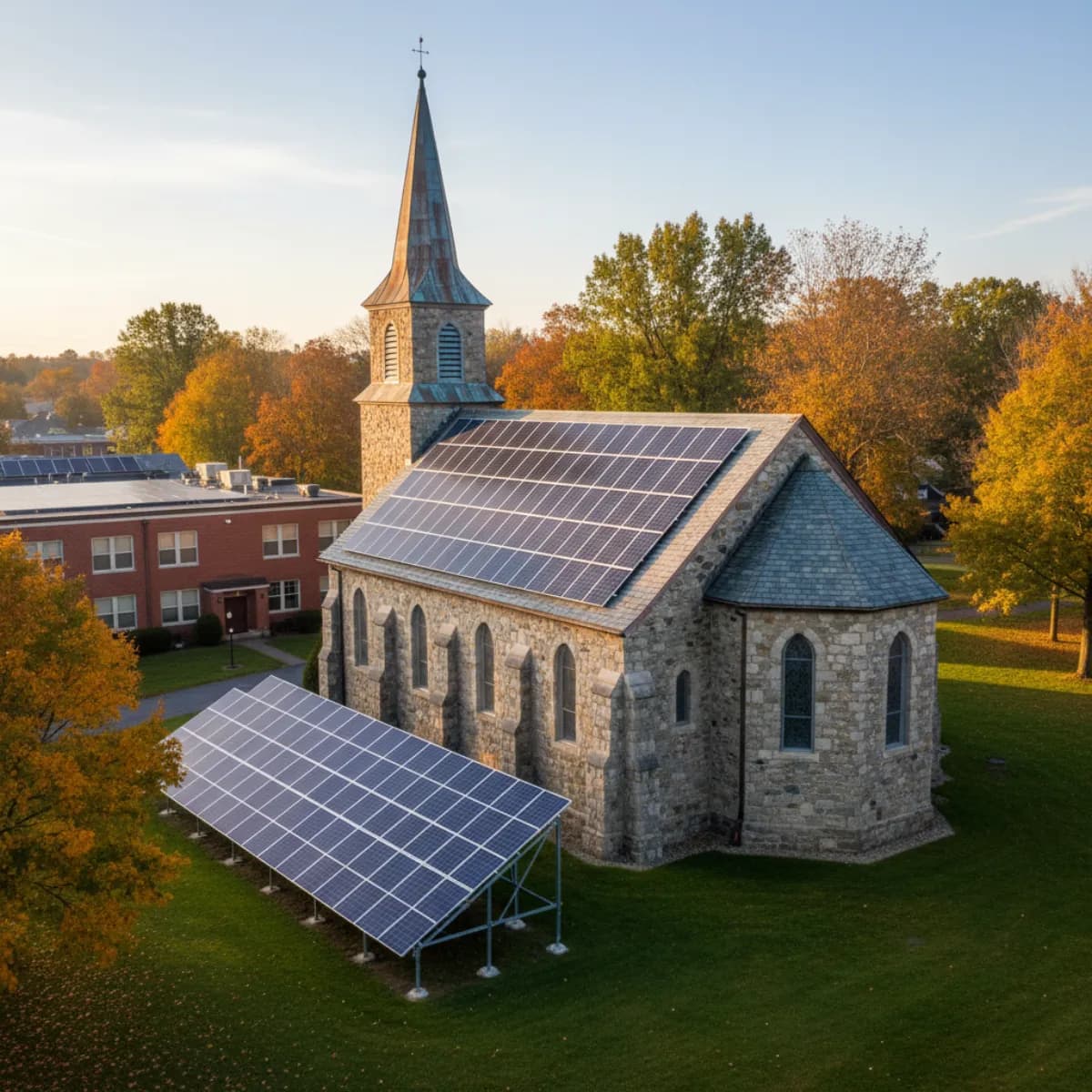
Tax-exempt NJ organizations can now receive the Section 48E ITC as a direct cash payment from the IRS — not a tax credit, but an actual refund. Combined with NJ ADI incentives ($110/MWh for 15 years on non-residential rooftop and carport systems under 1 MW, plus a $20/MWh public-entity bonus for school districts and municipalities), solar is financially transformative for churches, schools, and nonprofits. The begin-construction safe harbor closed July 4, 2026; new starts place in service by December 31, 2027.
Quick Answer
NJ nonprofits, churches, and schools can receive the Section 48E solar tax credit as a direct cash payment — no tax liability needed. The July 4, 2026 begin-construction window has closed; new starts generally must be placed in service by December 31, 2027. Combined with NJ's ADI program — $110/MWh for non-residential rooftop and carport systems under 1 MW, or $130/MWh once a net-metered public entity adds the $20/MWh bonus — tax-exempt organizations can offset 50-70% of installation costs.
For decades, tax-exempt organizations were shut out of solar tax credits because they had no tax liability. The Inflation Reduction Act changed everything with “direct pay” — allowing nonprofits to receive the ITC as a cash refund. The begin-construction safe harbor has now closed, but the credit remains available.
The Section 48E begin-construction window closed July 4, 2026. Projects that began construction on or before that date locked in the full timing pathway; new starts still qualify but generally must be placed in service by December 31, 2027. “Beginning of construction” means incurring 5% of costs or starting physical work. The residential credit (Section 25D) expired December 31, 2025 and is not relevant for commercial/nonprofit installations.
Tax-exempt organizations receive the 30%+ ITC as a cash refund from the IRS. A $300K system means a $90,000+ check. This was previously impossible for nonprofits.
The NJ ADI program pays $110/MWh for non-residential rooftop, carport and canopy systems under 1 MW — the tier nearly every nonprofit project sits in — for 15 years. Net-metered public entities such as school districts and municipalities add a $20/MWh bonus, reaching $130/MWh. Revenue goes directly to whoever owns the system.
NJ exempts solar equipment from sales tax (6.625% savings) and property tax assessment. These two exemptions save NJ nonprofits $15,000-$40,000 on a typical commercial installation.
New Jersey pays net-metered public-entity solar projects an extra $20/MWh on top of their segment rate — a rooftop or canopy array under 1 MW goes from $110/MWh to $130/MWh for 15 years. It is one of the least-marketed numbers in the program, and it turns on a definition that catches organizations out.
Tax-exempt status is not the test. The adder is for projects benefiting a government body, so a nonprofit that is not part of government earns the standard segment rate — still $110/MWh for 15 years, and still stackable with Section 48E direct pay. If you are a municipality, school district, county or authority rather than a private nonprofit, the adder does apply to you and the dedicated guide is municipal and public-entity solar in New Jersey.
Source:NJ BPU, “Order Regarding the One Year Review of the Administratively Determined Incentive Program,” Agenda Item 8C, Docket QO20020184, dated March 6, 2023, effective March 13, 2023. That order adjusted the segment rates and left the $20/MWh public-entity adder unchanged; the April 22, 2026 Board order recites the same non-residential segment rates. Confirm your entity type with the program administrator before relying on the adder in a budget.
Different tax-exempt organizations have different energy profiles, procurement requirements, and financial structures. Here's how solar works for each type.
Large rooftops and parking lots, weekend-heavy usage, congregation fundraising for project, historic building considerations for some properties
Direct ownership with Section 48E direct pay, or PPA for zero-upfront
Large flat roofs (ideal for solar), summer production during low-use months banks net metering credits for winter, educational tie-in for STEM curriculum, public procurement requirements
Direct ownership with Section 48E direct pay for large districts; PPA for smaller districts
Mission alignment with sustainability goals, donor interest in green projects, capital budget constraints, board approval process
PPA for zero-upfront if capital is limited; direct ownership + direct pay if capital available
Public buildings (town halls, libraries, fire stations), public procurement and bidding requirements, long budget cycles, community visibility and climate goals
Direct ownership with Section 48E direct pay; RFP process for large installations
Direct pay is the game-changer for tax-exempt organizations. Instead of a tax credit you can't use (because you don't pay taxes), the IRS sends you a cash payment equal to the credit amount. Here's exactly how the process works.
The base Section 48E credit is 6%, but it increases to 30% if the project meets prevailing wage and apprenticeship requirements (most NJ commercial installers qualify). Additional bonuses of 10-20% are available for projects in energy communities, low-income communities, or domestic content thresholds.
File IRS Form 990-T with elective payment election. Requires EIN and tax-exempt status confirmation. Pre-registration through IRS online portal generates a registration number.
The begin-construction safe harbor — incur 5% of total project costs (e.g., deposit on equipment, engineering fees) OR begin physical work of a significant nature (foundation drilling, roof mount installation) — closed July 4, 2026. New starts still qualify but generally must be placed in service by December 31, 2027.
The IRS continuity requirement means you must make continuous efforts to complete the project. A system started in 2026 must be placed in service by 2030, though most NJ projects complete in 4-8 months.
File IRS Form 990-T (even though you're tax-exempt) with the elective payment election. The IRS issues the direct pay amount as a refund — literally a check or direct deposit to your organization.
Installed cost: $350,000. Section 48E direct pay at 30%: $105,000 cash refund from the IRS. With bonus credits (energy community, domestic content): up to $140,000+ refund. Net cost to the church: $210,000-$245,000. ADI revenue ($11,000/year x 15 years) plus electric savings ($18,000/year) recover the remaining cost in 4-6 years.
Nonprofits have two main pathways to solar: a Power Purchase Agreement (PPA) for zero upfront cost, or direct ownership to maximize long-term savings. With Section 48E direct pay now available, ownership is more attractive than ever for tax-exempt organizations.
| Factor | PPA (Zero Upfront) | Direct Ownership |
|---|---|---|
| Upfront Cost | $0 | $150,000-$500,000+ |
| Section 48E Direct Pay | Goes to PPA provider | Your organization gets 30%+ cash |
| ADI Revenue | Goes to PPA provider | Your organization receives $110/MWh |
| Electricity Savings | 10-30% below utility rate | 100% of savings (after payback) |
| Maintenance Responsibility | PPA provider handles everything | Your responsibility (or O&M contract) |
| System Ownership | PPA provider owns for 20-25 years | You own from day one |
| Annual Escalator | 1-3% annual price increase | None — fixed cost |
| 25-Year Total Value | $80,000-$150,000 savings | $300,000-$600,000 savings + revenue |
If your organization can secure capital (loan, bond, reserve funds, or donor funding), direct ownership with Section 48E direct pay generates 2-4x more long-term value than a PPA. The 30%+ cash refund from the IRS, combined with 15 years of ADI revenue and 100% of electricity savings, makes ownership dramatically more profitable. PPAs are still a good option for organizations that cannot fund the upfront cost and need immediate savings with zero financial risk.
These representative examples show how NJ nonprofits, churches, and schools are using solar to reduce costs and generate revenue.
House of Worship
Congregation voted unanimously. Solar powers sanctuary AC during Sunday services. Parking lot carport provides covered fellowship space.
K-12 Public School
Board approved unanimously. STEM curriculum integration. Summer solar production banks credits for winter heating season. Freed $65,000/year for teacher salaries.
501(c)(3) Nonprofit
Mission-aligned investment. Annual savings redirected to build more homes. Donor appeal increased with visible solar installation on building.
Not every nonprofit can host its own solar system. Small buildings, rented space, shaded roofs, or historic structures may prevent on-site solar. NJ's Community Solar Energy Pilot (CSEP) offers an alternative: subscribe to a community solar project elsewhere in your utility territory and receive bill credits.
Many NJ churches and institutional buildings have historic significance. If your building is listed on the NJ or National Register of Historic Places, solar installation requires additional review — but it's not a deal-breaker.
Section 48E direct pay allows tax-exempt organizations (churches, schools, nonprofits, municipalities) to receive the investment tax credit as a cash refund from the IRS instead of a tax credit. For a $300,000 solar system, a 30% direct pay means the IRS sends your organization a $90,000 check. You must pre-register with the IRS and file Form 990-T to claim the payment. The begin-construction window closed July 4, 2026; projects starting now generally must be placed in service by December 31, 2027.
The begin-construction window closed July 4, 2026; projects placed in service by December 31, 2027 still qualify for the Section 48E investment tax credit (which includes direct pay for tax-exempt organizations). "Beginning of construction" means either incurring 5% of project costs (safe harbor) or starting physical work of a significant nature. For most NJ nonprofits, paying a deposit and signing a contract by early 2026 satisfies the safe harbor requirement.
Yes, through two pathways: (1) Power Purchase Agreement (PPA): a solar developer installs, owns, and maintains the system at no cost. The church buys the electricity at a rate 10-30% below the utility rate. (2) Direct ownership with financing: the church takes a loan, and the Section 48E direct pay (30% cash refund) plus ADI revenue covers a significant portion of the loan payments.
A NJ school district with 400 kW of solar (across multiple buildings) can save $60,000-$80,000 per year in electricity costs. With Section 48E direct pay ($360,000 cash refund on a $1.2M system) plus ADI revenue ($44,000/year for 15 years), the system typically pays for itself in 4-6 years. After payback, the savings flow directly to the school budget — often equivalent to 1-2 teacher salaries.
A Power Purchase Agreement (PPA) is a contract where a solar developer installs and owns the system on your property, and you buy the electricity at a fixed rate (typically 10-30% below your utility rate). PPAs require zero upfront investment but generate less long-term savings than ownership because the developer keeps the Section 48E credit and ADI revenue. PPAs are best for nonprofits with limited capital or complex board approval processes.
Yes. NJ's ADI (Administratively Determined Incentive) program is available to all solar system owners in NJ, including nonprofits. Nonprofit projects fall under the non-residential schedule, and almost all of them are under 1 MW: rooftop, carport and canopy systems under 1 MW earn $110/MWh, ground mount under 1 MW earns $90/MWh, and the lower $100/MWh rooftop rate only applies from 1 MW to 5 MW. Net-metered public entities — school districts and municipalities — add a $20/MWh bonus, for $130/MWh. Payments run 15 years, quarterly. The residential net-metered ADI rate is a separate, lower schedule and does not apply to these organizations. If you use a PPA, the developer (as system owner) receives the ADI revenue, not the nonprofit.
NJ's Community Solar Energy Pilot (CSEP) allows smaller nonprofits that can't host their own solar (e.g., renters, small buildings, shaded roofs) to subscribe to a community solar project and receive bill credits. NJ recently expanded the CSEP to 3,000 MW. Subscribers typically save 10-20% on their electric bill with no installation, no upfront cost, and no long-term commitment.
NJ historic buildings listed on the State or National Register of Historic Places may need approval from the NJ Historic Preservation Office (HPO) before installing solar. This typically involves reviewing panel placement to minimize visual impact from the street. Ground-mount solar or carport installations in the parking lot avoid historic building issues entirely. Most NJ churches are not on the historic register and can proceed with standard permitting.
Your church, school, or nonprofit can receive a 30%+ cash refund from the IRS for solar. The begin-construction window closed July 4, 2026; projects starting now still qualify but generally must be placed in service by December 31, 2027. Get a free site assessment and see your projected savings and direct pay amount.