
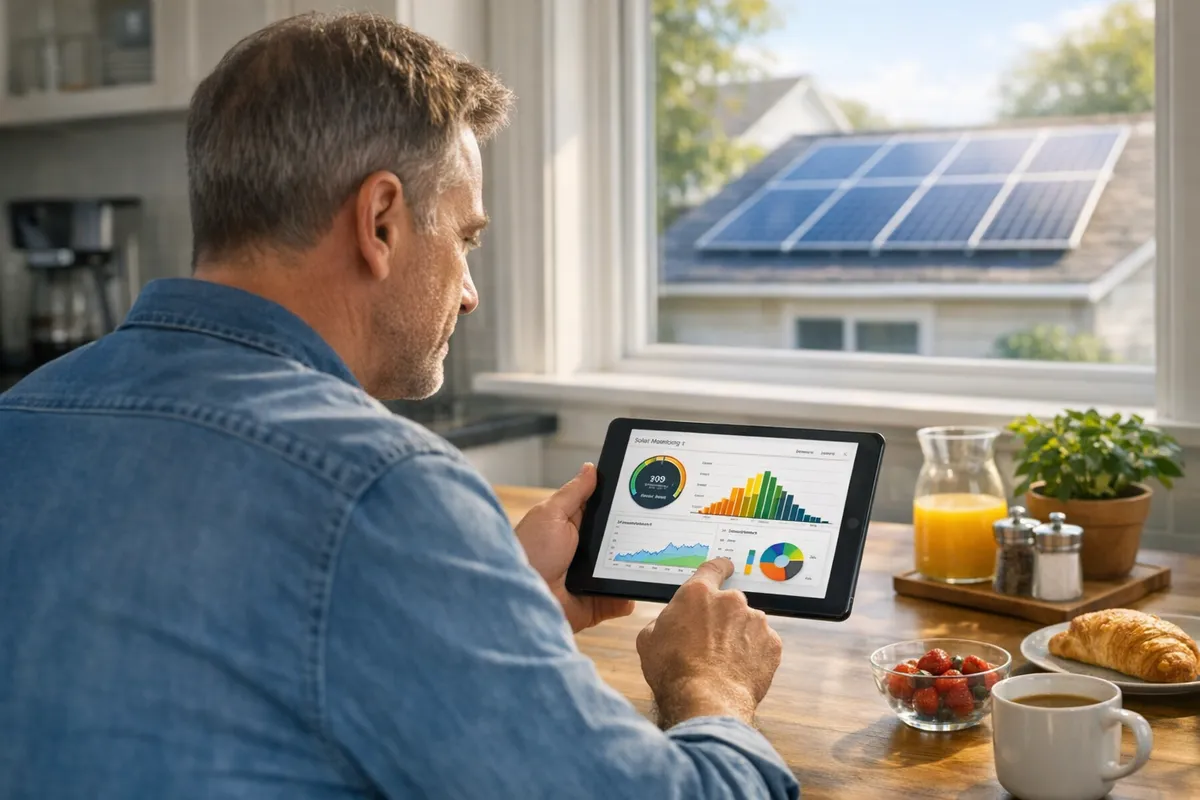
In Rhode Island, solar monitoring isn't just about watching your panels produce electricity. It's a financial tool. With the REG program paying $0.27/kWh for every kilowatt-hour your system generates, ConnectedSolutions earning $225/kW for battery dispatch events, and net metering credits at 80% of retail — your monitoring app is how you verify that you're getting paid correctly for every kWh your system produces.
The three dominant monitoring platforms in the RI residential solar market are Enphase Enlighten (for Enphase microinverter systems), SolarEdge MySolarEdge (for SolarEdge string inverter + optimizer systems), and the Tesla App (for Tesla solar inverter + Powerwall systems). Your monitoring platform is determined by your hardware — you don't choose separately.
Platform Comparison: Enphase vs SolarEdge vs Tesla
| Feature | Enphase | SolarEdge | Tesla |
|---|---|---|---|
| Panel-Level Monitoring | Yes | Yes | No |
| Real-Time Data | Yes (5 min) | Yes (5 min) | Yes |
| Battery Monitoring | Yes | Yes | Yes (best) |
| Data Export (CSV/PDF) | Yes | Yes | No |
| Web Portal | Yes | Yes | No |
| Consumption Tracking | Yes | Yes | Yes |
| Push Alerts | Yes | Yes | Yes |
| App Rating (iOS) | 4.5/5 | 4.3/5 | 4.6/5 |
| Monthly Cost | Free | Free | Free |
| REG Verification | Excellent | Excellent | Adequate |
| ConnectedSolutions | Good | Good | Excellent |
Enphase Enlighten
4.5/5 (iOS) / 4.2/5 (Android)Enphase IQ8 / IQ8+ Microinverters
RI-Specific Monitoring
Strengths
- Panel-level monitoring — identify individual underperformers
- Real-time production and consumption data (updates every 5 minutes)
- Automatic alerts for production drops, communication issues, or panel problems
- Clean, intuitive interface with daily/monthly/yearly graphs
- Energy independence tracking (self-consumption percentage)
- Battery state-of-charge and discharge history for ConnectedSolutions
Weaknesses
- No direct REG payment tracking (production only — payments come separately from RI Energy)
- Android app slightly less polished than iOS
- Occasional communication lag during cloud cover transitions
SolarEdge MySolarEdge
4.3/5 (iOS) / 4.0/5 (Android)SolarEdge HD-Wave / Home Hub Inverter + Power Optimizers
RI-Specific Monitoring
Strengths
- Panel-level optimization via power optimizers — each panel tracked individually
- Excellent power flow visualization (solar → home → grid → battery)
- Strong web portal with exportable CSV/PDF reports for REG documentation
- EV charger integration if using SolarEdge EV charger
- Shade and soiling detection at panel level
- Historical data with year-over-year production comparison
Weaknesses
- Single inverter = single point of failure (unlike distributed Enphase microinverters)
- App can be slower to load with large data sets
- Battery monitoring less detailed than Enphase for charge/discharge cycles
Tesla App (Powerwall + Solar)
4.6/5 (iOS) / 4.4/5 (Android)Tesla Solar Inverter (integrated with Powerwall 3)
RI-Specific Monitoring
Strengths
- Beautiful, intuitive interface — arguably the best-looking solar app
- Excellent Powerwall integration with Storm Watch (auto-charges before severe weather)
- Time-Based Control mode optimizes for self-consumption vs. export
- Real-time power flow animation (solar → home → Powerwall → grid)
- Push notifications for outages, system issues, and Powerwall events
- Vehicle charging integration if you have a Tesla
Weaknesses
- No panel-level monitoring (system-level only — can't identify individual panel problems)
- No web portal — app only (no desktop access for detailed analysis)
- No CSV/PDF export for REG payment documentation (must screenshot or manually record)
- Locked ecosystem — only works with Tesla solar inverter and Powerwall
How to Track REG Payments Using Your Monitoring App
The REG program pays you for every kWh your system produces — $0.27/kWh locked in for 15–20 years. Your monitoring app is the tool that lets you verify RI Energy is paying you correctly. Here's the step-by-step process:
Know Your REG Rate
Your REG contract specifies your locked-in rate (e.g., $0.27/kWh for PY2026). This rate is fixed for your entire 15–20 year term. Your monitoring app shows kWh produced — multiply by your rate for expected REG payment.
Track Monthly Production in Your App
All three apps show monthly kWh production. For an 8 kW RI system, expect 800–1,000 kWh/month in summer and 350–500 kWh/month in winter. At $0.27/kWh, that's $216–$270/month summer, $95–$135/month winter.
Compare App Data to RI Energy Statements
RI Energy sends REG payment statements separately from your electric bill. Compare the kWh on your REG statement to your app's production data for the same period. They should match within 1–2% (meter calibration variance).
Flag Discrepancies Early
If your app shows 950 kWh produced but your REG statement credits you for only 900 kWh, contact RI Energy immediately. Meter errors and communication gaps do occur. Your monitoring data is your proof of production.
Export Data for Records (Enphase/SolarEdge)
Enphase and SolarEdge allow CSV/PDF exports from their web portals. Download monthly production reports and save them. This documentation is valuable for REG audits, home sales, and tax purposes.
Monitoring ConnectedSolutions Battery Events
If you have a battery enrolled in RI Energy's ConnectedSolutions program ($225/kW summer, $50/kW winter), your monitoring app shows exactly when and how your battery participates in demand response events. Here's what to watch for:
| Event Type | What Happens | What You See in App | Earnings |
|---|---|---|---|
| Summer Peak Event | RI Energy signals your battery to discharge during grid peak demand | Battery state-of-charge drops; power flow shows discharge to grid; push notification from app | $225/kW per summer season (e.g., $2,250 for 10 kW battery) |
| Winter Peak Event | Similar to summer but during winter demand peaks | Same battery discharge pattern; may be shorter duration | $50/kW per winter season (e.g., $500 for 10 kW battery) |
| Post-Event Recharge | Battery recharges from solar or grid after dispatch event | Battery state-of-charge climbs back to set level; solar production directed to battery | N/A (operational cost — minimal) |
Troubleshooting Common Monitoring Issues
Production Lower Than Expected
Common Causes:
- --Cloud cover or seasonal variation (winter production is 40–50% of summer in RI)
- --New tree growth or neighboring construction creating shade
- --Snow cover on panels (temporary — usually melts within 1–2 days in RI climate)
- --Dirty panels (coastal salt spray in Narragansett, Newport, Warwick areas)
- --Individual panel failure (check Enphase/SolarEdge panel-level data)
- --Inverter communication error (system may be producing but not reporting)
Action: Compare current month to same month last year. If production is down 15%+ with no obvious cause, contact your installer.
App Shows "Communication Error" or "Offline"
Common Causes:
- --Home Wi-Fi outage or router reset (most common cause)
- --Inverter/gateway firmware update in progress
- --Internet outage (check your ISP)
- --Physical damage to communication gateway
Action: Check Wi-Fi first. Power-cycle the gateway (unplug for 30 seconds). If offline >24 hours, contact installer.
Battery Not Charging or Discharging
Common Causes:
- --Battery at 100% and no demand (normal in high-production periods)
- --ConnectedSolutions event holding battery for upcoming dispatch
- --Temperature protection mode (extreme cold or heat — rare in RI climate)
- --Battery firmware update in progress
Action: Check app for status messages. If no explanation visible, contact installer or battery manufacturer support.
REG Payment Doesn't Match App Production
Common Causes:
- --Meter vs. inverter measurement variance (1–2% is normal)
- --Timing mismatch between billing period and calendar month
- --Meter communication error (utility-side issue)
Action: Export production data and compare to REG statement. Contact RI Energy customer service with documentation if variance exceeds 3%.
Monthly Production Benchmarks for RI
Use these benchmarks to evaluate your system's performance. These are typical ranges for an 8 kW system on a south-facing roof in RI Energy territory:
| Month | Expected kWh | REG Income | NM Value |
|---|---|---|---|
| January | 400–550 | $108–$149 | $93–$128 |
| February | 500–650 | $135–$176 | $116–$151 |
| March | 700–850 | $189–$230 | $163–$197 |
| April | 850–1,000 | $230–$270 | $197–$232 |
| May | 950–1,100 | $257–$297 | $220–$255 |
| June | 1,000–1,150 | $270–$311 | $232–$267 |
| July | 1,000–1,150 | $270–$311 | $232–$267 |
| August | 900–1,050 | $243–$284 | $209–$244 |
| September | 750–900 | $203–$243 | $174–$209 |
| October | 600–750 | $162–$203 | $139–$174 |
| November | 400–550 | $108–$149 | $93–$128 |
| December | 350–500 | $95–$135 | $81–$116 |
| Annual Total | 8,400–10,200 | $2,268–$2,754 | $1,949–$2,368 |
REG income at $0.27/kWh. Net metering value at 80% of $0.29/kWh = $0.232/kWh. Actual production varies by roof orientation, shading, and weather.
The Bottom Line: Which App Is Best for RI?
If you care most about REG payment verification and panel-level diagnostics: Enphase Enlighten or SolarEdge MySolarEdge. Both offer data export, web portals, and panel-level detail that the Tesla app lacks. Enphase is slightly preferred due to microinverter redundancy (one panel failure doesn't affect the rest).
If you care most about battery management and ConnectedSolutions visibility: Tesla App has the best battery interface. The Powerwall 3 integration with Storm Watch and time-based control is excellent. But you sacrifice panel-level monitoring and data export.
The real takeaway: Your monitoring platform is determined by your hardware. If you're still choosing a system, factor monitoring capabilities into your decision — especially if tracking REG payments and having data export matter to you.