Loading NuWatt Energy...

We use your location to provide localized solar offers and incentives.
We serve MA, NH, CT, RI, ME, VT, NJ, PA, and TX
Loading NuWatt Energy...
NuWatt designs, installs, and manages solar, battery, heat pump, and EV charger systems across 9 states. One company, one warranty, one point of contact.
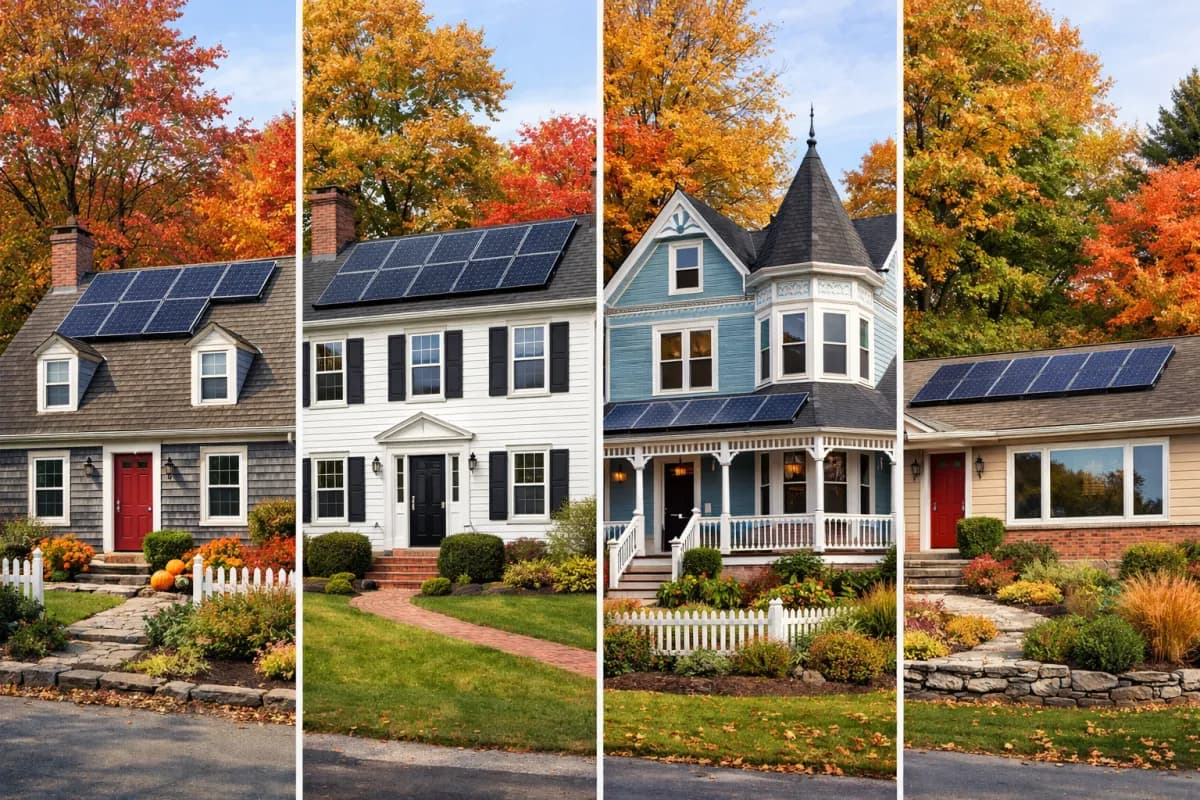
Get a Free QuoteYour home's architecture determines how many panels fit, where they go, and what they cost. Cape Cods, Colonials, Ranches, Victorians, Triple-Deckers — every New England style has a different solar story.
Quick Answer
Colonials and Ranches are the easiest and most cost-effective homes for solar in New England. Cape Cods, Garrisons, and Split-Levels are moderately complex. Victorians and Saltboxes are the most challenging due to complex geometry and limited usable roof area. Triple-deckers are surprisingly good — flat roofs allow optimal tilt racking with zero penetrations. System sizes range from 4 kW (Saltbox) to 15 kW (Triple-Decker) depending on your home's architecture.
Solar companies quote based on watts and panels — but your roof geometry determines what actually fits. Two homes with identical square footage can differ by 50% or more in solar capacity based on architecture alone.
A 2,000 sq ft roof may have only 600 sq ft usable for solar after accounting for dormers, turrets, vents, chimneys, and code setbacks. Colonials use 60-70% of total roof area; Victorians may use only 25-35%.
Optimal pitch for New England (42°N latitude) is 30-35 degrees. Ranches at 15-20 degrees lose 5-8% production. Cape Cods at 45 degrees lose 3-5%. Flat roofs use tilt racks to hit the sweet spot.
Dormers, turrets, and multi-level roofs create shadows that move throughout the day. A single dormer can reduce output of 2-4 panels by 20-40%. Microinverters mitigate this by letting each panel operate independently.
Simple roofs (Colonial, Ranch) cost less to install because they require less engineering, fewer equipment transitions, and shorter labor time. Complex roofs (Victorian, Split-Level) need custom racking and more labor hours.
Victorians, Saltboxes, and older Colonials in historic districts face additional review. Most commissions allow rear-facing panels but may restrict street-visible installations. All-black panels are usually preferred.
Simple roofs with one large south plane can use cost-effective string inverters. Complex roofs with multiple planes at different orientations require microinverters — adding $0.10-$0.20/W to the total system cost.
A quick-reference comparison of how each New England house style performs for solar installations, from system capacity to cost implications.
| House Style | Solar Rating | System Size | Cost Premium | Main Challenge | Snow Shed |
|---|---|---|---|---|---|
| Cape Cod | 3/5 | 4-6 kW | +5-10% | Dormers + limited south face | Excellent |
| Colonial | 5/5 | 8-12+ kW | Baseline | Chimney shading | Good |
| Ranch | 5/5 | 6-10 kW | -5% | Low pitch, tree shading | Fair |
| Victorian | 2/5 | 4-8 kW | +15-25% | Complex geometry + historic rules | Excellent |
| Garrison | 4/5 | 6-9 kW | +5-8% | Overhang conduit routing | Good |
| Split-Level | 3/5 | 6-10 kW | +8-12% | Multi-level shading + wiring | Varies |
| Triple-Decker | 4/5 | 8-15 kW | +10-15% | Ownership allocation | N/A (flat) |
| Saltbox | 2/5 | 4-7 kW | +5-10% | Long north slope unusable | Excellent |
Common in: Cape Cod, MA coast, RI, southern ME • Ideal orientation: South-facing gable end
The quintessential New England home — steep gable roof with dormers and limited south-facing area. Cape Cods present unique challenges because the steep 45-degree roof pitch reduces effective panel area, and dormers create shadows and break up usable space.
Focus panels on the south-facing roof slope, avoiding dormer shadow zones. Use microinverters (not string inverters) to handle partial shading from dormers. If the south face is too small, split the array across south and west slopes. On 1.5-story Capes with a full second-floor dormer shed, the upper roof section above the dormer often provides a clean, unobstructed area.
A 1,400 sq ft Cape in Hyannis, MA with two front dormers: 14 panels (6.2 kW) installed on the south-facing rear roof slope, avoiding the dormer shadows. Enphase IQ8+ microinverters handle the partial shading. Annual production: 7,500 kWh, covering 85% of the household electric bill.
Common in: Throughout New England, suburban neighborhoods • Ideal orientation: South-facing rear roof
The gold standard for residential solar. Colonials feature large, unobstructed rectangular roof planes with moderate pitch (typically 30-35 degrees) — almost perfectly optimized for solar panel layout. The symmetrical design means one entire side of the roof faces south on properly oriented lots.
Fill the entire south-facing roof slope from ridge to eave, leaving code-required setbacks (typically 3 feet from ridge, 18 inches from edges). If the south face alone supports 8+ kW, no need to use other roof planes. For maximum capacity (12+ kW), extend to the west-facing slope. Place panels in landscape orientation for the most efficient use of rectangular roof space.
A 2,200 sq ft Colonial in Lexington, MA: 28 panels (12.3 kW) covering the entire south-facing rear roof. String inverter with two strings. Annual production: 14,800 kWh — fully offsetting a 100% electric household including two heat pumps and an EV charger. Zero production loss from shading.
Common in: Suburban NE, CT, RI, southern NH • Ideal orientation: South-facing long axis
Single-story homes with long, low-pitched roofs that are a solar installer's dream. The ground-level roof access eliminates the need for expensive scaffolding, and the wide roof spans provide ample continuous area. Ranches built in the 1950s-1970s often have the longest uninterrupted roof lines in any residential style.
Orient panels along the long axis of the roof. On low-pitch roofs (under 20 degrees), consider tilt-up mounting brackets to increase the angle by 10-15 degrees — this boosts annual production by 5-8% in New England. Use the south-facing slope as primary, with the option to extend to east or west slopes for larger systems. Keep panels clear of any whole-house exhaust fan vents common in ranch attics.
A 1,600 sq ft Ranch in Warwick, RI: 22 panels (9.7 kW) across the south-facing roof with tilt-up brackets adding 12 degrees to the 18-degree roof pitch. Installation completed in one day (single-story access). Annual production: 11,600 kWh. The tilt brackets added $400 to the project but increased output by 7%.
Common in: Historic districts, Portland ME, Providence RI, Boston neighborhoods • Ideal orientation: Varies — multiple small planes
Beautiful but challenging for solar. Victorians feature complex roof geometry with turrets, dormers, bay windows, ornamental trim, and steep intersecting planes. Every Victorian is unique, which means every solar design is a custom engineering exercise. Historic district regulations add another layer of complexity.
Microinverters are mandatory — no two roof planes will have the same orientation or pitch. Focus on the largest south-facing plane first, then add panels on secondary planes in order of solar exposure. Avoid the street-facing roof to satisfy historic commissions (most allow rear and side installations). Use all-black panels to minimize visual impact. For homes in strict historic districts, consider a ground-mount system in the rear yard.
A Queen Anne Victorian in Portland, ME (historic district): 16 panels (7 kW) split across 4 rear-facing roof planes, approved by the historic review board because they are invisible from the street. Enphase microinverters handle the mixed orientations. A custom flashing kit was needed for the ornamental cornice. Annual production: 8,200 kWh, offsetting 70% of the home's bill.
Common in: MA, NH, CT suburbs (1960s-1980s developments) • Ideal orientation: South-facing upper roof
A distinctive New England style where the second floor overhangs the first by 12-18 inches. This overhang creates a shadow line on the lower wall but, more importantly for solar, it means the roof of the overhanging side is slightly larger than the foundation footprint. The garrison's roof is typically a simple gable, making it more solar-friendly than it first appears.
Treat the garrison like a Colonial for panel layout purposes. Focus on the south-facing roof slope, running panels from the ridge setback to the eave. The slight asymmetry from the overhang is cosmetic and does not meaningfully affect production. Route conduit on the non-street-facing wall to avoid the overhang trim. If the overhang faces south, it actually provides a slightly larger roof area on that side — a minor advantage.
A 1,800 sq ft Garrison in Nashua, NH: 20 panels (8.8 kW) on the south-facing rear roof. The 16-inch second-floor overhang faces north, creating no shading issues for the south array. Conduit routed along the east wall, entering the basement through the foundation. Annual production: 10,500 kWh, covering 90% of the household bill.
Common in: Suburban NE, especially CT, NJ, southern MA • Ideal orientation: Upper level south-facing
Split-levels have multiple roof planes at different heights — typically two or three distinct levels connected by half-flights of stairs. For solar, this means panels at different elevations, complex wiring runs between roof sections, and potential shading from the higher roof casting shadows on the lower sections.
Start with the highest south-facing roof section — it receives the most sun and shades the other sections, not the reverse. Then assess the lower roof sections for additional capacity, running shade analysis to determine which panels lose production during winter months when the sun is low. Use microinverters so each panel operates independently. Bridge conduit between roof levels inside the wall cavity where possible. If the highest section alone supports 6+ kW, consider using only that section for a cleaner, more efficient installation.
A 1,900 sq ft Split-Level in Glastonbury, CT: 18 panels split between the upper level (12 panels, 5.3 kW) and the lower garage roof (6 panels, 2.6 kW). Enphase microinverters handle the independent roof planes. The upper roof shades 2 of the lower panels for about 90 minutes on winter afternoons, reducing those panels' output by approximately 12% during December-January. Total annual production: 9,400 kWh.
Common in: Boston, Worcester, Providence, Lowell, New Bedford, Somerville • Ideal orientation: Flat roof — any direction with tilt racks
The iconic three-family building of urban New England — and increasingly popular for solar. Triple-deckers have flat (or very low-slope) roofs that are ideal for ballasted racking systems requiring zero roof penetrations. The catch: multi-unit ownership means deciding who pays, who benefits, and how to split the credits.
Use ballasted tilt racks at 20-25 degrees facing south. Leave 3-4 foot aisles between rows to prevent row-to-row shading. Typically, a 1,200 sq ft flat roof can accommodate 24-30 panels in this configuration (accounting for the tilt spacing). For ownership, the building owner installs the system and allocates net metering credits across all three meters. In Massachusetts, the SMART 3.0 program allows this allocation through virtual net metering. Consider community solar if unit owners cannot agree on shared investment.
A triple-decker in Somerville, MA: 30 panels (13.2 kW) on a ballasted flat-roof system. The building owner installed the system and allocates net metering credits equally to all three units, reducing each tenant's electric bill by $90-$110/month. The system cost $36,000 after the installer claimed Section 48E ITC through a lease structure. Payback: approximately 7 years at current National Grid rates ($0.32/kWh).
Common in: Historic NE towns, CT, MA, NH (Colonial-era homes and reproductions) • Ideal orientation: Short south-facing slope
Named for its resemblance to a colonial salt container, the saltbox has an asymmetric roof — a short, steep slope on the south (street) side and a long, sweeping slope extending down to the first-floor level on the north side. This means most of the roof area faces north and is essentially useless for solar, while the short south-facing slope has limited capacity.
Maximize every inch of the short south-facing slope. Use high-efficiency panels (440W+) to get maximum wattage from limited space. All-black panels blend better with the traditional aesthetic. If the south slope only supports 4-5 kW and you need more, add a ground-mount array in the yard. The long north slope is a definitive no — even at New England latitudes, a north-facing 30-degree slope produces 40-50% less than south-facing, making it economically unviable.
A restored Saltbox in Old Lyme, CT: 12 panels (5.3 kW) filling the entire short south-facing slope, plus an 8-panel (3.5 kW) ground-mount array in the backyard. Total system: 8.8 kW. The roof portion alone would only cover 55% of the home's usage, but the ground-mount brings total offset to 90%. All-black panels were chosen to complement the historic exterior.
Your inverter choice depends on your roof complexity. Here is what works best for each house style category.
Best for: Colonial, Ranch, Garrison
Homes with one large, unobstructed south-facing roof plane can use string inverters (SolarEdge, Fronius). Lower cost ($0.15-$0.25/W), centralized monitoring, and simpler installation. Works when all panels have the same orientation and shading profile.
Best for: Cape Cod, Victorian, Split-Level, Triple-Decker, Saltbox
Homes with multiple roof planes, dormers, or shading issues need microinverters (Enphase IQ8+). Each panel operates independently, so a shaded panel does not drag down the entire string. Higher cost ($0.25-$0.40/W) but essential for complex roofs.
Solar performance in New England is shaped by snow, coastal weather, and older building stock — factors that interact differently with each house style.
Steep-roofed styles (Cape Cod, Victorian, Saltbox at 40-50 degrees) shed snow quickly, sometimes within hours. This means less winter production loss but also avalanche risk — snow guards are recommended below panel arrays on steep roofs. Low-pitched Ranches may hold snow for days, reducing winter output by 5-10%. Flat triple-decker roofs need manual clearing or rely on ambient heat from below.
Homes within 5 miles of the coast (Cape Cod, RI shore, Maine coast) face salt-spray corrosion. Use stainless steel or marine-grade racking hardware. Black-anodized frames resist salt better than raw aluminum. Annual panel cleaning is recommended for coastal homes. Wind ratings become critical — ensure mounting hardware is rated for your local wind zone (110-150 mph in coastal NE).
Many New England homes are 50-200+ years old. Original roof structures may use non-standard rafter spacing, hand-hewn timbers, or inadequate dimensions for modern panel loads. A structural assessment ($300-$600) is essential for any home built before 1970. Timber-frame Colonials and Saltboxes are typically over-built and handle solar weight easily. Balloon-frame Victorians may need selective reinforcement.
New England has the densest tree canopy in the US. Ranch homes are most affected because their single-story roofs sit below the surrounding tree line. A shade analysis (using tools like Aurora or Suneye) should be conducted between June and August when leaf cover is full. Removing one strategically located tree can increase solar production by 15-25% — and the tree removal cost ($500-$2,000) pays for itself within 2-3 years.
Tell us your address and we will analyze your specific roof geometry, orientation, and shading to design a system that fits your home perfectly.
Get Your Free QuoteColonials and Ranches are the best house styles for solar in New England. Colonials offer large, unobstructed south-facing roof planes with near-optimal 30-35 degree pitch. Ranches provide easy single-story access and long, continuous roof spans. Both styles typically accommodate 8-12 kW systems with minimal design complexity or cost premiums.
Yes, but Cape Cods present challenges. Dormers fragment the usable roof space and create shadows, and the steep 45-degree pitch reduces effective panel area by 15-20%. Most Cape Cods support 4-6 kW systems (10-15 panels). Use microinverters to handle dormer shading, and focus panels on the south-facing slope away from dormer shadow zones. A typical Cape Cod solar installation costs 5-10% more than a Colonial.
Victorians are the most challenging house style for solar due to complex roof geometry with turrets, dormers, and multiple small planes. Microinverters are mandatory because every roof section has a different orientation. Most Victorians support 4-8 kW across 3-5 rear-facing roof planes. Historic district regulations may restrict street-facing installations. Budget 15-25% more than standard installation costs.
Yes, and triple-deckers are actually well-suited for solar. Their flat roofs allow ballasted racking at optimal tilt angles with zero roof penetrations. A typical triple-decker accommodates 8-15 kW (20-38 panels). The main challenge is multi-unit ownership — deciding who pays and who benefits. In Massachusetts, SMART 3.0 virtual net metering allows credit allocation across all three units.
Cost premiums vary by complexity: Victorians add 15-25% due to custom engineering and multiple micro-planes. Split-levels add 8-12% for multi-level wiring. Triple-deckers add 10-15% for ballasted racking systems. Cape Cods and saltboxes add 5-10% for dormer work or ground-mount supplements. Colonials and Ranches have no premium — Ranches actually cost about 5% less due to easier single-story access.
Yes. The optimal roof pitch for solar in New England is 30-35 degrees (matching the 42-degree latitude). Colonials and Garrisons hit this sweet spot. Steep roofs (Cape Cods, Victorians at 40-50 degrees) produce slightly less in summer but more in winter and shed snow better. Low-pitch roofs (Ranches at 15-25 degrees) produce slightly less year-round but can use tilt-up brackets to add 10-15 degrees for a 5-8% production boost.
Usually yes, with restrictions. Most historic commissions allow solar panels on rear and side roof planes that are not visible from the street. All-black panels are typically preferred for visual compatibility. Ground-mount systems in rear yards usually face fewer restrictions. Some states (like MA) have solar access laws that limit how much historic commissions can restrict solar installations. Always check with your local historic commission before signing a contract.
Saltboxes are challenging because the long north-facing slope is unusable, limiting the system to the short south-facing slope (typically 4-5 kW, 10-12 panels). This may only offset 50-60% of your electric bill. The solution: supplement with a ground-mount array in the yard. Combined roof and ground systems can reach 8-9 kW and offset 85-90% of usage. Use high-wattage panels (440W+) to maximize the limited roof space.