Loading NuWatt Energy...

We use your location to provide localized solar offers and incentives.
We serve MA, NH, CT, RI, ME, VT, NJ, PA, and TX
Loading NuWatt Energy...
NuWatt designs, installs, and manages solar, battery, heat pump, and EV charger systems across 9 states. One company, one warranty, one point of contact.
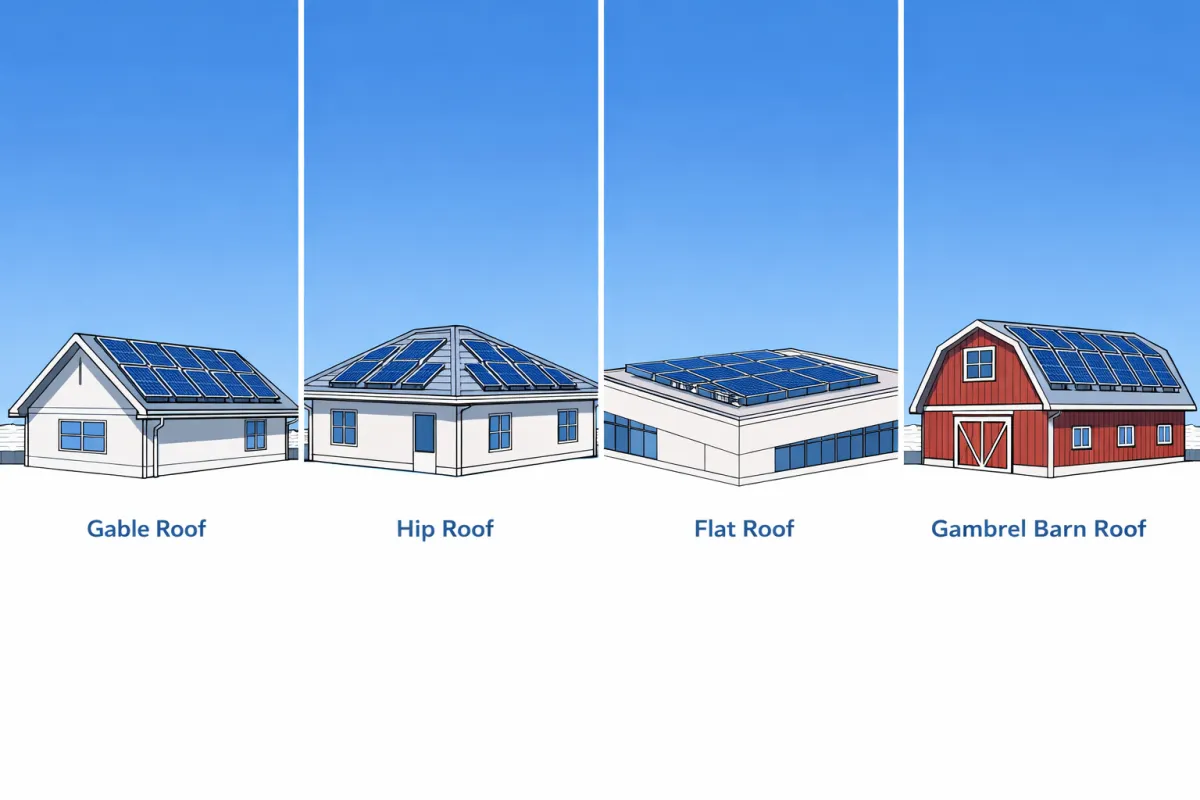
Get a Free QuoteYour roof shape determines how panels mount, how many fit, and what they cost. Gable, hip, flat, gambrel, mansard, shed, and metal standing seam — every type has a different solar equation.
Quick Answer
Metal standing seam and south-facing gable roofs are the best for solar — simple mounting, high capacity, and lowest cost. Hip and flat roofs are strong options with minor premiums. Gambrel and shed roofs work with limitations. Mansard roofs have the least solar capacity. Three roof types allow zero-penetration mounting: flat (ballasted), mansard (ballasted top), and metal standing seam (clamp). System sizes range from 3 kW (mansard) to 15+ kW (flat).
Solar companies talk about panels and inverters, but your roof is the foundation of the entire system. Its shape, pitch, material, and condition determine everything from mounting method to long-term leak risk.
Different roofs require different mounting hardware. Lag bolts into rafters for shingles, S-5 clamps for metal standing seam, ballasted blocks for flat roofs. The wrong method risks leaks, structural damage, or voided warranties.
A 1,500 sq ft gable roof may have 700 sq ft usable for solar. The same footprint as a hip roof: 550 sq ft. As a mansard: 350 sq ft. Roof geometry directly caps your maximum system size.
The ideal solar tilt for New England is 30-35 degrees. Gable and gambrel lower slopes naturally hit this range. Flat roofs use tilt racks to achieve it. Steep cape and victorian roofs exceed it by 10-15 degrees, losing some summer production.
Every roof penetration is a potential leak point. Metal standing seam clamps and flat-roof ballasted systems eliminate this risk entirely. Asphalt-shingle lag bolt installations rely on flashing quality — choose an installer with a strong workmanship warranty.
Simple gable roofs are the cost baseline. Complex hips add 5-8%. Ballasted flat-roof systems add 10-15%. Mansard installations add 15-20%. Metal standing seam can actually be cheaper because clamp mounting is faster than drilling.
Solar panels last 25-30 years. Your roof should outlast them. Asphalt shingles (20-30 years) need timing coordination. Metal standing seam (50+ years) eliminates the issue. Never install solar on a roof with less than 10 years remaining.
A side-by-side comparison of solar performance across every common roof type, from mounting method to cost impact.
| Roof Type | Rating | Capacity | Mounting | Penetrations | Cost Impact | Best For |
|---|---|---|---|---|---|---|
| Gable | 5/5 | 6-12+ kW | Rail mount (lag bolts) | Yes | Baseline | Most NE homes |
| Hip | 4/5 | 5-10 kW | Rail mount (multi-plane) | Yes | +5-8% | Coastal/wind-prone areas |
| Flat | 4/5 | 8-15 kW | Ballasted tilt racks | None | +10-15% | Triple-deckers, commercial |
| Gambrel | 3/5 | 5-9 kW | Rail mount (lower slope) | Yes | +5-10% | Farmhouses, barn homes |
| Mansard | 2/5 | 3-6 kW | Ballasted on flat top | None | +15-20% | Urban historic buildings |
| Shed | 3/5 | 3-8 kW | Rail mount (if south) | Yes | Varies | South-facing additions |
| Metal Standing Seam | 5/5 | 6-12+ kW | S-5 clamps (no drill) | None | -5 to +5% | New builds, renovations |
Common on: Colonials, Capes, Ranches, Garrisons — the most common NE roof • Mounting: Standard rail mount with lag bolts into rafters
The gable roof is the most common roof type in New England and the most solar-friendly. Two large rectangular planes slope from a central ridge, creating expansive areas for panel placement. On properly oriented lots, one entire slope faces south — providing a single, unobstructed plane that can accommodate large arrays with minimal design complexity.
Standard flush-mount racking using rail systems (IronRidge, Unirac) attached to the roof with lag bolts into rafters. Flashing boots seal each penetration point. Rail spacing matches rafter spacing (typically 16 or 24 inches on center). Panels mount in landscape or portrait orientation depending on rafter layout. This is the simplest, lowest-cost mounting method in residential solar.
Gable roofs are the baseline for solar pricing — no premium. Average installation on a gable roof in New England costs $2.80-$3.20/W. The simple geometry means fewer labor hours, standard racking, and minimal engineering. If your gable faces south, expect the fastest installation timeline (typically 1 day for systems under 10 kW).
New England gable roofs typically have 25-35 degree pitch, which is near-optimal for solar at 42°N latitude. Steeper gables (35-45 degrees, common on Cape Cods) shed snow faster but reduce summer production slightly. Asphalt shingle gable roofs should ideally have 10+ years of life remaining before solar installation to avoid the cost of removing and reinstalling panels during a re-roof.
Common on: Mid-century homes, some Ranches, Craftsman bungalows • Mounting: Standard rail mount, often on multiple planes
A hip roof has four sloping sides that all meet at the top, with no vertical gable walls. Each side is a trapezoid (or triangle), which means less usable area per plane than a gable but more orientation options. Hip roofs are inherently stronger than gables (better wind resistance) and are becoming more common in new construction, especially in coastal areas.
Same rail-mount system as gable roofs, but panels are typically placed on 2-3 slopes to maximize capacity. The south-facing hip is the primary target, with east and west hips as secondary options. The triangular shape of each hip means panels near the top are shorter rows (fewer panels) while bottom rows are longer. This creates a stepped or tapered panel layout that requires more rails and connectors per watt than a rectangular gable layout.
Expect a 5-8% premium over a gable installation. The additional cost comes from: more racking hardware to cover multiple planes, microinverters instead of string inverters (for mixed orientations), and additional labor time for transitioning between roof sections. A 8 kW hip-roof system in New England typically costs $3.00-$3.45/W.
Hip roofs perform well in New England coastal areas because they resist hurricane-force winds better than gables. The multi-directional slopes also produce more consistent daily output — east and west hips capture morning and afternoon sun respectively, which can be advantageous for time-of-use rate optimization. Snow sheds off all four sides, but accumulation in valleys between hips can persist longer.
Common on: Triple-deckers, urban row houses, commercial buildings, modern homes • Mounting: Ballasted tilt racks (no roof penetrations) or mechanically attached
Flat roofs (technically low-slope, 1-3 degrees) are common on triple-deckers, urban row houses, and commercial buildings throughout New England. They are excellent for solar because the installer chooses the tilt angle and orientation — the roof itself imposes no constraints. Ballasted systems use concrete blocks to hold panels in place with zero roof penetrations, preserving the waterproof membrane.
Ballasted racking systems (e.g., Unirac RM, IronRidge BX) use pre-cast concrete blocks or aggregate-filled trays to anchor tilted panel rows to the roof surface. No roof penetrations needed — the system weight holds everything in place. Panels are typically set at 20-25 degree tilt facing south, with 3-4 foot aisles between rows to prevent row-to-row shading. Alternatively, mechanically attached systems bolt through the membrane into the roof structure and are sealed with pitch pans. Mechanical attachment is used when ballast weight exceeds roof load capacity or in high-wind zones.
Ballasted systems cost 10-15% more than standard roof-mount due to the racking hardware and concrete blocks. A typical flat-roof system in New England costs $3.10-$3.60/W. However, the ability to optimize tilt and orientation means flat-roof systems often produce 5-10% more energy per panel than fixed-pitch roof-mount systems — partially offsetting the higher installation cost with better ROI.
New England flat roofs face unique challenges: heavy snow loads (up to 50 PSF design load in northern areas) require extra structural margin beyond the ballast weight. EPDM rubber membrane roofs — extremely common on NE triple-deckers — have a 20-30 year lifespan and should be assessed before solar installation. If the membrane has less than 10 years of life remaining, replace it first. The cost of removing and reinstalling a ballasted solar system during a re-roof is $2,000-$4,000.
Common on: Farmhouses, barn conversions, Dutch Colonial homes — common in rural NE • Mounting: Standard rail mount on lower slope; upper slope usually too steep
The gambrel roof has two slopes on each side: a steep upper slope (60-70 degrees) and a gentler lower slope (25-35 degrees). The lower slope is ideal for solar — it has good pitch and provides a wide, continuous area. The upper slope is generally too steep for standard panel mounting and produces poorly due to the extreme angle. This makes the gambrel a partial-utilization roof for solar.
Standard rail-mount on the lower slope section only. The transition point between upper and lower slopes (the "knee") acts as a natural setback line. Panels mount on the lower slope from the knee down to the eave, typically in landscape orientation. The upper slope is avoided: at 60-70 degrees, panels would barely produce in summer and the steep angle makes safe installation difficult. Some installers place 1-2 rows on the upper slope if the lower slope alone is insufficient, but this is rare and requires specialized steep-slope safety equipment.
Expect a 5-10% premium over a standard gable installation. The additional cost comes from working around the slope transition and potential need for longer conduit runs. A gambrel system in New England typically costs $2.95-$3.40/W. The limited usable area means system sizes max out at about 9 kW for most residential gambrels — sufficient for smaller to mid-sized homes but may not fully offset high-usage households.
Gambrel roofs are especially common in rural New England — converted barns, farmhouses, and Dutch Colonial reproductions. Many have excellent south-facing exposure with minimal tree shading (cleared agricultural land). The barn-style construction often features oversized timbers that easily support solar panel loads. For barn conversions, verify that the building has been properly permitted and has adequate electrical service (100A minimum) before planning a solar installation.
Common on: Second Empire Victorian homes, some urban brownstones, commercial buildings • Mounting: Flat upper section only; vertical lower walls unusable for standard mount
The mansard roof features a nearly vertical lower slope on all four sides (often containing dormer windows) and a flat or very low-slope upper section. For solar, the vertical lower portions are unusable — panels need at least 15 degrees of tilt to produce efficiently, and mounting on near-vertical surfaces creates structural challenges. The flat upper section works, but it is typically small (30-40% of the total roof footprint).
Ballasted or flush-mount racking on the flat upper section only, similar to a flat-roof installation. If the upper section has a slight slope, standard rail-mount works. The vertical mansard walls are not candidates for standard solar mounting — the near-90-degree angle would produce only 40-50% of optimal output and require custom brackets. Some commercial mansard roofs have larger flat sections that can accommodate substantial arrays, but residential mansards are typically limited to 10-15 panels on the upper portion.
Mansard installations carry a 15-20% premium due to limited usable area requiring maximum optimization, potential ballasted racking on the flat upper section, and access complexity. Expect $3.30-$3.80/W for a mansard system in New England. The small system size (3-6 kW) means mansard solar often covers only 40-60% of household usage — consider supplementing with a ground-mount system if yard space permits.
Mansard roofs are found primarily in urban areas — Boston's Back Bay, Providence's East Side, Portland's West End — where they are frequently in historic districts. The good news: most historic commissions cannot see the flat upper section from the street, making approval straightforward. The challenge: these urban locations often have adjacent buildings that shade the upper roof. Conduct a thorough shade analysis before committing. Some NE mansard buildings have had their flat upper sections replaced with rubber membranes, which are compatible with ballasted solar racking.
Common on: Home additions, modern builds, garages, porches, passive solar homes • Mounting: Standard rail mount — orientation is make-or-break
A shed roof is a single slope — one plane tilting in one direction. This is the simplest possible roof geometry, but its solar performance depends entirely on which way it faces. A south-facing shed roof is a solar dream: one large, unobstructed plane at a consistent pitch. A north-facing shed roof is essentially useless for solar. East or west orientations produce 15-20% less than south but can still be viable.
Standard flush-mount racking on south, east, or west-facing shed roofs. Identical to gable-roof mounting but with the entire roof surface available (no "wrong side"). For north-facing sheds, the only option is reverse-tilt mounting — brackets that tilt panels away from the roof surface to face south — but this is expensive, reduces the number of panels that fit, and creates wind-load issues. In most cases, a north-facing shed roof is a non-starter for rooftop solar; consider a ground-mount alternative.
A south-facing shed roof costs the same as a gable installation ($2.80-$3.20/W) since the mounting is identical. East or west-facing sheds cost the same to install but produce less energy, so the effective cost per kWh is 15-20% higher. North-facing sheds requiring reverse-tilt add 15-20% to installation cost and are generally not recommended. Many shed roofs are on home additions or garages with limited area, capping system size at 3-5 kW.
Passive solar homes built in the 1970s-1980s (common in VT, NH, rural MA) often have large south-facing shed roofs specifically designed to capture solar heat. These are perfect for photovoltaic panels — proper orientation, generous tilt, and substantial area. Modern new construction in NE is increasingly using shed roofs on additions or as part of contemporary designs. For older shed-roofed additions, verify the rafter sizing — many were built with 2x6 rafters that may need evaluation for panel loads.
Common on: New construction, renovated farmhouses, modern builds, green homes • Mounting: S-5 clamps on seams — zero roof penetrations
Metal standing seam roofs are the premium solar substrate. The raised seams that run vertically from ridge to eave are perfect anchor points for S-5 clamps — no drilling, no penetrations, no leak risk. A 50-year metal roof paired with 25-year solar panels means one installation that lasts a generation. Metal roofs also run cooler than asphalt shingles, which slightly boosts solar panel efficiency in summer.
S-5 clamps (S-5! brand, or compatible) grip the standing seams without penetrating the metal. Rails attach to the clamps, and panels mount to the rails — the same rail system used on any roof, but with a faster, cleaner attachment method. No sealant, no flashing boots, no lag bolts. Installation is typically 20-30% faster than asphalt-shingle mounting because there is no drilling, no waterproofing, and no rafter-locating needed. The clamps are rated for high wind loads and can be repositioned if needed.
The solar installation itself costs about the same or slightly less than asphalt-shingle mounting ($2.75-$3.15/W) because the clamp system eliminates drilling and waterproofing labor. However, the metal roof itself is a significant upfront investment ($12-$18/sq ft vs. $4-$7/sq ft for asphalt). The combined value proposition: if you need a new roof AND solar, doing both simultaneously saves $3,000-$5,000 vs. doing them separately, and the 50-year metal roof means you never pay to remove and reinstall panels for a re-roof.
Metal standing seam is increasingly popular in New England, especially in northern areas (NH, VT, ME) where heavy snow loads benefit from metal's shedding characteristics. Snow avalanches off metal roofs quickly — install snow guards below panel arrays to prevent dangerous sheet slides. In coastal areas, specify marine-grade or Galvalume metal panels to resist salt corrosion. The combination of metal roof + solar is becoming the standard recommendation for new construction and major renovations in NE, particularly for homeowners planning 20+ year occupancy.
Solar panels last 25-30 years. Your roof needs to outlast them — or you will pay $2,000-$5,000 to remove and reinstall the panels during a future re-roof.
Typical lifespan: 20-30 years
Replace if less than 10 years remain
Most common NE roof material. 3-tab lasts 20 yrs; architectural lasts 30 yrs. Check for curling, granule loss, and daylight visible from attic.
Typical lifespan: 50+ years
Ideal — install solar immediately
The perfect solar substrate. 50-year lifespan means you never re-roof during the panel lifetime. S-5 clamp mounting preserves the metal surface.
Typical lifespan: 20-30 years
Replace if less than 10 years remain
EPDM rubber is extremely common on NE triple-deckers. Check for bubbling, seam separation, and ponding. A new TPO membrane + ballasted solar is the recommended combination.
If you need a new roof AND solar panels, doing both simultaneously saves $3,000-$5,000 compared to separate projects. The solar installer can coordinate with a roofing contractor (or handle both in-house) to lay the new roof, immediately install the solar mounting hardware while the crew is already on the roof, and complete the panel installation. This avoids double mobilization costs, double permit fees, and the risk of damaging a new roof to install solar later. Ask about our solar + reroof bundles.
Worried about roof leaks? Three roof types allow solar installation with absolutely zero holes drilled in your roof.
Concrete blocks hold tilted panel racks in place by weight alone. No bolts, no drilling, no sealant. The system can be completely removed without any roof damage. Standard on triple-deckers and commercial buildings.
Added load: 8-12 PSF added load
Engineered clamps grip the raised seams of standing seam metal roofs. No holes, no sealant, no interference with the metal panels. The clamp design actually strengthens the seam connection. Repositionable if panel layout changes.
Added load: Panel weight only (2.5-3 PSF)
The flat upper section of a mansard roof works exactly like a flat-roof installation. Ballasted racks sit on the surface with no penetrations. Limited area (3-6 kW typical) but completely non-invasive. Invisible from street level.
Added load: 8-12 PSF added load
Tell us your address and we will analyze your specific roof type, pitch, orientation, and condition to design the optimal solar system.
Get Your Free QuoteYes, and flat roofs are actually excellent for solar. Ballasted racking systems sit on the roof surface using concrete blocks for weight — no drilling or penetrations required. Panels are tilted at 20-25 degrees facing south for optimal production. Flat roofs in New England typically accommodate 8-15 kW systems. The only downsides are the 10-15% cost premium for ballasted racking and the need for row spacing to prevent self-shading, which uses about 30-40% of the roof area for aisles.
Metal standing seam and south-facing gable roofs are the two best roof types for solar. Metal standing seam allows clamp mounting with zero roof penetrations, zero leak risk, and the fastest installation time. Gable roofs provide large, continuous rectangular planes at good pitch angles with the lowest installation cost. Colonials with gable roofs and Ranches with gable roofs consistently deliver the best solar ROI in New England.
Properly installed solar panels should not damage your roof. Standard rail-mount systems use lag bolts into rafters with flashing boots that seal each penetration point — the same waterproofing methods used for plumbing vents and chimneys. Flat-roof ballasted systems and metal standing seam clamp systems require zero penetrations. The main risk is poor installation: incorrectly sealed penetrations can cause leaks. Always verify your installer carries workmanship warranty coverage for roof penetrations.
Yes. Hip roofs work well for solar, though they accommodate 15-20% fewer panels than a gable roof of the same footprint because each triangular/trapezoidal slope has less usable area. The advantage is multiple orientation options — you can place panels on the south, east, and west hips. Microinverters are recommended for hip roofs because each slope faces a different direction. Expect a 5-8% cost premium over a gable installation.
On standing seam metal roofs, solar panels mount using S-5 clamps that grip the raised seams without any drilling or penetration. Rails attach to the clamps, and panels mount to the rails. Installation is 20-30% faster than asphalt-shingle mounting because there is no drilling, flashing, or sealing. The clamps are engineered for high wind loads and can be repositioned. This only works on standing seam profiles — corrugated or ribbed metal roofs require through-bolt mounting.
If your roof has less than 10 years of life remaining, replace it before solar installation. Removing and reinstalling solar panels during a future re-roof costs $2,000-$5,000 and disrupts production for 1-2 weeks. Asphalt shingle roofs last 20-30 years; metal standing seam lasts 50+ years. If you need both a new roof and solar, doing them simultaneously saves money — and a metal standing seam roof with solar clamp mounting eliminates future re-roof concerns entirely.
Yes, but only on the lower slope section. Gambrel roofs have a steep upper slope (60-70 degrees) that is effectively unusable for solar, and a gentler lower slope (25-35 degrees) that is ideal. The lower slope typically accommodates 5-9 kW (12-22 panels). The steep upper slope sheds snow quickly, keeping the lower panels clear in winter. Expect a 5-10% installation premium over a standard gable roof.
Mansard roofs have very limited solar capacity. The near-vertical lower walls are unusable for standard panel mounting, leaving only the small flat upper section. Residential mansard systems typically top out at 3-6 kW, covering 40-60% of household usage. The flat upper section works well with ballasted racking, and panels are invisible from the street — an advantage in historic districts. For full energy offset, supplement with a ground-mount system.