Loading NuWatt Energy...

We use your location to provide localized solar offers and incentives.
We serve MA, NH, CT, RI, ME, VT, NJ, PA, and TX
Loading NuWatt Energy...
NuWatt designs, installs, and manages solar, battery, heat pump, and EV charger systems across 9 states. One company, one warranty, one point of contact.
Get a Free QuoteChurches cannot claim the solar tax credit — but the third-party company that owns your system can. Through a PPA or lease, your congregation pays $0 upfront and saves 30-70% on electricity from day one.
Quick Answer
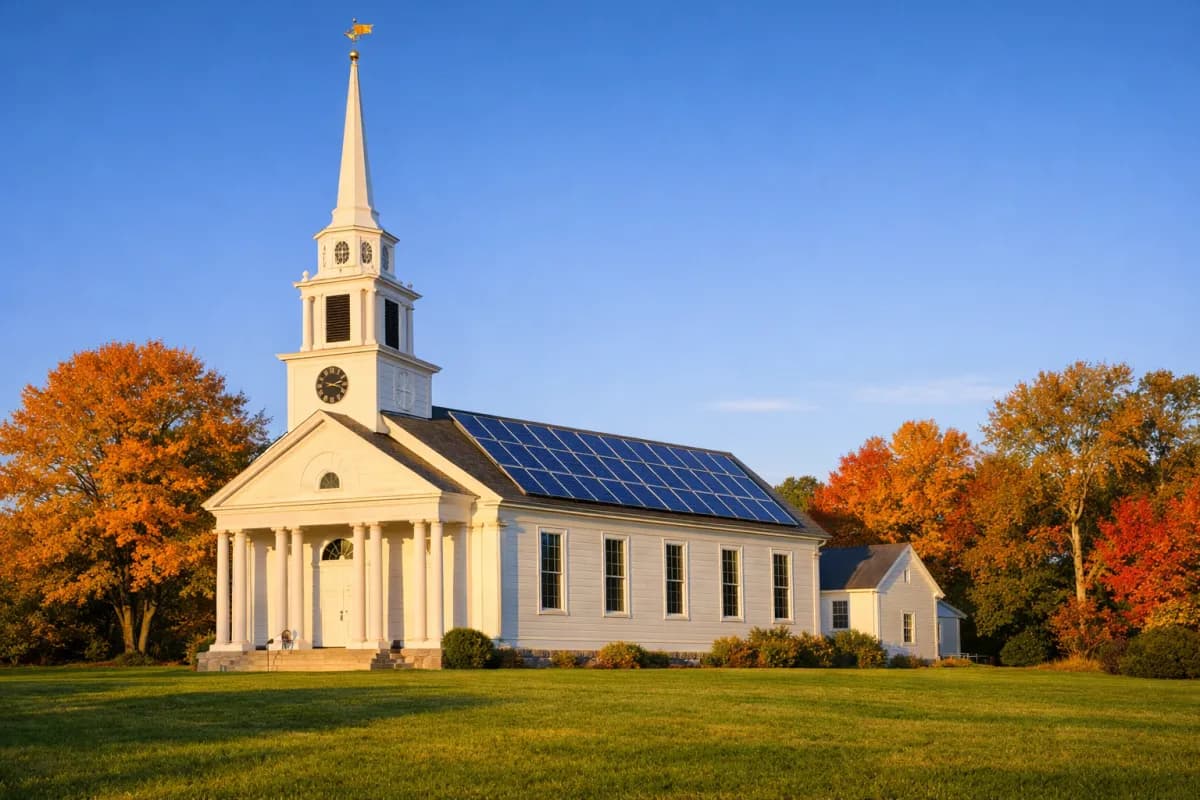
Churches and houses of worship are tax-exempt, so they cannot directly claim the federal solar Investment Tax Credit. The solution: a Power Purchase Agreement (PPA) or solar lease. A third-party developer installs and owns the solar system on your church roof or property at $0 upfront cost. The developer claims the Section 48E ITC (up to 30%+ with bonus adders) and MACRS depreciation, then sells you electricity at 30-70% below your current utility rate. A typical 30 kW church system saves $5,000-$10,000+ per year.
Churches spend $8-$15 billion annually on energy. Every dollar saved on electricity is a dollar redirected to ministry, outreach, and community service.
The average church spends $3,000-$12,000 per year on electricity. Solar PPA savings of 30-70% free up thousands of dollars annually for programs, staff, and community outreach instead of utility bills.
PPA rates are fixed or escalate at a low, predictable rate (1-2% per year) while utility rates have risen 3-5% annually. This budget certainty is valuable for congregations operating on tight annual budgets.
Nearly every major faith tradition has a theological mandate for caring for creation. Solar allows your congregation to live its values visibly, reducing carbon emissions by 20-40 tons annually for a typical church system.
Churches are trusted community institutions. A visible solar installation signals environmental leadership and can inspire parishioners, neighbors, and other organizations to adopt clean energy.
Adding battery storage to a solar system allows your church to function as an emergency shelter during power outages. Many churches already serve this role — solar + storage makes it reliable.
Solar projects unite congregations around a shared goal. Fundraising campaigns, educational programs, and dedication events create meaningful engagement — especially for younger members who prioritize sustainability.
Churches do not pay taxes, so they cannot use tax credits directly. But through third-party ownership, the financial benefits still flow to your congregation.
If a church buys a solar system outright, it cannot claim the Section 48E ITC because it has no tax liability. The church pays full price and receives no tax benefit. MACRS depreciation is also unavailable.
Result: Full system cost ($90,000+ for 30 kW) with no federal incentive offset. Still saves money long-term, but high upfront barrier.
A third-party developer owns the system and claims the Section 48E ITC (30% base, plus bonus adders). They also claim MACRS depreciation (100% first-year bonus, permanent under OBBBA). These tax benefits reduce the developer's costs, which they pass through as a lower PPA/lease rate.
Result: $0 upfront, 30-70% savings on electricity, zero maintenance. The ITC benefit flows to you indirectly through lower rates.
Standard credit for systems meeting prevailing wage + apprenticeship requirements
Using US-manufactured panels and inverters (FEOC-compliant equipment)
Project located in a former fossil fuel or brownfield community
Serving low-income communities or qualifying housing projects
Note: These credits apply to the third-party system owner, not the church. But a developer with a 50-70% effective ITC + MACRS can offer much lower PPA rates. July 4, 2026 was a begin-construction safe-harbor date, not a deadline to claim the credit: developers that began construction on or before July 4, 2026 locked in the full Section 48E timing pathway (placed in service through roughly 2030), and projects that begin construction after that date still qualify but generally must be placed in service by December 31, 2027.
Most churches go solar with zero upfront cost. Here are all available options, from PPAs to community fundraising.
| Option | How It Works | Upfront | Term | Who Claims ITC |
|---|---|---|---|---|
| Power Purchase Agreement (PPA) | Third-party developer owns, installs, and maintains the system. Church buys electricity at a fixed rate below retail. | $0 | 20-25 years | System owner (developer) |
| Solar Lease | Similar to PPA — third party owns the system. Church pays a flat monthly lease rather than per-kWh. | $0 | 20-25 years | System owner (lessor) |
| Cash Purchase (Fundraising) | Congregation raises funds to buy the system outright. Church owns the system but cannot claim ITC (tax-exempt). | $60K-$150K | Immediate ownership | No one (church is tax-exempt) |
| Green Bank / CDFI Loan | Below-market-rate loan from a community development financial institution or state green bank. | $0-$10K | 10-20 years | No one (church is tax-exempt) |
| Community Solar Subscription | Church subscribes to an offsite solar farm. No installation required. Saves 5-15% on electric bill. | $0 | Month-to-month or 12-month | Solar farm developer |
Over 70% of nonprofit solar installations use a PPA structure. The math is simple: the developer captures the tax credits and depreciation (which churches cannot use), and passes those savings through as a lower electricity rate. The church benefits from the ITC indirectly without needing any tax liability. The developer handles all maintenance, monitoring, and insurance for the life of the contract.
Here is what a typical church solar project looks like under a PPA in New England, where average utility rates are $0.27/kWh.
Based on $0.27/kWh utility rate with 3% annual escalation, fixed PPA rate of $0.08/kWh. Actual savings depend on system production, utility rates, and contract terms.
Many denominations have formal positions on environmental stewardship, and some offer grants, loans, or recognition programs for churches that adopt renewable energy.
Laudato Si' Action Platform
Pope Francis's 2015 encyclical calls for climate action. The Vatican's Laudato Si' Action Platform encourages parishes to adopt renewable energy as part of their ecological conversion.
Creation Justice Movement
The UMC's Social Principles call for sustainable energy. Many annual conferences have set carbon-neutral goals and offer grants for solar installations at local churches.
Earth Care Congregations
The PCUSA Earth Care certification program recognizes churches that integrate environmental stewardship, including on-site renewable energy generation.
Episcopal Church Resolutions
General Convention has passed multiple resolutions supporting carbon neutrality. Many dioceses offer low-interest loans or grants for parish solar projects.
ELCA Sustainability Goals
The ELCA Social Statement "Caring for Creation" calls for reducing fossil fuel dependence. The denomination targets 40% carbon reduction by 2030.
7th Principle Project
UU congregations, grounded in the 7th Principle (respect for the interdependent web of existence), have been early adopters of solar. Many congregations have committed to 100% renewable energy.
Many churches occupy historically significant buildings. Solar is still possible — it just requires creative approaches.
Solution: Install panels on the rear-facing roof slope (not visible from the public right-of-way). Many State Historic Preservation Offices (SHPOs) approve this approach. Alternatively, use ground-mount arrays on church property behind the building.
Solution: Modern panel-level optimization (microinverters or power optimizers) handles partial shading and irregular layouts efficiently. A professional designer can maximize production even on multi-faceted roofs.
Solution: Non-penetrating ballasted mounting systems sit atop flat roof sections. For sloped slate/tile roofs, specialized hooks slide under existing tiles without drilling. Solar canopies over parking lots avoid the roof entirely.
Solution: All-black panels (black frames, black backsheets) blend with dark roofing. Ground-mount systems can be landscaped with native plants. Solar canopies over parking provide both shade and power while keeping the building facade untouched.
Solution: Work with your insurer before installation. Most policies can be amended. Under a PPA, the system owner typically carries their own equipment insurance, reducing the church burden. Get written confirmation of coverage.
Many churches still use T8 fluorescent tubes, incandescent bulbs, or halogen floods. Upgrading to LED before installing solar reduces your required system size and maximizes ROI.
A comprehensive energy audit identifies lighting waste, HVAC inefficiencies, and insulation gaps. Many utilities offer free audits for nonprofits. This establishes your baseline consumption.
Replace all lighting with LED. Churches average 30-50% electricity savings from lighting alone due to high-ceiling fixtures, parking lot lights, and classroom/office lighting that runs for extended hours.
With reduced consumption from LED upgrades, a smaller (cheaper) solar system offsets a larger percentage of your remaining usage. A 20 kW system may now offset 80-100% instead of 50-60%.
Adding battery storage to a church solar system enables emergency backup power and can generate additional revenue through demand response programs.
Many churches serve as emergency shelters during storms and power outages. Solar + battery storage ensures your building can provide lighting, phone charging, refrigeration, and heating/cooling when the grid is down — exactly when your community needs it most.
In Massachusetts, Rhode Island, and Connecticut, the ConnectedSolutions demand response program pays battery owners to discharge stored energy during peak grid demand events (typically 10-30 times per summer).
For congregations that prefer ownership over a PPA, fundraising can cover the upfront cost. Remember: without a PPA, no one claims the ITC — but you own the system and all its output.
Add a solar line item to an existing building fund or renovation campaign. Churches that already have a capital campaign infrastructure find this the easiest path. Typical goal: $60,000-$120,000.
Allow donors to "sponsor" individual panels ($300-$500 each). Donors receive a dedication plaque or certificate. This approach works well for memorial gifts and honors, and makes the project tangible for each contributor.
Interfaith Power & Light, many denominational foundations, and local community foundations offer grants for church energy projects. Grants typically cover 10-30% of project cost, reducing the fundraising target.
Online platforms (GoFundMe, GiveSendGo, or denomination-specific tools) can reach beyond your congregation. Some foundations offer 1:1 matching for church green energy projects, effectively doubling contributions.
Church property insurance policies must be updated to cover solar equipment. Most insurers add solar panels to existing coverage for $200-$500 per year in additional premium. Failure to notify could void coverage for solar-related damage.
Under a PPA or lease, the third-party system owner typically carries their own equipment insurance. The church only needs to ensure its underlying property policy is not voided by having equipment on the roof. This significantly reduces the church insurance burden.
Solar panels are tested to withstand 1-inch hail at 50+ mph and winds up to 140 mph. However, in high-wind or hail-prone areas, confirm that your policy specifically covers solar equipment damage without excessive deductibles.
If your solar array is ground-mounted on church property, ensure your general liability policy covers the fenced array area. This is especially important if church property is open to the public (playgrounds, sports fields, community gardens).
Get a customized estimate for your house of worship. We specialize in nonprofit solar projects with $0 upfront PPA and lease options.
Get Your Free Church Solar QuoteNot directly. Churches and nonprofits cannot claim the Section 48E Investment Tax Credit because they do not pay federal taxes. However, through a PPA or solar lease, a third-party system owner installs and owns the panels, claims the ITC themselves (up to 30%+ with bonus adders), and passes those savings through as a lower electricity rate for the church. This is the primary way churches access solar incentives.
A typical church system (20-50 kW) costs $60,000-$150,000 if purchased outright. However, most churches use PPA or lease financing with $0 upfront cost. Under a PPA, the church pays a per-kWh rate (typically $0.06-$0.10/kWh) that is well below retail utility rates ($0.20-$0.32/kWh in New England), saving $5,000-$15,000+ per year.
It depends on your historic designation. Nationally registered historic buildings may face restrictions on visible rooftop alterations. Options include ground-mount systems on church property, rear-facing roof installations not visible from the street, solar canopies over parking areas, or community solar subscriptions that require no on-site installation. Consult your State Historic Preservation Office (SHPO) before proceeding.
A Power Purchase Agreement (PPA) is a contract where a third-party developer installs, owns, and maintains a solar system on your church property at no upfront cost. The church agrees to buy the electricity generated at a fixed rate — typically 30-70% below your current utility rate — for 20-25 years. The developer claims the Section 48E ITC and MACRS depreciation, which lowers their costs and allows them to offer you a discounted rate.
Successful church solar fundraising campaigns include capital campaigns (adding solar to a building fund drive), memorial or dedication panels (donors sponsor individual panels), green matching programs (some foundations match church solar donations), grant applications (Interfaith Power & Light, denomination-specific grants), and crowdfunding platforms. Many churches raise $50,000-$100,000 through dedicated green energy campaigns.
Most church insurance policies can be amended to cover rooftop solar panels, typically adding $200-$500 per year to premiums. Under a PPA or lease, the system owner usually carries their own insurance for the equipment. Always notify your insurer before installation. Ground-mount systems and solar canopies may require separate coverage. Request a written confirmation of coverage from your insurer.
Under a PPA or lease, the contract typically includes provisions for assignment or transfer to a new property owner. If the church is sold, the PPA obligation transfers to the buyer. If purchased outright, the solar system becomes part of the property and adds to its resale value. Discuss exit clauses before signing any agreement.
Yes, and this is often the smartest approach. Replacing old lighting with LEDs first reduces the church electricity consumption by 30-50%, which means a smaller (cheaper) solar system can offset a larger percentage of remaining usage. Many solar installers and energy auditors offer bundled LED + solar packages. Some state programs cover LED upgrades for nonprofits.