Loading NuWatt Energy...

We use your location to provide localized solar offers and incentives.
We serve MA, NH, CT, RI, ME, VT, NJ, PA, and TX
Loading NuWatt Energy...
NuWatt designs, installs, and manages solar, battery, heat pump, and EV charger systems across 9 states. One company, one warranty, one point of contact.
Get a Free QuoteAI training facilities, cryptocurrency mines, and hyperscale data centers are consuming thousands of megawatts of Texas grid power — and ERCOT reserve margins are shrinking. Residential rates are climbing from $0.12-$0.16/kWh toward $0.15-$0.20/kWh in deregulated areas. Solar panels lock your effective rate at $0/kWh for 25+ years.
Quick Answer
Texas electricity rates have increased significantly as AI data centers, cryptocurrency mining, and industrial electrification drive unprecedented demand on the ERCOT grid. Residential rates averaged $0.12-$0.16/kWh in 2024 but are trending toward $0.15-$0.20/kWh in deregulated areas. Solar panels lock your effective rate at $0/kWh through solar buyback programs — and every future rate increase makes your solar investment more valuable.
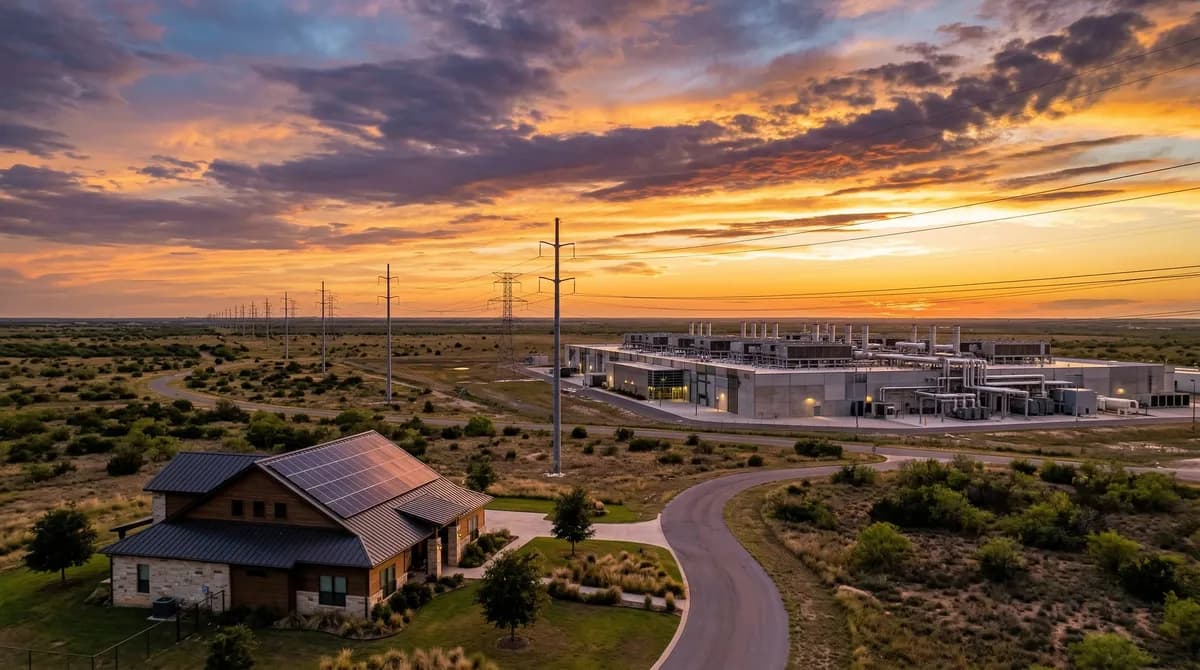
Texas is experiencing the largest single source of new electricity demand in its history. AI data centers, cryptocurrency mining operations, and hyperscale cloud facilities are collectively adding thousands of megawatts to the ERCOT grid — and homeowners are paying the price.
A single large AI training cluster can consume 100-300 MW of continuous power — the equivalent of 80,000 to 240,000 average Texas homes. Companies like OpenAI, Google, Meta, and Microsoft are building massive GPU farms in Texas, attracted by cheap land, low regulation, and ERCOT's deregulated power market. Each new facility adds constant, 24/7 baseload demand that never cycles off.
ERCOT's interconnection queue contains over 60,000 MW of data center load requests — far more than can be built, but even a fraction would strain the grid. The DFW metroplex, San Antonio, and West Texas are primary targets. Texas approved more data center construction in 2024-2025 than any other state, and the pace is accelerating with the generative AI boom.
ERCOT's summer reserve margin — the buffer between available generation and peak demand — has been hovering at 10-12%, below the 13.75% target. Adding 5,000-9,000 MW of data center load without proportional generation additions means the grid has less room for error during summer heat waves. Tighter margins mean higher wholesale prices and more frequent conservation appeals.
In ERCOT's deregulated market, Retail Electric Providers (REPs) buy wholesale power and sell it to residential customers. When wholesale prices rise — driven by data center demand competing with your air conditioner — REPs increase fixed-rate plan prices, add higher risk premiums, and offer fewer promotional rates. Variable-rate customers face direct exposure to wholesale spikes that can exceed $0.50/kWh during peak hours.
| Segment | Estimated Load | Primary Locations | Status |
|---|---|---|---|
| Major AI hyperscalers | ~3,000+ MW | DFW, San Antonio, West TX | Under construction / planned |
| Cryptocurrency mining | ~2,500 MW | West TX, Midland-Odessa, Abilene | Active + expanding |
| Cloud providers (AWS, Azure, GCP) | ~2,000 MW | DFW, San Antonio, Austin | Active + expanding |
| Colocation & enterprise | ~1,500 MW | DFW, Houston, Austin | Active |
| Total Estimated | ~9,000+ MW | Equivalent to ~7.2 million average TX homes | |
Sources: ERCOT interconnection queue filings, industry reports, public utility commission data. Figures are estimates and include planned, under construction, and operational facilities.
Texas residential electricity rates have climbed steadily since 2020. The combination of post-Uri securitization costs, natural gas volatility, and now data center demand is pushing rates higher than the historical norm.
+43%
Rate increase since 2020 in deregulated areas (11.5c to 16.5c/kWh)
9,000+ MW
Estimated data center load in TX (operating + under construction + planned)
$0/kWh
Your effective rate with solar — immune to ERCOT spikes and data center demand
Previous TX rate increases were cyclical — driven by weather events (Uri), temporary gas price spikes, or regulatory adjustments. The data center boom is structural and permanent. AI workloads do not decrease when summer ends. Crypto mining runs 24/7/365. These facilities have 20-30 year operational lifespans. Unlike a gas price spike that eventually moderates, the demand growth from data centers is a one-way ratchet that will continue pushing rates higher for the foreseeable future.
Solar is the only way to permanently lock your electricity cost at $0/kWh. Every rate increase makes your solar investment more valuable — and in Texas, rates are only going one direction.
Key insight:If data center-driven rates push TX averages to $0.20/kWh by 2028, payback drops to ~8 years and 25-year savings exceed $85,000. Solar gets more valuable every time your neighbor's bill goes up.
A battery supercharges your solar investment by enabling time-of-use arbitrage. Charge during cheap overnight hours, discharge during expensive afternoon peaks when ERCOT prices — and data center demand — are highest.
Grid rate: $0.05-$0.08/kWh
Charge battery from grid at lowest rates
Grid rate: $0.00/kWh (solar)
Solar panels power home + charge battery from surplus
Grid rate: $0.25-$0.40/kWh (TOU)
Discharge battery — avoid the highest rates entirely
Data centers run 24/7, but residential A/C demand peaks from 3-8 PM. When both data center baseload and residential cooling peak simultaneously during Texas summer afternoons, ERCOT wholesale prices can spike 300%+ within hours. Variable-rate customers and those on TOU plans pay $0.25-$0.40/kWh during these peaks. A solar + battery system lets you completely avoid these peak hours by using stored solar energy. As data center load pushes peak prices higher, battery arbitrage becomes even more valuable.
Your solar buyback plan determines how much credit you get for exported energy. Choosing the right REP is critical — the difference between a good and bad buyback plan can be thousands of dollars per year.
Most popular for solar homes. Credits offset full retail rate.
Newer entrant with solar-specific plans and competitive supply rates.
Green energy REP with solar buyback options. 100% renewable source.
Terrible value. Many REPs offer near-wholesale buyback rates for solar exports.
Warning: Most REPs Offer Terrible Solar Buyback
The majority of Texas REPs pay only $0.03-$0.05/kWh for exported solar energy — barely above wholesale. This is 70-80% lessthan what you pay to buy electricity from them. Before signing with any REP, always ask: "What is your solar buyback rate?" If it is below $0.08/kWh, keep shopping. See our TX Solar Buyback Guide for detailed comparisons.
Cannot afford $27,000 upfront? Propel financing lets you go solar with $0 down by leveraging the commercial Section 48E ITC that the residential 25D credit no longer provides.
Third-party system owner purchases and installs solar on your roof
Third party claims the 30%+ Section 48E commercial ITC (not available to homeowners directly)
You finance through a Concert Loan + Prepaid ESA at $0 down
Effective system cost reduced by ITC benefit passed through to you
Silfab 440W FEOC-compliant panels required
After Winter Storm Uri killed 246 Texans and left millions without power, energy independence is not just about money — it is about safety. Data centers are making the grid less reliable for everyone else.
Grid collapsed for 4+ days. 4.5 million homes lost power. Wholesale prices hit $9,000/MWh. 246 deaths. Solar + battery homes maintained critical loads.
ERCOT hit record demand of 85 GW. Multiple conservation appeals. Wholesale prices spiked 300%+ on 15+ days. Variable-rate customers saw $0.50+/kWh bills.
Adding 5,000-9,000+ MW of constant baseload demand reduces available capacity for residential customers during emergencies. Grid flexibility decreases as baseload increases.
24-72 hrs
Typical backup time with solar + battery during a grid outage (with load management). Solar recharges the battery each day, extending backup indefinitely for essential loads.
$0/kWh
What you pay during an ERCOT price spike. While your neighbors are paying $0.50+/kWh on variable plans, your solar panels are generating free electricity.
25+ years
Solar panel warranty period. Unlike a fixed-rate REP plan that expires in 12-24 months, solar provides decades of rate protection against data center-driven increases.
Common questions about AI data centers, rising TX electricity rates, and solar.
Texas electricity rates are rising due to massive new demand from AI data centers, cryptocurrency mining facilities, and industrial electrification. ERCOT is seeing unprecedented load growth of 5,000-9,000+ MW from data centers alone, while grid capacity additions have not kept pace. This tightens reserve margins, increases wholesale prices, and REPs pass those costs to residential customers through higher fixed-rate plans and variable-rate exposure.
A single large AI training data center can consume 100-300 MW of continuous power — equivalent to 80,000-240,000 average Texas homes. Texas currently has 7,000-9,000+ MW of data center load either operating, under construction, or in ERCOT interconnection queues. This represents the single largest source of new electricity demand in the state, surpassing even population growth.
Yes. Solar panels lock your electricity production cost at effectively $0/kWh for 25-30 years. Once installed, every rate increase makes your solar investment more valuable. Unlike a fixed-rate REP plan that expires in 12-24 months and resets at higher rates, solar panels produce free electricity for decades. A 10 kW system in Texas produces approximately 15,000 kWh per year.
TXU Solar Buyback is the most popular, offering 1:1 bill credits up to 100% of your usage. Chariot Solar Buyback and Green Mountain Renewable Rewards also offer competitive solar-specific plans. Avoid REPs that only pay $0.03-$0.05/kWh for exported solar — this is near-wholesale pricing and significantly undervalues your solar production. Always check the buyback rate before signing with any REP.
A battery allows you to store solar energy produced during the day and use it during expensive evening peak hours (4-8 PM) when ERCOT prices are highest. On TOU plans, this peak-to-off-peak arbitrage can save $0.10-$0.25/kWh during summer peaks. Additionally, a battery provides backup power during grid outages — a critical benefit given Texas grid reliability concerns after Winter Storm Uri and recurring summer stress events.
ERCOT is not expected to "run out" of power but is facing historically tight reserve margins. The grid operator projected a 10-12% reserve margin for summer 2026, below the 13.75% target. Data center interconnection requests totaling 60,000+ MW are in the ERCOT queue, though not all will be built. The risk is not a permanent blackout but more frequent conservation appeals, price spikes, and localized reliability issues during extreme weather.
Solar panels in Texas cost $2.60-$2.80 per watt installed in 2026, making a typical 10 kW system $26,000-$28,000. Texas has no state solar rebate and the federal 25D residential tax credit expired December 31, 2025. However, Texas property tax exemption for solar (100% of added value) and sales tax exemption on equipment provide ongoing benefits. Propel financing offers $0 down with a third-party claiming the commercial ITC.
Yes. Propel financing is available in Texas. It works through a Concert Loan combined with a Prepaid ESA — the third-party system owner claims the 30%+ Section 48E commercial ITC, reducing your effective cost. Terms are 25 years at 8.49–10.49% APR by credit tier with $0 down, $0 dealer fee, and 660 minimum FICO. Financing is sized for typical residential systems — fit is confirmed at design.
AI data centers are not slowing down. Every month you wait, ERCOT demand grows and your electricity rate moves further from where it was. Solar locks your rate at $0/kWh for 25+ years — regardless of what data centers, crypto miners, or summer heat waves do to the grid.
Free, no-obligation quote in 2 minutes. See your savings based on your actual roof and electricity usage.
TX Solar Buyback Rates 2026
Compare REP buyback rates
TX Electricity Rate Trends
Full ERCOT market analysis
ERCOT Deregulation & Solar
How deregulation affects solar
Solar + Battery TOU Guide
Peak shaving strategies
TX Grid Outage & Solar
Backup power for grid failures
Propel Solar TX
$0 down financing
TX Solar Panel Cost 2026
Current pricing by city
Solar Without Tax Credit
The math without 25D ITC