Loading NuWatt Energy...

We use your location to provide localized solar offers and incentives.
We serve MA, NH, CT, RI, ME, VT, NJ, PA, and TX
Loading NuWatt Energy...
NuWatt designs, installs, and manages solar, battery, heat pump, and EV charger systems across 9 states. One company, one warranty, one point of contact.
Get a Free Quote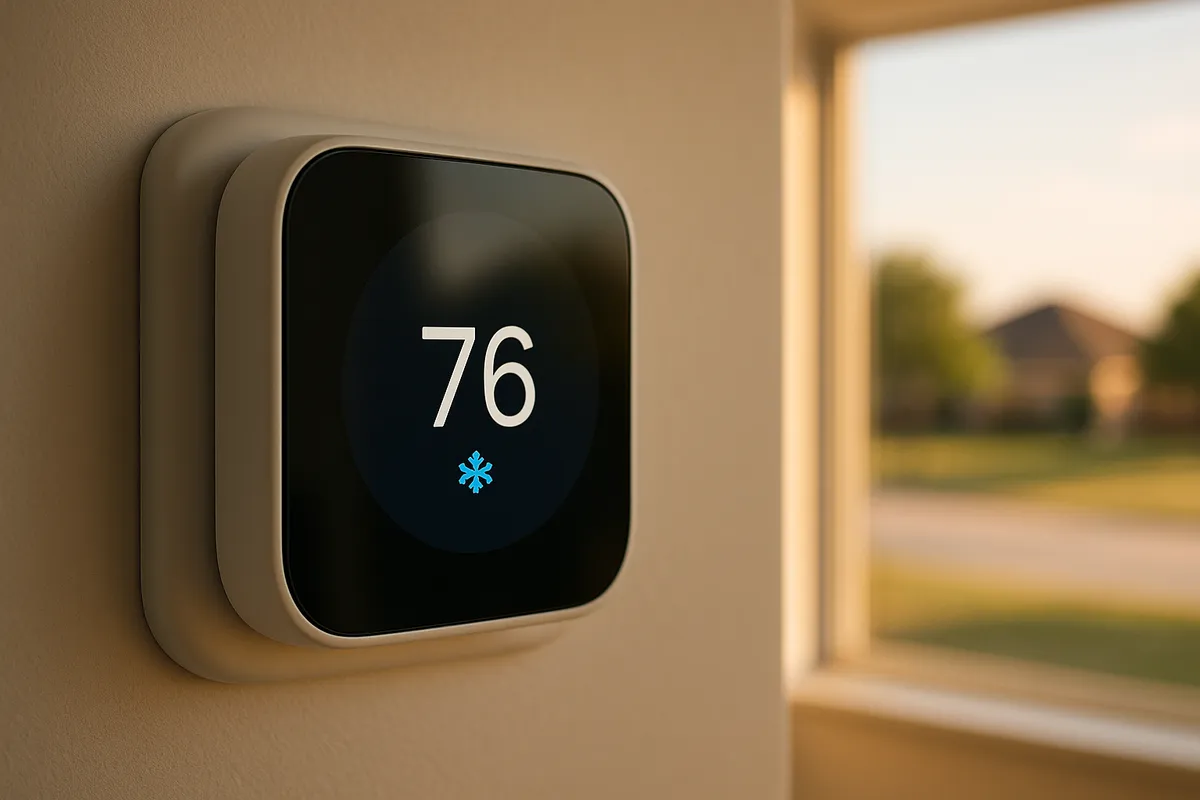
Texas cooling runs 4-5 months a year. The right thermostat settings save $300-$600 annually. Combine with TOU rate plans, smart thermostats, and solar buyback optimization to maximize savings in the ERCOT deregulated market.
Summer (Home)
76-78°F
Summer (Sleep)
78-80°F
Winter (Home)
68°F
Winter (Sleep)
65-66°F
Federal 25C Tax Credit: Expired
The Section 25C energy efficiency tax credit (formerly up to $2,000 for heat pumps) expired December 31, 2025. Smart thermostats no longer qualify for any federal credit. TX utility rebates from Oncor, CenterPoint, and others remain available.
Texas is a cooling-dominant climate. Your heat pump runs cooling mode 80% of the year. These settings balance comfort, efficiency, and cost for each season.
Home / Awake
76-78°F
Sleeping
78-80°F
Away
82-85°F
Texas summers are 4-5 months of sustained 95-105°F heat. Every degree above 72°F saves 3-5% on cooling costs. Setting to 76°F instead of 72°F saves 12-20% ($150-$350/summer).
TOU Tip: Pre-cool to 74°F before 2 PM when TOU off-peak rates apply, then let the home rise to 78°F during peak hours (2-7 PM).
Home / Awake
72-74°F
Sleeping
70-72°F
Away
65-80°F (auto)
Mild weather means minimal runtime. Many TX homes can run fans only during October and April. Use auto mode to let the heat pump switch between heating and cooling as needed.
TOU Tip: TOU savings are minimal during shoulder months. Focus on using auto mode and letting the system idle when outdoor temps are 65-80°F.
Home / Awake
68°F
Sleeping
65-66°F
Away
60-62°F
Texas winters are mild (avg 40-55°F in DFW/Houston, warmer in SA/Austin). Heat pumps are extremely efficient at these temperatures. Each degree below 72°F saves 2-3%.
TOU Tip: Winter TOU rates often have different peak hours (6-9 AM, 6-9 PM). Pre-heat to 70°F before morning peak, then let it settle to 68°F.
Texas has a deregulated electricity market. Over 85% of Texans can choose from dozens of retail electric providers (REPs) with TOU, free nights, free weekends, and dynamic pricing plans. Your thermostat strategy should match your rate plan.
Peak Hours
Mon-Fri 6 AM - 9 PM (varies)
Off-Peak Rate
Free (nights) / ~$0.12/kWh
Peak Rate
$0.18 - $0.22/kWh
Strategy: Pre-cool aggressively before 6 AM and after 9 PM. Run heavy loads at night. With solar buyback, export during day and use free electricity at night.
Peak Hours
Mon-Fri (all day)
Off-Peak Rate
Free (weekends) / ~$0.14/kWh weekdays
Peak Rate
$0.16 - $0.20/kWh
Strategy: Maintain normal settings on weekdays. On weekends, run heavy cooling, laundry, and EV charging during free hours. Pre-cool to 72°F Friday night.
Peak Hours
2 PM - 7 PM (summer)
Off-Peak Rate
~$0.10/kWh
Peak Rate
$0.18 - $0.25/kWh
Strategy: Classic TOU approach: pre-cool to 74°F before 2 PM, let the home drift to 78-80°F during peak, resume cooling at 7 PM off-peak.
Peak Hours
Dynamic (varies by grid load)
Off-Peak Rate
As low as $0.04/kWh
Peak Rate
Up to $0.30+/kWh
Strategy: Smart thermostat integration shifts cooling to lowest-cost hours automatically. Best paired with Nest or Ecobee for automated response.
This schedule shows how to use your home as a thermal battery. Pre-cool during cheap off-peak hours, then coast through expensive peak hours.
| Time | Set Temp | What Happens | Rate Period |
|---|---|---|---|
| 6:00 AM | 76°F | Wake up — normal cooling | Off-peak ($0.08-$0.12) |
| 11:00 AM | 74°F | Pre-cool 2°F below setpoint | Off-peak / Solar |
| 2:00 PM | 74°F | Peak begins — HP reduces output | Peak ($0.18-$0.25) |
| 4:00 PM | 77°F | Home drifts up — thermal mass absorbs heat | Peak ($0.18-$0.25) |
| 7:00 PM | 78°F | Peak ends — HP resumes cooling | Off-peak ($0.08-$0.12) |
| 9:00 PM | 76°F | Normal evening cooling | Off-peak / Free |
| 10:30 PM | 78°F | Sleep setback | Off-peak / Free |
Savings estimate: This pre-cooling strategy shifts 40-60% of cooling load from peak to off-peak hours. On a typical TOU plan, this saves $15-$40/month in summer, or $200-$500 over the May-September cooling season.
A smart thermostat automates TOU optimization, learns your schedule, and provides energy reporting. These three work best with heat pumps in the Texas ERCOT market.
Nest Renew is particularly valuable in Texas. It shifts your heat pump runtime to hours when the ERCOT grid has surplus wind/solar, which often coincides with lowest electricity prices. Saves $100-$200/year for the average TX home on a TOU plan.
Room sensors are essential for two-story TX homes where upstairs runs 5-10°F hotter. The thermostat averages readings across sensors instead of just the hallway where it is mounted. eco+ can auto-adjust during ERCOT conservation events.
Budget-friendly option that still provides geofencing and scheduling. No TOU-specific optimization, but programmable schedules can be manually set around your rate plan peak hours.
If you have solar panels on a Texas buyback plan, your thermostat strategy can dramatically increase your total savings. Here is how to stack solar production with TOU rate arbitrage.
If you have solar panels, run your heat pump aggressively during peak solar production (10 AM - 3 PM) to pre-cool your home using your own free electricity. Then let the home drift during evening hours when you would otherwise buy from the grid.
Estimated savings: $200 - $400/yearOn a solar buyback plan with TOU rates, export your solar production during peak hours (2-7 PM) at $0.18-$0.25/kWh credits. Then run your heat pump during off-peak hours (9 PM - 6 AM) at $0.08-$0.12/kWh. The arbitrage nets $0.06-$0.13/kWh profit.
Estimated savings: $300 - $600/yearWith a battery (Tesla Powerwall, Enphase, Franklin), charge from solar during the day, then discharge to run your heat pump during evening peak hours. This eliminates peak-rate electricity entirely for cooling.
Estimated savings: $400 - $800/yearCosts $150-$350 more per summer. Your heat pump works hardest when the gap between indoor and outdoor temperature is largest. At 105°F outside and 72°F inside, that is a 33°F differential. At 78°F, it is only 27°F — much less work.
Emergency heat uses electric resistance strips at 2-3x the cost of heat pump operation. In TX, where winter lows rarely drop below 25°F, your heat pump is more efficient than resistance heat almost all winter.
In TX summer, an unoccupied home can reach 110°F+ inside. This damages electronics, wood furniture, and creates mold-friendly conditions. Set to 85°F instead. The heat pump barely runs but prevents damage.
In humid TX climates, running the fan continuously re-evaporates moisture from the coil back into your home. Keep the fan on AUTO so it stops when the compressor stops, letting moisture drain off the coil.
Dropping the thermostat from 85°F to 72°F when you get home forces the heat pump to run at maximum capacity for an extended period. Use geofencing or scheduling to start cooling 30-60 minutes before arrival.
These programs pay you or reward you for shifting energy use during ERCOT grid stress events. Both work with smart thermostats.
A properly sized heat pump with smart thermostat integration saves $300-$600/year on a Texas TOU plan. Get a free assessment with customized settings for your home and rate plan.
Get Your Free Quote