
Loading NuWatt Energy...
We use your location to provide localized solar offers and incentives.
We serve MA, NH, CT, RI, ME, VT, NJ, PA, and TX
Loading NuWatt Energy...
NuWatt designs, installs, and manages solar, battery, heat pump, and EV charger systems across 9 states. One company, one warranty, one point of contact.
Get a Free QuoteCommunity solar lets you subscribe to a share of a local solar farm and receive credits on your electric bill — no rooftop panels needed. It is ideal for renters, condo owners, and homes with shaded roofs. Typical savings range from 5% to 15% on monthly electricity costs, and you can cancel or transfer your subscription if you move. Over 40 states now have community solar programs, though availability, savings, and contract terms vary significantly.
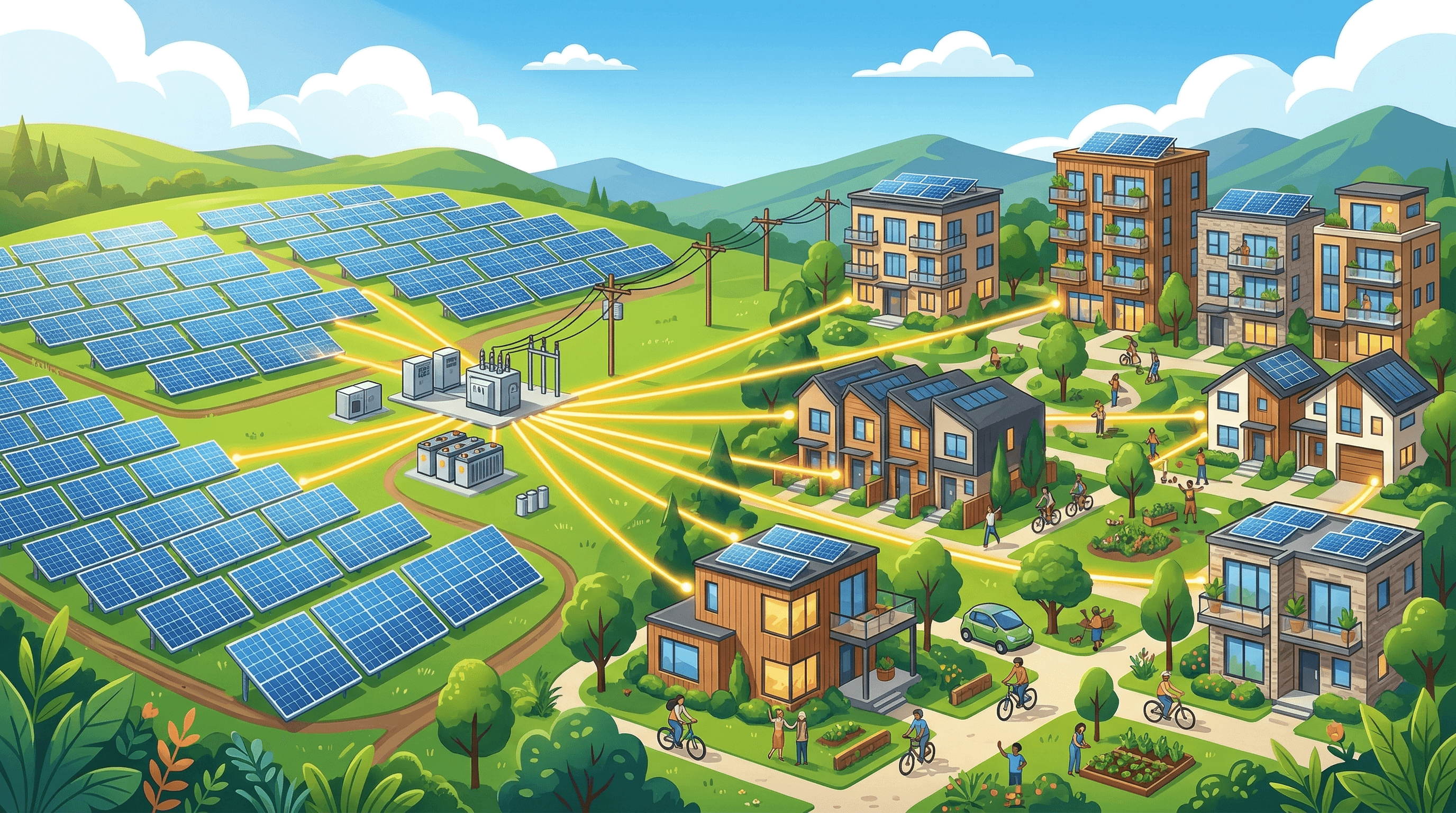
You do not need to own a roof — or even a house — to save money with solar energy. Community solar lets you subscribe to a share of a local solar farm and get credits directly on your electric bill. No installation, no maintenance, and typically 5-15% savings from day one.

40+
States with programs
5-15%
Typical savings
$0
Upfront cost
None
Installation
Quick Answer
Community solar lets you subscribe to a share of a local solar farm and receive credits on your electric bill — no rooftop panels needed. It is ideal for renters, condo owners, and homes with shaded roofs. Typical savings range from 5% to 15% on monthly electricity costs, and you can cancel or transfer your subscription if you move. Over 40 states now have community solar programs, though availability, savings, and contract terms vary significantly.
Community solar requires no rooftop installation — ideal for renters, condos, and shaded homes.
Savings typically range from 5% to 15% on your monthly electric bill, starting immediately.
You subscribe to a share of a solar farm and receive bill credits through your utility.
Over 40 states have community solar programs, but availability and terms vary widely.
Watch for contract red flags: escalation clauses, high termination fees, and overpromised savings.
Community solar saves less than rooftop solar, but it works for millions who cannot install panels.
Community solar — also called shared solar, solar gardens, or community solar farms — is a model where multiple people subscribe to a single, off-site solar energy project. Instead of installing panels on your own roof, you buy or lease a portion of a larger solar array built somewhere in your utility territory.
The electricity generated by the solar farm is fed into the local power grid. Your utility tracks how much energy your share produced, and applies bill credits to your monthly electric bill. You still receive power from the grid as usual — the credits simply reduce what you owe.
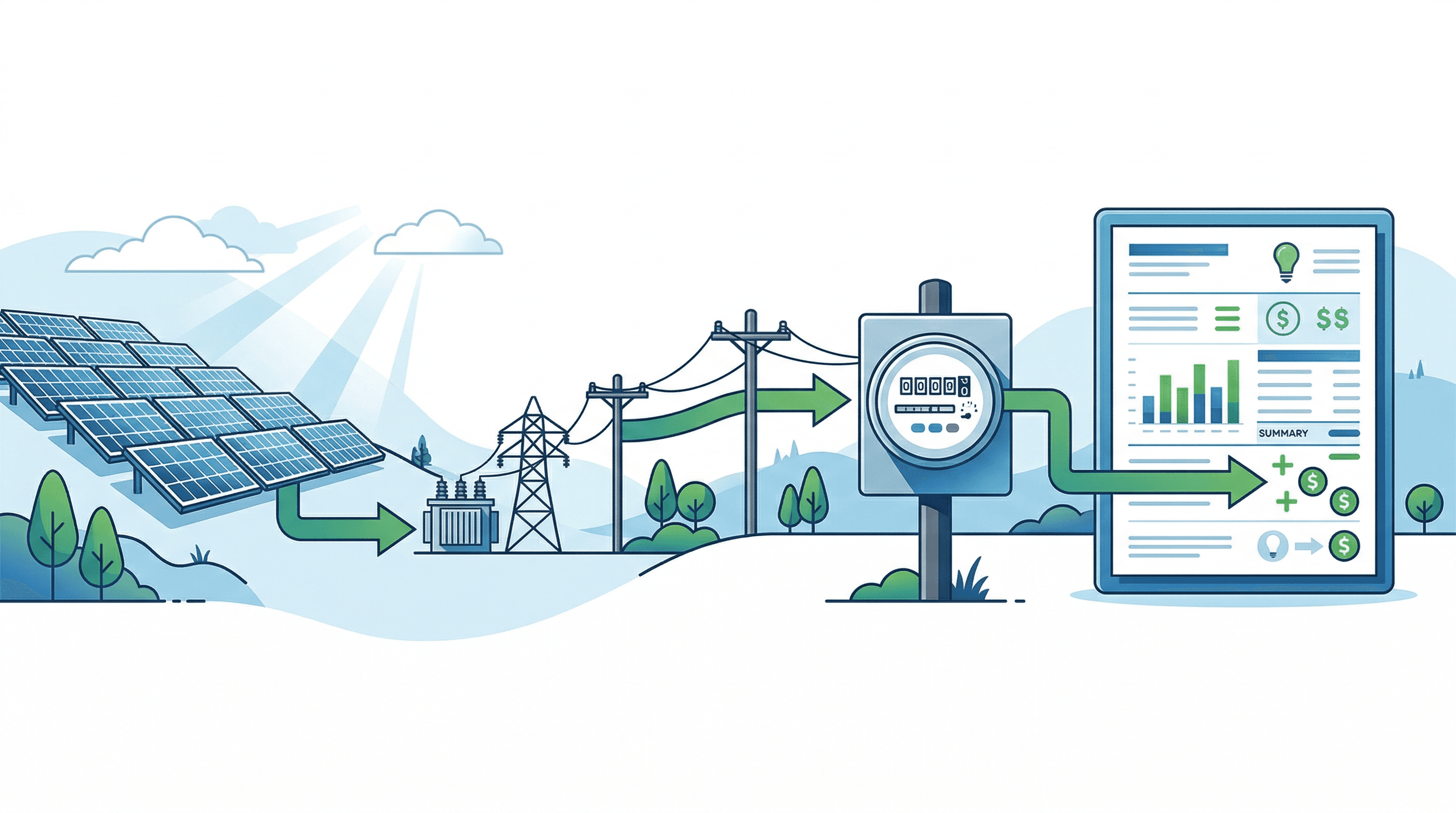
The mechanism that makes community solar possible is called virtual net metering (VNM). Traditional net metering credits you for electricity your own rooftop panels send back to the grid. Virtual net metering extends this concept: it credits you for electricity produced by panels somewhere else — the community solar farm — as if they were on your roof.
Here is how the process works:
Important: Community solar credits offset your electricity supply charges, not your entire bill. You will still pay delivery charges, customer charges, and other utility fees. This is why savings are typically 5-15% of your total bill, not 50-80% like rooftop solar.
Community solar exists to serve the roughly 50% of American households that cannot install rooftop solar. If any of the following situations apply to you, community solar may be your best path to solar savings.

You do not own your roof, so you cannot install panels. Community solar gives you access to solar energy with just a utility account. No landlord permission needed.
Shared roofs and HOA restrictions make rooftop solar difficult or impossible for condos. Community solar sidesteps these barriers entirely.
Mature trees, north-facing roofs, or complex roof geometry can make rooftop solar impractical. Community solar works regardless of your roof conditions.
Some HOAs prohibit visible solar panels (though many states have solar access laws). Community solar is invisible — nothing is installed on your property.
Many state programs reserve capacity for income-qualified subscribers with higher discount rates (up to 20-25%). No credit check or large upfront investment.
If you are moving within 2-5 years, rooftop solar may not pay back in time. Community solar subscriptions can often transfer to a new address within the same utility area.
Signing up for community solar is straightforward. There is no installation, no home assessment, and no changes to your property. Here is what the process looks like from start to savings.
Confirm that your state and utility support community solar. Most northeastern states have active programs. Search for available projects in your utility territory through a community solar marketplace or your state energy office.
Select a community solar project and decide how large a share you want. Most providers recommend matching your subscription to your average monthly electricity usage. A larger share means more credits, but you typically cannot receive credits exceeding your bill.
Read the subscription agreement carefully. Key terms to verify: subscription rate vs. utility rate, annual escalation (if any), contract length, early termination fees, and what happens when you move. See our "Contract Red Flags" section below.
The community solar provider handles enrollment with your utility. They submit the paperwork to activate virtual net metering on your account. This usually takes 1-2 billing cycles to go into effect.
Once enrolled, you will see solar credits appear as a line item on your utility bill each month. The credits offset your electricity supply charges. You pay the community solar provider their subscription fee, which is less than the credits — the difference is your savings.
Most providers offer an online dashboard where you can track your solar production, credits received, and cumulative savings. Your net savings typically run 5-15% of your electricity costs, month after month, with no maintenance on your end.
The honest answer: community solar saves less than rooftop solar, but it saves more than doing nothing. Here is what to realistically expect.
5-10%
Conservative
Fixed-rate contracts in competitive markets. Reliable, predictable savings.
10-15%
Typical
Most community solar subscribers see savings in this range, especially in strong programs like MA and NJ.
15-25%
Income-Qualified
Low-income set-asides in states like NJ and MA offer enhanced discounts for eligible households.
Your utility rate
Higher utility rates mean larger dollar credits. Subscribers in high-rate states like MA ($0.28-0.32/kWh) save more in absolute dollars than those in low-rate areas.
Subscription discount rate
The discount off the credit value is your guaranteed savings. A 10% discount means you pay 90 cents for every dollar of bill credits — guaranteed 10% savings.
Contract escalation
If your subscription rate escalates faster than your utility rate, savings shrink over time. Fixed-rate contracts protect you from this risk.
Subscription size match
If your subscription generates more credits than your bill, the excess may carry over or be lost, depending on your utility. Right-sizing your subscription matters.
Solar farm production
Monthly production varies with weather and seasons. Summer months produce more credits. Annual production is predictable, but individual months fluctuate.
A Massachusetts household paying $150/month for electricity subscribes to a community solar project with a 10% discount. Each month, the solar farm generates roughly $80 in bill credits on their account. They pay the community solar provider $72 (the $80 credit minus 10%). Net result: they save $8/month, or about $96/year, with zero upfront cost and zero maintenance. Not life-changing, but it is free money for doing nothing.
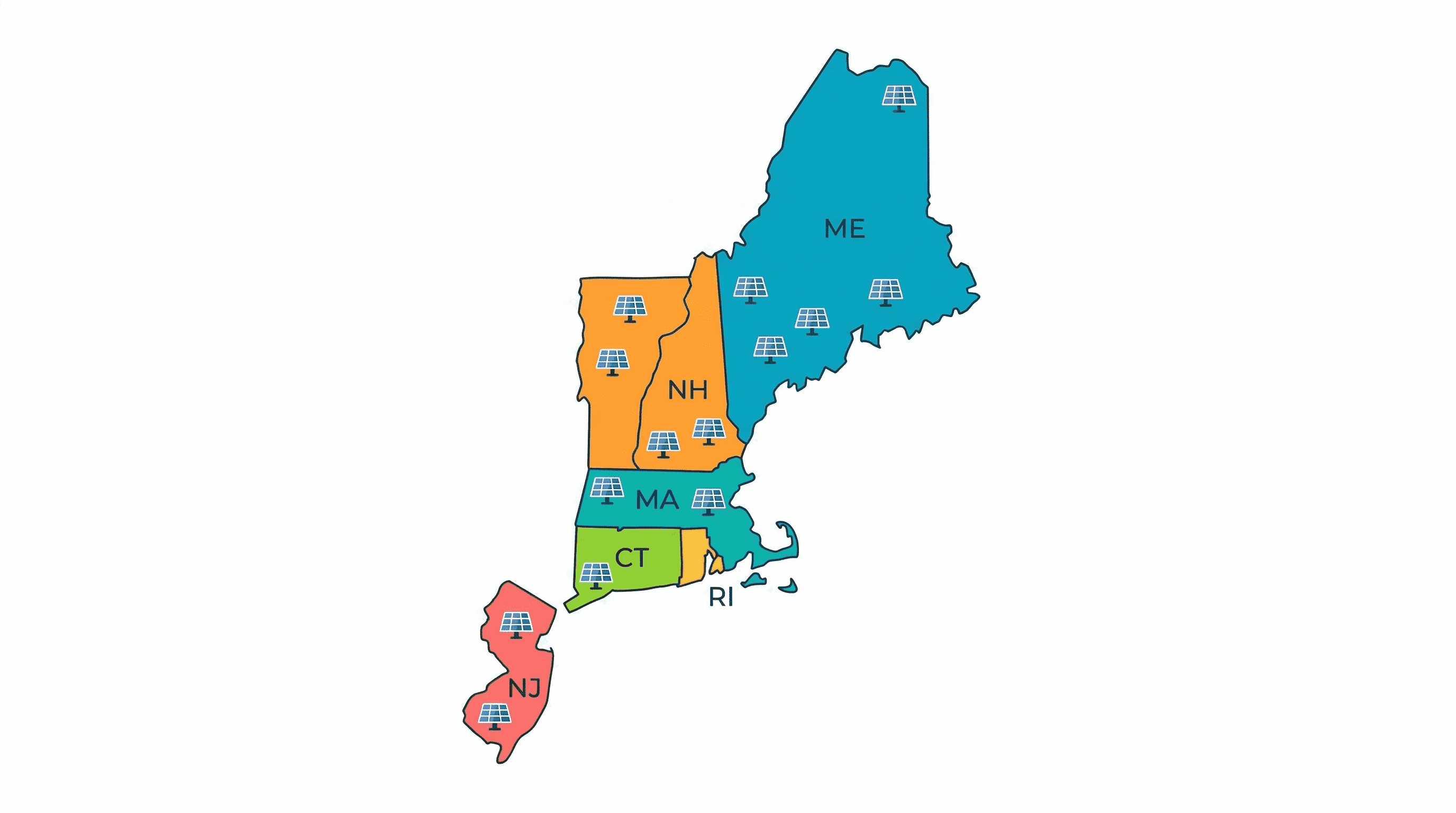
Community solar rules are set at the state level, and programs vary dramatically. Here is what NuWatt covers in each of our service states. Click through for detailed program guides with current rates, waitlist status, and local provider comparisons.
SMART 3.0 program
One of the most mature community solar markets in the US. SMART 3.0 incentives support new projects, with strong low-income set-asides.
Read full guideCSEP program
Community Solar Energy Pilot (CSEP) with 51% capacity reserved for low- and moderate-income subscribers. Expanding rapidly.
Read full guideLD 1711 / LD 1777
Strong net billing framework. Community solar farms can sell to subscribers at a discount off retail rates. Growing market.
Read full guideVirtual net metering
REG program and virtual net metering enable community solar subscriptions. Rhode Island Energy supports bill crediting for subscribers.
Read full guideGroup net metering
NEM 2.0 supports group net metering for community solar. Eversource, Liberty, and Unitil all participate.
Read full guideShared Clean Energy
Shared Clean Energy Facility (SCEF) program allows subscribers to receive bill credits from community solar projects.
Read full guideBeyond our service area: Community solar is available in over 40 states, including New York, Illinois, Colorado, Minnesota, and California. If you are outside the Northeast, check your state energy office or search a community solar marketplace like EnergySage or Arcadia for projects in your area.
Most community solar providers are legitimate, but the industry has its share of bad actors. Before signing any community solar contract, watch for these warning signs. A good provider will be transparent about every term.
Some contracts increase your rate 3-5% annually. If your utility rate rises slower, you lose money. Look for fixed-rate contracts or escalators capped at 2%.
Reasonable cancellation fees are $0-$200. Anything higher locks you in. Ask: "Can I cancel with 60 days notice and no penalty?"
If someone promises 25-30% savings on community solar, be skeptical. Realistic community solar savings are 5-15%. Verify the math against your actual utility rate.
Community solar contracts typically run 10-20 years. Anything longer reduces your flexibility. Shorter terms (1-5 years with auto-renew) are more subscriber-friendly.
A good contract explains exactly how credits are calculated, when they appear on your bill, and what happens in months with low production. If it is vague, walk away.
Legitimate community solar providers give you time to review contracts. High-pressure sales tactics are a red flag. Request the full contract, take it home, and read every clause.
Community solar and rooftop solar serve different needs. Neither is universally better — it depends on your living situation, budget, and goals. Here is an honest comparison.
| Feature | Community Solar | Rooftop Solar |
|---|---|---|
| Installation required | None | Yes — panels on your roof |
| Upfront cost | $0 in most programs | $15,000-$35,000 (cash/loan) |
| Typical savings | 5-15% on electric bill | 50-80% on electric bill |
| Roof ownership required | No — works for renters | Yes — you must own the roof |
| Home value increase | No direct impact | Adds $10K-$30K to home value |
| Portability when you move | Transfer or cancel (same utility) | Stays with the house |
| Maintenance responsibility | None — operator handles it | You or your installer |
| Long-term payoff (20 yrs) | Modest cumulative savings | Significant: $30K-$60K+ |
Not sure which is right for you? NuWatt can help. If rooftop solar makes sense for your home, we will design a system. If community solar is the better fit, we will point you to the best programs in your state. Start with a free solar assessment to find out.
You subscribe to a portion of a local solar farm (often called a "solar garden"). The electricity it generates is fed into the grid, and your utility applies credits to your bill based on your share of the production. You never need to install anything on your property.
Most community solar programs offer 5% to 15% savings on your electricity bill. The exact amount depends on your state program, the subscription rate, and how much energy your share produces. Some programs guarantee a fixed discount percentage, while others vary month to month.
Yes. Community solar is specifically designed for people who cannot install rooftop panels. You only need a utility account in the service territory where the solar farm operates. You do not need to own property or have landlord permission.
Most community solar programs have no upfront cost. You simply subscribe and start receiving bill credits. Some programs charge a monthly subscription fee that is less than the credits you receive, resulting in net savings. Always compare the subscription cost to the guaranteed credits.
Most contracts allow you to transfer your subscription to a new address within the same utility territory, or cancel with 30-90 days notice. Check your contract for early termination fees — some programs charge them, others do not. This is one of the key contract terms to verify before signing.
No. With rooftop solar, panels are installed on your home and you own or lease the system. With community solar, you subscribe to a share of a remote solar farm. Community solar typically saves less (5-15% vs. 50-80% with rooftop) but requires no installation, no roof assessment, and no long-term property commitment.
Community solar requires your utility to participate in a virtual net metering or bill credit program. Most major utilities in states with community solar legislation support it, but availability varies. Check with your utility or a community solar marketplace to confirm eligibility.
Yes. Many states reserve a portion of community solar capacity for low- and moderate-income households, often with higher discounts (up to 20-25% savings). Programs like New Jersey CSEP and Massachusetts community solar set-asides specifically target underserved communities.
NuWatt helps homeowners and renters across the Northeast find the best solar option for their situation. Whether that is a custom rooftop system, a community solar subscription, or a lease/PPA, we will give you honest advice based on your home and your goals.
This guide is for informational purposes only and does not constitute financial or legal advice. Community solar program details, savings estimates, and contract terms vary by state, utility, and provider. Always review your specific contract and consult with your utility before enrolling. Data current as of March 2026.