
Loading NuWatt Energy...
We use your location to provide localized solar offers and incentives.
We serve MA, NH, CT, RI, ME, VT, NJ, PA, and TX
Loading NuWatt Energy...
NuWatt designs, installs, and manages solar, battery, heat pump, and EV charger systems across 9 states. One company, one warranty, one point of contact.
Get a Free QuoteProtect your investment with the right warranties, O&M plans, and maintenance strategies. From panel cleaning and inverter replacement to monitoring systems and MA-specific weather considerations.

O&M Cost
$15-$25
Per kW per year
Energy Savings
$200-$400
Per kW per year
Lifetime Boost
5-15%
More production with O&M
Panel Warranty
25-40 yr
Top manufacturers
A well-maintained commercial solar system produces 95%+ of expected output over 25 years. Annual O&M costs range from $15-$25/kW/year for standard-to-comprehensive plans — that is $1,500-$2,500/year for a typical 100 kW system. In comparison, a 100 kW system in Massachusetts generates $200-$400/kW/year in combined electricity savings and SMART program revenue. O&M pays for itself by recovering 2-5% production lost to soiling, detecting faults early, and extending equipment life. Without maintenance, effective degradation rises to 0.8-1.2%/year versus 0.3-0.5% with professional O&M, resulting in 5-15% more lifetime energy production.
Commercial solar systems are 25-year infrastructure assets. A well-maintained 100 kW system in Massachusetts will generate approximately 2.8 million kilowatt-hours over its lifetime, producing over $750,000 in combined electricity savings and SMART program revenue. But that revenue depends on the system performing at or near its rated capacity year after year. Without proper maintenance, real-world degradation rates can be two to three times higher than manufacturer specifications, silently eroding your investment returns.
The warranty landscape for commercial solar is more complex than residential systems. A commercial installation involves six or more distinct warranties from different entities — panel manufacturers, inverter manufacturers, racking suppliers, and the installer. Understanding what each warranty covers, what it excludes, and how to successfully file claims is essential for protecting your investment. Many commercial system owners discover warranty gaps only after a failure occurs, when it is too late to negotiate better terms.
Massachusetts presents unique maintenance challenges that do not exist in sunbelt states. Nor'easters with 60+ mph winds test mounting systems. Coastal salt air corrodes hardware. Heavy western MA snowfall stresses roof structures. Spring pollen and fall leaves cause soiling losses. And the dramatic temperature swings between January and August — sometimes spanning 100+ degrees Fahrenheit over the course of a year — create thermal cycling stress on panel cells and electrical connections. A generic maintenance plan designed for Arizona or Florida will not adequately protect a Massachusetts commercial solar system.
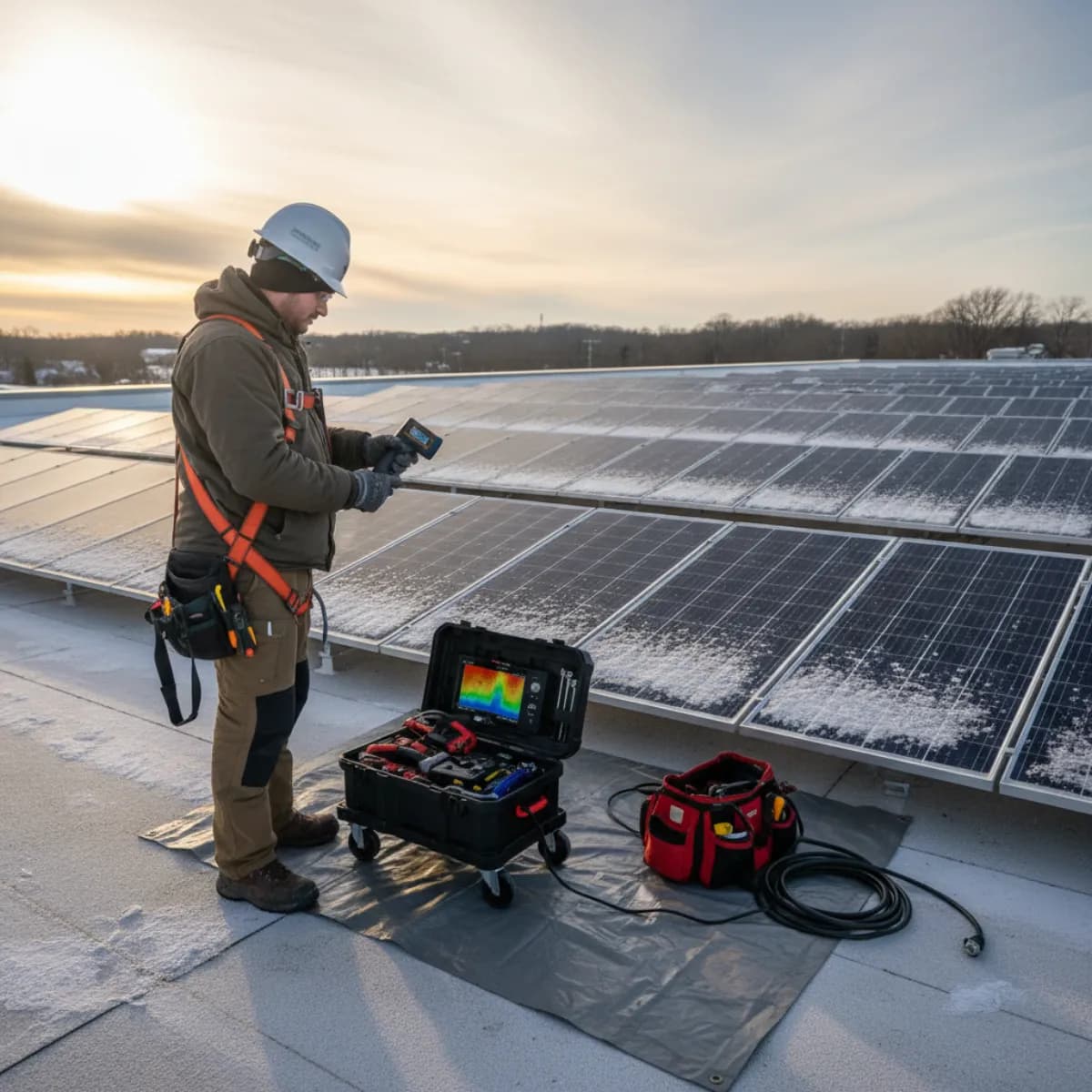
A NuWatt technician conducting an annual inspection on a commercial rooftop solar array. Regular maintenance preserves performance and protects warranty coverage.
Every commercial solar installation is protected by multiple overlapping warranties from different parties. Understanding which warranty covers which failure mode — and which gaps exist between warranties — is critical for ensuring complete asset protection over the 25-30 year system life.
What's Covered
Manufacturing defects, material failures, delamination, junction box failures, frame corrosion, cell cracking, and premature degradation beyond warranted thresholds.
What's Excluded
Damage from improper installation, external forces (hail beyond IEC 61215 test limits, fire, flooding), unauthorized modifications, and cosmetic issues that do not affect performance.
Claim Process
Document the defect with photos and monitoring data. Submit claim to manufacturer with proof of purchase and installation records. Manufacturer may send a field technician for inspection before approving replacement panels.
What's Covered
Guarantees minimum power output over time — typically no more than 2% degradation in year 1 and 0.4-0.55% per year thereafter. Most panels warrant 80-87% of nameplate output at year 25.
What's Excluded
Performance losses from shading, soiling, snow cover, system design issues, inverter failures, or wiring degradation. The warranty covers inherent panel degradation only, not external factors that reduce system output.
Claim Process
Requires independent power output testing (flash test or IV curve trace) showing output below the warranted threshold. Testing must account for standard test conditions (STC). Manufacturer typically provides replacement panels or financial compensation for the shortfall.
What's Covered
Component failures, firmware defects, fan failures, capacitor degradation, and communication board malfunctions. Microinverters typically carry 25-year warranties. String inverters carry 12-15 year base warranties with optional extensions to 20-25 years.
What's Excluded
Damage from power surges beyond SPD ratings, improper installation, operation outside rated temperature or voltage ranges, and firmware issues caused by unauthorized modifications.
Claim Process
Most commercial inverter manufacturers offer advance replacement — they ship the replacement unit before receiving the failed one. File claim through manufacturer portal with error codes, monitoring data, and serial number. Turnaround is typically 5-10 business days.
What's Covered
Structural integrity of rails, clamps, feet, and hardware. Covers corrosion, material fatigue, and manufacturing defects. Most racking systems are tested to UL 2703 standards for structural and electrical bonding.
What's Excluded
Damage from wind loads exceeding the engineered design rating, improper installation torque values, use of incompatible hardware, and corrosion caused by galvanic incompatibility (e.g., mixing aluminum and steel fasteners without isolation).
Claim Process
Submit claim with photos of the defective component and installation records. Manufacturer typically ships replacement parts. Labor for racking replacement is usually covered under the installer workmanship warranty, not the racking manufacturer warranty.
What's Covered
Defects in installation labor — improper wiring, loose connections, inadequate weatherproofing, incorrect mounting, conduit issues, and any workmanship-related failures that cause system underperformance or damage.
What's Excluded
Normal wear and tear, damage from acts of nature, modifications made by parties other than the original installer, and issues covered under manufacturer product warranties.
Claim Process
Contact the original installer directly. Reputable commercial installers maintain service teams for warranty work. NuWatt provides 25-year workmanship warranties backed by our service team and insurance. Document all issues with photos and monitoring data before submitting the claim.
What's Covered
Waterproofing of all roof penetrations created during solar installation — lag bolt flashings, conduit penetrations, and any modifications to the roofing membrane or surface. Guarantees no leaks attributable to the solar installation.
What's Excluded
Leaks caused by pre-existing roof conditions, damage to the roof from non-solar-related activities, and deterioration of the original roofing membrane. If the roof is replaced, the penetration warranty may be voided unless the solar system is properly removed and reinstalled.
Claim Process
Report any suspected leak immediately. The installer dispatches a crew to inspect the penetration points. If the leak is attributable to the solar installation, the installer repairs at no cost. For ballasted systems (no penetrations), this warranty is typically not applicable.
Not all solar panel warranties are created equal. The difference between a manufacturer offering 80% output at year 25 versus 92% at year 25 translates to 12% more production in the final years of the system — worth thousands of dollars annually on a commercial installation. Degradation rate, product warranty length, and the practical ease of filing claims all matter when selecting panels for a 25-year commercial investment.
| Manufacturer | Product Warranty | Performance Warranty | Degradation | Claim Ease |
|---|---|---|---|---|
SunPower Maxeon Premium | 40 years | 40 years (92% at year 40) | 0.25%/year | Excellent |
REC Alpha Premium | 25 years | 25 years (92% at year 25) | 0.25%/year | Very Good |
Canadian Solar Value | 25 years | 30 years (83.1% at year 30) | 0.40%/year | Good |
Qcells Mid-Tier | 25 years | 25 years (86% at year 25) | 0.40%/year | Very Good |
LONGi Value | 25 years | 30 years (84.8% at year 30) | 0.40%/year | Good |
First Solar (Series 7) Commercial | 25 years | 25 years (87.5% at year 25) | 0.30%/year | Very Good |
A 30-year warranty is only as good as the company backing it. Several solar manufacturers have gone bankrupt or exited the US market in recent years, rendering their warranties unenforceable. Prioritize Bloomberg NEF Tier 1 manufacturers with strong balance sheets, US-based service operations, and a track record of honoring warranty claims. SunPower, REC, Qcells, Canadian Solar, LONGi, and First Solar all maintain active US warranty service operations as of 2026.
Operations and maintenance (O&M) contracts for commercial solar range from basic remote monitoring to full-service plans with performance guarantees. The right tier depends on your system size, financing structure, risk tolerance, and how critical uninterrupted production is to your business economics. Here are the four standard service tiers available for Massachusetts commercial solar systems.
100 kW system: $500-$1,000/year
What's Included
Response Time
Alert-based only (no scheduled visits)
Recommended For
Small systems (25-50 kW) with manufacturer warranties still active and low-risk installations on newer roofs.
100 kW system: $1,500-$2,000/year
What's Included
Response Time
48-72 hours for non-emergency issues
Recommended For
Most commercial systems (50-250 kW). Balances cost and coverage for typical rooftop installations.
100 kW system: $2,000-$3,000/year
What's Included
Response Time
24-48 hours for non-emergency, 4 hours for production-critical issues
Recommended For
Mid-to-large systems (100-500 kW), especially those relying on SMART program revenue where production loss directly impacts income.
100 kW system: $2,500-$3,500/year
What's Included
Response Time
Same-day for production-critical issues, 24 hours for all other issues
Recommended For
Large systems (250+ kW), PPA/lease structures where the O&M provider guarantees production to investors, and facilities with high electricity costs where downtime is expensive.
A proactive maintenance schedule is the backbone of long-term commercial solar performance. The following schedule is calibrated for Massachusetts climate conditions — accounting for pollen season, fall leaf drop, winter snow, and the temperature cycling that can accelerate wear on electrical connections and mounting hardware.
Compare actual production against expected output using weather-adjusted models. Identify string-level underperformance, inverter clipping, and communication failures. Flag any system producing below 95% of expected output for investigation.
Comprehensive on-site inspection of all panels, wiring, junction boxes, mounting hardware, inverters, and electrical connections. Check for cracked cells, delamination, hot spots, loose connectors, corroded hardware, animal damage, and vegetation overgrowth. Inspect roof condition around all penetration points.
Professional cleaning using deionized water and soft brushes. Massachusetts systems accumulate pollen (April-June), bird droppings, leaf debris (fall), and road dust. Soiling losses in MA average 2-5% annually without cleaning. Cleaning recovers most of this loss, paying for itself on systems above 50 kW.
Infrared camera scan of the entire array to detect hot spots — cells or panels operating at elevated temperatures indicating micro-cracks, bypass diode failures, or internal shunting. Hot spots reduce output and can become fire hazards if left unaddressed. Drone-mounted IR cameras are used for large rooftop and ground-mount arrays.
Detailed evaluation of inverter performance metrics: efficiency curves, fan operation, capacitor health (via ripple current measurement), and firmware status. String inverters typically show measurable efficiency decline around year 10-12. This assessment informs replacement planning and budgeting.
String inverters have an expected lifespan of 12-15 years (though some last 20+). Replacement cost is $0.10-$0.20/W — roughly $10,000-$20,000 for a 100 kW system. Modern replacement inverters are typically more efficient than the originals, partially offsetting panel degradation. Microinverter systems typically do not require full replacement.
Massachusetts commercial solar systems are designed to self-clear snow within 1-3 days due to panel tilt and dark surface absorption. Manual snow removal is recommended only when accumulation exceeds 48 hours of lost production or when ice dams form on low-slope roofs. Never use metal tools or salt-based de-icers on solar panels.
Massachusetts presents a unique combination of weather, environmental, and regulatory factors that impact commercial solar maintenance requirements. Systems designed and maintained for generic conditions will underperform compared to those specifically adapted for the MA operating environment. The following five considerations should be incorporated into every Massachusetts commercial solar O&M plan.
Massachusetts experiences 2-4 nor'easters per year with sustained winds of 40-60 mph and gusts exceeding 80 mph. Post-storm inspections should check for lifted panels, bent racking, loosened hardware, and displaced ballast blocks on flat-roof systems. Commercial solar systems are engineered to withstand 110+ mph wind loads per ASCE 7, but aging hardware and corroded fasteners can reduce wind resistance over time.
Recommended Action
Schedule a post-storm inspection after any nor'easter with sustained winds above 50 mph. Check all exposed fasteners and ballast positioning.
Installations within 1 mile of the Massachusetts coastline — Cape Cod, the South Shore, North Shore, and the Islands — are exposed to salt-laden air that accelerates corrosion of aluminum racking, steel hardware, and electrical connections. Standard galvanized hardware can show visible corrosion within 3-5 years in marine environments.
Recommended Action
Specify marine-grade stainless steel hardware and anodized aluminum racking for all coastal installations. Include salt spray inspection in annual O&M visits. Consider panels with enhanced frame corrosion resistance (salt mist test per IEC 61701).
Western Massachusetts (Berkshires, Pioneer Valley) receives 60-80 inches of snow annually — significantly more than eastern MA (40-50 inches). Commercial roofs must support both dead load (solar array weight of 3-5 psf) and live load (snow at 30-50 psf ground snow load depending on municipality). The combined load can approach structural limits on older buildings.
Recommended Action
Verify structural engineering accounts for local ground snow loads per ASCE 7 Table 7.1-1. Monitor snow accumulation on arrays during heavy storms. Consider snow guards on sloped roofs to prevent sudden avalanche loads on lower roof sections or walkways.
Low-slope commercial roofs (less than 2:12 pitch) are susceptible to ice dams forming at panel edges and between panel rows. Ice dams can block drainage paths, causing ponding water that accelerates roof membrane deterioration and can cause leaks. The temperature differential between heated building spaces below and cold panel surfaces above exacerbates ice formation.
Recommended Action
Ensure adequate drainage pathways between panel rows. Install heat trace cables along critical drainage paths if ice dam history exists. Maintain minimum 3-inch gap between panels and roof surface for airflow. Include ice dam inspection in winter O&M visits.
Commercial systems with battery storage enrolled in the ConnectedSolutions demand response program require additional maintenance considerations. Battery health directly impacts demand response participation and revenue. Lithium-ion batteries in Massachusetts experience temperature cycling from -10°F winter lows to 95°F summer highs, which affects cycle life.
Recommended Action
Monitor battery state of health (SOH) quarterly. Ensure HVAC conditioning in battery enclosures maintains 50-85°F operating range. Verify ConnectedSolutions dispatch signals are being received and executed. Budget for battery augmentation or replacement at year 10-12 (approximately $200-$300/kWh).
The question every commercial solar owner asks: does O&M pay for itself? The short answer is yes — by a significant margin. The long answer involves understanding how maintenance reduces effective degradation rates, prevents cascading failures, and preserves both electricity savings and SMART program revenue streams.
System Size
100 kW
Annual Production
120,000 kWh
Electric Rate
$0.27/kWh (MA commercial average)
SMART Rate
$0.05/kWh
Annual O&M Cost
$2,000/year (Standard O&M at $20/kW)
Additional Revenue from O&M
$3,000-$5,000/year
Net Annual Benefit
$1,000-$3,000/year net positive
Revenue sources: Higher production from cleaning ($1,200-$1,800), faster fault detection ($800-$1,500), extended inverter life ($500-$1,000), preserved SMART revenue ($500-$700)
25-year cumulative benefit: $25,000-$75,000 additional lifetime value in additional production value after subtracting O&M costs.
The economics are even more compelling for larger systems. A 250 kW commercial installation with $5,000/year in O&M costs can recover $8,000-$12,000/year in additional production, yielding a 60-140% annual return on the O&M investment. The ROI compounds over time because the production gap between maintained and unmaintained systems widens every year as undetected issues accumulate and degradation differences compound.
Beyond the direct financial return, professional O&M provides three additional benefits that are difficult to quantify but critically important. First, documented maintenance records strengthen warranty claims — manufacturers can (and do) deny claims when systems show evidence of neglect. Second, regular inspections catch safety issues before they become liabilities — hot spots, damaged wiring, and water intrusion near electrical components. Third, O&M providers serve as your advocate when interacting with utilities, equipment manufacturers, and insurance companies, ensuring your interests are protected throughout the system lifetime.
A commercial solar monitoring system is the foundation of effective O&M. Modern monitoring platforms track production at the panel, string, and system level in real time, comparing actual output against weather-adjusted expected output. When a panel fails, a string drops, or an inverter faults, the monitoring system detects the anomaly within minutes and triggers alerts to the O&M team.
For Massachusetts commercial systems, monitoring is especially important because production losses compound with SMART program revenue. Every hour of undetected downtime costs both electricity savings (at $0.22-$0.30/kWh) and SMART payments (at $0.04-$0.10/kWh). A single failed string on a 100 kW system might represent 10-15% of total output — if undetected for three months, that is $1,000-$2,000 in lost revenue that could have been recovered with a simple connector repair.
Tracks total system output via the inverter data feed. Detects total system failures and major production drops. Minimum viable monitoring for any commercial installation.
Limitation
Cannot identify individual panel or string failures. A 5-10% production loss from a failed string may not trigger system-level alerts.
Tracks output per inverter string (typically 10-20 panels per string). Identifies which string is underperforming. Standard with most commercial string inverters (SolarEdge, SMA, Fronius).
Limitation
Cannot identify individual panel failures within a string. A single panel failure reduces string output by 5-10%, which may or may not trigger an alert depending on thresholds.
Tracks individual panel output via microinverters (Enphase) or DC optimizers (SolarEdge). Identifies exact panel failures, shading impacts, and soiling patterns. Most granular data available.
Limitation
Higher upfront cost ($0.05-$0.10/W more than string inverters). More communication hardware to maintain. Best suited for systems where maximum uptime justifies the additional investment.
For most Massachusetts commercial installations between 50-500 kW, we recommend string-level monitoring combined with a Standard or Comprehensive O&M plan. This provides sufficient granularity to detect meaningful production losses while keeping costs reasonable. For systems above 500 kW or those under PPA/lease structures with production guarantees, panel-level monitoring with Premium O&M ensures maximum uptime and protects investor returns.
Complete guide to commercial solar costs, incentives, ITC, SMART 3.0, and financing options in Massachusetts.
Step-by-step timeline from site assessment to PTO. Navigate permitting and interconnection queues.
Five real project profiles: warehouse, school, hospital, retail, and municipal. Real costs and payback periods.
MACRS depreciation guide for commercial solar — bonus depreciation, tax basis, and year-by-year schedule.
The panel performance warranty is the most financially significant warranty because it guarantees minimum energy output over 25-30 years. A performance warranty guaranteeing 87% output at year 25 (vs. 80%) translates to 7% more production in the final years — worth $2,000-$5,000 per year on a 100 kW system. However, the workmanship warranty is equally critical for the first 10-15 years because installation defects cause the majority of early system failures. Look for installers offering at least 10-year workmanship warranties — NuWatt provides 25 years.
NuWatt provides 25-year workmanship warranties and full-service O&M plans for Massachusetts commercial solar systems. Get a custom maintenance quote.